AI Content Writing: What It Is and Why It Matters Right Now
Scr0ll d0wn to D0VVNL0AD
What is AI content writing? It’s the process of using artificial intelligence tools — powered by large language models and natural language processing — to draft, edit, or fully generate written content like blog posts, emails, product descriptions, and social media copy.
Here’s a quick answer:

| Question | Answer |
|---|---|
| What creates the content? | AI models trained on billions of words |
| What types of content can it produce? | Blog posts, ads, emails, product descriptions, social posts |
| Does it replace human writers? | No — it works best alongside human oversight |
| Is it good for SEO? | Yes, when combined with human editing and quality control |
| Does Google penalize it? | Not for being AI-generated — only for being low quality |
AI writing tools have been around for years, but they’ve changed dramatically. In 2026, they’re fast, surprisingly capable, and used by businesses of all sizes. A striking 90% of marketers now use AI to speed up their work — and 65% of companies report better SEO results when AI is part of their process.
But here’s the catch: 42% of content creators who use AI don’t edit the output at all. That’s a problem. Raw AI output often contains errors, generic phrasing, and content that misses the mark for your specific audience.
So the real question isn’t just “what is AI content writing?” — it’s how do you use it well?
This guide covers everything: how it works, where it helps, where it falls short, and how small business owners can use it to save time without sacrificing quality.
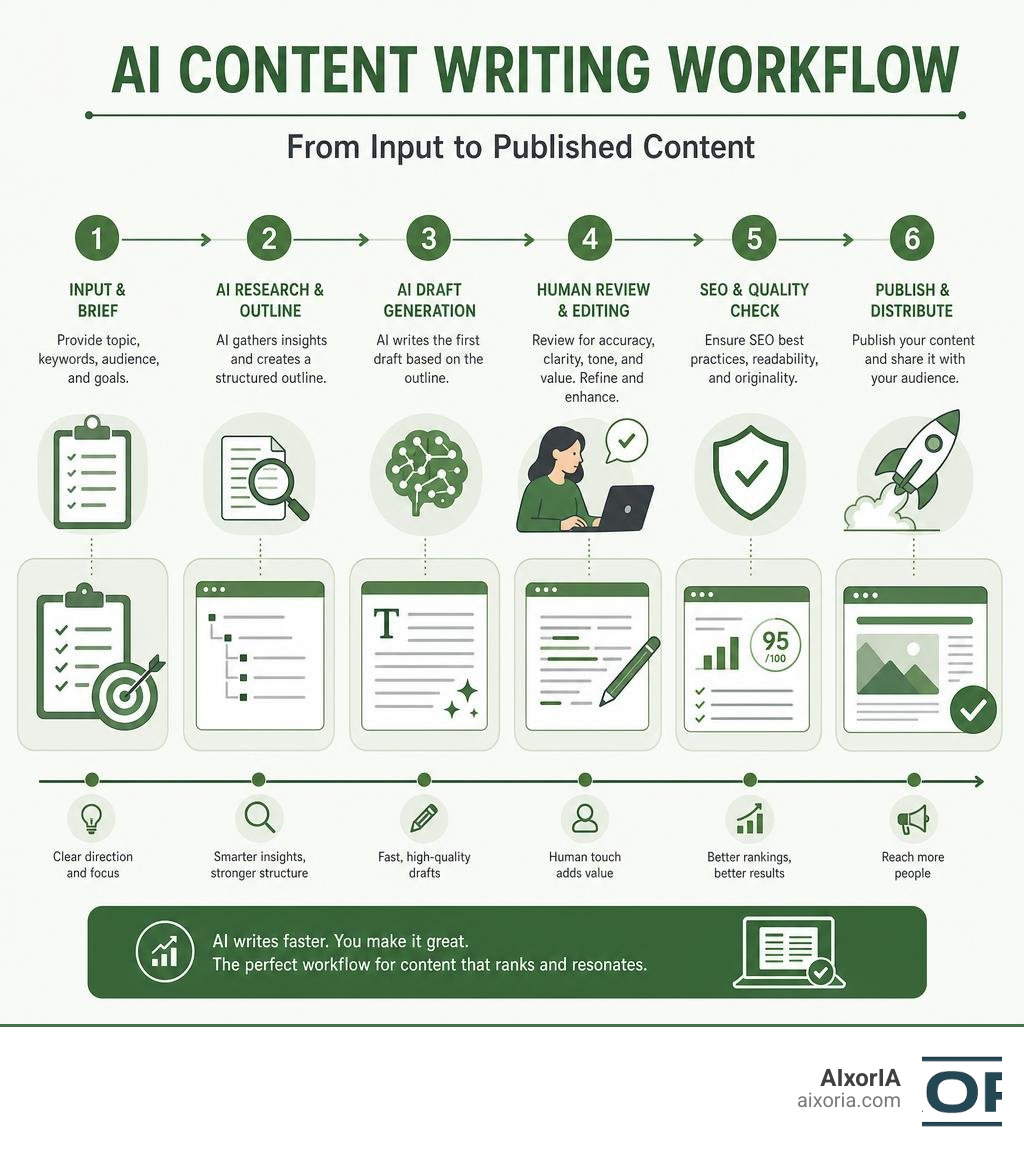
What is AI Content Writing and How Does It Work?

To truly understand how to leverage this technology, we first need to look under the hood. At its core, AI content writing is the automated process of generating text using machine learning models.
Rather than “thinking” the way a human does, these tools analyze vast amounts of data to predict the most logical sequence of words based on the prompt you provide. According to the foundational breakdown of What is AI-Generated Content? | IBM, this technology relies on deep learning and neural networks to mimic human language patterns, transforming simple text prompts into highly structured articles, reports, or marketing copy.
Understanding What is AI Content Writing in 2026
In 2026, the question of what is ai content writing has evolved from simple sentence completion to highly sophisticated, multi-step content generation. Modern tools do not just spit out generic paragraphs; they can research, structure, and format content to match highly specific guidelines.
This development has opened up a massive ecosystem of specialized applications. If you are looking to build out your toolkit, you can explore the Best Ai Tools For Content Creation In 2026 to see how these generators function in real-world environments.
For a deeper dive into how businesses are scaling their output, the What is AI Content Generation? The Complete 2026 Guide | Writesy AI Blog outlines how modern systems bridge the gap between simple text generation and strategic content planning.
The Technology Behind AI-Generated Text
Modern AI writing tools rely on Large Language Models (LLMs) built on transformer networks. Here is how they turn your prompt into a finished piece of text:
- Tokenization: The AI breaks your prompt down into smaller pieces called tokens (which can be words or syllables).
- Self-Attention Mechanism: The transformer network analyzes how different words in your prompt relate to one another, ensuring it captures the context.
- Probability and Token Prediction: Based on its massive training datasets, the AI calculates the most plausible next token. It repeats this process thousands of times per second to build sentences and paragraphs.
Because these models optimize for “plausibility” rather than absolute truth, they require human guidance to ensure the generated text is accurate and meaningful.
Human vs. AI Content: Quality, Accuracy, and SEO Performance
How does machine-written text stack up against traditional human writing? Let’s look at the key differences:
| Feature | Human-Written Content | Raw AI-Generated Content |
|---|---|---|
| Factual Accuracy | High (subject to human verification) | Moderate (prone to confident “hallucinations”) |
| Originality & Depth | High (draws on personal experience) | Low (recombines existing web data) |
| Production Speed | Hours to days | Seconds to minutes |
| E-E-A-T Alignment | Excellent (natural expertise and trust) | Poor (requires manual injection of real experience) |
| Cost | Higher investment | Extremely low cost |
When looking at search performance, the differences become even clearer. As detailed in the analysis of AI Content Generation for SEO: Pros, Cons & How to Use It, human-written content still outranks pure AI content the vast majority of the time. However, the highest-performing content teams are those combining both worlds: using AI for efficiency and humans for quality control.
Why What is AI Content Writing Matters for Modern SEO
Search engines do not penalize content simply because it was made with AI. Instead, search algorithms focus on whether the content provides real value, matches search intent, and satisfies E-E-A-T (Experience, Expertise, Authoritativeness, and Trustworthiness) guidelines.
AI is incredibly efficient at structuring articles and identifying semantic keywords. For example, using the Best Ai Paraphrasing Tool For Marketing Content 2026 can help you reframe stiff technical jargon into highly readable, SEO-friendly copy. To understand the economic shift behind this, check out AI Content Writing: Definition & Guide | theStacc, which highlights how businesses are restructuring their budgets to focus on AI-assisted workflows.
The Limitations of Purely Automated Content
Publishing raw AI text without human review is a major risk. Because LLMs predict the most likely next word rather than verifying facts, they frequently “hallucinate” incorrect statistics, fake product prices, or outdated information.
Furthermore, raw AI writing tends to be repetitive, using predictable transition phrases (like “in conclusion,” “it is crucial to remember,” or “delve deeper”). To see how these patterns hold up under scrutiny, we tested the market’s leading options in our guide on the 20 Best Ai Rewriting Tools In 2026 Tested, revealing why human editors remain absolutely essential for catching repetitive phrasing and factual errors.
Best Practices for Integrating AI into Your Content Workflow

To get the most out of AI without losing your brand’s unique identity, you must treat AI as a supportive assistant rather than a hands-off replacement. In the What Is AI Writing? Complete Guide to AI Content (2026), the industry consensus is clear: the future belongs to creators who master human-AI collaboration.
Using AI for Research, Outlining, and Ideation
AI is an incredible tool for overcoming writer’s block and organizing your thoughts. You can use it to:
- Generate 20 different headline variations for A/B testing.
- Create structured outlines based on top-ranking search results.
- Summarize long transcripts or research documents in seconds.
This approach is incredibly valuable for specialized writing. For instance, academic writers and researchers frequently use the Best Ai Tools For Academic Research In 2026 or the Best Ai Tools For Literature Review 2026 to organize complex papers.
Similarly, professionals in other fields leverage targeted tools, such as the Best Ai For Technical Report Writing In 2026, the Best Ai Tools For Proposal Writing In 2026, or even the Best Ai Tool For Writing A Book to streamline their drafting phases.
Maintaining Brand Voice and Originality
To keep your content from sounding like every other generic blog post on the internet, you must feed the AI specific instructions. Give your tool detailed style guides, outline your target audience’s experience level, and provide examples of your best-performing articles.
As emphasized in AI Content Marketing: The Ultimate Guide | Salesforce, maintaining a consistent brand voice requires strict human guardrails and continuous performance audits. Always run a final plagiarism check and have a human editor inject real-world anecdotes, unique perspectives, and expert quotes before hit publishing.
If you are looking to support younger writers or team members in mastering these skills early on, sharing resources like the Best Ai Writing Tools For Students In 2026 or the Best Ai Tools For Essay Writing Free In 2026 can help them practice structuring their thoughts ethically alongside technology.
Frequently Asked Questions about AI Writing
Will AI replace professional content writers?
No, but it is changing the job description. Around 60% of writers are currently being affected by the rise of language models. However, the demand for writers who can bring unique perspectives, conduct first-hand interviews, and master human-AI collaboration is actually increasing. AI cannot experience the world, meaning it cannot write from personal experience.
Does Google penalize AI-generated content?
Google’s official stance is that it does not penalize content solely because it was generated by an AI. Google cares about the quality and helpfulness of the content. If your AI-assisted content answers the user’s question, is factually accurate, and includes original value, it can rank incredibly well.
Is AI-generated content copyright protected?
The legal landscape surrounding AI content is still evolving. In most jurisdictions, purely AI-generated text cannot be copyrighted because copyright laws require human authorship. However, content that has been significantly edited, modified, and structured by a human creator is generally eligible for protection.
Conclusion
Understanding what is ai content writing is no longer just about knowing how to use a basic text generator. It is about understanding how to strategically combine machine efficiency with human creativity, empathy, and oversight.
At AIxorIA, we believe that technology should empower your business, not overcomplicate it. We specialize in providing custom AI solutions, practical tool training workshops, step-by-step tutorials, and detailed performance audits designed to help your team work smarter. With our commitment to simple language, affordable services, and incredibly fast customer support, we make digital transformation accessible for businesses of all sizes.
Ready to optimize your content workflow and scale your business safely? Explore AIxorIA’s Custom AI Solutions today, and let us help you build a content engine that truly connects with your audience.