Why Getting the Right AI for Technical Report Writing Matters
Finding the best AI for technical report writing is not as simple as opening ChatGPT and typing a prompt. Technical reports are a different beast entirely — they demand precision, structured formatting, source traceability, and compliance with industry standards that general-purpose AI tools often can’t deliver reliably.
Here’s a quick look at the top AI tools technical writers are using right now:
| AI Tool | Best For |
|---|---|
| Acrolinx | Content governance and style compliance |
| Claude AI | Research, drafting, and long-form coherence |
| Grammarly | Real-time grammar, tone, and readability |
| Paligo | Structured authoring and content reuse (CCMS) |
| DeepL Write | Technical translation and tone adjustment |
| Perplexity AI | Evidence-backed research with citations |
| Heretto | DITA-based documentation workflows |
| Manus | End-to-end report generation with data analysis |
Technical writing isn’t just about clear sentences. It involves creating documents with precise methodology sections, reproducible findings, regulatory language, and terminology that subject matter experts will scrutinize. A grammar-checking AI won’t cut it here.
The good news? AI can genuinely help — if you pick the right tool for the job.
Technical writers using AI report up to 50% faster content production, and AI-assisted translation is already cutting localization costs significantly. But the key is matching the tool to the task.
This guide breaks down exactly which AI tools work best for technical report writing, what features matter most, and how to use them without sacrificing accuracy or quality.
Why Technical Report Writing Requires Specialized AI
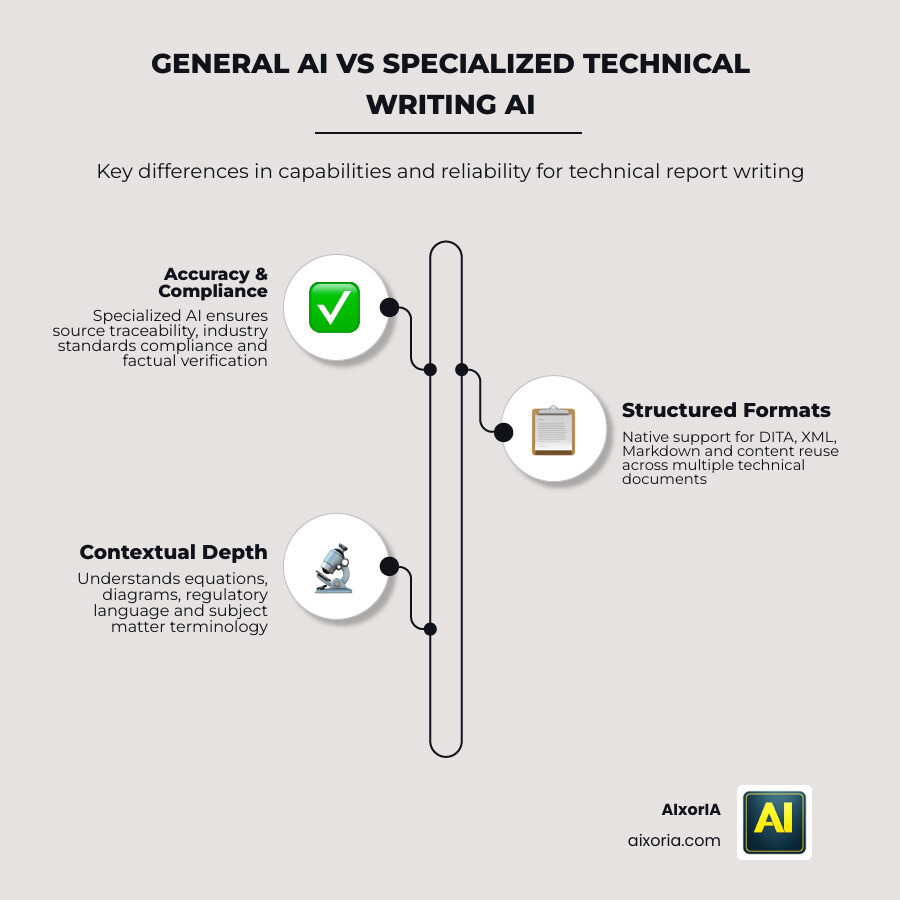
Technical report writing is distinct from general content creation because it prioritizes factual integrity and structured logic over creative flair. While a general AI might write a great blog post, it often struggles with the rigid constraints of a technical manual or an engineering assessment.
We need tools that understand structured content formats like DITA (Darwin Information Typing Architecture), XML, and Markdown. These formats allow for content reuse—where a single technical description can be updated in one place and automatically reflected across hundreds of different reports. General-purpose chatbots simply aren’t built to navigate these complex documentation systems.
Furthermore, technical reports often require the rendering of complex equations, the generation of precise diagrams, and adherence to strict compliance standards. Whether you are working on a system audit or a safety manual, the Best AI for Technical Report Writing must be able to handle specialized terminology without “hallucinating” or making up facts. If you’re interested in how these tools compare to broader creative applications, check out our guide on the Best AI Tools for Content Creation in 2026.
Ensuring Accuracy with the Best AI for Technical Report Writing
Accuracy is the non-negotiable foundation of any technical document. In 2026, the best tools utilize multi-agent research systems. Instead of one AI model trying to guess an answer, these systems deploy hundreds of autonomous agents to conduct parallel research, cross-reference data points, and verify findings against peer-reviewed sources.
Key features to look for include:
- Source Traceability: The ability to click on any statement in a generated report and see exactly which source document it came from.
- Evidence-Backed Insights: Ensuring that conclusions are grounded in the data you provide, rather than general internet knowledge.
- Audit Trails: Maintaining a record of how a report was constructed, which is vital for regulated industries like aerospace or medicine.
Maintaining Consistency and Style Compliance
Consistency is a major challenge when multiple authors contribute to a single large technical project. AI-powered content governance solutions, such as Acrolinx, act as a digital “editor-in-chief.” They ensure that every contributor follows the same style guides, uses approved terminology, and maintains a consistent tone.
These tools also provide readability scores. In technical writing, the goal is often to make complex information as simple as possible. AI can flag overly long sentences or passive voice, ensuring the report remains accessible to its intended audience—whether that’s a board of directors or a team of field engineers.
Key Features of the Best AI for Technical Report Writing
When we evaluate the Best AI for Technical Report Writing, we aren’t just looking at how well it writes. We look at how well it fits into a professional workflow. This includes version control (to track changes over time), integration with existing documentation systems, and robust data privacy.
| Feature | General AI Chatbot | Specialized Technical AI |
|---|---|---|
| Structure | Unstructured narrative | Templates (Abstract, Methodology, etc.) |
| Data Privacy | Public training (usually) | SOC 2 / ISO 27001 Compliance |
| Citations | Often missing or fabricated | Real-time source traceability |
| Formatting | Text only | LaTeX, DITA, XML, PDF, Word |
| Collaboration | Single user | Multi-user collaborative authoring |
For professionals who need to move beyond simple drafting into deep analysis, exploring the Best AI Tools for Business Analysts in 2026 can provide additional insights into how AI handles structured data.
Top AI-Powered Platforms for Technical Documentation in 2026
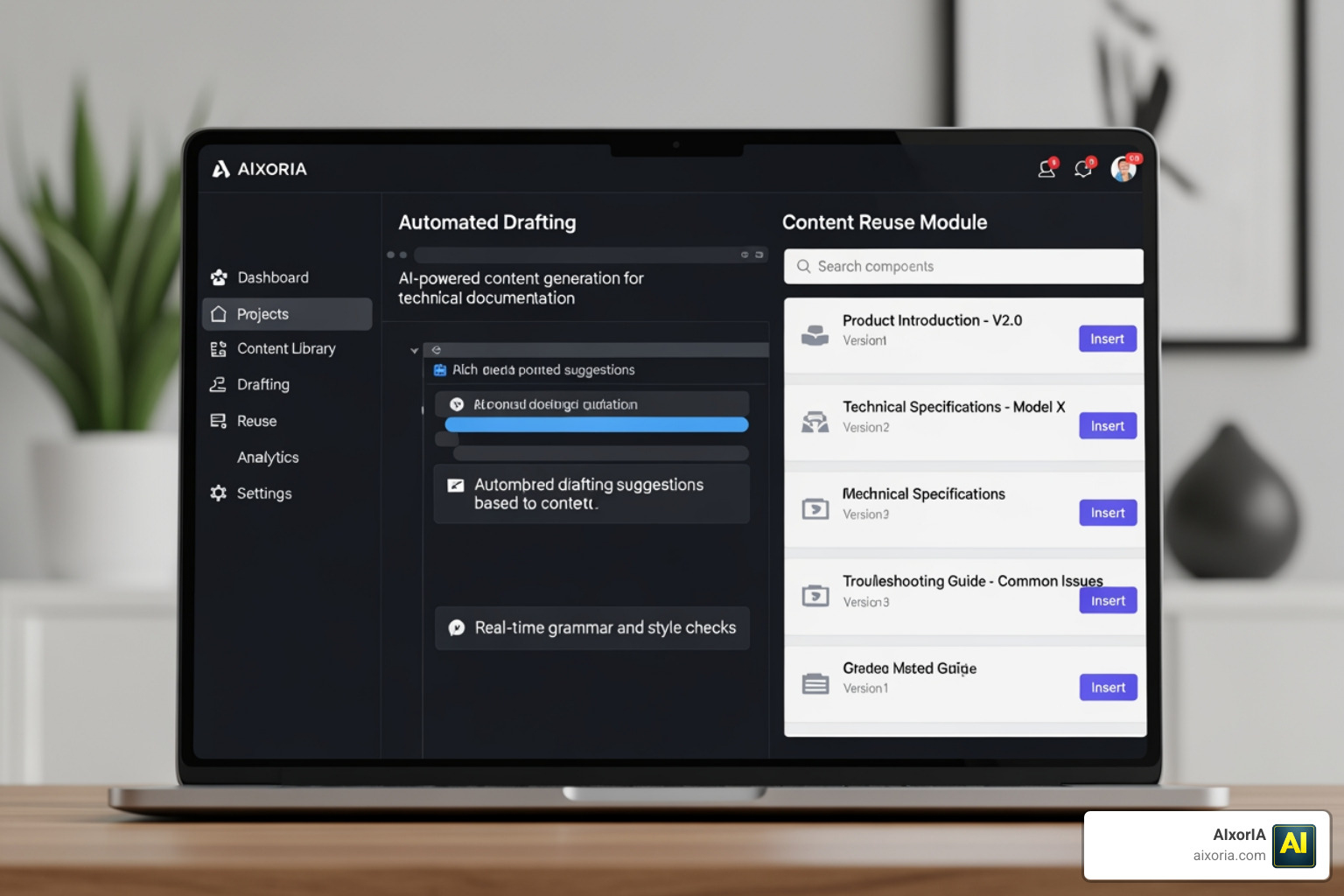
The landscape of technical writing has shifted toward Component Content Management Systems (CCMS) that have AI baked directly into the core. Platforms like Paligo and Heretto allow for dynamic publishing, where documentation can be updated automatically across multiple platforms without manual intervention.
These platforms use AI for:
- Autonomous Research: Gathering data from internal repositories to draft initial sections.
- Content Reuse: Identifying existing snippets of text that can be repurposed to save time.
- API Documentation: Automatically generating clear explanations for code blocks, reducing the burden on developers.
If your technical writing is more academic or research-focused, you might find our list of the Best AI Tools for Academic Research in 2026 particularly useful for managing large bibliographies and literature reviews.
Specialized AI for Technical Report Writing and Research
Different reports require different “brains.” A financial performance analysis needs an AI that is excellent at math and trend visualization, while an engineering assessment needs an AI that understands physical constraints and safety protocols.
Modern AI tools like Manus and NextDocs allow users to upload raw data—Excel sheets, PDFs, or even video footage of a site inspection—and generate a comprehensive first draft in under five minutes. This isn’t just a summary; it’s a structured document with an introduction, methodology, results, and recommendations, all ready for expert review.
Best Practices for Integrating AI into Technical Workflows
At AIxorIA, we always emphasize that AI is a collaborator, not a replacement. The most successful technical writers use AI to handle the “heavy lifting” of repetitive tasks—like formatting, initial drafting, and machine-assisted translation—while reserving their own expertise for quality assurance and high-level logic.
To get the most out of your AI tools, we recommend:
- Start with a Prompt Framework: Don’t just ask for a “report.” Specify the audience, the business goal, the required sections, and the tone.
- Use Custom Style Guides: Upload your company’s specific dictionary and formatting rules so the AI doesn’t flag industry jargon as an error.
- Human Oversight is Mandatory: Always have a subject matter expert (SME) validate the technical accuracy of AI-generated content.
For those involved in the earlier stages of project development, check out our guide on the Best AI Tools for Proposal Writing in 2026.
Overcoming Limitations in AI-Generated Technical Reports
Even the Best AI for Technical Report Writing has its limits. AI can sometimes miss the subtle “contextual nuances” of a specific project. For example, it might not understand the political sensitivities of a certain recommendation or the unique environmental conditions of a construction site.
“Hallucination mitigation” is a major focus in 2026. This involves using “grounded” AI models that are restricted to only using the data they are given. However, human expertise remains the gold standard for final quality assurance. We must ensure that the “why” behind a report is as solid as the “what.”
Frequently Asked Questions about Technical AI
Can AI effectively handle complex technical formatting and equations?
Yes. Specialized AI tools now support LaTeX and other mathematical notation systems. When integrated into a CCMS, they can maintain complex formatting across various export types, including PDF, Word, and HTML, ensuring that equations and diagrams remain legible and accurate.
How do AI tools ensure data security and industry compliance?
Top-tier AI platforms for technical writing prioritize security through SOC 2 Type II and ISO 27001 certifications. They offer “isolated environments” where your proprietary data is never used to train public models. Always check for GDPR and CCPA compliance before uploading sensitive technical data.
Will AI replace human technical writers in 2026?
No. While AI can produce content 50% faster, it lacks the high-level reasoning and ethical judgment required for complex technical decision-making. The role of the technical writer is evolving from “drafter” to “content strategist and editor,” focusing on accuracy, strategy, and user experience.
Conclusion
The journey to finding the Best AI for Technical Report Writing leads away from general chatbots and toward specialized, governed, and structured platforms. By automating the tedious aspects of documentation—like formatting, basic research, and translation—technical writers can focus on providing the deep insights that drive businesses forward.
At AIxorIA, we specialize in helping businesses navigate this transition. Whether you need custom AI solutions, tool training workshops, or performance audits to ensure your documentation workflow is as efficient as possible, we are here to help. Our focus is on providing simple language help and affordable services to empower your team.
Ready to optimize your technical documentation? Best AI for Technical Report Writing in 2026 is just the beginning. Schedule a consultation with AIxorIA today to see how we can transform your reporting workflows.
4 thoughts on “Best AI for Technical Report Writing in 2026 (Tested AI Tools Ranked)”