Why Comparing Car Insurance Quotes Online Can Save You Hundreds

Insurance car quotes online comparison is one of the fastest ways to stop overpaying for your auto coverage. In fact, drivers who skip this step could be leaving serious money on the table — industry analysis found that not comparing rates can cost drivers as much as $2,452 more per year.
Here’s a quick answer to what you need to know:
| What | How It Works |
|---|---|
| What it is | A free tool that shows quotes from multiple insurers side by side |
| How long it takes | Usually 5–10 minutes online |
| Average savings | Up to $867–$1,100 per year |
| What you need | ZIP code, vehicle info, driving history, current coverage details |
| Is it safe? | Yes — reputable platforms don’t sell your data to spammers |
| How often to do it | Every 6–12 months, or when your policy renews |
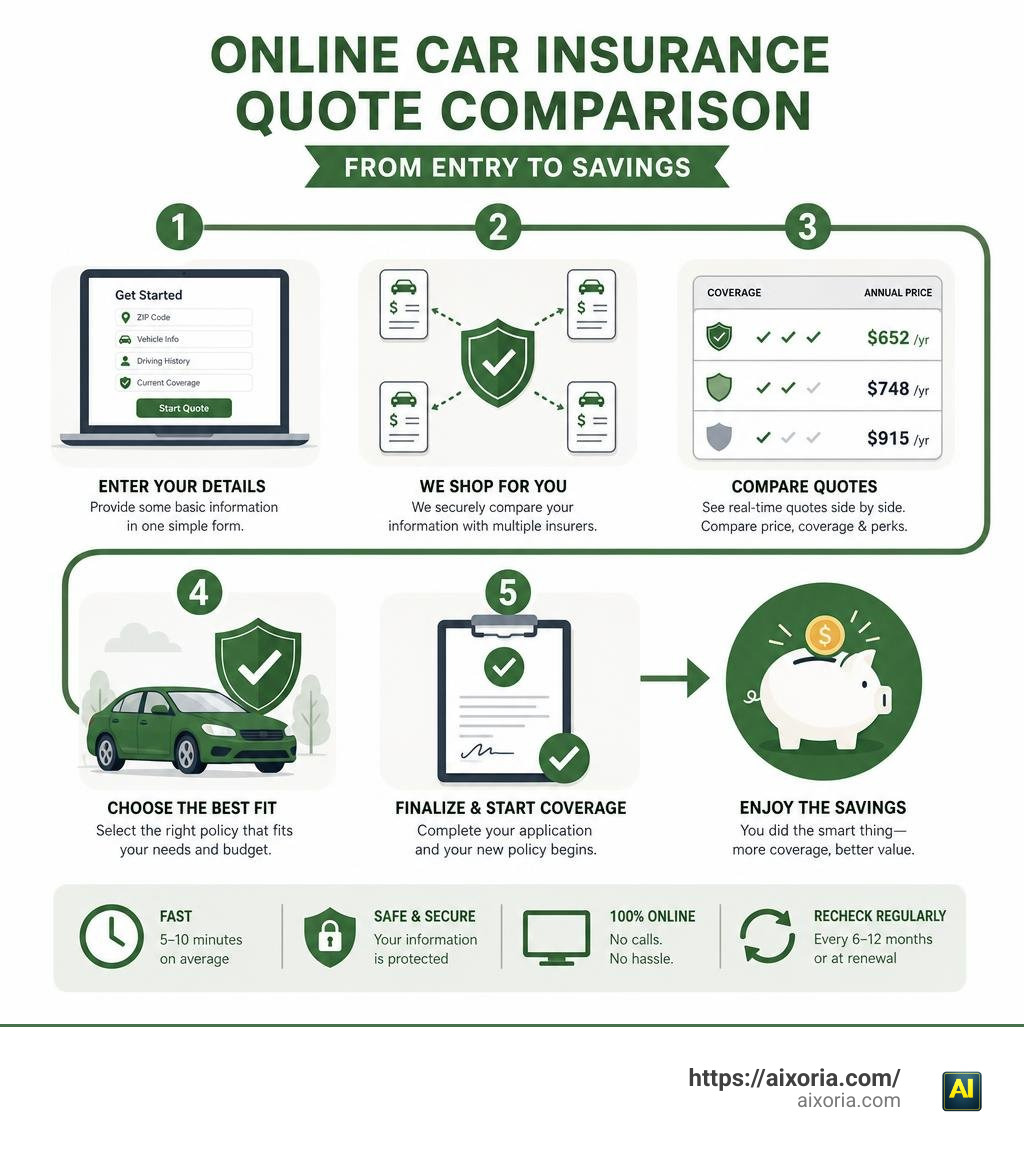
The idea is simple. Instead of visiting each insurer’s website one by one, you enter your details once and get multiple quotes back in minutes. You compare prices, coverage levels, and perks — then choose the best fit.
The catch? Most drivers never do it. They stick with the same insurer year after year, often paying far more than they need to.
This guide walks you through exactly how online comparison works, what to watch out for, and how to get the most accurate quotes possible.
What is an Insurance Car Quotes Online Comparison?
An insurance car quotes online comparison is the process of using digital marketplaces and tools to evaluate multiple auto insurance policies simultaneously. Instead of the old-school method of calling individual agents or manually filling out forms on ten different carrier websites, modern comparison engines do the heavy lifting for us.
These comparison platforms act as aggregators. When you input your driving profile, vehicle details, and preferred coverage limits, the platform communicates with various insurance carriers. Within minutes, it generates a side-by-side list of real-time rates or highly accurate estimates. For a neutral overview of common policy components, the National Association of Insurance Commissioners provides an auto insurance consumer guide that can help you understand the coverage terms you may see while comparing quotes.
When comparing policies online, you will typically see options categorized by coverage levels:
- Minimum Coverage: Only includes the bare minimum liability insurance required by your state law. It is the cheapest option but leaves your own vehicle unprotected.
- Typical/Standard Coverage: Usually includes higher liability limits (such as $100,000 per person/$300,000 per accident) along with collision and comprehensive coverage.
- Full Coverage: Offers the highest level of protection, often required if you finance or lease your car. It combines high liability limits, collision, comprehensive, and sometimes extras like roadside assistance.
By utilizing these tools, we can easily see how changing our deductible or coverage limits instantly impacts our monthly premiums across different carriers.
How Comparing Car Insurance Quotes Online Saves You Money
The core reason an insurance car quotes online comparison saves you money is simple: no two insurance companies calculate risk the exact same way.
Every auto insurer uses its own proprietary algorithm to determine premiums. One company might penalize you heavily for a minor speeding ticket from two years ago, while another might barely raise your rate. Similarly, some insurers offer better pricing for urban drivers, while others focus their best rates on rural areas.
By comparing rates, you expose these pricing gaps. For example, industry data reveals that:
- Shoppers save an average of $1,100 annually by comparing quotes side by side.
- According to industry data, users save up to $867 per year, often cutting their auto insurance bills by as much as 50%.
- Even for high-risk drivers, shopping around pays off. Following a DUI, switching insurers can yield immediate savings in 61% of ZIP codes.
To ensure you are matching these competitive rates with top-tier service, we recommend checking out our breakdown of the Most Reputable Car Insurance Companies In 2026 Top 10 Ranked to find a reliable partner.
The Cost of Not Doing an Insurance Car Quotes Online Comparison
When we skip the comparison process, we fall victim to “price optimization.” This is an industry practice where insurers gradually raise rates on loyal customers because data shows they are unlikely to shop around. If you have been with the same carrier for five years without comparing rates, you are almost certainly overpaying.
To put this into perspective, let’s look at how average annual premiums can vary wildly depending on your driver profile and the company you choose:
| Driver Profile | Cheapest Estimated Annual Premium | Most Expensive Estimated Annual Premium | Potential Annual Overpayment |
|---|---|---|---|
| 35-Year-Old (Good Credit, Clean Record) | $1,582 (USAA) | $4,105 (Farmers) | $2,523 |
| 20-Year-Old Driver | $2,900 (Regional Carrier) | $4,687 (National Average) | $1,787 |
| Driver with One Speeding Ticket | $1,692 (Travelers) | $3,096 (Liberty Mutual) | $1,404 |
| Driver with Poor Credit | $2,100 (State Farm) | $4,400 (Progressive) | $2,300 |
As the table shows, the pricing spread for the exact same driver profile can be thousands of dollars. Failing to compare is essentially agreeing to pay a “loyalty tax.”
Key Factors That Influence Your Personalized Rates
When you perform an online comparison, the quotes you see are shaped by several critical variables:
- Driving Record: A clean record always gets the lowest rates. Speeding tickets, accidents, and DUIs will raise your quotes, though some insurers are far more forgiving than others.
- Credit Score: In most states, insurers use credit-based insurance scores to predict risk. Drivers with poor credit can pay nearly double what drivers with excellent credit pay. (Note: California, Hawaii, Massachusetts, and Michigan prohibit using credit scores to set auto insurance rates).
- Location and ZIP Code: Local traffic density, litigation rates, and local weather patterns (like hail or flood risks) heavily influence your rate.
- Vehicle Make and Model: Cars that are cheaper to repair or have stellar safety ratings cost less to insure. For instance, a Subaru Forester is historically one of the cheapest vehicles to insure, while high-end luxury sedans or sports cars sit at the top of the pricing scale.
To see how these rates compare to other personal insurance lines, you can read our State Farm Renters Insurance Review 2026 Coverage Cost Discounts to understand how multi-policy bundling can drive your auto rates even lower.
How to Use Online Comparison Tools Safely and Effectively
While comparing quotes online is incredibly convenient, it is important to approach the process with a focus on data security and efficiency.

Many drivers worry that entering their personal details online will result in an endless barrage of spam calls and emails. To protect your privacy and secure the best deals, keep these best practices in mind:
- Use Reputable Platforms: Stick to well-known, licensed comparison marketplaces that have clear privacy policies. Legitimate platforms will not sell your data to third-party lead generators.
- Watch Out for Impersonators: Some scam sites mimic popular comparison tools to steal personal information. Always double-check the URL before typing in sensitive details.
- Consider a Dedicated Email/Phone Number: If you want to keep your primary inbox pristine, set up a free, temporary email address and use a Google Voice number specifically for your insurance shopping.
What Information Do You Need to Provide?
To get highly accurate, binding quotes rather than rough estimates, you should gather a few pieces of information before you begin:
- Driver’s License Numbers: For all drivers in your household who will be on the policy.
- Vehicle Identification Number (VIN): While you can search by make and model, entering the exact VIN ensures the system pulls your car’s specific safety features, which can qualify you for discounts.
- Driving History: Be honest about any violations or accidents over the last three to five years. Insurance companies will eventually run your official Motor Vehicle Record (MVR), and any undisclosed incidents will cause your final premium to jump.
- Current Coverage Declarations Page: Having your current policy handy allows you to copy your exact coverage limits and deductibles, ensuring a true apples-to-apples comparison.
If you are currently managing multiple debts alongside your vehicle expenses, you might also find it helpful to learn Which Banks Offer Debt Consolidation Loans For Bad Credit In 2026 to help free up monthly cash flow.
Understanding the Limitations of an Insurance Car Quotes Online Comparison
Online comparison engines are incredibly powerful, but they do have a few limitations:
- Estimates vs. Final Pricing: The initial price you see is often an estimate. The final price is only locked in after the insurer runs your credit and driving history reports during the final checkout stage.
- High-Risk Drivers: If you require an SR-22 or have multiple recent DUIs, automated comparison sites may return fewer quotes. In these cases, you may need to work directly with specialized high-risk insurers who cater to your specific situation.
- Regional Availability: Some highly competitive regional insurers do not participate in large comparison networks. To catch these, it is smart to supplement your online search by checking regional carriers directly.
Pros and Cons of Online Comparison Sites vs. Traditional Agents
When shopping for auto coverage, you have three main paths: using an online comparison site, buying directly from a carrier, or working with an independent insurance agent. Each approach has its own set of advantages and disadvantages.

Online Comparison Sites (Self-Service)
- Pros: Unmatched speed and convenience; completely free to use; allows you to shop at your own pace without high-pressure sales tactics.
- Cons: You must choose your own coverage limits; limited hands-on guidance for complex insurance needs.
Independent Insurance Agents
- Pros: Personalized, expert advice; can navigate complex situations (like combining business and personal use); can shop carriers that do not sell online.
- Cons: The process takes longer; agents may favor certain carriers due to commission structures.
To see an example of a carrier that works well through both digital portals and independent agents, take a look at our Aspire General Insurance Review 2026 Coverage Claims Customer Ratings to see how they balance customer service and pricing.
For those with unique vehicles or specialty coverage needs, you might also want to review our American Modern Insurance Review 2026 Coverage Cost Pros Cons report.
Frequently Asked Questions about Car Insurance Comparisons
How do comparison sites make money without charging fees?
Comparison sites are completely free for consumers. They make money by partnering with insurance companies. When you click on a quote and purchase a policy, or simply click through to an insurer’s site, the comparison platform receives a commission or referral fee from the insurance company.
Because these commissions are paid by the insurers out of their marketing budgets, the price you pay for your policy is exactly the same as if you went directly to the carrier’s website.
How often should I compare car insurance quotes online?
We recommend comparing auto insurance quotes every 6 to 12 months, ideally right when your current policy is up for renewal. You should also run a comparison immediately after major life events, such as:
- Moving to a new ZIP code
- Getting married (married couples pay significantly less on average)
- Adding a teen driver to your household
- Buying a new vehicle
- Having a ticket or accident fall off your record (typically after 3 years)
Just like comparing auto rates, checking other coverages periodically is highly recommended. For instance, you can use our Travel Insurance Comparison 2026 Compare Plans Save Money guide to protect your next vacation.
Are the quotes shown in real-time or just estimates?
It depends on the platform. High-quality comparison tools use direct API integrations with insurance companies to pull real-time, personalized quotes based on the specific zip code and driver profile you enter.
However, these rates remain “pre-underwritten” estimates until you complete the final step of the application, where the insurer officially verifies your claims history, driving record, and credit score.
Conclusion
Conducting an insurance car quotes online comparison is one of the easiest financial wins you can secure this year. With potential annual savings hovering around $1,000 for the average driver, spending 10 minutes to run your details through a comparison platform is an incredibly high-return activity.
By understanding the factors that influence your rates, gathering your information beforehand, and utilizing secure comparison platforms, you can easily take control of your auto insurance costs.
Beyond auto insurance, smart financial planning is all about optimizing your recurring expenses. If you want to protect other members of your family, check out our guide on the Highest Rated Pet Insurance Company, or secure your property with our insights on Homeowners Short Term Rental Insurance. For long-term peace of mind, you can also read our comprehensive Ethos Life Insurance Reviews.
To discover more ways to optimize your household budget and leverage modern technology for smarter money management, Explore AI Tools for Financial Planning to streamline your financial future.
6 thoughts on “Insurance Car Quotes Online Comparison in 2026: Save Up to $1,100”