Why Choose State Farm Renters Insurance for Your Home

State Farm renters insurance is one of the most affordable and widely available renters policies in the U.S. — and if you’re trying to decide whether it’s the right fit, here’s the short answer:
| What You Want to Know | Quick Answer |
|---|---|
| Average annual cost | ~$110/year (~$9/month) |
| National average for comparison | ~$151/year |
| Core coverages | Personal property, liability, loss of use, medical payments |
| Top discounts | Bundle with auto (save up to $900/year), home alert devices |
| J.D. Power rating | Above average (2025 U.S. Home Insurance Study) |
| NerdWallet score | 4.9 out of 5 stars |
| Not covered | Floods, earthquakes, intentional damage, mold |
| Claims filing | Online, mobile app, or by phone (800-SF-CLAIM) |
Most renters don’t think about insurance until something goes wrong. A break-in. A kitchen fire. A burst pipe while you’re away. By then, it’s too late to wish you had coverage.
The good news? A solid renters policy costs less than a Netflix subscription. State Farm’s average rate of $110 a year is well below the national average of $151 — and it comes backed by one of the largest insurance networks in the country.
But cheap doesn’t always mean right for you. Coverage limits, exclusions, and optional add-ons vary. This guide breaks it all down so you can make a confident, informed decision.
When we look for an insurance provider, we want more than just a low monthly rate. We want to know that if a worst-case scenario occurs, the company has the financial strength to pay out our claim without a fight. State Farm stands out as an industry giant with exceptional financial stability, meaning they have the cash reserves to handle widespread disaster claims.
In the J.D. Power 2025 U.S. Home Insurance Study, State Farm ranked above average for customer satisfaction among renters insurance providers. This rating reflects real feedback from policyholders regarding customer service, billing convenience, and policy offerings.
Additionally, according to NerdWallet’s comprehensive review, State Farm earned an impressive 4.9 out of 5 stars for overall performance. This high score is driven by its incredibly low average rates, standard replacement cost coverage, and a massive network of local agents who can provide personalized, face-to-face support.
What Does State Farm Renters Insurance Cover?
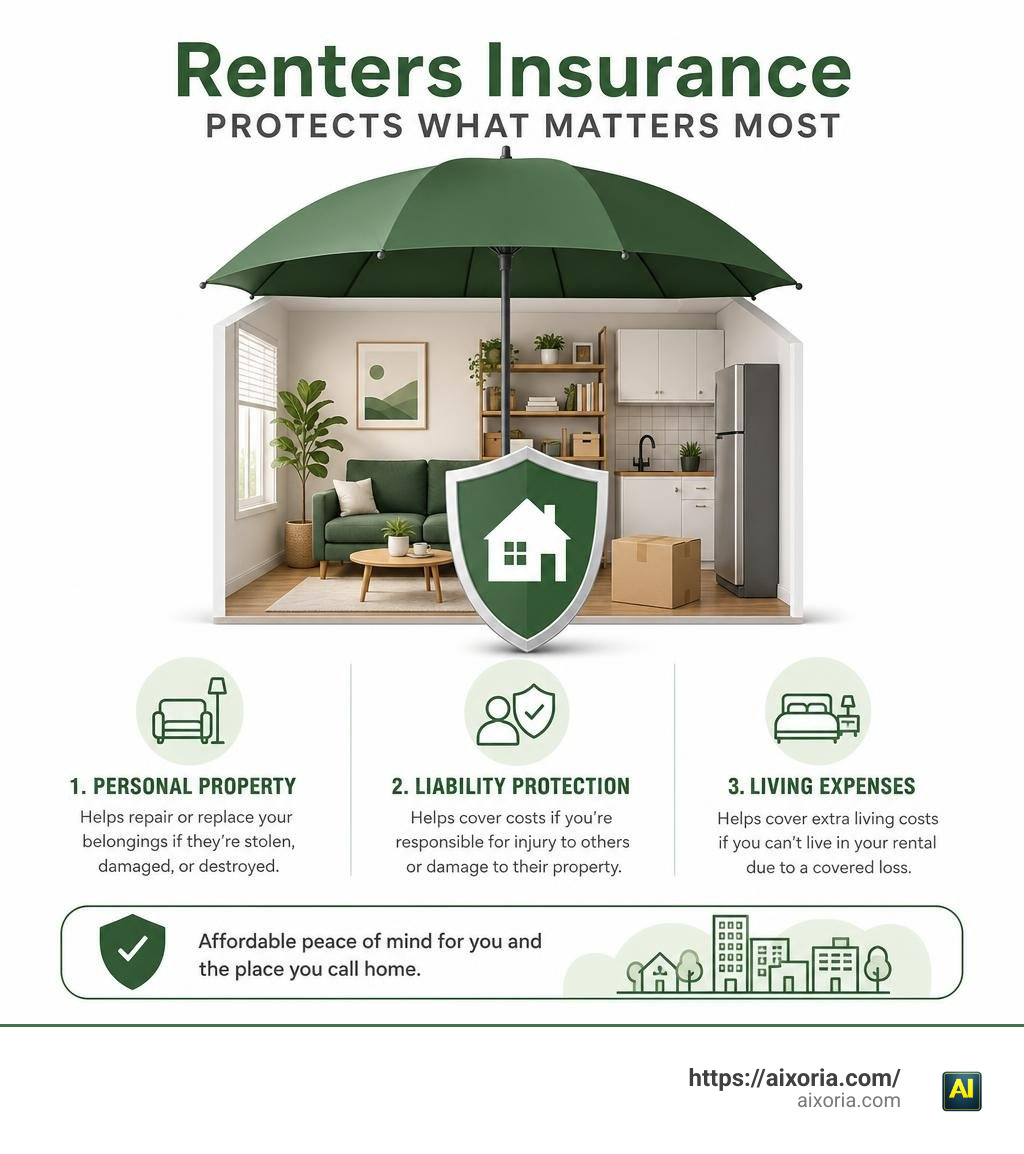
A standard policy from State Farm acts as a financial safety net for your everyday life. When you sign up for State Farm’s official renters policy, you are securing four primary types of protection:
- Personal Property Coverage (Coverage B): This protects your belongings—like electronics, furniture, clothes, and bicycles—against covered perils such as fire, smoke, vandalism, theft, and certain types of accidental water damage. This coverage applies even when you are away from home; for example, if your laptop is stolen from your car while you are traveling, it is covered.
- Personal Liability Protection (Coverage L): If someone is accidentally injured in your home or if you accidentally damage someone else’s property, personal liability coverage steps in. It helps pay for legal defense fees and court-ordered settlements up to your policy limit (typically starting at $100,000).
- Loss of Use / Additional Living Expenses (Coverage C): If a fire or severe water leak makes your rental entirely uninhabitable, this coverage pays for your temporary relocation costs. It can cover hotel bills, restaurant meals, and storage fees for up to 24 months while your rental is being repaired.
- Medical Payments to Others (Coverage M): This covers minor medical expenses (usually up to $1,000 to $5,000) if a guest is injured on your property, regardless of who was at fault. It is a quick way to handle small injuries without escalating to a liability lawsuit.
Key Exclusions: What is Not Covered?
While renters insurance covers a broad list of mishaps, it does not cover everything. It is crucial to read the fine print of your policy to avoid unpleasant surprises during a claim. According to the California policy exclusions document (Form H4-2105), standard policies exclude:
- Flooding and Surface Water: Damage caused by natural disasters like hurricanes, rising rivers, or coastal storm surges is strictly excluded. For flood protection, you must purchase a separate policy through the National Flood Insurance Program (NFIP).
- Earth Movement: Earthquakes, landslides, sinkholes, and mudflows are not covered under a standard policy. However, you can often buy an earthquake endorsement for an additional premium.
- Intentional Acts and Negligence: If you intentionally damage your own property or if your roommate damages the apartment on purpose, State Farm will not cover the loss.
- Mold, Fungus, and Wet Rot: Mold damage is generally excluded unless it is the direct result of a sudden, covered water leak (like a burst pipe) and was addressed immediately.
- Infestations: Damage from bedbugs, mice, termites, or other pests is considered a maintenance issue and is entirely your responsibility.
- Roommate Property: Your policy only covers people listed on the declarations page. Unless your roommate is a relative or is explicitly named on your policy, their belongings are not protected.
Policy Costs, Deductibles, and Available Discounts

How much you pay for state farm renters insurance depends on several personal risk factors. When calculating your premium, underwriters look at your ZIP code, the construction style and age of your building, your personal claims history, and your credit score (in states where this is legally permitted).
Another massive factor is your choice of deductible. The deductible is the amount of money you pay out-of-pocket before your insurance coverage kicks in. Choosing a higher deductible (like $1,000 instead of $500) will lower your monthly premium, but you must ensure you have that cash on hand in case you need to make a claim.
It is also important to understand how State Farm calculates payouts. Unlike many competitors that default to Actual Cash Value (ACV)—which subtracts depreciation for age, wear, and tear—State Farm offers replacement cost coverage as its standard. This means if your five-year-old television is stolen, State Farm pays what it actually costs to buy a brand-new, comparable TV today, rather than giving you a fraction of the price for a used model.
How Much Does State Farm Renters Insurance Cost?
On average, renters insurance is incredibly affordable. According to a survey by the National Association of Insurance Commissioners (NAIC), the average tenant pays about $13 a month for roughly $34,000 in personal property coverage.
State Farm is highly competitive, often beating these averages. In MoneyGeek’s cost analysis, State Farm’s rates were found to be 26% to 65% below national averages depending on the state and coverage level selected.
Here is a breakdown of what you can expect to pay annually with State Farm across different personal property limits (assuming a standard $100,000 liability limit and a $500 deductible):
| Personal Property Limit | Average State Farm Annual Premium |
|---|---|
| $20,000 | ~$145 |
| $50,000 | ~$226 |
| $100,000 | ~$336 |
Note: Actual rates vary by state. For example, annual premiums for $20,000 in coverage can range from as low as $80 in some states to over $300 in higher-risk coastal regions.
Smart Ways to Save: Discounts and Bundles
Even though State Farm is already highly affordable, we love saving extra money wherever we can. State Farm offers several straightforward discounts to help lower your premium:
- Multiple Policy Discount (Bundling): This is the single biggest saver. When you bundle your renters insurance with a State Farm auto policy, you can save up to $900 annually across both policies.
- Home Alert Protection Discount: You can earn a discount by equipping your rental with safety and security devices, such as smoke detectors, fire alarms, fire extinguishers, or a burglar alarm system.
- Claim-Free Discount: If you have gone several years without filing an insurance claim, State Farm may reward your low-risk status with a lower rate.
- Wildfire Mitigation Discounts: For renters in states like California, taking proactive property-level or community-level wildfire safety measures can qualify you for localized discounts.
Optional Coverages and Policy Endorsements
If standard coverage is not quite enough for your situation, State Farm allows you to customize your policy with optional endorsements. These add-ons provide targeted protection for specific risks:
- Scheduled Personal Property: Standard policies have sub-limits on high-value items. For example, jewelry theft might only be covered up to $1,000, and firearms up to $2,500. By “scheduling” these items, you can cover them for their appraised value with no deductible.
- Water Backup Coverage: If a sewer or drain backs up and floods your apartment with dirty water, a standard renters policy won’t cover the cleanup or property damage. Adding this endorsement protects you from expensive water backup bills.
- Identity Theft Protection: For about $25 a year, you can add identity restoration coverage. This helps cover legal fees, lost wages, and administrative costs associated with recovering your identity.
- Business Property Coverage: If you work from home, a standard policy only covers up to $1,500 of business property on the premises (and $750 away from premises). An endorsement can increase these limits to protect your professional gear.
- Personal Umbrella Policy: If you have significant assets to protect and want more than the standard $100,000 to $300,000 in liability coverage, an umbrella policy can extend your liability limits into the millions.
If you are a landlord reading this to protect your rental building rather than your personal belongings as a tenant, you will need a Rental home insurance – State Farm® policy instead. This is a landlord dwelling policy designed to protect the physical building structure, loss of rental income, and landlord liability.
How to File a Claim and Manage Your Policy

Filing an insurance claim can feel daunting, but State Farm has digitized much of the process to make it as painless as possible. However, before you ever need to file a claim, the most important step you can take is creating a home inventory. Walk through your rental room-by-room and take photos and videos of your belongings, noting brand names, serial numbers, and approximate purchase prices. Keep this inventory, along with major receipts, stored safely in a digital cloud or on your phone.
If disaster strikes, the claims process follows a structured sequence to get your life back to normal.
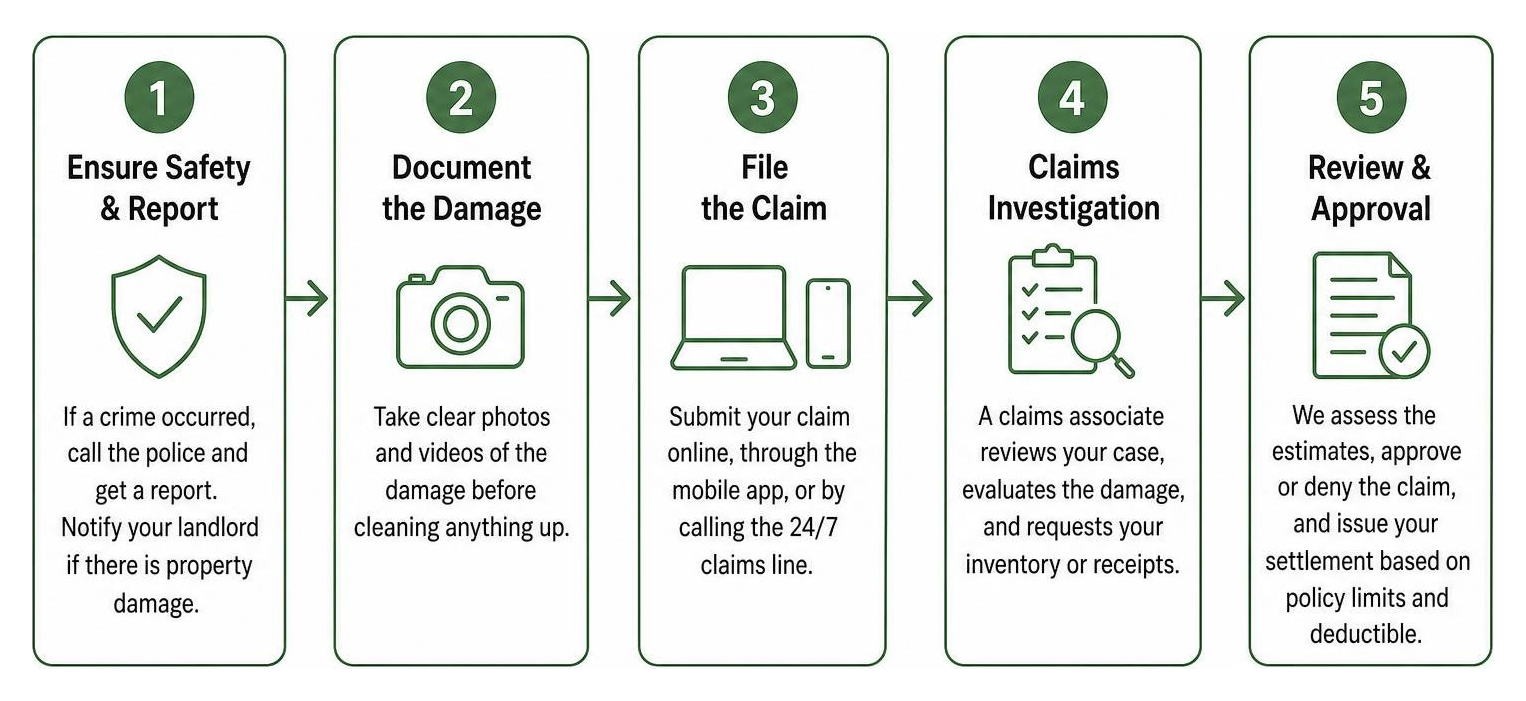
- Ensure Safety & Report: If a crime occurred, call the police immediately and obtain a copy of the police report. If there is property damage, notify your landlord.
- Document the Damage: Take clear photos and videos of the damage before cleaning anything up.
- File the Claim: Submit your claim online, through the State Farm mobile app, or by calling their 24/7 claims line at 800-SF-CLAIM.
- Claims Investigation: A claims associate will review your case, evaluate the damage, and request your home inventory or purchase receipts.
- Review & Approval: State Farm will assess the estimates, approve or deny the claim, and offer a settlement payout based on your policy limits and deductible.
While State Farm has an easy-to-use digital portal, some users on ConsumerAffairs customer feedback have noted that claims processing times can vary. Some policyholders reported delays or disputes over water damage claims, highlighting how vital it is to keep detailed records and maintain a thorough home inventory.
Frequently Asked Questions About Renters Insurance
Is renters insurance required by law?
No, there are no state or federal laws that mandate renters insurance. However, many landlords and property management companies require you to show proof of a active renters policy before handing over the keys. They do this to ensure that if you accidentally cause a fire or water leak, your liability policy will help cover the repairs.
Does renters insurance cover roommate belongings?
Generally, no. A standard policy only covers the policyholder and any relatives living in the household. If you live with an unrelated roommate, they must purchase their own renters insurance policy to protect their belongings. While you can sometimes add a roommate to your policy as an “additional insured,” it is usually cleaner and safer to maintain separate policies to avoid claims disputes.
Does State Farm cover dog bites under liability?
Yes. If your dog bites a guest, the medical payments and personal liability sections of your policy will typically cover the guest’s medical bills and your legal defense. Unlike some insurance companies, State Farm does not refuse coverage or charge higher premiums based on specific dog breeds. However, they may exclude coverage or deny renewal if your dog has a history of aggression or prior bite claims.
Conclusion
At the end of the day, state farm renters insurance offers some of the most reliable and budget-friendly protection on the market. With average rates of just $9 a month, standard replacement cost coverage, and a highly rated mobile app, it provides incredible peace of mind for very little out-of-pocket cost.
Whether you are renting a small studio apartment or a large family home, securing a policy ensures that a sudden accident won’t wipe out your hard-earned savings.
For more helpful guides on protecting your lifestyle and staying ahead of the latest consumer trends, check out our team at Aixoria and explore the Aixoria AI Updates platform today!
10 thoughts on “State Farm Renters Insurance Review 2026: Coverage, Cost & Discounts”