Which Banks Offer Debt Consolidation Loans for Bad Credit?

If you’re wondering which banks offer debt consolidation loans for bad credit, the short answer is that several lenders — from traditional banks to online platforms — will work with you even if your credit score is below 600.
Here are the main options available in July 2026:
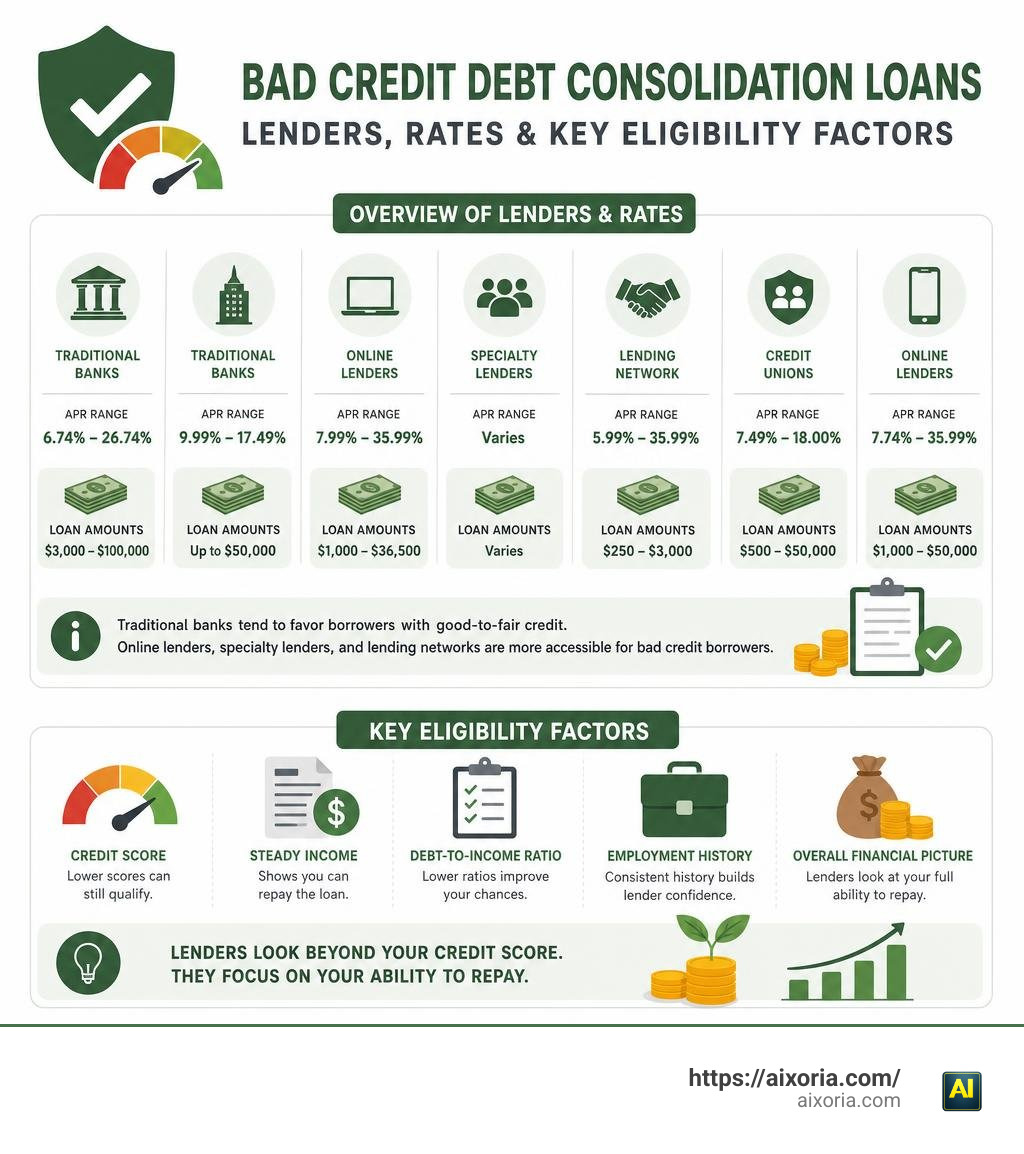
| Lender | Type | Min. Credit Score | APR Range | Loan Amounts |
|---|---|---|---|---|
| Wells Fargo | Traditional bank | Not publicly stated | 6.74%–26.74% | $3,000–$100,000 |
| Citi | Traditional bank | Not publicly stated | 9.99%–17.49% | Up to $50,000 |
| LendingPoint | Online lender | ~580 | 7.99%–35.99% | $1,000–$36,500 |
| World Finance | Specialty lender | No hard minimum | Varies | Varies |
| Yup Loans | Lending network | No hard minimum | 5.99%–35.99% | $250–$3,000 |
| Truliant FCU | Credit union | Not publicly stated | 7.49%–18.00% | $500–$50,000 |
| Upgrade | Online lender | 600 | 7.74%–35.99% | $1,000–$50,000 |
Note: Wells Fargo and Citi tend to favor borrowers with good-to-fair credit. LendingPoint, World Finance, and Yup Loans are more accessible for bad credit borrowers.
Having bad credit doesn’t automatically disqualify you from debt consolidation. But it does make things harder — and more expensive.
The difference between a good-credit rate and a bad-credit rate can be more than 25 percentage points on the same loan amount. That gap matters a lot when you’re trying to lower your monthly payments.
The good news? Some lenders look beyond your credit score. They consider your income, your ability to repay, and your overall financial picture. That opens doors even when your FICO score is low.
This guide walks you through who will lend to you, what it will cost, and how to improve your odds of approval.

When you are hunting for a way to merge your bills, finding the right partner is crucial. The landscape of lenders is broad, ranging from local institutions to massive nationwide operations and rapid digital platforms. If you have been searching to see Debt Consolidation Loans for Bad Credit in June 2026 , you have likely noticed that traditional banks are often the toughest nut to crack.
Traditional brick-and-mortar banks typically prefer borrowers with flawless credit profiles. However, some select banks, credit unions, and highly specialized online platforms have built models specifically designed to evaluate the creditworthiness of borrowers with less-than-perfect scores.
These bad credit lenders understand that a low credit score is often a lagging indicator of financial health. Perhaps you had a medical emergency last year, or a brief gap in employment. These lenders look at your current trajectory rather than just your past mistakes, offering loan terms and interest rates that make consolidation a realistic path forward.
Criteria for Which Banks Offer Debt Consolidation Loans for Bad Credit
Before we dive into the specific institutions, we need to understand how these lenders make their decisions. If you have bad credit, banks will not simply hand over money based on a handshake. They rely on several alternative metrics:
- Minimum Credit Score Requirements: While some bad credit lenders can work with scores as low as 580 (or even lower through specialized networks), others have a hard floor at 600 or 620.
- Debt-to-Income (DTI) Ratio: This is the percentage of your gross monthly income that goes toward paying debts. Even with bad credit, if your DTI is low (ideally under 40% to 45%), lenders feel much more comfortable.
- Stable Income Verification: Lenders want to see a reliable stream of income. This proves you have the cash flow to handle the new, single monthly payment.
- Relationship Status: Some major institutions will relax their criteria if you already have an active checking or savings account with them.
For instance, if you look at the Debt Consolidation Loan up to $30000. No Fees | Citi.com, you will find that having an established relationship with a bank can sometimes help you clear hurdles that would otherwise stop a cold applicant.
Traditional Banks and Financial Institutions
Let’s look at the major traditional banks. While they are generally more conservative, they do offer some pathways:
- Wells Fargo: They offer personal loans ranging from $3,000 to $100,000 with terms between 12 and 84 months. They do have competitive rates (6.74% to 26.74% APR), but there is a major catch: these loans are only available to existing Wells Fargo customers. To give you an idea of how rates shake out, data from January 1, 2026, to March 31, 2026, showed that at least 10% of approved Wells Fargo applicants qualified for the lowest rate available. If your credit is poor, however, expect to land on the higher end of that spectrum.
- Citi: Citi offers personal loans up to $50,000 with fixed rates and zero fees (no origination fees, no application fees, and no pre-payment penalties). While they are highly competitive, they generally require fair-to-good credit. If you are on the boundary line of bad credit, an existing Citi account might tip the scales in your favor.
- BankSA: For our international readers or those looking at global banking structures, institutions like BankSA offer unsecured personal loans for debt consolidation. They offer borrowing limits from $2,000 to $50,000 with terms ranging from 1 to 7 years. You can read more about how they structure these products via Debt Consolidation – How to get out of debt? | BankSA.
Online Lenders and Specialized Platforms
Because traditional banks can be highly restrictive, online lenders and specialized platforms are where most bad credit borrowers find success. These companies leverage modern underwriting algorithms to look at your entire financial story.
- LendingPoint: LendingPoint specializes in helping fair and bad credit borrowers. They offer loans from $1,000 to $36,500 with terms from 24 to 72 months. Their APRs run from 7.99% to 35.99%. They are highly transparent and allow you to check your options without affecting your credit score. You can explore their offerings directly through Debt Consolidation Loans – LendingPoint.
- World Finance: World Finance takes a highly personal approach. Instead of relying solely on automated credit scores, they look at your full financial picture, including your income sources and actual ability to make payments. They offer same-day funding in many cases, which is perfect for urgent consolidation needs. Learn more about their process at Quick and Easy Debt Consolidation Loans | Loans by World Finance.
- Yup Loans: If you aren’t sure where to start, Yup Loans acts as a matching service. They connect bad credit borrowers with specialized lenders offering loans between $250 and $3,000. It is a fantastic option for smaller, high-interest debts that need immediate consolidation. Check them out at Debt Consolidation Loans for Bad Credit | Yup Loans.
Pros, Cons, and Costs of Bad Credit Debt Consolidation

Before signing on the dotted line, we must weigh the benefits against the potential hazards. Consolidation is a tool, and like any tool, it can build your house or break your thumb depending on how you use it. If you find yourself struggling to navigate these choices or are dealing with wider payment issues, you might want to read our guide on Who Should You Contact If You Have Trouble Making Student Loan Payments 2026 Guide to see how to handle multiple financial pressures at once.
Understanding the True Cost: Fees and APRs
When you have bad credit, the interest rate (APR) is only part of the story. You must keep an eye out for hidden and upfront costs:
- Origination Fees: This is a fee charged by the lender for processing your loan. For bad credit loans, origination fees can range from 1% to as high as 12% of the loan amount. This fee is usually deducted directly from your loan payout, meaning if you borrow $10,000 with an 8% fee, you will only receive $9,200 in your bank account—but you still owe the full $10,000!
- Establishment Fees: Similar to origination fees, these are flat upfront fees common with traditional banks (for example, BankSA charges a $250 establishment fee).
- Late Payment Penalties: Always check the fine print to see what happens if you miss a payment deadline.
To protect yourself, we recommend reviewing formal financial disclosures. If you have ever wondered What Document Explains Your Rights and Responsibilities as a Federal Student Loan Borrower, you know how critical these fine-print documents are for understanding the true cost of borrowing.
How Consolidation Affects Your Credit Score
Consolidating your debt has a dual effect on your credit profile.
In the short term, you will likely see a small, temporary dip in your score. This happens because the lender will perform a “hard inquiry” to check your credit, and you are opening a brand-new credit account.
However, in the long term, consolidation can do wonders for your score if managed correctly. By paying off multiple credit cards, you drastically lower your credit utilization ratio (how much of your available credit limit you are using). Furthermore, making consistent, on-time payments on your new loan builds a stellar payment history, which is the single largest factor in your FICO score.
If you are facing legal or administrative hurdles with other types of debt, such as academic liabilities, understanding how these systems interact is vital. Feel free to check out our analysis of the Federal Student Loan Discharge Lawsuit 2026 Who Qualifies How to Win to see how legal shifts can impact your overall credit health.
How to Improve Your Approval Odds and Find Alternatives
If your credit score is currently in the “subprime” zone, you do not have to accept defeat. There are active steps you can take to make yourself look like a much safer bet to lenders. For a detailed breakdown of how to analyze lending terms and structure your applications, you can read our Advantage Student Loan Review 2026 Rates Eligibility Pros Explained.
Credit Unions vs. Which Banks Offer Debt Consolidation Loans for Bad Credit
If traditional banks say no, your next stop should be a credit union. Because credit unions are member-owned, not-for-profit organizations, they are often far more forgiving than commercial banks.
For example, Truliant Federal Credit Union offers debt consolidation loans with rates as low as 7.49% to 18.00% APR. They offer borrowing amounts from $500 up to $50,000. Because their mission is to serve their members rather than maximize corporate profits, they are often willing to sit down and listen to your story.
If you are trying to manage excess funds or loans, or if you are looking for guidance on what to do when you have over-borrowed, you can read our resource on Who Do You Contact If You’ve Accepted More Student Loan Money Than You Need 2026 Guide.
Strategies to Boost Approval Odds
If you want to maximize your chances of getting approved for a debt consolidation loan, try these proven tactics:
- Apply with a Cosigner or Co-borrower: If you have a friend or family member with strong credit who is willing to back you, their score can help you secure approval and land a much lower interest rate.
- Offer Collateral (Secured Loans): Unsecured loans carry high risk for lenders. If you secure the loan with an asset—like a vehicle title, a savings account, or a certificate of deposit (CD)—the lender’s risk drops, and your approval odds skyrocket.
- Dispute Credit Report Errors: Check your credit reports for free. If you find outdated or incorrect negative marks, dispute them with the credit bureaus to get a quick score boost.
- Reduce Your Utilization: Pay down whatever small balances you can before submitting your application.
These strategies are highly effective across all lending types. If you are also looking to secure larger assets like recreational vehicles, you can check out our guide on Bank of America RV Loans in 2026 to see how collateral and credit requirements shift for specialized vehicle lending.
Non-Lending Alternatives for Debt Relief
If a debt consolidation loan is simply out of reach or too expensive, don’t panic. You have other viable options:
- Debt Management Plans (DMPs): Offered by non-profit credit counseling agencies, a DMP allows you to make a single payment to the agency, which then distributes it to your creditors. They can often negotiate lower interest rates and waive fees without requiring you to take out a new loan.
- Balance Transfer Credit Cards: If your credit is in the “fair” range (around 660), you might qualify for a card like Discover’s personal options, which offer introductory 0% APR periods. Be aware that these typically require a 3% to 5% transfer fee.
- Debt Settlement: This involves negotiating with creditors to pay a lump sum that is less than what you owe. Use caution, as this can severely damage your credit.
- Bankruptcy: As a last resort, bankruptcy can offer a fresh start, though Chapter 7 or Chapter 13 bankruptcies can remain on your credit report for up to 10 years.
Frequently Asked Questions about Bad Credit Debt Consolidation
How quickly can I get approved and funded for a bad credit loan?
Online lenders are incredibly fast. Platforms like LendingPoint and World Finance can provide pre-qualification offers within minutes using a soft credit check. Once you submit a full application, approval can happen the same business day. If approved, funds are typically sent via electronic disbursement directly to your bank account or your creditors as soon as the next business day.
Can I use a debt consolidation loan for student loan debt?
Generally, no. Most personal loans used for debt consolidation specifically exclude post-secondary education expenses or student loans in their terms of service (this is a standard restriction for lenders like Wells Fargo and Citi). For student loans, you should look into specialized student loan refinancing options instead.
Do I need collateral to secure a debt consolidation loan with bad credit?
No, you do not need collateral. Most debt consolidation loans are unsecured personal loans. However, if your credit score is very low, opting for a secured loan (using a vehicle title, savings account, or other assets as collateral) can significantly improve your chances of approval and help you secure a much more affordable interest rate.
Conclusion
Finding which banks offer debt consolidation loans for bad credit requires looking past traditional financial institutions and embracing credit unions, specialized online lenders, and strategic financial planning. By understanding the true costs of borrowing and taking active steps to improve your financial profile, you can simplify your payments and pave a clear path toward a debt-free future.
For more cutting-edge financial insights and updates on how technology is changing the lending world, check out our AI Updates and Financial Tech section. We are here to help you navigate your financial journey with ease and confidence!
1 thought on “Which Banks Offer Debt Consolidation Loans for Bad Credit in 2026?”