What Does $1 Million in General Liability Insurance Cost?

The general
Scr0ll d0wn to D0VVNL0AD
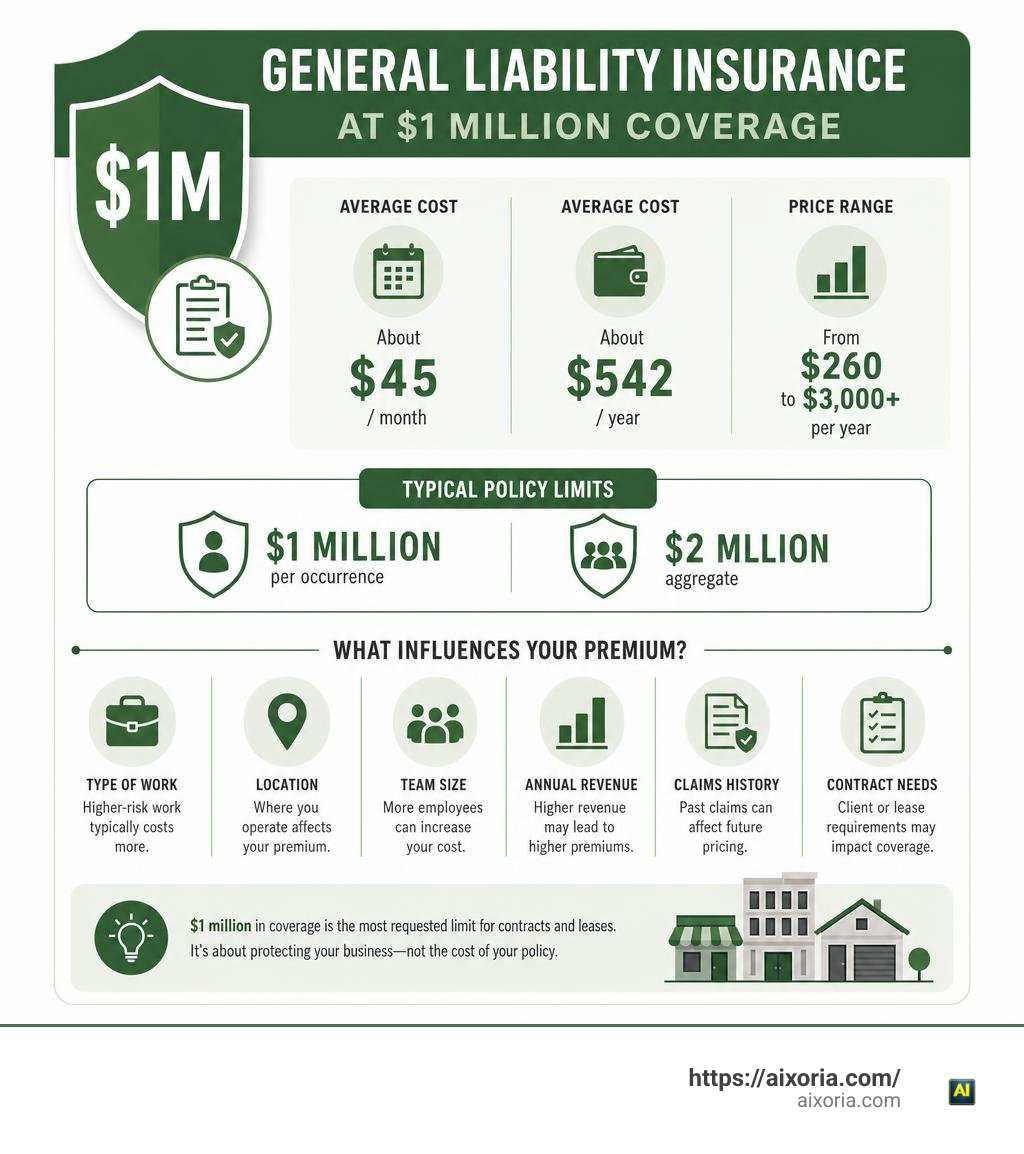
liability insurance cost for $1 million in coverage is often about $45 per month, or $542 per year, for a small business. Real prices can range from roughly $260 to more than $3,000 a year, depending on the work you do, where you operate, your team size, revenue, and claims history.
| Quick cost answer | Typical benchmark |
|---|---|
| Average monthly cost | About $45 |
| Average annual cost | About $542 |
| Common low-risk starting price | Around $260-$350 per year |
| Higher-risk business range | $3,000+ per year |
| Common policy limits | $1 million per occurrence / $2 million aggregate |
A $1 million policy does not mean the policy costs $1 million. It usually means the insurer can pay up to $1 million for one covered claim, subject to the policy terms. Many client contracts and commercial leases ask for this level of protection.
Price differences can be wide. A home-based consultant may pay far less than a roofer, restaurant, or contractor with employees working at customer sites. The right benchmark is useful for budgeting, but a quote based on your actual business details is what determines the final premium.
Understanding General Liability Insurance Cost for $1 Million Policies
When we evaluate commercial insurance premiums, understanding what goes into a baseline policy is essential. General liability insurance protects your business against third-party claims involving bodily injury, physical property damage, and personal or advertising injury (such as libel, slander, or copyright infringement).
Because $1 million is the universal standard requested by commercial landlords, government entities, and enterprise clients, insurers construct their primary rating scales around this limit. However, calculating your true financial outlay requires looking beyond single averages and examining how market pricing is distributed.
Average Monthly and Annual Premium Expectations
For most typical small businesses, the general liability insurance cost for $1 million falls within a manageable range. Across standard commercial lines data, the national average premium sits around $45 to $69 per month, which translates to $542 to $824 annually.
When evaluating these figures, it helps to distinguish between mean (average) and median figures:
- Median Pricing: The median cost for a $1 million policy across standard business accounts sits near $42 to $55 per month ($500 to $660 annually). Median numbers filter out extreme high-risk outliers, offering the clearest picture of what a standard low-to-moderate risk enterprise pays.
- Mean Pricing: National average metrics often range higher—around $68 to $123 per month—because high-risk industries like heavy construction or specialized medical operations skew the mathematical average upwards.
- Baseline Rates: Sole proprietors in low-risk sectors like digital marketing, management consulting, or accounting frequently find plans starting between $250 and $350 per year ($21 to $29 per month).
To better understand general commercial risk pricing in 2026, you can explore our detailed guide on how much is GL insurance for a small business in 2026.
Per-Occurrence vs. Aggregate Limits Explained
When you review a commercial liability policy quote, you will rarely see just a single dollar figure. Instead, coverage is written using dual-limit terms, such as $1 million / $2 million ($1M/$2M).
To understand how your policy functions during a legal dispute, it is crucial to recognize how these limits cap payout structures:
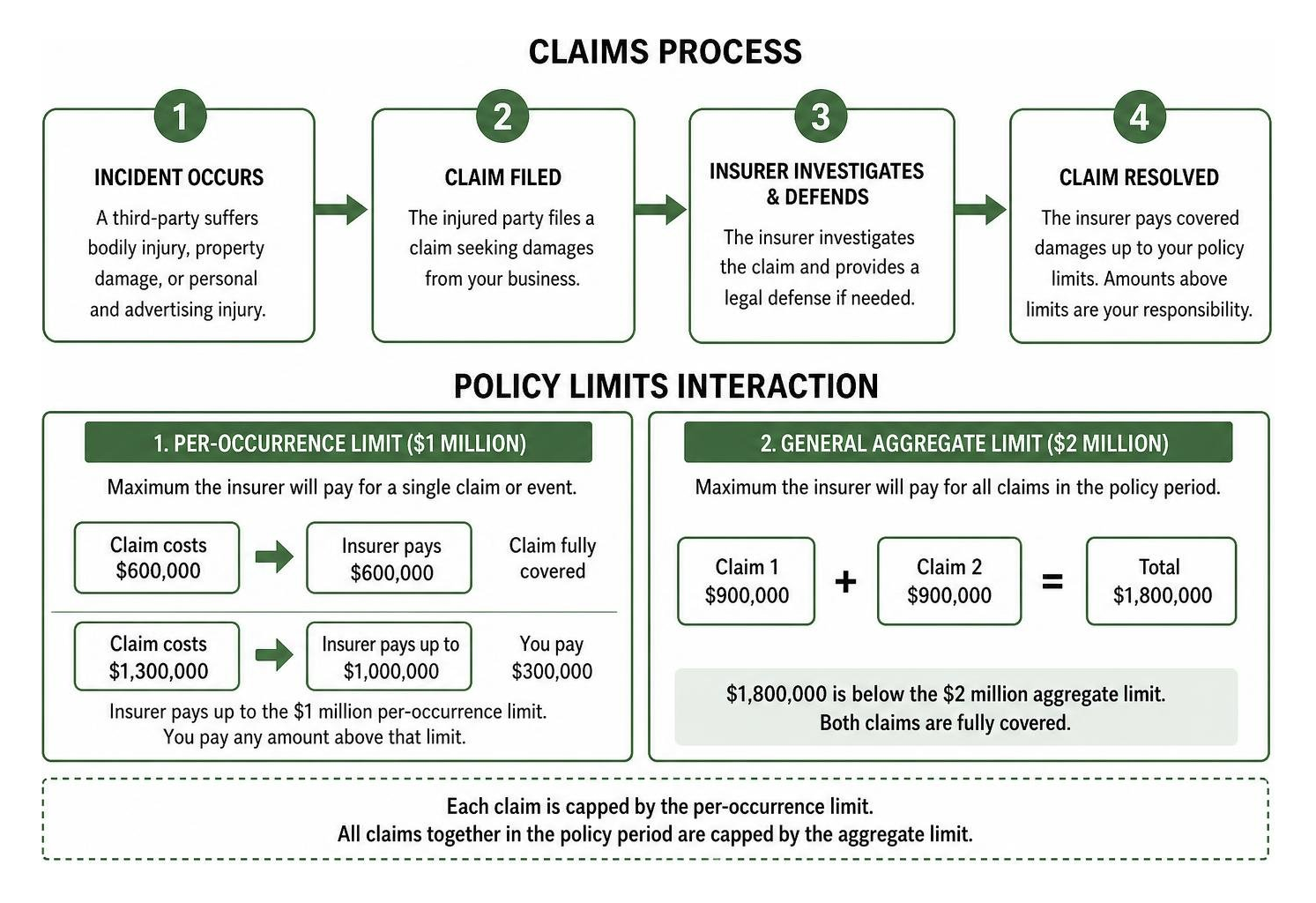
- Per-Occurrence Limit ($1 Million): This represents the maximum amount the insurance company will pay for a single event or claim. If an customer suffers a slip-and-fall injury at your office resulting in $600,000 in medical and legal costs, your per-occurrence limit covers the entire claim. However, if a single incident results in $1.3 million in total damages, your policy pays out $1 million, leaving your business responsible for the remaining $300,000 out of pocket.
- General Aggregate Limit ($2 Million): This represents the cumulative total maximum payout the insurance carrier will issue across all claims during your one-year policy period. If you incur two separate $900,000 claims in the same year, both are fully covered because each individual claim is under $1 million, and their combined total ($1.8 million) stays below your $2 million annual aggregate cap.
Understanding these caps is essential when checking whether a policy meets your contractual requirements. You can read more about evaluating overall policy pricing structures in our resource on general liability insurance rate per 1000 how to calculate.
Primary Pricing Factors Driving Premium Rates
Insurers do not select rates at random. Underwriters evaluate precise risk profiling formulas based on historical actuarial data across nearly 1,000 class codes.

How Industry and Risk Exposure Influence Pricing
Your primary business activity is the single largest factor shaping your baseline premium. Insurers categorize enterprises into distinct risk tiers based on physical exposure, foot traffic, and potential claim severity:
- Low-Risk Professional Services: Desk-bound professionals, consultants, accountants, and IT specialists face minimal physical risk exposure. Average costs for a $1 million policy in tech or consulting range between $27 and $45 per month ($320 to $540 annually).
- Retail and Personal Services: Businesses that host physical public foot traffic—such as boutiques, fitness studios, salons, or dry cleaners—pay slightly more due to customer slip-and-fall risks. Typical premiums run $35 to $65 per month ($420 to $780 annually).
- Restaurants and Hospitality: High public foot traffic combined with hot surfaces, wet floors, and food handling increases risk exposure. Average annual costs range between $1,100 and $1,400 per year ($90 to $115 per month).
- Construction and Specialty Trades: Physical labor on third-party job sites involves elevated bodily injury and property damage risks. Solo handymen or interior painters may pay $400 to $800 annually, while general contractors and roofing specialists often pay $2,000 to over $6,000 per year.
For detailed market pricing benchmarks across industry segments, you can review comprehensive industry insurance guides.
Impact of Employee Count and Revenue Calibration
As your operations expand, your exposure to third-party claims increases proportionately. Underwriters calibrate rates using two primary volume metrics: team headcount and annual gross revenue.
- Employee Headcount: Sole proprietors pay the lowest baseline rates, averaging around $65 per month across all risk classes. However, hiring staff introduces supervisory exposure. Small businesses with 1 to 4 employees pay an average of $123 per month ($1,474 annually). Crossing into the 5 to 9 employee threshold often triggers a significant premium step up—averaging roughly $330 per month—reflecting the multiplied physical activity on job sites.
- Revenue Exposure: Higher annual sales volume indicates more transactions, products sold, or client sites serviced. Underwriters project annual revenue during policy inception and conduct end-of-year premium audits to reconcile actual exposure against initial estimates.
If you are expanding your workforce, review our guide on how does workers comp work for a small business 2026 guide to properly plan your total labor insurance obligations.
Geographic Location and Regional Legal Climates
Where you operate your business impacts your annual premium. Insurance carriers adjust rates geographically based on regional legal environments, medical care costs, population density, and municipal claim histories.
- Favorable Legal Climates: States with lower litigation rates and stable legal defense costs—such as West Virginia, Ohio, or Iowa—boast lower average general liability premiums, often ranging between $70 and $90 per month for standard policies.
- Higher-Litigation Environments: States known for higher litigation frequency, elevated legal defense fees, and dense urban foot traffic—such as California, New York, Florida, and Louisiana—see higher average premiums. For instance, an identical contracting profile that costs $1,000 annually in the Midwest may reach $1,900 to $3,500 annually in higher-cost urban regions.
For self-employed professionals operating in higher-cost states, check our specialized guide on business insurance for self employed in California 2026 guide.
Policy Configurations and Coverage Expansion Options
Structuring your coverage correctly ensures you fulfill contractual requirements without overpaying for unnecessary coverage additions.
Evaluating General Liability Insurance Cost for $1 Million Across Limit Structures
Many business owners wonder how changing policy limits impacts their final bill. Interestingly, raising your aggregate cap does not double your price, because insurer risk scales sub-linearly.
- $1M Per Occurrence / $1M Aggregate ($1M/$1M): This minimal structure sets both individual claim caps and annual aggregate caps at $1 million. It is slightly cheaper than standard policies, but leaves no safety cushion if a second claim occurs in the same policy year.
- $1M Per Occurrence / $2M Aggregate ($1M/$2M): Chosen by over 85% of small business policyholders, this setup provides $1 million per claim with a $2 million total annual protection buffer. The nationwide average cost for this standard policy sits at approximately $45 per month ($542 per year).
- Upgrading to $2M Per Occurrence / $4M Aggregate ($2M/$4M): Doubling your overall policy caps from $1M/$2M to $2M/$4M adds surprisingly little to your premium. Across industry datasets, upgrading to a $2M/$4M limit adds an average of only $11 per year—bringing the average annual premium from $542 to just $553.
For a deeper dive into adjusting policy limits, evaluate your specific operational risks and client coverage mandates.
Bundling Protection with a Business Owner’s Policy
One of the most effective ways to lower your general liability insurance cost for $1 million is by purchasing a Business Owner’s Policy (BOP).
A BOP combines three core commercial coverages into a single package:
- General Liability Insurance: Protects against third-party bodily injury and property damage claims.
- Commercial Property Insurance: Protects your owned or rented building, equipment, inventory, and office furnishings.
- Business Interruption Insurance: Replaces lost income and ongoing payroll if a covered property disaster forces a temporary shutdown.
Bundling these policies into a BOP typically generates a 10% to 25% discount compared to purchasing each policy separately. While standalone general liability averages $45 to $69 monthly, a complete BOP combining property and liability averages roughly $83 to $141 per month ($1,000 to $1,687 annually) for low-to-moderate risk enterprises.
To determine if property coverage is mandatory for your premises, consult our article on is commercial property insurance mandatory as well as our overall guide on which insurance is best for business in 2026 complete guide.
Adding Commercial Umbrella Coverage for Higher Limits
If your business signs high-value enterprise contracts, works on large commercial development projects, or operates in high-risk physical environments, clients may require $3 million, $5 million, or higher liability limits.
Because standard commercial general liability policies typically top out at $2 million per occurrence, expanding your coverage limits is achieved by adding a Commercial Umbrella Policy (or excess liability policy).
- How Umbrella Insurance Works: Commercial umbrella insurance sits directly on top of your primary general liability policy. If a massive lawsuit generates $3 million in settlement costs, your underlying $1 million general liability policy pays its limit first, and the umbrella policy covers the remaining $2 million.
- Umbrella Pricing Benchmarks: Commercial umbrella insurance is remarkably affordable, averaging about $40 per month ($480 per year) for each $1 million block of additional coverage. Constructing a total $5 million liability limit ($4M GL aggregate + $3M umbrella) typically adds roughly $1,200 annually to your base insurance package.
Proven Strategies to Lower Premium Expenses
Managing operational budget demands that we keep risk management expenses as lean as possible without leaving dangerous financial gaps.

Risk Management and Maintaining Clean Claims History
Insurers reward businesses that proactively reduce risk exposure. Your claims history serves as a primary pricing factor during annual policy renewals:
- Loss-Free Premium Discounts: Maintaining a clean claims history for three to five consecutive years can lower your annual premiums by 10% to 25%.
- Impact of Claims: In contrast, experiencing multiple slip-and-fall or property damage claims within a short window can increase renewal premiums by 20% to 50% or result in non-renewal.
- Safety Standard Operating Procedures (SOPs): Implementing documented safety protocols—such as floor inspections, clear job site signage, mandatory equipment training, and regular hazard reviews—minimizes incident frequency and establishes a strong loss profile.
Discover more ways to optimize your commercial coverage in our comprehensive guide on 10 proven ways to reduce your commercial insurance premium.
Practical Steps to Lower Your General Liability Insurance Cost for $1 Million Coverage
Beyond risk management, several actionable financial strategies can immediately reduce your out-of-pocket insurance costs:
| Cost-Reduction Strategy | Estimated Savings | Implementation Details |
|---|---|---|
| Pay Annual Premium in Full | 5% to 10% total discount | Eliminates monthly carrier installment fees and administrative charges. |
| Increase Policy Deductible | 10% to 20% premium reduction | Elevating deductible from $500 to $1,000 or $2,500 lowers annual rates. |
| Bundle into a BOP | 15% to 25% combined savings | Package general liability with commercial property coverage. |
| Direct Carrier Purchasing | Up to 15% savings | Buy directly from underwriting carriers to remove agent commission fees. |
| Accurate Payroll Projections | Prevents audit penalties | Report precise revenue and employee metrics to avoid unexpected audit bills. |
| Subcontractor COI Collection | Avoids payroll reclassification | Collect Certificates of Insurance (COIs) from all sub-trades before work starts. |
To compare market rates and find affordable options for your business, explore our guide on who has the cheapest business insurance in 2026 compare rates and review our advice for independent operators in best business insurance for sole proprietors in 2026.
Frequently Asked Questions About $1 Million Coverage
Is $1 million in general liability coverage enough for a small business?
For the vast majority of small businesses, a $1 million per-occurrence / $2 million aggregate policy provides adequate baseline protection. It satisfies standard commercial lease agreements, client vendor contracts, and trade licensing requirements.
However, if your business operates in high-risk sectors (such as roofing, heavy excavation, or chemical manufacturing), handles high-value commercial properties, or maintains high revenue exposure, expanding limits to $2 million or adding an umbrella policy is recommended.
How does deductible selection affect annual liability premiums?
Your deductible is the out-of-pocket amount your business agrees to pay toward a covered claim before insurance benefits begin. Most small business owners select deductibles between $500 and $1,000.
Increasing your deductible from $500 to $1,000 can lower your annual premium by 10% to 20%. However, we always recommend choosing a deductible level that your business can comfortably pay out of liquid cash reserves without disrupting ongoing operations.
What is covered and excluded under a standard $1 million policy?
Understanding what your policy covers—and what requires separate insurance policies—prevents dangerous financial surprises during a loss:
Standard Covered Risks:
- Third-Party Bodily Injury: Pays medical bills, ambulance costs, and legal defense if a client slips, falls, or suffers physical harm at your business location or job site.
- Third-Party Property Damage: Covers repairs or replacement costs if you or your staff damage a customer’s physical assets or premises while performing work.
- Personal and Advertising Injury: Protects against legal claims alleging libel, slander, false arrest, copyright infringement, or trade dress violations in your advertising.
Standard Excluded Risks (Require Separate Policies):
- Employee Workplace Injuries: Excluded under GL; requires dedicated Workers’ Compensation insurance.
- Professional Advice or Service Errors: Excluded under GL; requires Professional Liability / Errors & Omissions (E&O) insurance.
- Damage to Owned Business Property: Excluded under GL; requires Commercial Property insurance or a Business Owner’s Policy.
- Commercial Auto Accidents: Excluded under GL; requires Commercial Auto insurance.
Businesses operating internationally or seeking cross-border insights can also review our guide on how much is general liability insurance in Canada 2026 costs.
Conclusion
Securing the right commercial coverage is a foundational pillar of building a sustainable enterprise. The standard general liability insurance cost for $1 million in coverage remains highly affordable for most small businesses, averaging around $45 per month ($542 per year), with median rates for low-risk trades starting between $250 and $350 annually.
By accurately assessing your operational risks, maintaining documented workplace safety protocols, bundling policies into a Business Owner’s Policy (BOP), and selecting optimal policy limits, you can protect your assets while keeping overhead low.
At Aixoria, we help business owners leverage modern technology and strategic insights to streamline operations, manage commercial risks, and scale efficiently. Explore our latest insights on business automation and digital strategies by visiting our section on AI Updates and Business Solutions.
1 thought on “How Much Does $1 Million in General Liability Insurance Cost?”