How Much Is General Liability Insurance in Canada?
Scr0ll d0wn to D0VVNL0AD

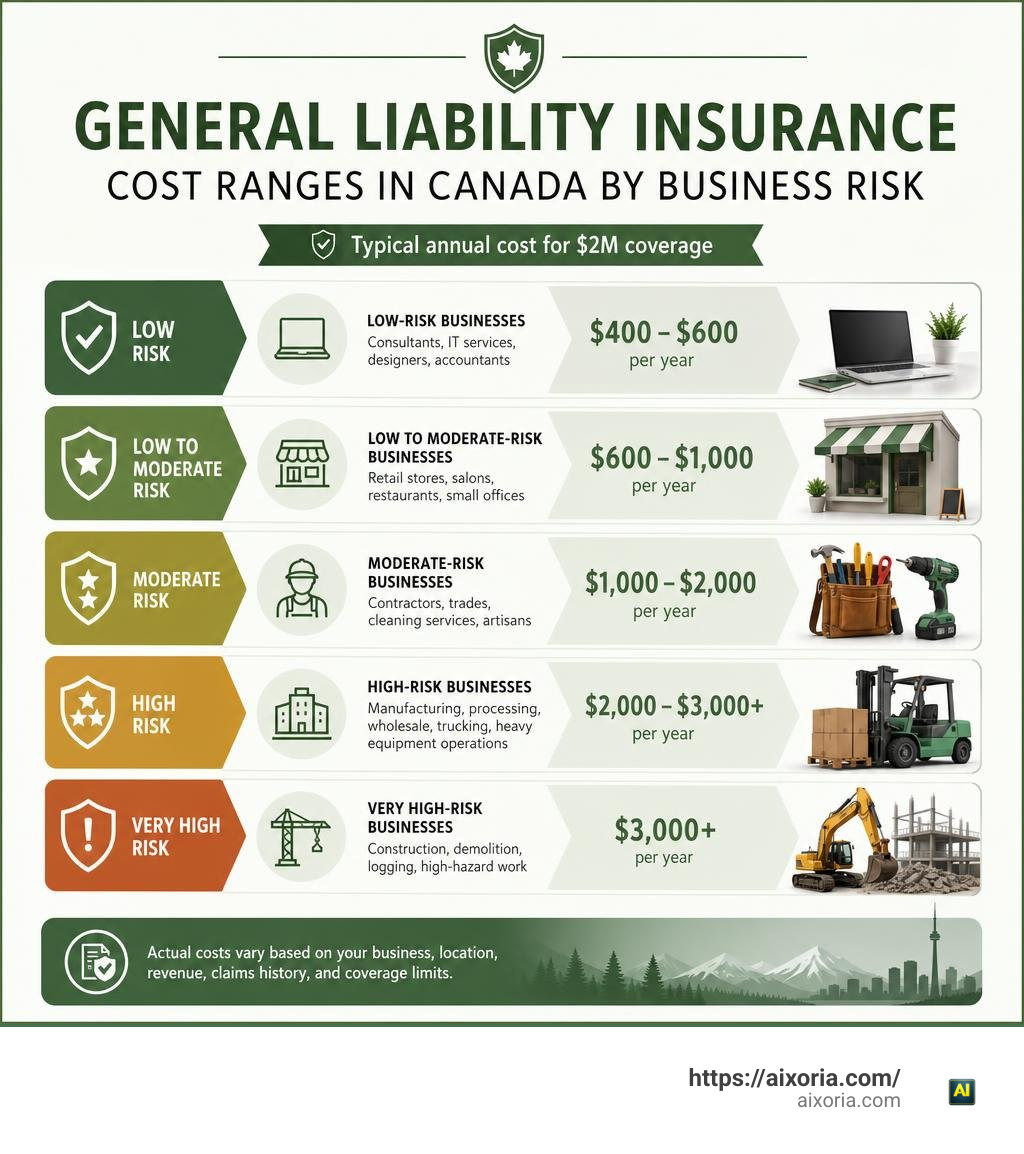
How much is general liability insurance in Canada? Most small businesses pay roughly $400 to $1,000 per year for basic coverage. A $2 million Commercial General Liability (CGL) policy often starts around $450 to $500 annually for lower-risk businesses, while contractors and higher-risk trades may pay $1,000 to $3,000 or more.
The final price depends on what your business does, where it operates, its revenue, employee count, claims history, and the coverage limit you choose.
General liability insurance helps cover the cost of third-party injury, property damage, and related legal claims. It is not required by law for every Canadian business, but many landlords, clients, and contracts require proof of coverage.
Commercial General Liability (CGL) Basics and Coverage Scope

When we talk about commercial coverage in Canada, Commercial General Liability (CGL) forms the cornerstone of almost every business insurance package. Accidents can happen in a split second—a customer slipping on a freshly mopped floor in a coffee shop, or a technician accidentally knocking over a high-end monitor during an on-site consultation. When unexpected accidents occur, CGL insurance stands between your hard-earned business revenue and massive out-of-pocket legal expenses.
Understanding what this policy actually does (and what it leaves out) helps us build a realistic picture of why premiums vary so widely across industries.
Coverage Scope: Bodily Injury, Property Damage, and Exclusions
Commercial General Liability insurance primarily addresses four major liability categories involving external third parties:
- Third-Party Bodily Injury: Pays for medical bills, rehabilitation expenses, lost wages, and legal defense costs if a non-employee is physically hurt on your business premises or due to your operations.
- Third-Party Property Damage: Covers repair or replacement costs if you or an employee accidentally damages physical assets belonging to a client, supplier, or bystander.
- Personal and Advertising Injury: Protects your firm against legal allegations of slander, libel, copyright infringement in marketing materials, false arrest, or wrongful eviction.
- Tenant’s Legal Liability: Covers damage to commercial property that you lease or rent if you are held legally responsible for peril damage like an accidental fire or water leak.
To understand how these elements function in the real world, check out this step-by-step claims process diagram:

It is equally critical to recognize standard CGL exclusions. Basic liability insurance will not protect your enterprise against:
- Workplace Employee Injuries: Injuries sustained by your own staff fall strictly under provincial workers’ compensation boards (such as Ontario’s WSIB or WorkSafeBC).
- Commercial Motor Vehicles: Accidents involving company-owned delivery vans or personal vehicles used for business require dedicated commercial auto insurance.
- Intentional Misconduct or Criminal Acts: Malicious property damage or fraud is never covered under standard policies.
- Professional Errors & Omissions: Inaccurate advice, software bugs, or miscalculations that cause purely financial losses are excluded from CGL.
For more details on standard statutory terms and provincial operational standards, see this guide on general liability requirements and rates.
CGL vs. Professional Liability Insurance
A common pitfall for Canadian entrepreneurs is confusing Commercial General Liability with Professional Liability Insurance (often called Errors & Omissions or E&O). While both shield your company from expensive lawsuits, they address entirely different operational risks.
Here is a side-by-side comparison matrix breaking down the key operational differences:

- CGL addresses physical hazards: Slips, falls, smashed equipment, damaged floors, and bodily injury.
- Professional Liability addresses intellectual hazards: Faulty tax calculations by an accountant, flawed structural drawings by an engineer, or code bugs by an IT consultant that cause financial hardship to a client without causing physical injury.
If an IT consultant spills hot coffee on a client’s laptop during a meeting, CGL responds to replace the laptop. However, if that same IT consultant writes code that crashes a client’s e-commerce store during a holiday sale, causing $50,000 in lost revenue, Professional Liability responds. Small service providers usually pay between $500 and $1,500 annually for a separate professional liability policy.
How Much Is General Liability Insurance in Canada? Average Cost Breakdown

When asking how much is general liability insurance in Canada?, we find that most small to medium-sized businesses pay somewhere between $450 and $2,000 annually for a standard policy with a $2 million coverage limit.
The baseline starting rate for a brand-new, low-risk home-based operation can sit near $360 to $400 per year ($30 to $35 per month). Conversely, complex operations with high physical exposure, large crews, or heavy machinery regularly face annual rates upwards of $3,000 to $10,000+.
| Business Type & Industry Risk Level | Average Annual Premium ($1M Limit) | Average Annual Premium ($2M Limit) | Primary Risk Drivers |
|---|---|---|---|
| Low Risk (IT Consultants, Accounting, Virtual Assistants) | $350 – $500 | $450 – $650 | Minimal public foot traffic; remote service delivery |
| Moderate Risk (Retail Stores, Hair Salons, Bakeries, Cafes) | $500 – $750 | $600 – $900 | High customer foot traffic; premises hazard risks |
| Higher Risk (Plumbers, Electricians, Carpenters) | $800 – $1,500 | $1,000 – $3,000 | Water damage exposure; hand tool usage on site |
| High Risk (Heavy Construction, Demolition, Roofing) | $2,500 – $5,000+ | $3,000 – $10,000+ | Height hazards; heavy machinery; structural perils |
How Much Is General Liability Insurance in Canada for Small vs Large Businesses?
Company size directly shifts premium costs. Insurers assess risk exposure using metrics like annual gross revenue, total payroll, physical location footprint, and employee headcount.
- Sole Proprietors and Freelancers: Operating with zero staff and modest revenues (under $100,000) keeps risks predictable. Independent consultants usually see baseline CGL quotes from $400 to $650 per year.
- Growing Small Businesses (2 to 10 Employees): As you hire staff, customer interactions increase, work trucks travel to job sites, and project scale broadens. Small storefronts or service teams with revenues around $500,000 typically pay $600 to $1,200 annually.
- Mid-Sized to Corporate Enterprises: When revenues cross millions of dollars and staff headcounts expand, injury probabilities naturally compound. Larger enterprises typically see customized commercial policies starting at $2,000 to $5,000+ per year.
Geographic location also influences pricing. Business owners seeking commercial general liability insurance in Ontario or British Columbia often pay 10% to 15% higher premiums than identical operations based in Alberta or Manitoba. Higher population density, elevated property values, and increased litigation frequency in major urban centres like Toronto and Vancouver drive this cost difference.
How Much Is General Liability Insurance in Canada Across Different Risk Levels?
Insurers calculate premiums by assigning a risk multiplier to your specific industry code. They balance this multiplier against your gross annual revenue (e.g., $2.00 to $5.00 of insurance premium per $1,000 of generated revenue).
- Low-Risk Sector Examples: Management consultants, graphic designers, copywriters, and remote software engineers pose negligible physical hazards to the general public. Insurance underwriters view them as safe bets, keeping annual rates close to $450 to $600 for $2M coverage.
- Moderate-Risk Sector Examples: Local retail boutiques, coffee shops, and dry cleaners host dozens of visitors daily. A single wet floor or mislaid merchandise box can trigger a slip-and-fall lawsuit costing over $20,000 in legal defense alone. Rates for this category range between $600 and $900 per year.
- High-Risk Sector Examples: Skilled trades and general contractors carry elevated operational exposure. A plumber installing a pipe fitting incorrectly might trigger an undetected leak that destroys a client’s $35,000 kitchen. Because property damage claims occur frequently in construction, trade contractors expect annual premiums starting at $1,000 to $3,000+.
Key Factors Influencing Rates and Savings
Understanding how underwriters calculate premiums helps us manage and reduce commercial policy costs effectively. Beyond basic industry classifications, underwriters evaluate several core factors when pricing a policy:
- Gross Revenue & Projections: Higher gross sales reflect higher operational volume, which translates into higher statistical exposure to potential claims.
- Claims History: Maintaining a 5-year clean record without insurance claims earns risk management discounts. Conversely, multiple past payouts yield steep underwriting surcharges.
- Building Safety & Security Standards: Equipping premises with monitored fire alarms, security cameras, and automated sprinkler systems reduces environmental hazard surcharges.
- Choice of Deductible: Selecting a higher out-of-pocket deductible per claim (e.g., $2,500 instead of $500) reduces annual premium costs.
Impact of $1M vs $2M Limits on Annual Premiums
When setting up coverage, business owners must decide between standard policy limits—typically $1 million versus $2 million.
A common misconception is that doubling your coverage limit from $1 million to $2 million will double your annual premium. In reality, insurance pricing operates on a declining cost curve. Insurers know that while small claims occur periodically, severe claims reaching multi-million dollar amounts are rare.
As a result, doubling your coverage limit usually adds only a marginal cost:
Because legal defense fees, court settlements, and medical inflation continue to rise across Canada, $2 million has effectively become the standard baseline coverage limit. Many commercial landlords, municipal licensing boards, and corporate clients now require proof of a $2M liability limit before signing lease agreements or awarding contracts. To review detailed breakdowns of policy limits and current pricing trends, see this guide on $2 million liability insurance costs.
Proven Strategies to Lower Business Insurance Costs
We do not have to settle for off-the-rack insurance rates. Here are five practical strategies to lower commercial general liability costs without compromising protection:
- Bundle Coverage in a Business Owner’s Policy (BOP): Combining Commercial General Liability with Commercial Property and Business Interruption insurance under a single carrier can save between 10% and 25% compared to purchasing standalone policies.
- Pay Premiums Annually Instead of Monthly: Opting for annual upfront payments avoids installment processing charges and financing fees, saving roughly 5% to 15% overall.
- Raise Your Policy Deductible: Shifting your claim deductible from $500 up to $1,000 or $2,500 signals to underwriters that you will handle minor repairs out of pocket, lowering annual premiums by 10% to 20%.
- Implement Formal Risk Management Protocols: Documenting routine floor inspections, staff safety training sessions, and site cleanup logs demonstrates active risk reduction, helping qualify your business for lower premium tiers.
- Estimate Premiums with Online Tools: Using an interactive Business Insurance Quote Calculator helps you model different deductible choices, revenue levels, and liability limits before committing to a final contract.
Frequently Asked Questions About Liability Protection
Is General Liability Insurance Mandatory for Businesses in Canada?
No federal or provincial statute explicitly forces every business in Canada to carry commercial general liability insurance. Unlike mandatory personal auto coverage, you can technically start a business without a liability policy.
However, operating without CGL in practice is extremely difficult. Most commercial landlords will not issue keys to a retail or office space without a Certificate of Insurance (COI) confirming at least $2M in liability coverage. Similarly, general contractors, municipal authorities, and corporate enterprise clients almost universally require active liability coverage before signing vendor contracts.
How Do I Get an Accurate Business Insurance Quote in Canada?
To secure a precise quote quickly, gather key business metrics before contacting a broker or completing an online application:
- Projected 12-month gross revenue figures
- Current payroll totals and worker headcounts
- Detailed breakdown of business operations and services rendered
- Physical location details (building age, floor area, security systems)
- Five-year historical claims records from previous insurers
Comparing quotes across 3 to 5 licensed insurance providers helps ensure you secure competitive rates for your industry class.
What Counts as a Third Party Under Commercial General Liability?
A third party includes any individual or entity outside your immediate business organization.
If a visiting client trips on a loose rug in your office foyer, CGL applies because they are an external third party. If a full-time staff member trips on that same rug while carrying office supplies, CGL does not respond; the injury must be processed through your provincial workers’ compensation board.
https://www.mediafire.com/file/2hug0y813rmq202/Caves_and_Beyond_BY_MCMPDL.mcaddon/file
Conclusion
Securing appropriate general liability insurance is a critical element of managing operational risk for any Canadian enterprise. While baseline coverage for low-risk, home-based businesses starts around $400 to $500 annually, moderate retail shops and high-exposure construction trades should budget between $600 and $3,000+ for a robust $2 million CGL policy.
By selecting suitable deductibles, bundling coverage types, maintaining clean claim records, and comparing rates across providers, Canadian business owners can protect their operational cash flow against unexpected third-party claims without overspending.
Stay updated with business strategy insights at Aixoria to explore new frameworks for managing operational risk, optimizing overhead costs, and scaling your business securely.
2 thoughts on “How Much Is General Liability Insurance in Canada? (2026 Costs)”