How Does Workers’ Comp Work for a Small Business?
Scr0ll d0wn to D0VVNL0AD

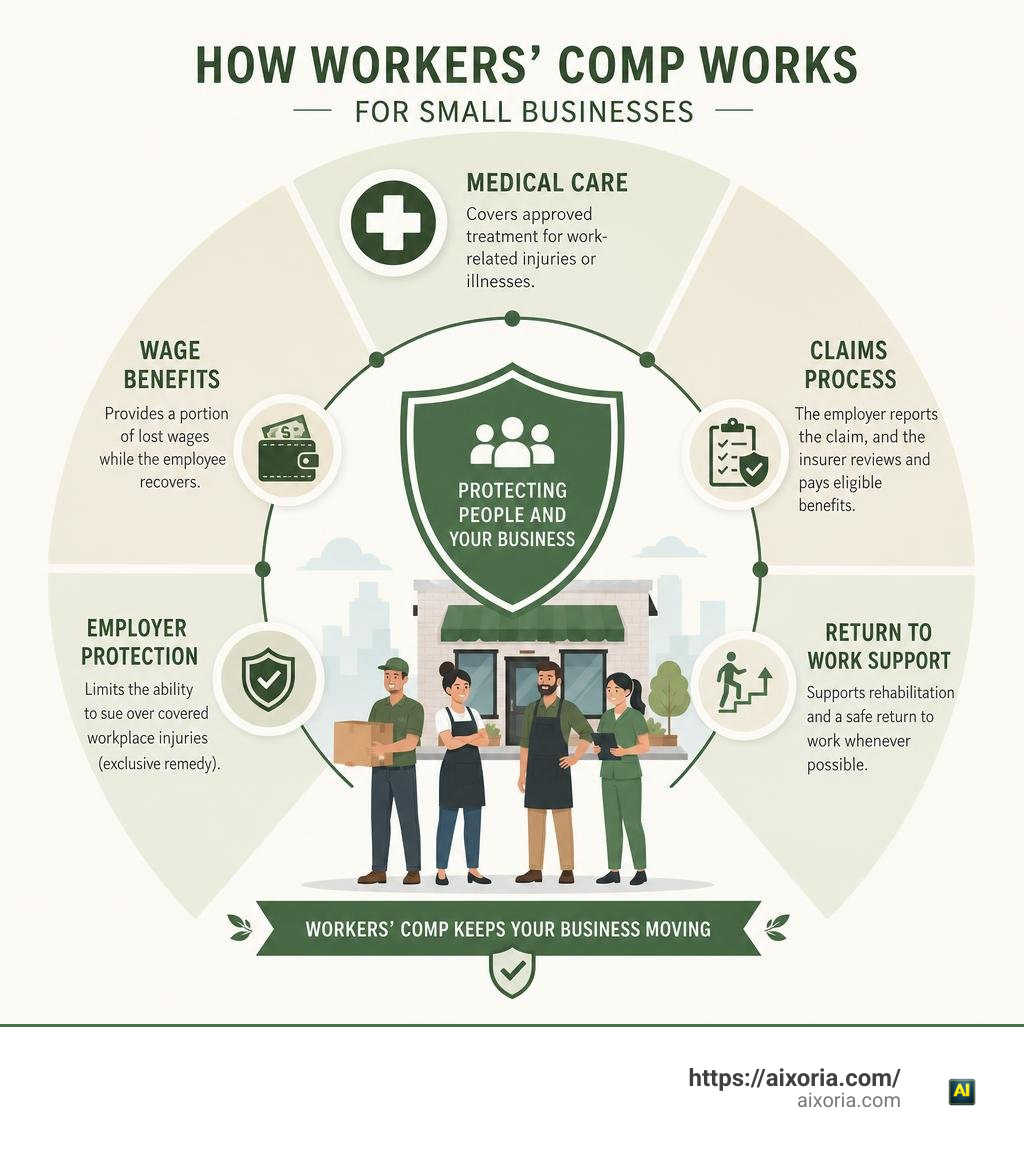
How does workers’ comp work for a small business? It is state-regulated insurance that pays benefits when an employee is hurt or becomes ill because of their work. The policy can cover medical treatment, part of lost wages, rehabilitation, disability benefits, and death benefits. In return, it usually limits an employee’s ability to sue the employer over that workplace injury.
For most small businesses, the basic process looks like this:
- The business buys coverage when state law requires it, often as soon as it hires an employee.
- The employer pays premiums based mainly on payroll, job risk, location, and claims history.
- An injured employee reports the incident and receives approved medical care.
- The employer reports the claim to its insurer and follows state deadlines.
- The insurer reviews the claim and pays eligible benefits while supporting a safe return to work.
Workers’ comp rules are not the same everywhere. Most states require coverage for employers with one or more workers, including many part-time and seasonal employees. Texas is the main exception because private employers can choose not to carry coverage, though going without it can create serious lawsuit risk.
For a small team, one injury can disrupt both people and operations. Workers’ comp is therefore more than a legal checkbox: it is a way to protect employees, manage a costly incident, and reduce the business’s direct financial exposure.
What Is Workers’ Compensation and What Does It Cover?
Workers’ compensation is built on what legal historians call the “Grand Bargain.” Dating back to the early 20th century, this model established a no-fault system: injured employees receive guaranteed financial and medical benefits regardless of who caused the incident, and in exchange, workers forfeit their right to sue their employer for civil negligence over the workplace injury (known as the exclusive remedy doctrine).
Understanding what this insurance covers helps us protect our employees and manage operational liabilities. To learn more about standard policy structures, see this guide on Workers’ Compensation Insurance 101.

Core Coverage Features
A standard workers’ compensation policy consists of two main components: Part A (Statutory Workers’ Compensation Benefits) and Part B (Employers’ Liability Coverage).
Part A covers necessary statutory benefits without any maximum monetary policy limits, including:
- Medical Treatment: Pays for 100% of reasonable and necessary medical expenses related to the injury or occupational illness. This includes doctor visits, emergency hospital care, surgeries, prescription medications, diagnostic testing, and physical therapy.
- Wage Replacement Benefits: When a doctor orders time off work, workers’ comp replaces a portion of the employee’s lost income—typically between 60% and 70% of their average weekly wage. These benefits cover temporary total disability, temporary partial disability, or permanent disability.
- Vocational Rehabilitation: If an occupational injury prevents a worker from returning to their former role, coverage pays for physical therapy, occupational training, and skill retraining to help them transition back into the workforce.
- Survivor and Death Benefits: In the tragic event of a fatal workplace injury, policies provide financial assistance to surviving dependents for funeral expenses and ongoing partial wage replacement.
Part B (Employers’ Liability) protects our business when an employee alleges that negligence contributed to their injury outside the standard workers’ comp administrative framework. Standard Employers’ Liability limits typically start at $100,000 per accident, $500,000 policy limit for disease, and $100,000 per employee for disease.
Exclusions and Non-Covered Incidents
While workers’ comp offers broad protection, it does not cover every injury that happens anywhere near a workplace. Exclusions explicitly protect insurers and employers from non-job-related claims:
- Off-Duty and Off-Site Injuries: Accidents occurring while an employee is attending voluntary social events or personal errands outside working hours are excluded.
- The Daily Commute: Under the established “going and coming rule,” injuries sustained during a worker’s normal daily commute to and from work are not covered.
- Intentional Self-Harm or Illegal Acts: Self-inflicted injuries or harm sustained while committing a crime on the job are strictly barred.
- Substance Intoxication: Claims resulting directly from workplace alcohol or illegal drug intoxication are generally denied.
- Workplace Horseplay: Injuries resulting from unauthorized physical practical jokes or fighting that fall entirely outside job duties are excluded.
How Does Workers’ Comp Work for a Small Business?
According to data from the U.S. Small Business Administration, roughly 1 in 5 small business owners is legally required to carry a current workers’ comp policy. Industry research indicates there is a 50% chance that a small business will experience an injury claim in any given 10-year period. In a three-person startup, a single injury temporarily eliminates one-third of the active workforce, making risk management essential.
State Requirements and Legal Obligations
Workers’ compensation is regulated exclusively at the state level. Each jurisdiction sets its own mandatory employee headcount thresholds, filing rules, and administration bodies. To stay compliant, review this detailed Workers Comp Requirements Guide.
Most states require small businesses to secure coverage immediately upon hiring their very first W-2 employee, whether full-time, part-time, or seasonal. However, key structural differences exist across state lines:
- Employee Headcount Thresholds: While 49 states mandate coverage, the trigger varies. Most states enforce a 1-employee threshold, but states like Georgia and South Carolina set the limit at 3 employees, while Alabama requires coverage at 5 employees.
- Monopolistic State Funds: In four states—Ohio, North Dakota, Washington, and Wyoming—employers cannot buy standard workers’ comp from private commercial carriers. Coverage must be purchased directly through a dedicated state fund. Employers operating in monopolistic states usually need to purchase “stop-gap coverage” as an endorsement on their General Liability policy to secure Part B Employers’ Liability protection.
- Competitive State Funds: Roughly 22 states operate state-run competitive funds alongside private commercial insurance options, giving business owners multiple carrier channels to secure insurance.
- The Texas Exception: Texas is the only state where private employers can opt out of mandatory workers’ comp (becoming “non-subscribers”). However, non-subscribers forfeit common-law defenses in court. If an injured worker sues a non-subscribing employer in Texas, the employer cannot claim employee contributory negligence. For more details on state-specific rules, consult this resource on Small Business Workers Comp Rules.
How Does Workers’ Comp Work for a Small Business Claim Step-by-Step?
When an accident occurs, having a structured incident plan keeps the business legally compliant and ensures the injured team member receives immediate care.
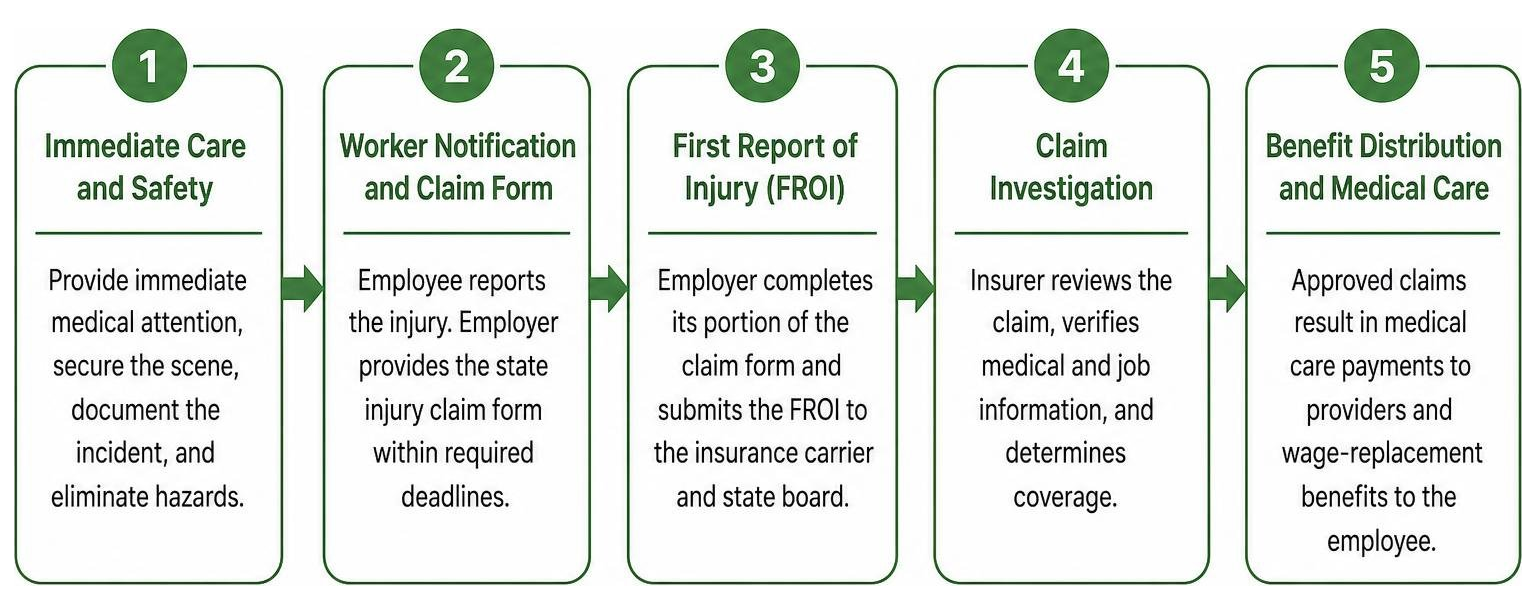
- Immediate Care and Safety: Provide immediate medical attention or emergency assistance. Secure the scene, take clear photos of any equipment or environment involved, and eliminate ongoing hazards.
- Worker Notification and Claim Form: The injured employee notifies the employer of the workplace incident. The employer must immediately furnish the state’s official injury claim form (such as the DWC 1 form in California) within statutory deadlines—often within 24 hours of notice.
- First Report of Injury (FROI): The business completes its portion of the claim form and submits a First Report of Injury to its insurance carrier and the state workers’ compensation board.
- Claim Investigation: The insurer evaluates the claim, verifies medical documentation, assesses job duty connections, and approves or denies benefits.
- Benefit Distribution and Medical Care: Once approved, the insurance carrier pays treating medical providers directly and distributes weekly wage-replacement payments to the employee.
- Transitional Return to Work: The business coordinates with treating physicians to offer light-duty or modified-duty tasks, helping the recovering employee re-enter work safely while keeping claim costs down.
How Does Workers’ Comp Work for a Small Business Payroll and Audits?
Because premiums are directly connected to worker payroll, policies require an annual audit reconciliation. Historically, traditional insurance policies required estimated lump-sum payments upfront, followed by a stressful end-of-year audit where unexpected payroll expansion resulted in huge lump-sum retroactive bills.
Today, modern pay-as-you-go billing solutions integrate directly with regular payroll processing. Pay-as-you-go calculates premiums based on actual real-time payroll per pay period rather than rough estimates. Survey statistics reveal that 98% of small business clients prefer spreading premium payments across their regular payroll cycles, and 90% report that pay-as-you-go solutions noticeably improve operational cash flow.
During the mandatory annual workers’ comp audit, the insurer reviews actual payroll records, 941 tax filings, job logs, National Council on Compensation Insurance (NCCI) class codes, and Certificates of Insurance (COI) for independent contractors to verify that policy classifications and premium bases were accurate.
How Much Does Workers’ Comp Cost for a Small Business?
The cost of small business workers’ compensation depends on the type of work performed, total payroll, location, and past safety records. Small businesses with under $300,000 in annual payroll often pay an average of $81 per month, with lower-risk policy premiums starting as low as $13 to $20 per month. National commercial carrier data indicates a median monthly cost of $76 ($912 annually) and an average price of $121 per month ($1,452 annually). Across all industries, the national average rate sits near $1.03 per $100 of gross payroll. For additional cost management frameworks, read this Workers’ Comp Insurance Guide.
Premium Calculation Formula and Experience Modifier
Insurance companies calculate annual premiums using a simple mathematical formula:
$$\text{Estimated Premium} = \left(\frac{\text{Gross Payroll}}{100}\right) \times \text{Class Code Rate} \times \text{Experience Modification Rate (EMR)}$$
The key components of this formula include:
- Gross Payroll: Total gross employee compensation divided into $100 units. Overtime premiums can often be excluded from the payroll base if kept cleanly separated in accounting logs.
- Class Code Base Rate: The basic risk rate assigned to a job duty per $100 of payroll.
- Experience Modification Rate (EMR): A multiplier representing a company’s 3-year safety record relative to industry averages.
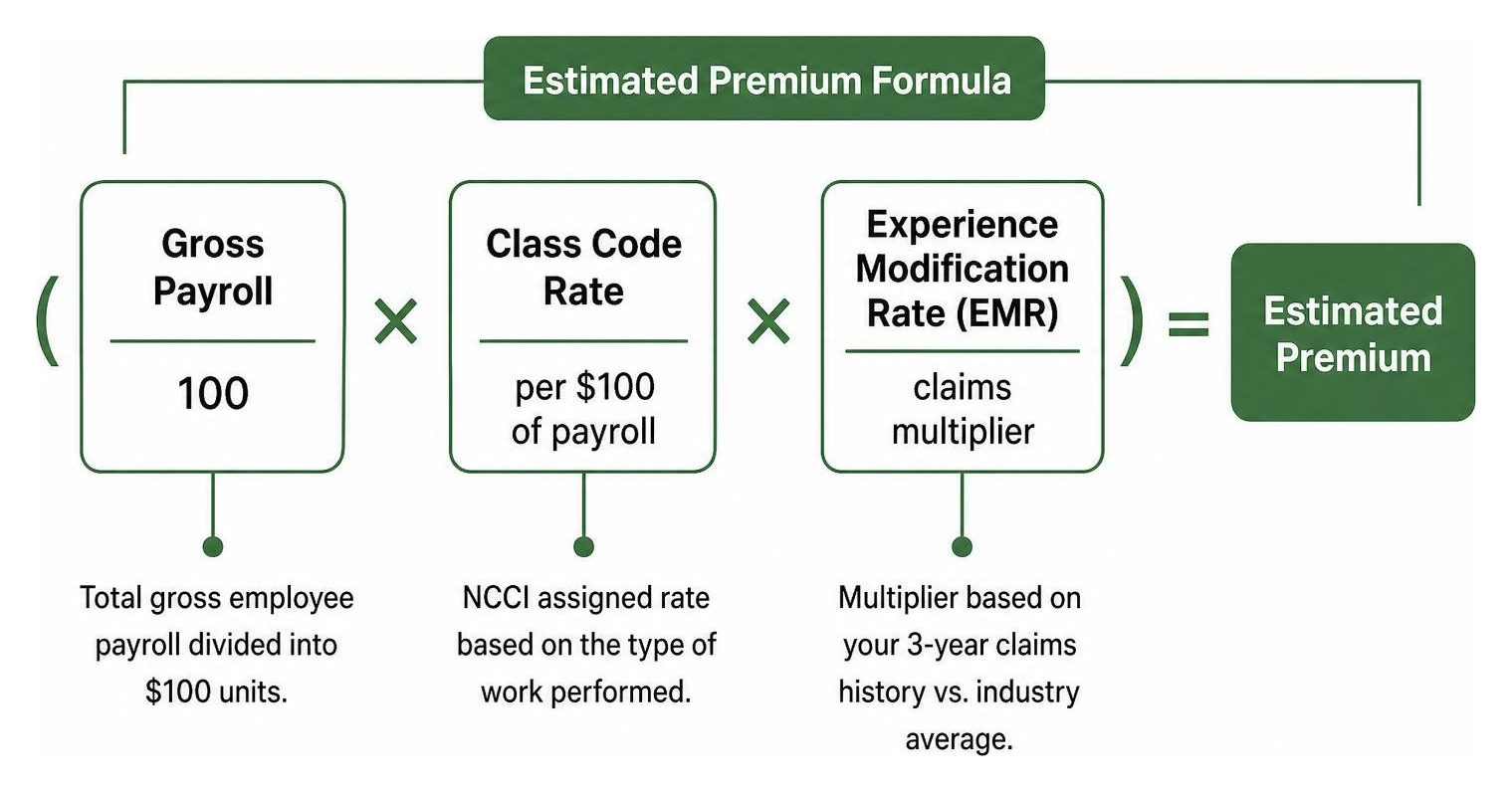
An EMR of 1.0 represents an average claims history. If our safety measures prevent workplace accidents, our EMR might drop to 0.85, granting us a 15% discount on total premiums. Conversely, frequent claims can raise our EMR to 1.25, imposing a 25% surcharge on annual insurance costs for three consecutive years. Because the EMR formula places greater weight on claim frequency than overall severity, keeping minor workplace injuries to a minimum pays major financial dividends.
Industry Risk Factors and Classification Codes
The National Council on Compensation Insurance (NCCI) assigns four-digit classification codes based on job risk levels. The table below illustrates sample class code rates per $100 of payroll across standard small business industries:
| Industry / Role | Sample NCCI Class Code | Estimated Rate per $100 Payroll | Estimated Annual Premium on $200k Payroll |
|---|---|---|---|
| Clerical / Office Staff | 8810 | $0.20 – $0.50 | $400 – $1,000 |
| Engineers & Professional | 8601 | $0.40 – $0.70 | $800 – $1,400 |
| Beauty Salons & Barbers | 9586 | $0.60 – $1.10 | $1,200 – $2,200 |
| Restaurants & Food Service | 9079 | $1.25 – $2.20 | $2,500 – $4,400 |
| Pet Grooming & Boarding | 8831 | $1.50 – $2.50 | $3,000 – $5,000 |
| Residential Carpentry | 5645 | $12.00 – $21.00 | $24,000 – $42,000 |
| Roofing Trade | 5551 | $15.00 – $25.00+ | $30,000 – $50,000+ |
A business that misclassifies an administrative worker under a high-risk trade code pays significantly higher premiums than necessary. Splitting payroll accurately between low-risk clerical roles and higher-risk job duties protects cash flow.
Workers’ Comp vs. General Liability Insurance
Small business owners frequently confuse workers’ compensation with general liability insurance. While both protect against financial loss, they cover entirely different risk exposures:
| Feature | Workers’ Compensation Insurance | General Liability Insurance |
|---|---|---|
| Primary Target | Injuries or illnesses suffered by employees | Injuries or property damage suffered by third parties (customers, vendors, visitors) |
| Legal Mandate | Mandatory by law in 49 states for employers | Usually optional, though often required by commercial leases and client contracts |
| Injury Benefits | Covers medical care, 60-70% lost wages, rehab, permanent disability, death benefits | Covers third-party medical costs, court defense, settlements, property repairs |
| Lawsuit Protections | Grants exclusive remedy protection against employee injury tort suits | Defends against customer slip-and-fall claims or accidental property damage suits |
| Fault System | No-fault benefits system | Fault-based liability system |
For instance, if a customer slips on a wet tile floor in our retail store, Commercial General Liability covers their medical expenses and legal defense. If an employee slips on the same wet floor while stocking shelves, workers’ compensation covers their emergency medical treatment and lost wages.
Frequently Asked Questions About Small Business Workers’ Comp
Do sole proprietors and independent contractors need workers’ comp?
Sole proprietors, partners, and single-member LLC owners without employees are generally exempt from state workers’ comp mandates. However, carrying voluntary coverage is often wise. Personal health insurance policies frequently contain explicit exclusions for job-related injuries. If a sole proprietor suffers a serious accident on a client site without workers’ comp, personal health coverage may deny the claims entirely. Additionally, many general contractors and commercial clients require sole proprietors to present a valid Certificate of Insurance (COI) before awarding contracts.
Regarding independent 1099 contractors, genuine contractors carry their own insurance policies. However, simply handing a worker a 1099 tax form does not make them an independent contractor in the eyes of state labor boards. If an auditor or court determines that an employer directs the worker’s schedule, tools, and daily tasks, that worker will be reclassified as an employee. The business will then face back premiums, audit penalties, and potential liability for any injuries sustained. For foundational guidelines on worker coverage, review this resource on Workers’ Compensation Basics.
What are the penalties for operating without workers’ comp insurance?
Failing to carry state-mandated workers’ comp insurance carries severe regulatory penalties:
- Financial Fines: State authorities impose severe civil administrative fines. Fines in California reach up to $100,000, while states like Alabama penalize uninsured employers up to $1,000 per employee per day.
- Stop-Work Orders: State agencies can issue immediate stop-work orders, forcing the business to shut down all operational activities until coverage is bound and outstanding fines are cleared.
- Criminal Penalties: In many jurisdictions, operating intentionally without workers’ comp is classified as a misdemeanor or felony, punishable by jail time for business owners.
- Uncapped Personal Liability: If an uninsured employee suffers a workplace injury, the exclusive remedy legal shield is destroyed. The employer becomes 100% personally liable out-of-pocket for all medical expenses, lost wages, and potential civil personal injury lawsuits.
For more information on legal non-compliance implications, see this breakdown on What Is Workers’ Compensation?.
What are common mistakes small business owners make with workers’ comp?
- Misclassifying Workers: Labeling hazardous trade employees under cheap office codes or misclassifying regular workers as 1099 contractors to lower costs triggers heavy audit back-assessments.
- Missing Injury Reporting Deadlines: Delaying First Report of Injury filings with state boards or insurance carriers leads to late claim penalties and increased legal disputes.
- Failing to Verify Subcontractor Certificates: Hiring subcontractors without collecting active Certificates of Insurance (COI) causes insurance auditors to automatically bill the primary employer for those workers during year-end reconciliation.
- Allowing Coverage to Lapse: Experiencing policy cancellations due to missed payments flags the business in state databases, triggering automatic compliance audits and fines.
- Neglecting Workplace Safety Management: Treating workplace safety as an afterthought rather than establishing active return-to-work protocols drives up claims frequency and inflates the business’s EMR multiplier for years.
- “https://www.mediafire.com/file/8c473aetbh3icf1/Eternal_Caves_1.1_BY_MCMPDL.mcaddon/file“;
Conclusion
Understanding how workers’ compensation works empowers small business owners to meet state legal requirements while safeguarding both cash flow and staff. Far from being a mere bureaucratic burden, a well-managed workers’ comp strategy—combining precise employee job classifications, seamless pay-as-you-go billing, and active safety measures—protects your workforce and shields your bottom line from unexpected liability.
As small businesses scale, integrating automated compliance checks, modern HR tools, and data-driven risk management simplifies policy management and controls costs. To explore how emerging technology and operational automation can help streamline your business workflows, Discover AI insights for business growth at Aixoria.
Pito