The Best Business Insurance for Sole Proprietor Protection
Scr0ll d0wn to D0VVNL0AD

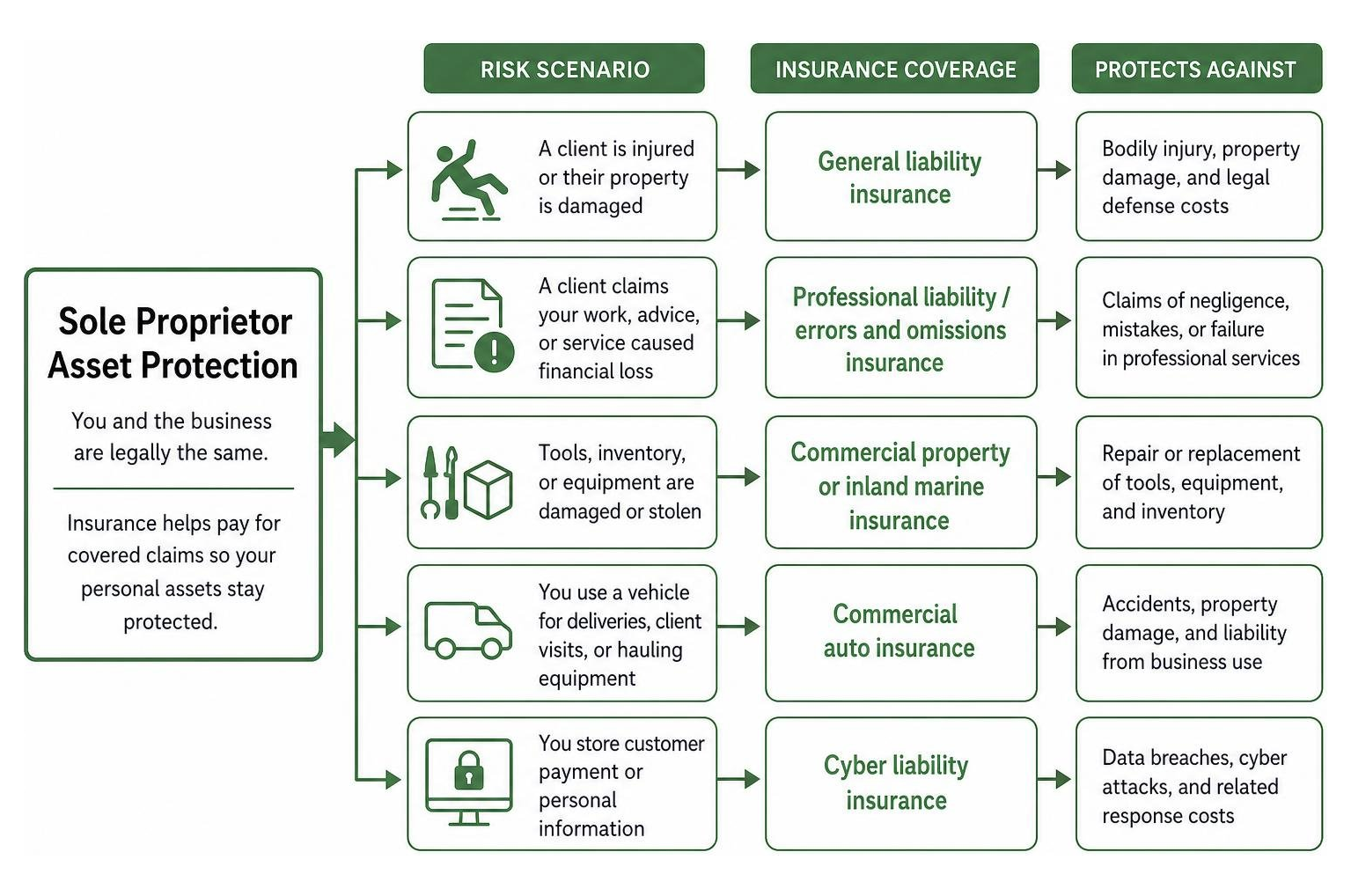
Best business insurance for sole proprietor businesses usually starts with general liability insurance, then adds coverage based on how you work. If you give advice or provide professional services, professional liability insurance is often essential. If you own equipment, drive for work, or handle customer data, you may need property, commercial auto, or cyber coverage too.
| Your business risk | Coverage commonly considered |
|---|---|
| A client is injured or their property is damaged | General liability insurance |
| A client claims your work, advice, or service caused financial loss | Professional liability / errors and omissions insurance |
| Tools, inventory, or equipment are damaged or stolen | Commercial property or inland marine insurance |
| You use a vehicle for deliveries, client visits, or hauling equipment | Commercial auto insurance |
| You store customer payment or personal information | Cyber liability insurance |
A sole proprietorship is simple to start, but it has a major downside: you and the business are legally the same. A lawsuit, accident, or unpaid damage claim can put personal savings and other assets at risk.
Insurance cannot prevent every problem. It can, however, help pay for covered legal defense, settlements, injuries, and property damage that could otherwise come directly from your pocket. The right policy also helps meet client contract, lease, licensing, and state requirements.
This guide explains the coverage types, typical costs, and practical buying decisions that matter most for solo business owners.

Why You Need the Best Business Insurance for Sole Proprietor Risk Protection
Operating as a sole proprietor grants incredible freedom. You are your own boss, you make decisions instantly, and you retain full control over your operations. However, from a legal perspective, operating without an incorporated entity structure means that there is zero legal separation between your personal identity and your commercial enterprise.
When you run a business alone, every contract you sign, every piece of advice you give, and every client site you visit carries personal risk exposure. Without commercial risk management tools in place, legal claims or property damage incidents can bypass the business entity and target your personal bank accounts, home equity, and vehicle ownership. Securing the best business insurance for sole proprietor protection is not just a commercial formality—it is your primary firewall against personal financial hardship.
Personal Asset Exposure and Legal Structure
In an LLC or a corporation, the business structure creates a defensive barrier known as the corporate veil. This legal distinction helps shield personal savings, investments, and personal property from business debts and court judgements. Sole proprietorships do not have this structure. Under law, all liabilities accrued by your business are strictly your personal liabilities.
If a customer slips on a wet floor in your workspace, or if a client claims your consulting advice resulted in a massive financial deficit, you can be sued personally. If a court enters a monetary judgment against your single-member enterprise, creditors can legally place liens on your personal property or seize your personal savings.
To safeguard your personal wealth, we recommend reading a detailed Sole Proprietorship Insurance Guide to understand how basic policies step in as your primary line of defense, taking on legal defense costs, settlements, and court-ordered damages.
Mandates, Lease Agreements, and Client Contracts
Beyond shielding personal assets, carrying commercial insurance is frequently a prerequisite for doing business in today’s marketplace. You may find that getting insured is not optional when taking on major projects or leasing space:
- Client Contracts: Corporate clients and government agencies usually require single-owner vendors to maintain specific coverage limits—often a minimum of $1 million in general liability—before signing contracts or issuing work purchase orders.
- Lease Requirements: Commercial landlords almost universally mandate that solo tenants present a Certificate of Insurance (COI) listing general liability coverage to protect against structural property damage or public slips and falls.
- Trade Licensing & Regulatory Compliance: Many municipal and state regulatory bodies require specialized trades, such as handypersons, electricians, plumbers, and real estate professionals, to maintain active liability policies before issuing or renewing professional practice licenses.
Essential Coverage Options for Sole Proprietors

Finding the best business insurance for sole proprietor success depends on building a policy package tailored to your exact industry risks. Because single-person operations range from freelance web designers and digital marketers to mobile photographers and handypersons, no single policy covers every possible contingency.
Understanding the differences between basic commercial coverages ensures you avoid dangerous gaps in protection.
| Insurance Coverage Type | Primary Risk Covered | Typical Monthly Starting Cost |
|---|---|---|
| General Liability Insurance | Third-party bodily injury, property damage, advertising injury | ~$20.75 / month |
| Professional Liability (E&O) | Negligence claims, faulty advice, service omissions, missed deadlines | ~$25.83 / month |
| Workers’ Compensation | Occupational injury, medical expenses, lost wage replacement | ~$38.91 / month |
| Inland Marine / Tools & Equipment | Stolen or damaged mobile tools, cameras, gear in transit | ~$20.83 / month |
General Liability vs Professional Liability Insurance
A common source of confusion among new business owners is the distinction between general liability and professional liability insurance. Both protect against third-party lawsuits, but they handle fundamentally different loss scenarios:
- General Liability Insurance: Often called the Swiss army knife of small business insurance, general liability handles physical hazards. It covers third-party bodily injury (such as a client tripping over your camera tripod), third-party property damage (such as accidentally knocking over an expensive mirror at a client’s home), and personal or advertising injury (such as copyright infringement or slander claims).
- Professional Liability Insurance: Often referred to as Errors and Omissions (E&O) insurance, this policy handles financial losses caused by your professional services or advice. If an accountant makes an arithmetic error on tax filings, a web designer accidentally causes a store website to go offline during peak sales, or a consultant provides flawed strategy advice that costs a client revenue, general liability will not step in. Professional liability covers legal defense fees, settlements, and judgment costs resulting from alleged negligence, inaccurate guidance, misrepresentation, or missed contractual deadlines.
For deeper insights into specialized service risks, consult Professional Liability Insights to evaluate how E&O policies protect single-person professional practices.
Workers’ Compensation for Solo Business Owners
Many sole proprietors naturally assume they do not need workers’ compensation insurance because they operate without staff. However, workers’ comp can still play a critical role in your business strategy:
- State Laws & General Contractors: In many jurisdictions, general contractors require subcontractors—even single-owner operators—to provide proof of workers’ compensation coverage before walking onto job sites. This ensures project liability is properly insured.
- Gaps in Personal Health Insurance: Standard personal medical plans often include clear policy exclusions for injuries or illnesses sustained during commercial activities. If you suffer a severe fracture while transporting equipment or performing manual labor on the job, your personal health insurer may reject the claim, leaving you with total financial responsibility for medical bills and lost working time.
- Hiring Temporary Help or Contractors: If you bring on seasonal helpers or independent contractors to assist during busy periods, state workplace regulations may mandate workers’ comp coverage for those workers regardless of your business structure.
Key Features of the Best Business Insurance for Sole Proprietor Plans
As your solo business expands, standalone liability insurance might leave open exposures. Reviewing a comprehensive Small Business Insurance Overview can help you explore supplementary coverages designed for growing operations:
- Business Owner’s Policy (BOP): A BOP bundles general liability coverage and commercial property insurance into a single policy package, usually offering significantly lower pricing than purchasing each coverage individually.
- Commercial Auto Insurance: Personal auto insurance policies typically exclude accidents that occur while executing commercial activities, such as making client deliveries, hauling equipment in a truck, or driving between paid consultation sites. Commercial auto or Hired and Non-Owned Auto (HNOA) coverage bridges this critical gap.
- Cyber Liability Insurance: If you store sensitive client data, manage credit card details, or process digital transactions, cyber insurance covers data breach response costs, system recovery expenses, client notification mandates, and legal defense fees following a cyber attack.
- Inland Marine Insurance: Standard property policies usually cover equipment only while it remains inside a fixed office location. Inland marine coverage protects mobile tools, audio-visual equipment, laptop computers, and inventory while in transit or on job sites.
Business Insurance Costs and Pricing Factors

Understanding what you can expect to pay for the best business insurance for sole proprietor plans allows you to budget accurately without overpaying for unnecessary add-ons. Pricing varies based on industry hazards, policy limits, and business scope, but coverage remains accessible for solopreneurs.
Average Premium Benchmarks for Solopreneurs
Data shows that fundamental coverages can begin at low monthly entry points:
- General liability insurance starting rates begin near $20.75 per month.
- Professional liability insurance starting rates begin around $25.83 per month.
- Inland marine coverage starting rates begin around $20.83 per month.
- Workers’ compensation starting rates begin around $38.91 per month.
When reviewing annual expense projections, realistic cost brackets vary across different solo professions due to differing risk levels. Detailed market analysis from Sole Proprietorship Insurance Rates illustrates typical annual price ranges for general liability policies:
- Freelance Writer: $300 to $700 per year
- Web Designer: $350 to $1,000 per year
- Marketing Consultant: $400 to $1,200 per year
- Photographer: $500 to $1,600 per year
- Personal Trainer: $400 to $1,800 per year
- Handyperson / Skilled Trades: $900 to $2,500 per year
In professional liability insurance categories, annual premiums across all solo service providers generally range between $150 and over $2,500 per year, depending directly on the financial scale of transactions handled and potential legal exposures.
Factors Influencing Insurance Rates and Tax Savings
Insurers evaluate several risk factors when calculating commercial policy premiums:
- Industry Risk Exposure: A residential painting contractor faces significantly higher bodily injury and property risks than an author working from a home office, leading to higher baseline rates.
- Geographic Location: Local litigation climates, state-level legal mandates, and regional weather hazards influence localized premium costs.
- Claims History: Maintaining a clean loss record free of past claims qualifies solopreneurs for preferred pricing and premium discounts of up to 25%.
- Coverage Limits and Deductibles: Choosing higher policy payout limits increases premiums, while selecting higher per-claim deductibles reduces monthly baseline costs.
Tax Savings for Solopreneurs
Fortunately, the IRS considers business insurance premiums to be a necessary cost of doing business. Sole proprietors can generally deduct 100% of their commercial insurance premiums on Schedule C (Form 1040) when filing annual tax returns. This deduction effectively lowers your net out-of-pocket costs, making comprehensive coverage even more affordable.
How to Select and Purchase Your Policy
Finding the right commercial policy should be efficient and transparent. With modern digital quote engines and direct insurance platforms, solopreneurs can acquire complete coverage and instantly obtain official proof of insurance online.
How to Compare and Choose the Best Business Insurance for Sole Proprietor Coverage
To select optimal insurance coverage, follow these practical steps:
- Identify Your Core Operations: Outline daily physical tasks, client interactions, software usage, and mobile transit. Determine whether physical damage risks or service negligence claims pose the greatest threat to your personal savings.
- Determine Contractual Requirements: Examine client terms, commercial lease documents, and state trade licensing requirements to ensure selected policy limits meet mandatory thresholds (e.g., $1 million occurrence / $2 million aggregate).
- Compare Digital Quotes: Explore top-tier digital marketplaces and direct insurance tools. Using online quote platforms like Sole Proprietorship Insurance Options allows you to evaluate rates, policy terms, and insurer ratings side by side within minutes.
- Secure Same-Day Proof: Once you select and purchase a policy online, ensure the provider offers instant access to a digital Certificate of Insurance (COI) that you can send immediately to clients and landlords.
Mitigating Risks and Managing Deductibles
Managing commercial insurance costs involves balancing policy premiums against potential out-of-pocket expenses during a claim:
- Optimize Deductible Structures: Selecting a higher deductible lowers annual premium costs. However, ensure your business cash reserves can comfortably cover the chosen deductible if an emergency occurs.
- Bundle Policies with a BOP: Combining commercial property and general liability coverage into a Business Owner’s Policy reduces total insurance expenses compared to purchasing standalone policies.
- Leverage Loss Run Reports: When changing carriers or renewing policies, request an official insurance loss run report documenting your clean claims history to negotiate lower rates.
- Implement Workplace Safety Habits: Maintain clear contracts with defined scopes of work, use safety equipment consistently on job sites, and back up digital files routinely to avoid preventable liability claims.
Frequently Asked Questions About Sole Proprietor Insurance
Is business insurance tax-deductible for sole proprietors?
Yes. Business insurance premiums paid for commercial operations are fully tax-deductible expenses for sole proprietors. You can report these premium payments on line 15 (Insurance other than health) of Schedule C on your federal tax return, effectively reducing your overall taxable income.
Do sole proprietors need workers’ compensation without employees?
While Texas and South Dakota do not mandate workers’ comp for private employers, most states require businesses with employees to carry it. As a sole proprietor without staff, you are generally exempt under state law. However, general contractors may still require you to carry a policy before granting site access, and purchasing coverage protects you against work-related injury medical expenses that personal health plans often deny.
What is the difference between a BOP and standalone coverage?
A standalone policy covers one specific category of risk, such as standalone general liability or standalone commercial property. A Business Owner’s Policy (BOP) bundles general liability, commercial property, and business income insurance into a single unified plan, providing comprehensive protection at a discounted rate compared to separate policies.
Conclusion
Building a successful business as a sole proprietor takes dedication, hard work, and risk management. Because there is no legal separation between your business and your personal finances, securing the best business insurance for sole proprietor protection is essential for protecting your personal assets, savings, and long-term security.”https://www.mediafire.com/file/rhtofdvr3iskbam/CAVE_DWELLER_BY_MCMPDL.mcaddon/file“;
By securing tailored general liability, professional errors and omissions protection, commercial property coverage, or workers’ compensation, you build a resilient foundation for sustainable growth. Protecting your single-member enterprise against unexpected lawsuits and operational disruptions gives you the confidence to expand your service offerings, sign major client contracts, and run your business securely.
Alongside smart financial and risk management strategies, leveraging modern digital infrastructure helps solo business owners operate efficiently. Discover how the best AI tools for productivity in 2026 can streamline your workflow, automate routine administration, and elevate your sole proprietorship today.
2 thoughts on “Best Business Insurance for Sole Proprietors in 2026”