Who Has the Cheapest Business Insurance in 2026?
Scr0ll d0wn to D0VVNL0AD

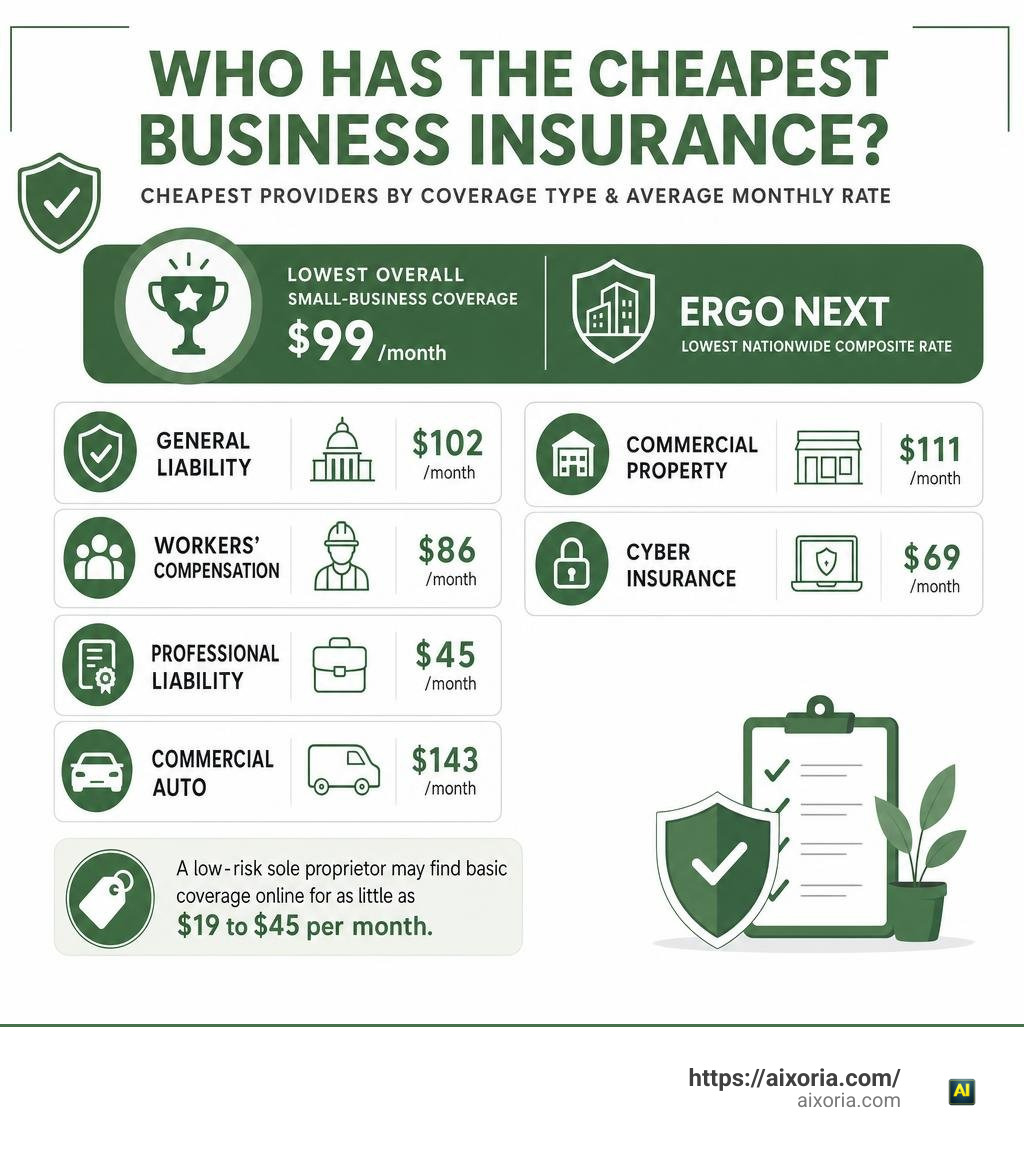
Who has the cheapest business insurance? ERGO NEXT has the lowest nationwide composite rate in recent comparisons, averaging about $99 per month across major small-business coverage types. But there is no single cheapest insurer for every business, policy, or state.
| Coverage need | Lowest-cost provider in available comparison data | Average monthly rate |
|---|---|---|
| Overall small-business coverage | ERGO NEXT | $99 |
| General liability | The Hartford | $102 |
| Workers’ compensation | ERGO NEXT | $86 |
| Professional liability | The Hartford | $45 |
| Commercial auto | Progressive Commercial | $143 |
| Commercial property | Thimble | $111 |
| Cyber insurance | Chubb | $69 |
A low-risk sole proprietor may find basic coverage online for as little as $19 to $45 per month. A business with employees, vehicles, customer foot traffic, costly equipment, or hands-on work will usually pay much more.
The real answer depends on what your business does, where it operates, how many people it employs, its claims record, and the coverage limits a client, landlord, or state requires. The cheapest quote can be a smart buy, but only when it covers the risks you actually face.
This guide compares costs by coverage type, industry, and location, then explains how to lower premiums without creating expensive coverage gaps.
Key Factors Influencing Small Business Insurance Rates

When we evaluate commercial coverage options, understanding how underwriters price business insurance policies is essential. Insurers do not pull numbers out of thin air; they rely on statistical risk algorithms to determine your baseline monthly rates.
The foundational pricing factors include:
- Workforce size and total payroll: Higher headcounts and larger payroll amounts naturally increase workers’ compensation and liability exposures.
- Industry risk level and classification codes: High-hazard work environments translate directly into higher premiums.
- Geographic location: Local litigation trends, regulatory requirements, and exposure to natural disasters heavily influence rates.
- Coverage limits and deductible selections: Choosing higher per-occurrence or aggregate limits increases premiums, while raising deductibles transfers risk back to you in exchange for lower monthly payments.
- Prior claims history: A clean loss history signals effective risk management, unlocking preferred rate tiers.
Business Size and Workforce Headcount
Your company’s physical footprint and payroll size represent critical risk variables. For sole proprietors without W-2 staff, liability risk remains largely isolated to the owner’s immediate work activities. However, as soon as you hire employees, your exposure multiplies.
According to market pricing comparisons, businesses with 0 to 4 employees often find digital-first insurers to be the cheapest option. Conversely, once payroll grows to 5 or more team members, traditional commercial carriers often offer lower overall composite rates due to scaled payroll pricing models.
Industry Risk and Classification Codes
Every business is assigned standard classification codes, such as North American Industry Classification System (NAICS) codes. A minor error in your assigned class code can cost you thousands of dollars per year.
For instance, an agency providing pure corporate advisory services might be misclassified under general marketing or public relations, leading to an inflated risk profile. High-risk trades—such as roofing or structural contracting—face significantly higher rates than home-based graphic designers or IT consultants because the probability and severity of property damage or physical injury are much higher.
Average Monthly Costs Across Business Coverage Lines
Insurance costs vary substantially across individual coverage lines. To build an optimal strategy when asking who has the cheapest business insurance?, we must look at individual coverage categories rather than relying solely on overall policy bundles.
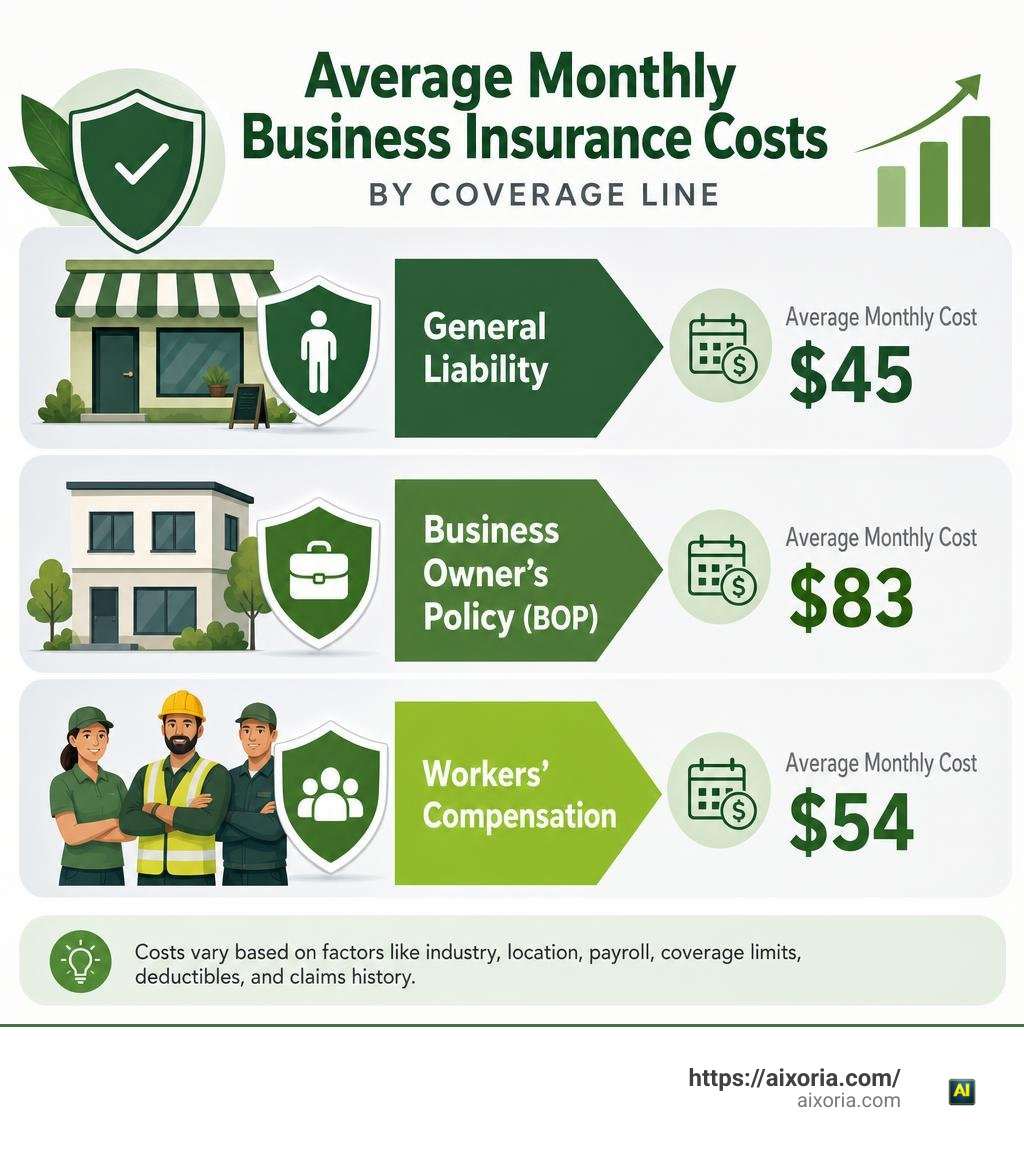
| Policy Type | National Composite Average Monthly Cost | Cheapest Rate Leader Monthly Average | Industry Average Savings |
|---|---|---|---|
| General Liability | $45 | $17 – $19 (Starting) / $102 (Carrier Average) | Up to 17% |
| Business Owner’s Policy (BOP) | $83 | $50 – $68 | Up to 25% |
| Workers’ Compensation | $54 | $86 (Carrier Average) | Up to 24% |
| Professional Liability (E&O) | $88 | $45 | Up to 20% |
| Commercial Auto | $164 | $143 | Up to 13% |
| Commercial Property | $125 | $111 | Up to 11% |
| Cyber Liability | $84 | $69 | Up to 18% |
General Liability and Property Bundling Options
General liability insurance covers third-party bodily injury, property damage, and advertising injuries. While baseline coverage can start as low as $17 to $19 per month for minimal-risk sole proprietors through providers like Thimble or ERGO NEXT, standard commercial general liability policies across all business types average approximately $45 per month.
For companies that own or lease physical workspace, tools, or inventory, combining general liability and commercial property into a Business Owner’s Policy (BOP) is almost always cheaper than purchasing separate policies. Packaging these coverages together can yield bundle savings of 20% to 30%. In fact, consolidated coverage options like THREE by Berkshire Hathaway seek to streamline multi-line risk into single, jargon-free contracts to prevent overlapping premium costs.
Specialized Coverage Line Cost Breakdown
Beyond general liability, specialized policies carry distinct pricing structures based on exposure:
- Errors & Omissions (E&O) / Professional Liability: Protecting against claims of negligent advice, service errors, or failure to deliver contractual work, E&O averages $88 per month nationally, though low-risk consultants can find policies starting around $45 per month.
- Cyber Liability Insurance: Protecting against data breaches, ransomware attacks, and cyber extortion, specialized cyber coverage averages $69 to $84 per month.
- Commercial Auto Insurance: Covering business-owned vehicles or personal vehicles used for commercial deliveries, commercial auto policies average between $143 and $164 monthly per vehicle.
Who Has the Cheapest Business Insurance Across Major Risk Categories?

No carrier holds the title of cheapest provider across every single category. Determining who offers the best combination of low cost and reliable protection depends heavily on your corporate scale and operational profile.
Who Has the Cheapest Business Insurance for Sole Proprietors and Low-Risk Operations?
For freelancers, micro-businesses, and independent contractors with no employees, digital-first insurers and insurtech platforms consistently offer the lowest entry-level rates. Industry data shows that ERGO NEXT leads overall affordability with an average composite rate of $99 per month, representing an 11% savings against the national baseline.
Digital platforms allow sole proprietors to purchase on-demand coverage by the job, month, or year. This flexibility is ideal for contractors who only require a Certificate of Insurance (COI) for temporary project sites without binding themselves to long-term annual contracts. Market analysis highlights how digital applications can yield instant coverage approval in under ten minutes for standard, low-risk business models.
Who Has the Cheapest Business Insurance by Industry Risk Classification?
When evaluating industry risk tiers, top price leaders shift significantly:
- Professional & Consulting Services: Home-based advisors, accountants, and software developers face low physical hazard risks. Carriers like The Hartford lead this space, offering professional liability starting at roughly $45 per month.
- Retail Storefronts & E-Commerce: Retailers face premises liability from customer foot traffic and inventory loss risks. A BOP is typically the cheapest route here, combining general liability with commercial property.
- Construction & Specialty Trades: Plumbers, electricians, and carpenters face elevated physical hazards. Specialized trade providers and platforms like biBERK or Thimble offer structured contractor liability starting around $27 to $42 per month for basic general liability.
According to market reviews, evaluating insurance providers based purely on advertised entry prices can be misleading. A carrier offering low baseline pricing may add fees for additional insured endorsements or charge extra for client certificate issuance, raising your total cost of coverage.
Regional Premium Differences and State Rules
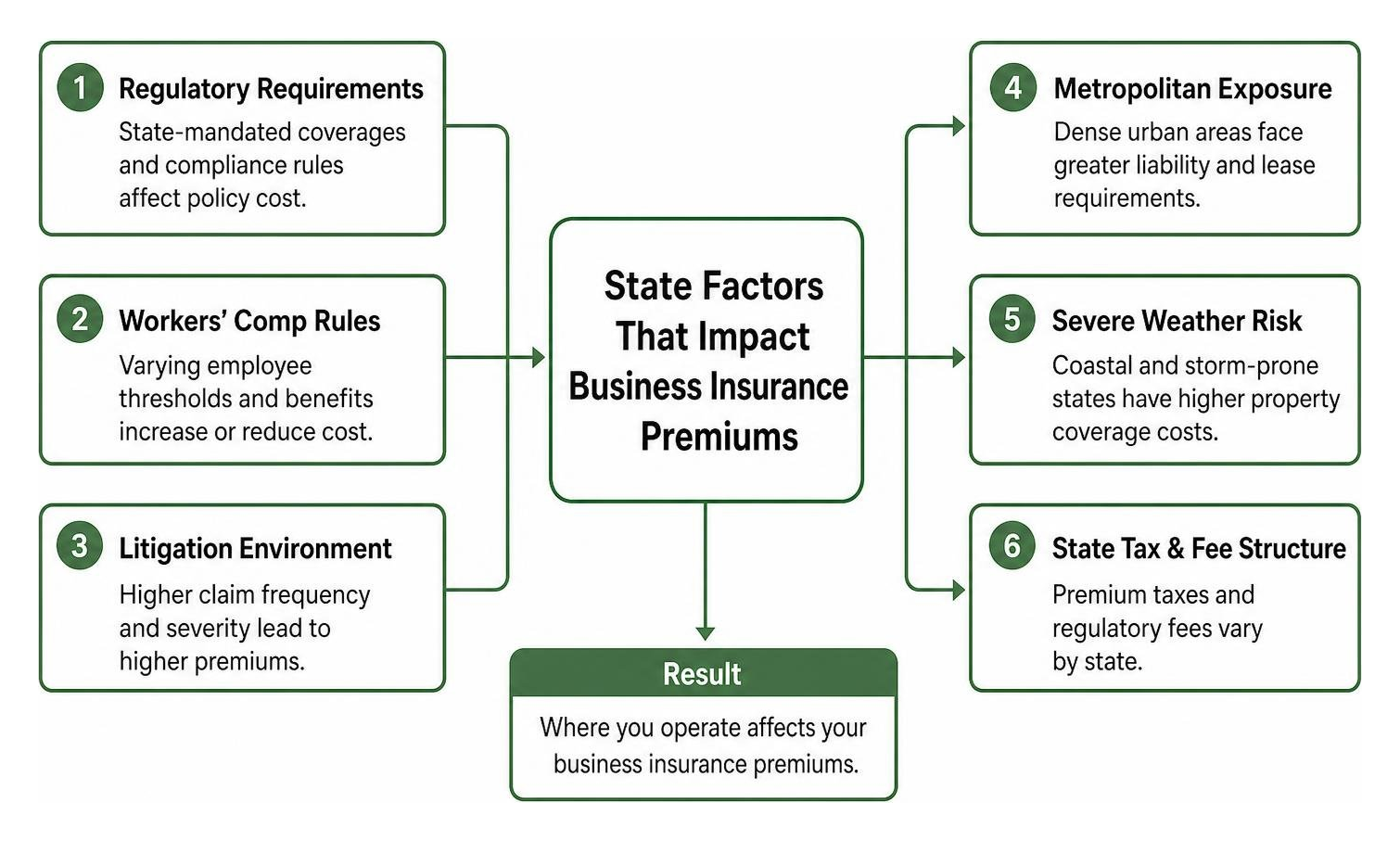
Where you register and operate your business directly affects your monthly premiums. Commercial insurance regulations, litigation environments, and statutory mandates vary considerably across state lines.
Key regional considerations include:
- Workers’ Compensation Statutory Thresholds: State rules govern when workers’ comp becomes mandatory. For instance, in South Carolina, state law mandates workers’ compensation insurance as soon as a business employs four or more staff members, including part-time workers. Business owners reviewing options in South Carolina will find average GL costs of $107 per month and workers’ comp averaging $76 per month.
- Metropolitan Exposure & Lease Demands: Commercial operations in dense urban areas face stricter landlord requirements and higher premises liability risks. Data on New York general liability coverage reveals that while entry-level quotes start at around $9 per month for low-risk micro-businesses, average rates across all industries hover between $149 and $204 monthly due to high commercial lease requirements and local litigation exposure.
- Severe Weather Risks: Businesses situated along coastal zones prone to hurricanes or severe weather events encounter higher property coverage premiums and may require specialized flood or windstorm endorsements.
How to Lower Premiums Without Sacrificing Protection
Finding cheap small business insurance does not require accepting weak coverage or dangerous exclusions. By adopting systematic risk management practices, we can lower annual premiums while preserving robust protection:
- Pay Premiums Annually Instead of Monthly: Most insurance carriers assess administrative financing or installment fees on monthly payment plans. Paying your policy premium upfront in one annual lump sum yields immediate savings of 5% to 10%.
- Adjust Policy Deductibles Strategically: Choosing higher deductibles—such as increasing property deductibles from $500 to $2,500—can lower commercial property or E&O premiums by 15% to 25%. However, keep in mind that general liability policies rarely have deductibles, so this strategy applies primarily to property, auto, and professional liability.
- Bundle Policies Into a Business Owner’s Policy (BOP): Combining general liability, commercial property, and business interruption insurance into a single BOP saves 20% to 30% compared to buying standalone policies across multiple providers.
- Verify Classification Codes (NAICS): Work with your agent or quoting system to ensure your operational classification code accurately reflects what your business actually does. Misclassifying high-risk tasks that your employees do not perform inflates your baseline rates unnecessarily.
- Implement Safety Controls and Risk Management: Maintaining safety protocols, non-slip flooring, documented employee training, and secure digital infrastructure demonstrates proactive risk management, unlocking loss-prevention discounts from underwriters.
- Re-Quote Policies Every 12 to 18 Months: Business insurance rates shift constantly as carriers update their underwriting guidelines. Requesting quotes across multiple reputable providers annually ensures your rates stay competitive.
Frequently Asked Questions about Small Business Insurance Costs
Is the cheapest business insurance policy always the best option?
Not necessarily. The absolute lowest price tag often reflects restrictive policy language, low coverage limits, or significant exclusions. A ultra-low-cost policy might lack required landlord endorsements, omit damage to rented premises, or impose long turnaround times for digital Certificates of Insurance (COIs).
If a cheap policy fails to satisfy a client’s contract requirements or leaves you exposed during a major lawsuit, the out-of-pocket losses will quickly wipe out any minor monthly savings.
Does bundling policies into a BOP always result in savings?
In most cases, yes. Bundling general liability and property insurance into a Business Owner’s Policy (BOP) delivers a single discounted premium that is lower than buying separate standalone policies.
However, there are exceptions. If your business has a highly specialized risk profile—such as high-risk contracting combined with expensive, highly delicate technology assets—buying standalone policies from specialized price leaders in each category can occasionally be cheaper than a standard bundled policy.
Are business insurance premiums tax-deductible?
Yes. In the vast majority of cases, commercial insurance premiums are fully tax-deductible as ordinary and necessary business expenses. Coverage lines such as general liability, professional liability, workers’ compensation, commercial auto, and property insurance directly reduce your total taxable business income. Always consult a qualified tax professional to confirm specific deductions for your corporate structure.
“https://www.mediafire.com/file/a79hucixxp6qkuq/Dinosaur_Era_2.2_BY_MCMPDL.mcaddon/file“;
Conclusion
Finding who has the cheapest business insurance requires balancing low monthly rates with realistic risk protection. While carriers like ERGO NEXT, The Hartford, Thimble, and biBERK lead affordability across different coverage lines, the right provider for your business depends on your specific industry code, workforce headcount, geographic location, and contractual needs.
By verifying your classification codes, selecting appropriate deductibles, bundling policies, and paying premiums annually, you can keep your fixed overhead low while protecting your business against unexpected liabilities.
To learn more about how technological innovation, automated risk analytics, and modern tools are transforming operational strategies for businesses, Explore AI Updates and Innovations with our latest insights.
I have been browsing online more than three hours today, yet I never found any interesting article like yours.
It is pretty worth enough for me. In my opinion, if all web owners and bloggers made good content as you did, the internet will be
a lot more useful than ever before.