Small Business Cyber Insurance Costs in 2026

What
Scr0ll d0wn to D0VVNL0AD
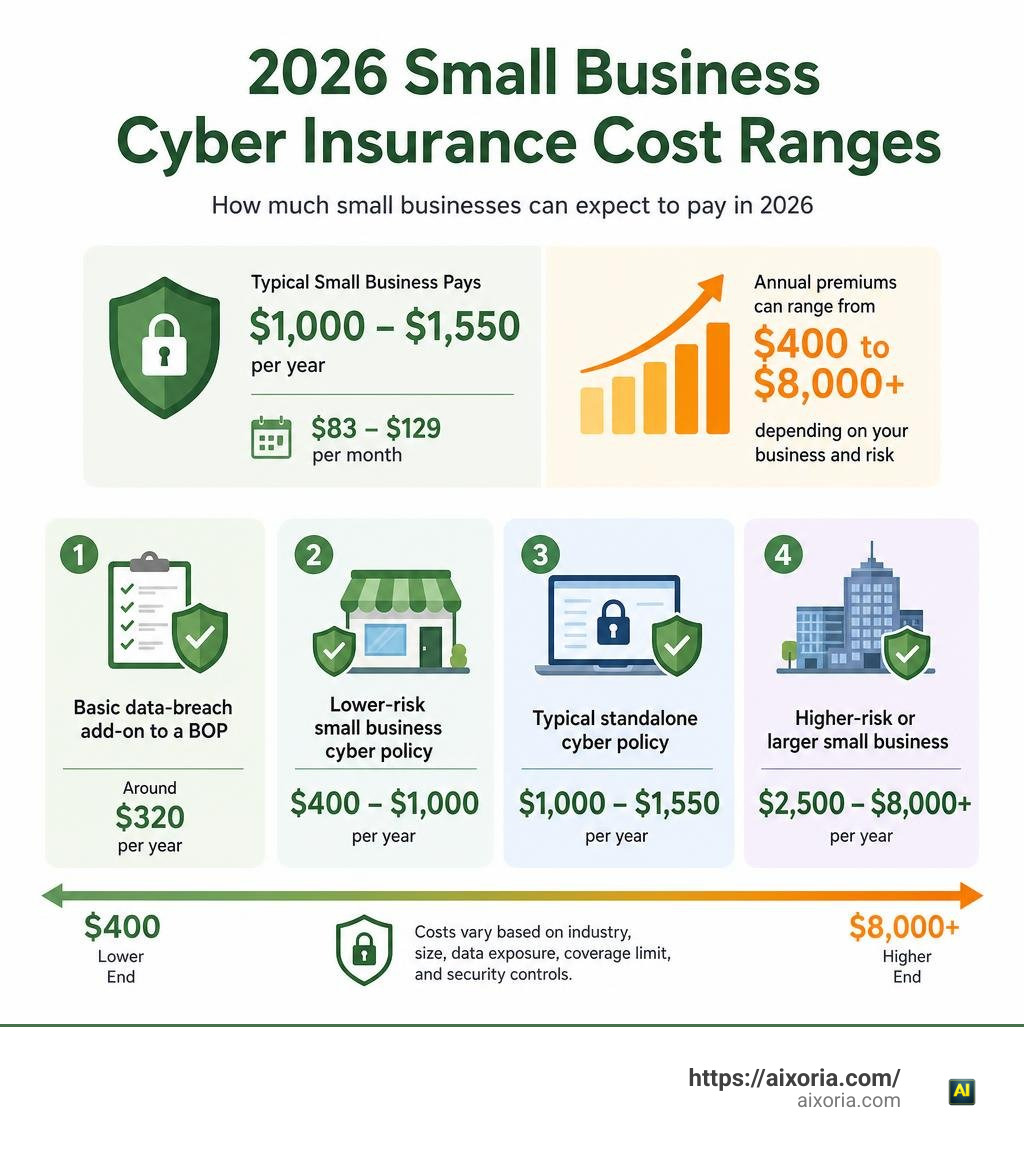
is the average cost of cybersecurity insurance for small businesses? In 2026, a typical small business pays about $1,000 to $1,550 per year, or roughly $83 to $129 per month. Actual annual premiums can range from about $400 to more than $8,000, depending on the business’s industry, size, data exposure, coverage limit, and security controls.
| Small business policy type | Typical annual cost |
|---|---|
| Basic data-breach add-on to a BOP | Around $320 |
| Lower-risk small business cyber policy | $400 to $1,000 |
| Typical standalone cyber policy | $1,000 to $1,550 |
| Higher-risk or larger small business | $2,500 to $8,000+ |
Cyber insurance helps pay for the financial fallout of a breach, ransomware event, payment fraud, or system outage. For many small businesses, the premium is modest compared with the cost of downtime, legal support, customer notices, data recovery, and lost income after an attack.
Still, there is no single price for every company. A local consultant with limited customer data may need only a basic policy. An online retailer, healthcare practice, or technology provider may need higher limits and broader protection.
What is the Average Cost of Cybersecurity Insurance for Small Businesses in 2026?
When we look across national market data in 2026, the national benchmark average for a basic small business policy sits around $83 per month, or approximately $996 per year, for a standard $1 million coverage limit. However, across various policy structures and business profiles, the median monthly cost reported by small business owners is $129 per month ($1,552 per year). On the broader market spectrum, small companies pay anywhere from $52 a month on the low end to $3,398 a month for complex mid-market operations.
Understanding Average Cyber Insurance Cost (2026 Report) requires looking closely at how insurance is purchased. A small company can secure protection in two main ways:
- Business Owner’s Policy (BOP) Endorsement: A simple add-on endorsement attached to standard commercial liability coverage. This typically costs around $320 annually. It offers baseline first-party protection but carries low limits (often capped at $50,000 to $250,000).
- Standalone Cyber Policy: A dedicated policy built specifically to cover digital risks, providing comprehensive first-party and third-party coverage with standard limits of $1 million per occurrence and $1 million aggregate. Standalone policies typically start around $1,000 to $1,500 annually for lower-risk businesses.
For many owners, calculating cyber insurance costs feels similar to assessing traditional property and casualty rates. If you have ever looked into How To Calculate General Liability Insurance Rate Per 1000, you know that base exposure rates are multiplied by your revenue or operational units. In cyber underwriting, however, the “exposure unit” is not just physical space or sales revenue—it is digital exposure, user endpoints, and record counts.
Comparing What is the Average Cost of Cybersecurity Insurance for Small Businesses by Industry
Industry risk tiers heavily influence your annual premium. Insurers categorize sectors by data sensitivity, operational dependence on technology, and historical claims frequency. Detailed analysis in the Cyber Insurance Cost in 2026: What Small & Mid-Size Businesses Actually Pay — Real Premiums by Industry report reveals distinct pricing categories:
- Healthcare and Medical Practices ($3,500 – $15,000+ / year): Healthcare organizations handle highly valuable Protected Health Information (PHI). Because a single compromised record can cost over $400 in recovery, notification, and regulatory fines, healthcare operations face industry surcharges of 20% or more above baseline rates.
- Technology and Software Providers ($2,500 – $8,000 / year): IT consultants, software developers, and SaaS firms pay higher rates—averaging around $179 per month—because system downtime or software bugs can cause widespread downstream financial damage to their clients.
- E-Commerce and Retail ($1,500 – $3,500 / year): Online merchants process payment card information (PCI) and store customer record databases. Median annual premiums for e-commerce sellers hover around $1,500 per year.
- Professional Services ($850 – $2,000 / year): Law firms, accounting practices, and business consultants maintain confidential client records, yielding median annual costs around $1,800 for developers and accountants, while basic consulting practices often pay as little as $350 to $1,000 per year.
- Low-Risk Services ($500 – $1,200 / year): Local trade contractors, janitorial services, and sports/recreation businesses with minimal digital transactions pay up to 38% below the national average.

How Employee Count and Revenue Impact What is the Average Cost of Cybersecurity Insurance for Small Businesses
Company size directly expands your digital attack surface. Every employee represents a email account, a potential entry point for phishing attacks, and a business device that could harbor malware.
Market data shows that crossing the 5-employee threshold increases cyber insurance costs by roughly 45%. Why? Because informal security habits that work for a 3-person team tend to break down when more staff members are onboarded. Furthermore, businesses with 20 to 49 employees face costs up to 325% higher than sole proprietors due to increased targeting by ransomware operators.
| Company Size & Profile | Employee Count | Average Annual Revenue | Typical Standalone Policy Limit | Average Annual Premium |
|---|---|---|---|---|
| Micro Business / Solo | 1 – 4 | Under $1M | $250,000 – $1,000,000 | $500 – $1,000 |
| Small Business Tier 1 | 5 – 19 | $1M – $5M | $1,000,000 | $1,200 – $2,500 |
| Small Business Tier 2 | 20 – 49 | $5M – $15M | $1,000,000 – $2,000,000 | $2,800 – $5,500 |
| Lower Mid-Market | 50 – 100 | $15M – $50M | $2,000,000 – $5,000,000 | $6,500 – $14,000 |
As sales revenue climbs, business interruption risk grows as well. A business generating $100,000 per day that suffers a 5-day operational halt due to ransomware faces $500,000 in immediate lost revenue—an exposure underwriters price directly into the annual premium.
Understanding Coverage Types: First-Party vs. Third-Party Cyber Protection
A comprehensive cyber liability policy provides two main pillars of coverage: first-party protection for direct losses your business suffers, and third-party protection for legal claims brought against you by outside parties.
First-Party Coverage Elements:
- Breach Response & Forensics: Covers the cost of hiring cybersecurity specialists to isolate the breach, stop the attack, and determine what data was accessed.
- Customer Notification & Credit Monitoring: Pays for mailing required legal notices to affected individuals and offering 12 to 24 months of identity theft protection services.
- Business Interruption & Lost Income: Reimburses operating expenses and lost profits while system outages prevent normal business operations.
- Cyber Extortion & Ransomware: Covers crisis negotiation services and approved extortion payments if attackers lock operational servers.
- Digital Asset Restoration: Reimburses software engineers and IT staff for repairing corrupted databases and rebuilding destroyed software systems.
Third-Party Coverage Elements:
- Litigation Defense: Pays for defense attorneys, court filing fees, and legal expenses if customers or vendors sue your company following a data exposure.
- Settlements and Judgments: Pays court-ordered awards or negotiated settlements resulting from privacy lawsuits.
- Regulatory Fines & Defense: Covers legal defense expenses and statutory penalties imposed by state attorneys general or federal regulators (such as HIPAA or PCI-DSS enforcement actions).
For context on how third-party liability interfaces with standard business liability insurance, check our guide on How Much Is GL Insurance For A Small Business In 2026.
Standard Business Policies vs Standalone Cyber Insurance
A common pitfall for small business owners is assuming that commercial general liability policies or commercial property insurance protect against cyber incidents. They do not.
General liability policies strictly respond to third-party claims involving physical bodily injury or property damage. Insurance contracts explicitly define electronic data as intangible, meaning unreadable or deleted customer databases do not qualify as physical property damage. To learn how different commercial policies fit together, explore our Which Insurance Is Best For Business In 2026 Complete Guide.
Furthermore, tech companies and software developers need to distinguish between Cyber Liability Insurance and Technology Errors & Omissions (Tech E&O). While cyber liability covers network breaches and data exposures, Tech E&O protects your firm if a coding flaw, system implementation failure, or professional service error causes a financial loss for your client.
Essential Policy Protections and Common Underwriting Exclusions
Modern policies cover a wide range of cyber risks, but underwriters also include strict exclusions to limit their liability.

Common Exclusions to Watch For:
- Unpatched Vulnerabilities: If an insurer publishes a critical patch warning and your business fails to apply the fix within a specified window (often 14 to 30 days), claims arising from that exploit may be denied.
- Social Engineering Sublimits: Funds transfer fraud and phishing tricks often carry lowered sublimits (e.g., $100,000 on a $1,000,000 policy) unless strict verbal verification protocols are documented.
- Acts of War & Cyber Warfare: Incidents attributed to foreign nation-state military operations are frequently excluded under traditional war clauses.
- Prior Known Acts: Any security breach or system vulnerability known to management prior to the inception of the policy is excluded from coverage.
- Non-Malicious Outages: System downtime caused by infrastructure failures at external cloud utility providers or non-malicious coding errors during routine updates may require specialized service-interruption endorsements.
Mandatory Technical Controls and How to Reduce Cyber Insurance Rates
In 2026, insurance carriers no longer rely solely on written questionnaires. Underwriters deploy continuous vulnerability scanners to analyze your public IP addresses, domain security, and email authentication protocols before offering a quote.
In fact, roughly 73% of small businesses fail their initial cyber insurance evaluation or face premium surcharges of up to 300% due to absent security controls. Implementing baseline security measures is the fastest way to qualify for coverage and lower rates. For more general strategies on optimizing commercial coverage, read our article on 10 Proven Ways To Reduce Your Commercial Insurance Premium.
Underwriting Security Requirements for 2026 Eligibility
To secure standalone coverage at competitive market rates in 2026, insurers mandate non-negotiable security controls:
- Multi-Factor Authentication (MFA): MFA must be enforced across all corporate email accounts, remote access endpoints, virtual private networks (VPNs), and administrative portals. Implementing MFA on email alone is no longer enough to satisfy underwriters.
- Endpoint Detection and Response (EDR): Traditional antivirus software is insufficient. Underwriters demand enterprise-grade EDR software that monitors device behavior 24/7 to block zero-day threats.
- Immutable, Tested Backups: Backups must be isolated, encrypted, and stored off-site or in an immutable cloud environment disconnected from the primary network. Crucially, insurers require documented backup recovery tests conducted within the past 12 months.
- Employee Security Awareness Training: Regular staff training and quarterly simulated phishing tests are required. Documenting training completion can earn direct premium discounts between 5% and 15%.
- Privileged Access Management (PAM): Restricting administrator privileges ensures that standard employee accounts cannot install unapproved software or alter core security configurations.
As detailed in the How Much Does Cyber Insurance Cost for a Small Business in 2026? | Christensen Group guide, adopting these mandatory controls prevents penalty surcharges of 25% to 50% and opens access to top-tier underwriters.
Actionable Strategies to Lower Your Small Business Premium
Beyond deploying technical security controls, small business owners can use strategic purchasing tactics to reduce annual cyber policy costs:
- Pay Premiums Upfront Annually: Opting for an annual upfront payment rather than monthly billing installments eliminates administrative fees and saves up to 5% to 10% on policy totals.
- Bundle Policies: Combining your cyber coverage with existing commercial liability, professional liability, or Business Owner’s Policies often qualifies your account for cross-policy discounts.
- Adjust Deductibles Strategically: Standard small business policy deductibles range from $1,000 to $10,000. Raising your deductible retention from $2,500 to $5,000 can lower annual premiums by 10% to 20%, provided your business maintains cash reserves to cover out-of-pocket costs during an incident.
- Clean Up Your Public IP Reputation: Underwriters run automated scans against your public IP addresses. Resolving open remote desktop ports, expired SSL certificates, or blacklisted IP addresses before submitting your application prevents unexpected price increases.
- Shop Multiple Underwriters Early: Start the renewal process at least 60 to 90 days before your policy expires. Comparing quotes across multiple insurance carriers ensures you get the best market pricing.
To compare baseline commercial liability rates across providers, read our review on Who Has The Cheapest Business Insurance In 2026 Compare Rates.
Determining Coverage Needs and Navigating Claims

Calculating the right coverage limits requires evaluating your organization’s specific data exposures and legal obligations rather than picking an arbitrary policy number.
Calculating How Much Cyber Insurance Coverage You Need
To calculate your ideal policy limit, evaluate three main factors:
- Volume and Sensitivity of Stored Data: Multiply your total record count by average industry recovery costs. Customer Personally Identifiable Information (PII) costs approximately $160 per record to recover and process following a breach, while financial or health records can exceed $400 per record.
- Operational Downtime Costs: Calculate daily revenue losses during a system outage. If your operations depend on cloud applications or point-of-sale systems, estimate how much income is lost if systems remain offline for 3 to 7 days.
- Client Vendor Compliance Mandates: Larger corporate clients and government entities frequently require vendors to carry at least $1 million or $2 million in dedicated cyber liability limits as a contract condition.
The Cyber Claim Filing Process and Post-Incident Rate Impacts
Knowing what to do when a breach occurs ensures your policy responds as intended.

Step-by-Step Claim Filing Process:
- Immediate Carrier Notification: Contact your insurance carrier’s 24/7 hotline immediately upon suspecting a breach. Most policies require notification within 24 to 48 hours of discovery.
- Engagement of Breach Counsel: The insurer will assign specialized legal counsel (a “breach coach”) who directs forensic investigators under attorney-client privilege.
- Forensic Investigation & Containment: Digital forensics experts isolate compromised systems, determine the breach entry point, and verify what data was exposed.
- Remediation & Claims Documentation: Keep detailed records of all direct costs, including emergency IT invoices, notification printing fees, credit monitoring setups, and documented revenue loss statements.
Post-Incident Renewal Impacts: Filing a claim will likely impact future insurance premiums. On average, submitting a claim causes policy renewal rates to increase by 20% to 50% for 3 to 5 years following the event. Maintaining comprehensive security logs and taking immediate remedial action after an incident helps mitigate long-term rate increases.
Frequently Asked Questions About Small Business Cyber Insurance
Is cyber insurance mandatory for small businesses?
Cyber insurance is not required by federal or state statutes. However, it is increasingly mandated through commercial contracts, client vendor agreements, regulatory standards, and commercial leases. If your business processes payment card transactions or handles sensitive client data, enterprise partners will often require proof of cyber coverage before signing contracts.
How much does a data breach endorsement cost on a Business Owner’s Policy?
Adding a basic data breach endorsement to an existing Business Owner’s Policy (BOP) costs an average of $320 per year (around $25 to $30 per month). While cost-effective, these add-ons usually feature low coverage limits (ranging from $50,000 to $250,000) and cover first-party response costs like notices and credit monitoring, leaving out comprehensive third-party liability protection.
Does cyber insurance cover ransomware extortion payments?
Yes, most standalone cyber insurance policies cover ransomware extortion demands and negotiation expenses. However, coverage requires explicit pre-approval from the insurer’s incident response team before funds are transferred. Additionally, insurers must perform mandatory sanction checks to ensure payment does not violate government trade restrictions.
Conclusion
When asking what is the average cost of cybersecurity insurance for small businesses?, the answer in 2026 comes down to an average of $83 to $129 per month ($1,000 to $1,550 annually) for standard standalone coverage. While baseline rates vary across industry tiers and company sizes, maintaining strong cybersecurity practices—such as multi-factor authentication, managed endpoint security, and regular backups—keeps coverage affordable and protects your business from major financial disruptions.
Modern risk management combines financial risk transfer with smart operational tools. Protecting your business requires maximizing productivity while keeping daily operations secure. Explore how cutting-edge automation can streamline your workflows by checking our complete guide: Optimize your operations and security with the best AI for productivity in 2026.
Hi there! I know this is somewhat off-topic however I needed to ask.
Does operating a well-established website such as yours require a large amount
of work? I’m brand new to running a blog however
I do write in my diary every day. I’d like to start a blog
so I will be able to share my experience and
feelings online. Please let me know if you have any recommendations or tips
for brand new aspiring bloggers. Thankyou!
Wonderful article! We are linking to this great post on our website.
Keep up the great writing.