Is It Mandatory to Take Insurance for Commercial Property?
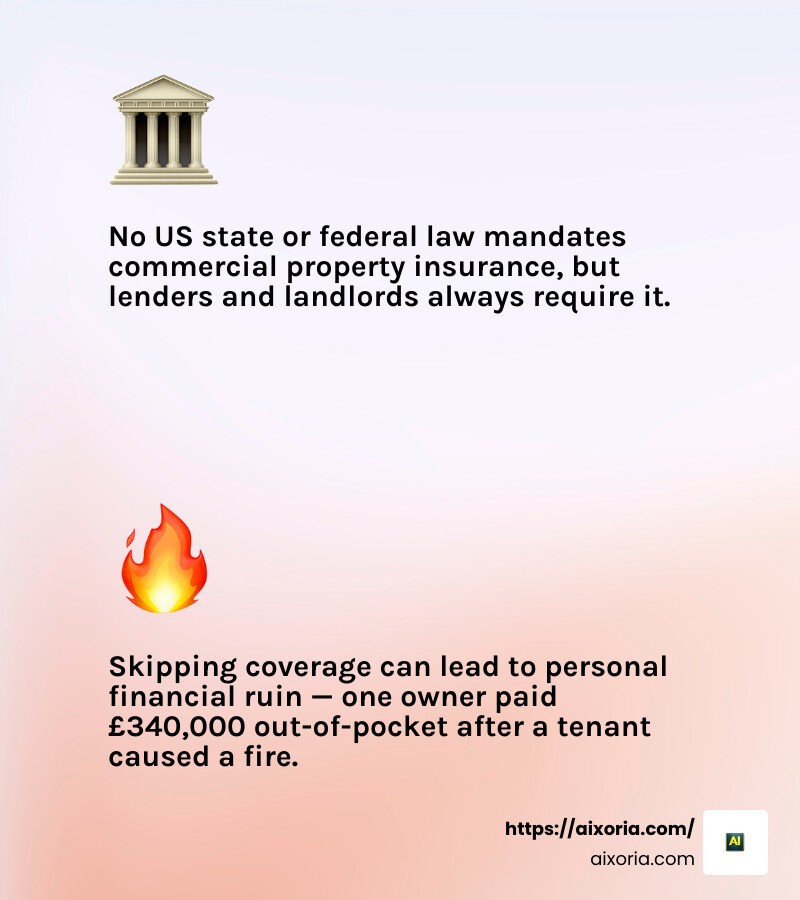
Is it mandatory to take insurance for commercial property? The short answer is: not by law in most cases — but in practice, it almost always is.
Here’s a quick breakdown:
| Situation | Is Insurance Required? |
|---|---|
| Government law (US federal) | No (only workers’ comp, unemployment, disability are federally mandated) |
| No US state legally mandates it | No |
| Commercial mortgage / lender | Yes — virtually always required |
| Commercial lease agreement | Yes — landlords almost always require it |
| SBA loan over $25,000 | Yes — hazard insurance is mandatory |
| Triple net (NNN) lease | Yes — tenant pays all insurance costs |
So while no law will fine you for skipping commercial property insurance, your bank, your landlord, or your loan agreement almost certainly will make it a hard requirement.
And going without it carries catastrophic financial risk. One real-world example illustrates this clearly: a property investor who owned an industrial unit outright — no mortgage — skipped buildings insurance because he thought it was optional. A tenant’s machinery caused a fire. The structural damage came to £340,000. He paid every penny personally.
The bottom line is simple: legally optional does not mean financially safe.
Is it mandatory to take insurance for commercial property?
When we look at the legal landscape in 2026, many new business owners ask us: Is it mandatory to take insurance for commercial property? The confusion usually stems from the difference between what the government forces you to do and what the commercial world requires to let you do business.
Statutorily, there is no sweeping federal or state law in the United States that says a business owner must purchase commercial property insurance simply for owning a building. If you bought a commercial warehouse with cash, own it outright, have no tenants, and do not employ anyone on-site, you are legally free to let that building sit completely uninsured.
However, as we outline in our comprehensive guide on Do You Need Commercial Property Insurance? 2026 Requirements, operating a modern business without this safety net is incredibly risky. Many business owners rely on business structures like Limited Liability Companies (LLCs) or corporations to protect their personal assets. While these legal structures do protect your personal home and savings from business-related lawsuits, they do absolutely nothing to protect your business assets from physical catastrophes. If your uninsured warehouse burns down, your LLC might shield your personal bank account, but your business’s physical assets, inventory, and equipment are gone forever, likely forcing you into bankruptcy.
Similarly, looking across the Atlantic, the Commercial Property Insurance: UK Legal Requirements paint a very similar picture. No UK statute forces a commercial property owner to buy buildings insurance. Yet, the layered web of contractual obligations with banks, commercial landlords, and local authorities means that going uninsured is practically impossible for any operating business.
Legal Mandates: Is Commercial Property Insurance Legally Required?
Let’s look closely at what the government actually mandates. At both the federal and state levels, legal insurance mandates are primarily designed to protect human beings rather than physical structures.
The federal government requires every business with employees to carry:
- Workers’ Compensation Insurance: To cover medical bills and lost wages if an employee is injured on the job.
- Unemployment Insurance: To support workers who lose their jobs through no fault of their own.
- Disability Insurance: Mandated in several states to provide partial wage replacement for non-work-related illnesses or injuries.
Because these coverages protect the livelihood of workers, the state enforces them with strict penalties and daily fines. Physical property, on the other hand, is viewed as a business risk that the owner has the right to manage—or mismanage—on their own.
For those who rent their business spaces, it is easy to confuse commercial property insurance with residential renters policies. If you want to understand the basic structure of tenant coverages, you can read about What Does Renters Insurance Cover in the USA to see how personal property protection works. In the commercial world, however, the stakes are much higher, and the lease agreements are far more demanding than standard residential leases.
Contractual Mandates: When Commercial Property Insurance Becomes Mandatory
While the government might not knock on your door demanding proof of property insurance, other parties certainly will. There are three primary triggers that turn “optional” commercial property insurance into a strict contractual mandate:
- Commercial Mortgage Lenders: If you finance the purchase of your commercial building, your lender has a massive financial interest in that physical asset. To protect their investment, lenders will make commercial property insurance (often referred to as hazard insurance) a non-negotiable condition of the loan. They will require coverage at full replacement value (not just the loan amount) and demand to be listed as a “mortgageholder” on your policy.
- Small Business Administration (SBA) Loans: If you secure an SBA loan—such as a 7(a) or 504 loan—or an SBA disaster loan exceeding $25,000, the federal government explicitly mandates hazard insurance. You must provide proof of coverage for all business assets used as collateral to secure the loan.
- Commercial Lease Agreements: If you rent a commercial storefront, office, or warehouse, your landlord’s insurance policy will only cover the building shell. They will contractually require you to carry commercial property insurance to cover your own inventory, equipment, and any tenant improvements or betterments (like custom flooring, lighting, or shelving you installed).
Key Differences Between Mandatory and Optional Coverage
Navigating commercial insurance can feel like trying to read a policy written in a foreign language. To help you make sense of what you must have versus what you should have, we need to distinguish between mandatory contractual requirements and optional risk-management coverages.
To understand this split, we must look at how risk is shared and how “insurable interest” is defined. An insurable interest exists when a person or entity faces a direct financial loss if a property is damaged. For a detailed breakdown of these insurance principles, you can refer to the academic guidelines in INSURING COMMERCIAL PROPERTY. Lenders and landlords require insurance because they have a direct insurable interest in your physical space. They want to ensure that if a disaster strikes, the building can be rebuilt, and your business can remain financially viable enough to keep paying your mortgage or rent.
Required Coverages: What Lenders and Landlords Demand
When you sign a commercial lease or a mortgage, the other party will typically demand a specific set of coverages. These usually include:
- Commercial Property Insurance: To cover the physical structure (if you own it) or your business personal property (if you rent it) against hazards like fire, windstorms, and vandalism.
- Commercial General Liability (CGL) Insurance: To protect against third-party claims of bodily injury or property damage occurring on the premises. If a customer slips on a wet floor in your retail shop, this coverage handles their medical bills and your legal defense. If you are also managing commercial vehicles, you may want to learn about What is Direct General Liability Auto Insurance to see how liability limits coordinate across different business operations.
- Dwelling Fire Policy (for Residential Landlords): If you are financing a commercial residential property (like a multi-family apartment building), lenders will require a specialized landlord policy rather than a standard homeowner policy.
- Additional Insured Status: Landlords almost always require you to add them as an “additional insured” on your general liability policy. This extends your liability protection to the landlord, ensuring that if a customer sues over an injury occurring inside your leased space, your insurance company defends the landlord as well.
Optional Coverages: Enhancing Your Business Protection
While the required coverages satisfy your contractual partners, they often leave massive gaps in your actual business survival plan. To truly protect your livelihood, we highly recommend looking into these critical “optional” coverages:
- Business Interruption Insurance: If a fire guts your retail store, commercial property insurance will pay to rebuild the walls and replace your inventory. But who pays your bills while you are closed for six months of repairs? Business interruption insurance replaces your lost net income, covers ongoing operating expenses (like payroll and taxes), and can even pay for a temporary relocation.
- Equipment Breakdown Coverage: Standard property insurance covers external damage (like a fire), but it excludes internal mechanical or electrical breakdown. If your building’s massive HVAC system or your commercial printing press experiences a sudden mechanical failure, this coverage pays for repairs and lost income.
- Flood and Earthquake Insurance: Standard commercial policies explicitly exclude natural disasters like floods and earthquakes. If your business is in a high-risk zone, you must purchase these as separate policies or endorsements.
- Business Owner’s Policy (BOP): For small to mid-sized businesses, insurance companies often bundle general liability, commercial property, and business interruption insurance into a single package called a BOP. This is highly cost-effective and simplifies your coverage. If you are looking to secure the best rates, you can read our guide on How to Get the Cheapest Renters Insurance for tips on structuring bundled policies, or check out our comprehensive State Farm Renters Insurance Review 2026 – Coverage, Cost, Discounts to see how major carriers structure packaged business and personal lines.
The Consequences of Operating Without Required Commercial Property Insurance
What happens if you decide to skip out on commercial property insurance when it is contractually required by a lease or mortgage? The short answer is: swift and severe financial pain.
First, let’s look at the immediate contractual consequences:
- Lease Forfeiture: If your landlord discovers you let your commercial renters insurance lapse, you are in immediate breach of your lease agreement. Most commercial leases allow the landlord to evict you quickly, lock you out of the property, and sue you for the remaining rent due on the lease term.
- Loan Default and Force-Placed Insurance: If you cancel your property insurance on a mortgaged building, your lender will be notified immediately by the insurer. The lender can declare your loan in default and demand immediate payment of the entire remaining loan balance. Alternatively, they will purchase “force-placed insurance” to protect their interest. This is a bare-bones policy that only protects the lender (not your business assets or liability), and the premium is often three to four times more expensive than a private policy—which they will force you to pay.
Beyond contract violations, operating uninsured exposes you to devastating policy penalties if you are underinsured. Most commercial property policies contain a coinsurance clause (typically requiring you to insure at least 80% or 90% of the property’s true replacement value).
If you underreport your property’s value to save on premiums, the insurer will apply a severe mathematical penalty during a claim using the standard coinsurance formula:
$$\text{Recovery} = \left( \frac{\text{Amount of Insurance Carried}}{\text{Amount of Insurance Required}} \times \text{Loss} \right) – \text{Deductible}$$
For example, let’s say your commercial building has a true replacement value of $1,000,000. Your policy has an 80% coinsurance clause, meaning you are contractually required to carry at least $800,000 in coverage. To save money, you only purchase a policy for $400,000.
If a fire causes $100,000 in partial damage, you might think you are fully covered because $100,000 is well below your $400,000 limit. However, because you only carried half of the required insurance ($400,000 instead of $800,000), the insurer will only pay 50% of your claim:
$$\text{Recovery} = \left( \frac{\$400,000}{\$800,000} \times \$100,000 \right) = \$50,000 \quad (\text{minus your deductible})$$
You are left to pay the remaining $50,000 out of pocket. This is known as the “average clause” penalty, and it ruins countless businesses every year. To avoid these traps, we always recommend regularly evaluating your property values using the Best Homeowners Insurance Comparison Sites and consulting with commercial experts to ensure your valuations are highly accurate.
Frequently Asked Questions about Commercial Property Insurance
Is it mandatory to take insurance for commercial property in India?
No, commercial property insurance is not legally mandated by the government in India. However, just like in the West, Indian banks and financial institutions make property insurance a mandatory pre-condition before approving any commercial property loan or business loan secured by real estate.
One unique challenge in the Indian market is that banks often use high-pressure tactics to force loan applicants to buy the bank’s own in-house, highly marked-up insurance policies. As a consumer, you have the right to decline the bank’s insurance offer and purchase a policy from an independent, IRDAI-approved insurer of your choice, which often provides much better coverage at a fraction of the cost. If a bank branch manager refuses to process your loan unless you buy their specific insurance policy, you can threaten to file a formal complaint with the Banking Ombudsman, which usually stops these illegal pressure tactics immediately.
Is it mandatory to take insurance for commercial property if I work from home?
If you run a business out of your home, you might assume your standard homeowners or renters insurance policy has you covered. This is a highly dangerous and incredibly common mistake.
Standard homeowners policies typically contain strict exclusions for commercial activities. They usually cap coverage for business-related personal property (like computers, inventory, or specialized tools) at a mere $2,500, and they provide absolutely zero liability coverage for business-related incidents. If a client visits your home office to sign a contract, slips on your rug, and breaks their wrist, your homeowners liability policy will likely deny the claim entirely because the injury arose from a commercial operation.
If your home-based business inventory or equipment is worth more than $2,500, or if you have clients visiting your home, you must secure either a home-based business insurance rider or a separate commercial general liability and property policy. For those looking to balance their personal and professional coverage, we recommend checking out the Best Homeowners Car Insurance Bundle in 2026 – Save More on Home & Auto to optimize your personal risk portfolio while keeping your business assets safely isolated.
What happens if a commercial building is vacant for more than 60 days?
In the commercial insurance world, a vacant building is viewed as a ticking time bomb for claims. Without regular occupancy, a minor water leak can run unchecked for weeks, causing catastrophic mold and structural damage, and the property becomes an easy target for vandals and thieves.
Because of this heightened risk, standard commercial property policies contain a strict vacancy clause. If a commercial building is vacant for more than 60 consecutive days prior to a loss:
- The insurance company will completely exclude coverage for specific high-risk perils, including vandalism, sprinkler leakage, glass breakage, water damage, and theft.
- For any other covered peril (such as a fire caused by lightning), the insurer will automatically reduce your claim payout by 15%.
If you own a commercial building that is currently empty or transitioning between tenants, you must contact your insurance broker immediately to secure a specialized vacancy permit or endorsement. This will adjust your coverage terms and keep you fully protected, though it will require a slightly higher premium to offset the increased risk. If you are exploring specialized, niche property coverages, you can read our review of American Modern Insurance Review 2026 – Coverage, Cost, Pros & Cons to see how specialty insurers structure policies for vacant, seasonal, or non-standard properties.
Conclusion
While the question “Is it mandatory to take insurance for commercial property?” technically yields a “no” from a purely governmental standpoint, the operational reality of running a business in 2026 makes it an absolute necessity. Whether driven by the strict demands of your mortgage lender, the non-negotiable clauses in your commercial lease, or the safety requirements of an SBA loan, commercial property insurance is a foundational pillar of any resilient business.
Operating without it doesn’t just violate your contracts; it exposes your company to immediate eviction, loan defaults, devastating coinsurance penalties, and total financial ruin in the event of a physical disaster. By proactively securing the right blend of mandatory and optional coverages, you protect not only your physical assets but also your ongoing cash flow and long-term peace of mind.
At Aixoria, we believe that staying informed is your best defense against unexpected risks. To keep your business ahead of the curve with the latest industry insights and technological shifts, explore our comprehensive resources on AI Updates and discover how modern tools are reshaping risk management for a digital world.
2 thoughts on “Is Commercial Property Insurance Mandatory in 2026? What Every Business Owner Should Know”