Why the Best Refinance Home Loan Calculator Can Save You Thousands

The best refinance home loan calculator helps you instantly compare your current mortgage against a new loan — showing your monthly savings, break-even point, and lifetime interest costs before you ever talk to a lender.
Top refinance calculators to know in 2026:
| Calculator Type | Best For | Key Feature |
|---|---|---|
| Rate Comparison | Rate shopping | Live rate data + lender comparison |
| Amortization Detail | Amortization insight | Re-amortization schedule detail |
| Cash-Out Planner | Cash-out planning | Equity + closing cost estimates |
| Full Payment Breakdown | Full payment picture | ARM vs. fixed, PMI, APR breakdown |
| Wealth Builder | Wealth building | Reinvestment return modeling |
Here’s what makes this matter right now: according to industry research, 87% of borrowers paid above the most competitive rate available to them — costing the average homeowner $3,343 a year. That’s $278 every single month, left on the table simply by not comparing options.
A good refinance calculator is the first tool that changes that.
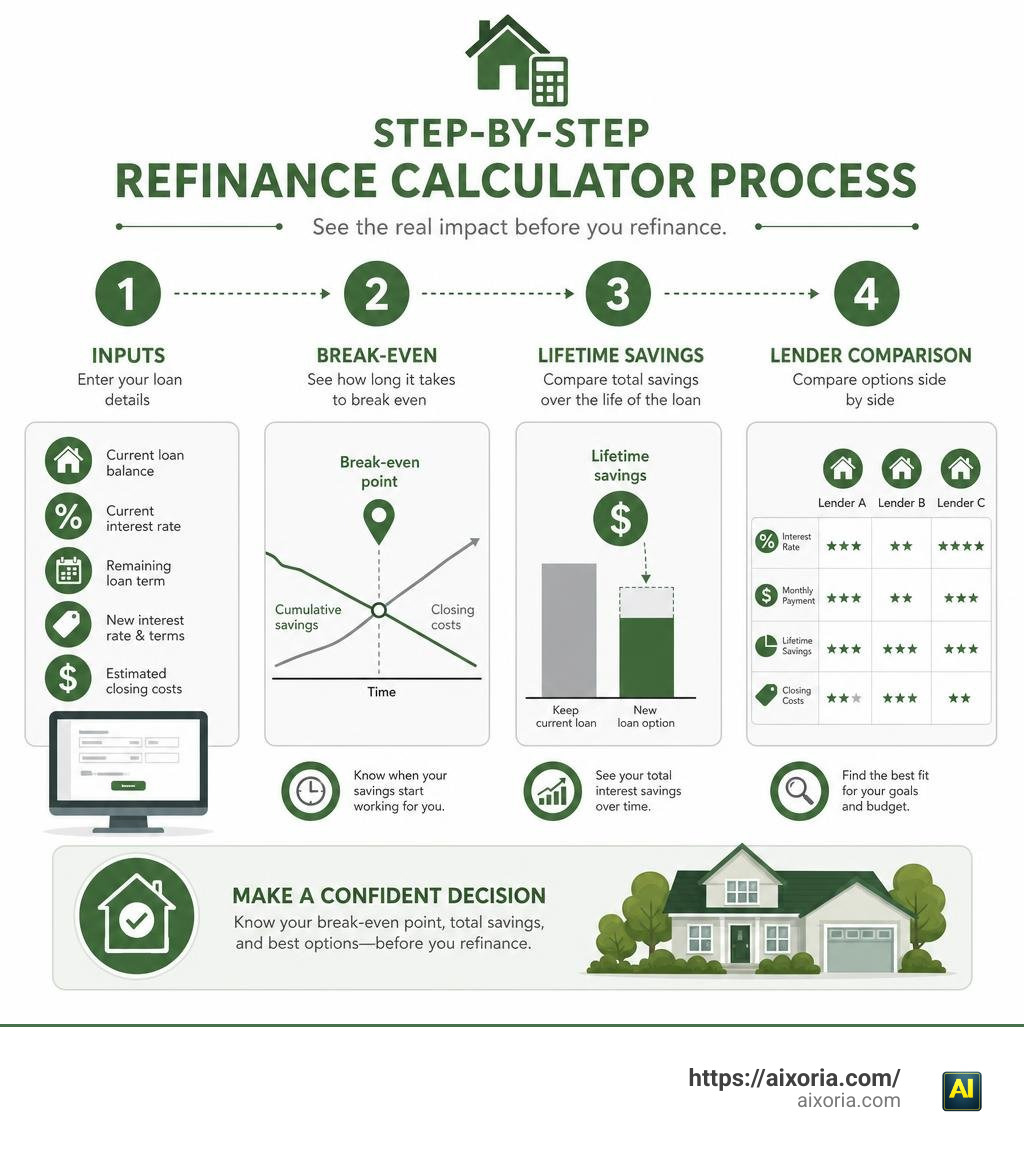
It takes your current loan balance, interest rate, remaining term, and the new rate you’ve been offered — then tells you whether the math actually works in your favor. Not just for next month, but over the full life of the loan.
Most homeowners focus only on the monthly payment drop. But as you’ll see, that can be misleading — especially if you reset your loan to a longer term.
How to Use the BEST refinance home loan calculator Effectively
To get the most accurate results from any digital tool, the old adage “garbage in, garbage out” holds entirely true. If you feed a calculator estimated numbers, it will spit out estimated — and often highly inaccurate — savings.
When we use the best refinance home loan calculator, we need to gather a few essential details first.
The Essential Inputs You Need
Before sitting down with a calculator, grab your most recent mortgage statement. You will need to input:
- Your Current Principal Balance: This is the actual remaining amount you owe on your home, not your original loan amount.
- Your Current Interest Rate: Enter this down to three decimal places (e.g., 6.875%) for maximum accuracy.
- Your Remaining Term: Knowing how many years and months you have left on your current mortgage prevents you from making unfair comparisons.
- Estimated Home Value: This helps calculate your Loan-to-Value (LTV) ratio, which determines if you will be forced to pay Private Mortgage Insurance (PMI).
- Your Zip Code: Because property taxes and homeowners insurance vary wildly by region, localized tools use your zip code to estimate regional expenses.
Understanding the Mechanics: Rate-and-Term vs. Cash-Out
When utilizing a refinance tool, you must select the right loan structure.
A rate-and-term refinance simply swaps your current loan’s interest rate or term length for a new one. This is the most common path for homeowners looking to lower their monthly bills or pay off their homes faster.
A cash-out refinance, on the other hand, allows you to borrow more than you currently owe and pocket the difference in cash. This is highly useful for major renovations or debt consolidation, but it typically requires you to maintain at least 20% equity in the property after the transaction is complete.
If your goal is simply to build up your personal savings, you can use our best monthly savings calculator in 2026 to map out how those extra monthly dollars can grow over time.
Additionally, we always recommend checking that your property’s overhead costs are optimized. For instance, reviewing your property’s underlying insurance terms through resources like the highest ranked condo homeowners insurance can help trim unnecessary expenses from your escrow account, maximizing the accuracy of your refinance calculator inputs.
Calculating Your Break-Even Point and Avoiding the Re-Amortization Trap
One of the most critical metrics the best refinance home loan calculator provides is your break-even point. This is the exact month where your cumulative monthly savings finally surpass the upfront fees you paid to secure the new loan.
The Break-Even Formula
The math behind the break-even point is straightforward:
$$\text{Break-Even Point (Months)} = \frac{\text{Upfront Closing Costs}}{\text{Monthly Payment Savings}}$$
For example, if your refinance closing costs total $4,000 and the new loan saves you $200 per month, your break-even point is:
$$\frac{\$4,000}{\$200} = 20 \text{ months}$$
If you plan to stay in your home for at least 2 years, this refinance is a smart financial move. If you plan to sell the home in 12 months, you will lose money by refinancing, even though your monthly payment is lower.
You can run these exact numbers using specialized online refinance calculators that offer break-even analysis. For official guidance on comparing lender fees and reviewing mortgage disclosures, the Consumer Financial Protection Bureau explains how to use a Loan Estimate before you commit to a refinance.
Exposing the Re-Amortization Trap
Many basic bank calculators are designed as lead-generation forms. They loudly highlight your monthly savings while quietly hiding the re-amortization trap.
When you refinance, you typically reset your mortgage clock. If you have already paid 7 years on a 30-year mortgage and you refinance into a brand-new 30-year mortgage, you have extended your total debt timeline to 37 years. Even with a lower interest rate, those extra seven years of payments can cost you thousands more in lifetime interest.
To illustrate this, let’s look at a realistic scenario for a homeowner with a remaining balance of $280,000:
| Metric | Current Mortgage | New 30-Year Refinance | New 27-Year Refinance |
|---|---|---|---|
| Remaining Balance | $280,000 | $280,000 | $280,000 |
| Interest Rate | 7.00% | 6.00% | 6.00% |
| Remaining Term | 27 Years | 30 Years | 27 Years |
| Monthly Principal & Interest | $1,929 | $1,678 | $1,760 |
| Monthly Savings | $0 | $251 | $169 |
| Total Lifetime Interest Paid | $345,160 | $324,320 | $290,440 |
| Actual Lifetime Savings | $0 | $20,840 | $54,720 |
By choosing a 27-year term that matches their remaining timeline instead of resetting to a fresh 30-year term, the borrower saves an additional $33,880 in lifetime interest, despite having a slightly higher monthly payment.
When to Refinance (and When to Avoid It)
Refinancing is a powerful wealth-building tool, but it is not always the right move. Knowing when to pull the trigger depends heavily on your credit profile, your equity, and broader market conditions.

The 0.75% Rule of Thumb
Historically, the mortgage industry standard suggests that if you can drop your interest rate by at least 0.75 percentage points, a refinance is generally worth it. This drop is typically large enough to offset standard closing costs (which range between 2% and 6% of the loan amount) within a reasonable timeframe.
Credit Score, DTI, and LTV Requirements
To secure those highly competitive rates, lenders look closely at your financial health:
- Credit Score: While you can qualify for conventional refinancing with a credit score of 620, borrowers with scores of 740 or higher receive the most favorable interest rates.
- Debt-to-Income (DTI) Ratio: Lenders prefer a DTI ratio of 43% or less.
- Loan-to-Value (LTV) Ratio: If your LTV is above 80% (meaning you have less than 20% equity), you will likely have to pay for Private Mortgage Insurance (PMI), which adds to your monthly costs.
If you find yourself with exactly 20% equity, refinancing from an FHA loan (which requires permanent mortgage insurance premiums) to a conventional loan is an excellent way to immediately cancel your monthly PMI.
Overpaying on Rates: The Cost of Not Shopping Around
A shocking 78.7% of refinance borrowers overpaid on their rate in 2025 because they accepted the first offer they received. The typical borrower who overpaid gave up $3,343 a year ($278 a month) over the life of their loan.
To avoid this, we recommend comparing quotes from at least three different lenders.
While optimizing your mortgage is crucial, don’t forget to evaluate other aspects of your financial portfolio. If you manage rental properties, securing specialized coverage like homeowners short term rental insurance can protect your cash flow.
If you are trying to find extra room in your budget to pay down your principal faster, running calculations with a roof cleaning cost calculator or mapping out independent income with a best freelance hourly rate calculator in 2026 can help you find hidden savings.
Furthermore, checking independent reviews such as ethos life insurance reviews or looking over a state farm renters insurance review 2026 coverage cost discounts ensures you aren’t overpaying on other essential protective policies.
Frequently Asked Questions about Refinancing
How do I find the BEST refinance home loan calculator for my needs?
The best refinance home loan calculator for your specific situation depends on your financial goals.
If you want real-time accuracy, look for a calculator that pulls live market rate data based on your specific credit score and location.
If you want to build long-term wealth, look for advanced options that allow you to model reinvesting your monthly savings into the market to see how your net worth grows over time.
Always choose calculators that let you adjust closing costs manually and show a complete side-by-side amortization schedule.
What is the difference between rate-and-term and cash-out refinancing?
A rate-and-term refinance only changes your interest rate, your loan term, or both, without allowing you to take cash out of your home.
A cash-out refinance replaces your current mortgage with a larger loan, paying you the difference in cash. This option typically requires at least 20% equity in the property to be eligible, and it is highly popular for debt consolidation or funding major home improvements.
Why should I use the BEST refinance home loan calculator before shopping for lenders?
Using a calculator first protects you from the “hidden homeownership tax” of overpaying. By running your numbers independently, you will know exactly what interest rate and monthly payment you need to break even.
When you do begin shopping, you can confidently compare the official Loan Estimates you receive against your calculator results to ensure the lender isn’t hiding excessive fees in your closing costs.
Conclusion
Refinancing your home is one of the most significant financial decisions you can make. By taking the time to use the best refinance home loan calculator, you can cut through the marketing noise, protect yourself from the re-amortization trap, and ensure you never overpay on your interest rate.
At Aixoria, we believe that smart financial planning starts with having the right tools at your disposal. Whether you are optimizing your mortgage, planning your yearly taxes with the best tax refund calculator, or looking to streamline your daily workflows, leverage the best AI for productivity in 2026 to make fast, data-driven decisions that secure your financial future.