
Saving money in 2026 is no longer about guessing a number and hoping for the best. The real challenge is understanding how much you should save every month based on your lifestyle, inflation, interest rates, and financial goals—and then actually following through.
That’s where modern monthly savings calculators have evolved. The best tools today don’t just calculate—they analyze, predict, and even automate your savings behavior. Instead of static formulas, they use real-time financial data, AI-driven insights, and behavioral nudges to help you reach your goals faster.
Whether you’re building a $25,000 emergency fund, saving for a home in a competitive U.S. market, or planning long-term wealth, this guide covers the best monthly savings calculators in 2026, including AI-powered platforms that go far beyond basic math.
Table of Contents
2026 Savings Tools: Fast Comparison
| Tool | Best For | Standout Feature | Pricing |
|---|---|---|---|
| Copilot Money | AI-native saving | Predictive “safe-to-save” insights | ~$95/year |
| NerdWallet Savings Calculator | Beginners | Simple, instant calculations | Free |
| Empower | Net worth tracking | Savings + investments view | Free |
| YNAB | Aggressive saving | Zero-based budgeting system | ~$99/year |
| Bankrate Savings Calculator | Interest optimization | Real-world APY comparisons | Free |
| Albert | Automation | Hands-off micro-saving | Subscription |
| SmartAsset Savings Calculator | Long-term planning | Tax + inflation modeling | Free |
| Monarch Money | Couples | Shared financial goals | ~$99/year |
| Calculator.net Savings Calculator | Advanced math | Full customization | Free |
What Makes the Best Monthly Savings Calculator in 2026?
The definition has changed. A good tool is no longer just about formulas—it’s about decision-making support.
Dynamic goal modeling
Modern tools adapt based on changing income, expenses, and interest rates.
Behavioral insights
They analyze spending habits and suggest realistic saving strategies.
Automation
The best platforms remove friction by automatically moving money into savings.
AI-driven predictions
Instead of fixed assumptions, AI tools forecast outcomes based on real data patterns.
READ MORE – Best Freelance Hourly Rate Calculator in 2026
Best AI-Native Monthly Savings Calculator
Copilot Money

Copilot Money represents the shift from manual budgeting to intelligent financial systems. Instead of asking you to input assumptions, it connects to your accounts and builds a real-time financial model based on your actual behavior.
The core strength of Copilot lies in its “safe-to-save” prediction engine. It doesn’t just tell you how much you should save—it calculates how much you can safely save without impacting your daily life. This is powered by machine learning models that track recurring expenses, variable spending, and income fluctuations.
Another key advantage is how it identifies inefficiencies. By analyzing subscription patterns, irregular charges, and spending spikes, it surfaces hidden opportunities to save more each month. Over time, the system becomes more accurate as it learns your habits.
Copilot also integrates forecasting tools that simulate future outcomes based on different saving scenarios. For example, it can show how increasing your monthly savings by 10% affects your timeline for reaching a goal.
Pricing: Paid (~$95/year)
Pros:
- Advanced AI-driven insights
- Real-time financial tracking
- Predictive savings recommendations
Cons:
- Requires account linking
- Premium pricing
Real experience: I tested Copilot for a quarter, and it flagged multiple unnoticed subscriptions, improving my monthly savings without changing my income.
Best Simple Monthly Savings Calculator
NerdWallet Savings Calculator

NerdWallet remains one of the most accessible tools for quick savings calculations. It focuses on delivering clear, immediate answers without requiring any setup.
Users can input their goal amount, timeframe, and interest rate, and the calculator instantly outputs the required monthly savings. This simplicity is its biggest strength—it eliminates friction and makes financial planning approachable for beginners.
While it lacks AI capabilities, it compensates with reliability and clarity. It’s particularly useful for validating quick scenarios or making fast decisions.
Pricing: Free
Pros:
- Extremely easy to use
- Fast and accurate calculations
- No login required
Cons:
- No automation or AI features
- Limited customization
Real experience: I often use this tool during quick planning sessions—it consistently delivers accurate results without unnecessary complexity.
Best for Net Worth and Long-Term Planning
Empower
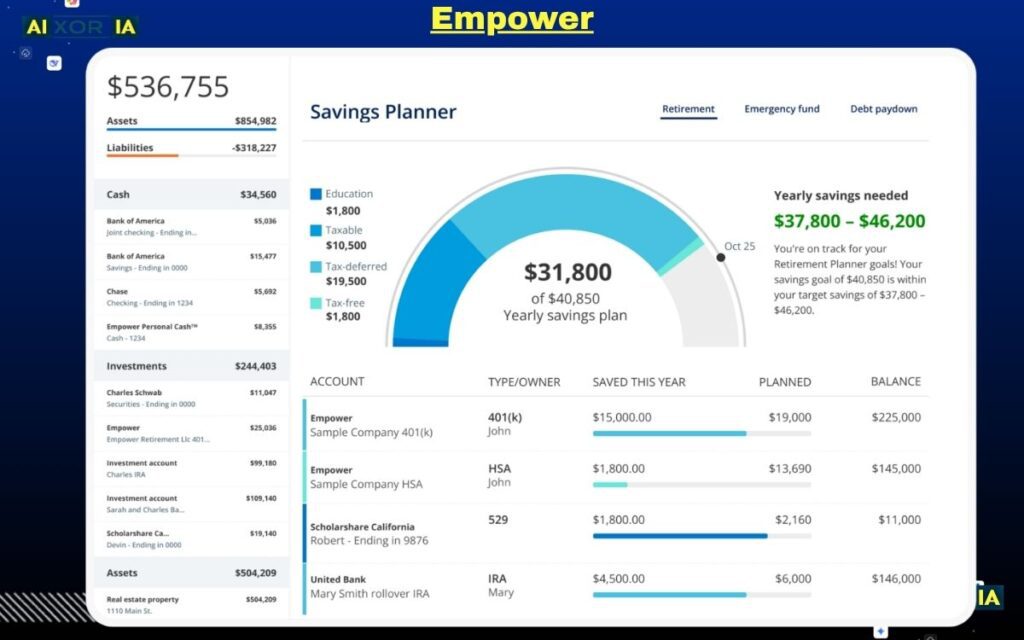
Empower takes a broader approach by integrating savings into a full financial ecosystem. Instead of isolating savings goals, it connects them with investments, retirement accounts, and overall net worth.
Its strength lies in scenario-based projections. Users can visualize how different savings strategies impact long-term wealth, including retirement timelines and investment growth.
AI-driven analytics provide insights into asset allocation and saving efficiency, helping users optimize their financial strategy rather than just calculate contributions.
Pricing: Free
Pros:
- Comprehensive financial overview
- Strong long-term projections
- Investment integration
Cons:
- More complex than basic tools
- Requires financial account linking
Real experience: Seeing savings alongside investment growth changed how I prioritize monthly contributions.
Best for Behavior-Driven Saving
YNAB

YNAB is designed to change how you think about money. Instead of focusing on future goals alone, it emphasizes controlling current spending through a structured budgeting system.
Its methodology assigns every dollar a role, ensuring that savings are intentional rather than leftover. AI-driven insights help identify patterns and suggest adjustments, making it easier to stay consistent.
Over time, YNAB transforms savings from a calculation into a habit.
Pricing: Paid (~$99/year)
Pros:
- Strong behavioral impact
- Goal-based budgeting
- Detailed financial control
Cons:
- Learning curve
- Requires active engagement
Real experience: After adapting to YNAB’s system, I saw a noticeable improvement in how consistently I saved each month.
Best for Interest Optimization
Bankrate Savings Calculator
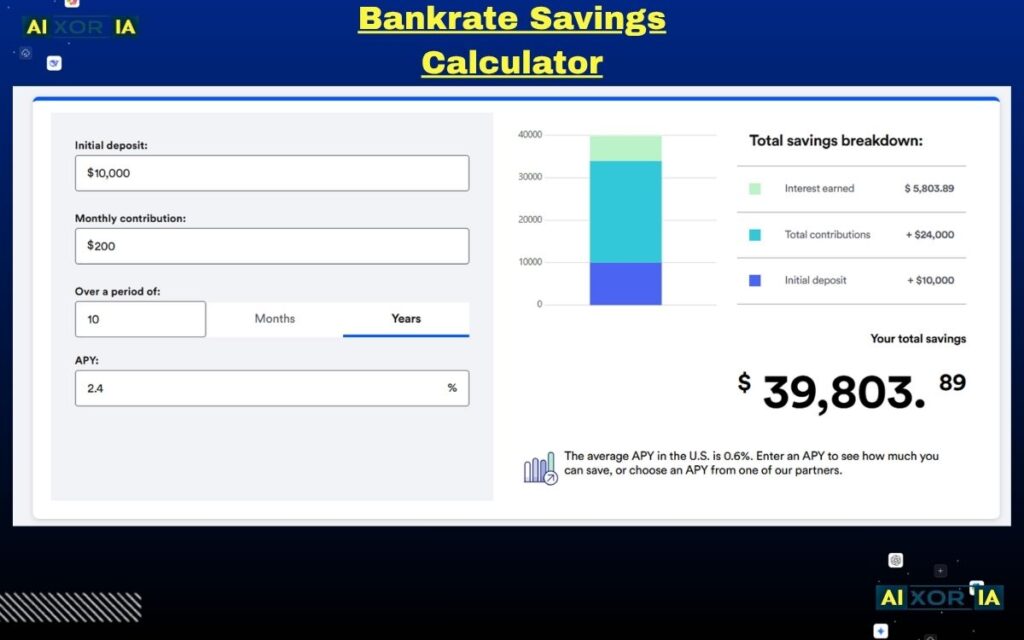
Bankrate focuses on maximizing returns by incorporating real-world interest rates into its calculations. It helps users understand how different savings accounts impact long-term outcomes.
This is especially useful in fluctuating interest environments, where choosing the right account can significantly increase returns.
Pricing: Free
Pros:
- Real-world financial context
- Reliable projections
- Easy to use
Cons:
- Limited personalization
- No AI automation
Real experience: It helped me identify how switching accounts could significantly increase annual savings growth.
Best Hands-Off Savings Tool
Albert

Albert introduces the concept of autonomous saving. Instead of asking you to calculate and transfer money manually, it analyzes your finances and automatically moves small amounts into savings.
Its AI ensures that transfers happen only when you can afford them, reducing the risk of overdrafts while maintaining consistency.
Pricing: Subscription-based
Pros:
- Fully automated savings
- AI-driven decision-making
- Minimal effort required
Cons:
- Less manual control
- Ongoing cost
Real experience: Small automated transfers added up quickly without requiring any active effort.
Best for Real-World Financial Modeling
SmartAsset Savings Calculator
SmartAsset stands out for incorporating tax impact and inflation into savings calculations. This provides a more realistic view of future value.
Its visual tools help users understand how external factors affect long-term goals, making it ideal for strategic planning.
Pricing: Free
Pros:
- Realistic projections
- Visual data representation
- Tax-aware calculations
Cons:
- Limited automation
- No AI-driven behavior tracking
Real experience: It provided a clearer understanding of how inflation impacts long-term savings goals.
Best for Shared Financial Goals
Monarch Money
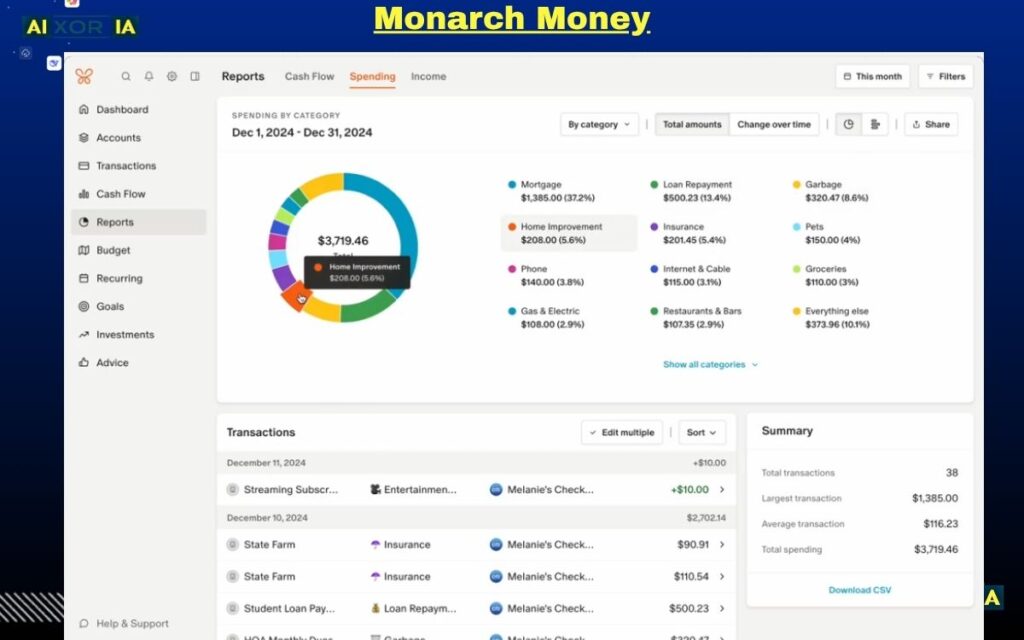
Monarch Money is designed for households and couples managing shared finances. It allows multiple users to track and contribute toward common goals.
The platform combines budgeting, savings tracking, and collaboration tools, making it easier to stay aligned financially.
Pricing: Paid (~$99/year)
Pros:
- Collaborative financial planning
- Unified dashboard
- Goal tracking
Cons:
- Subscription required
- Not ideal for solo users
Real experience: Sharing financial goals in one place improved coordination and accountability.
Best for Advanced Custom Calculations
Calculator.net Savings Calculator
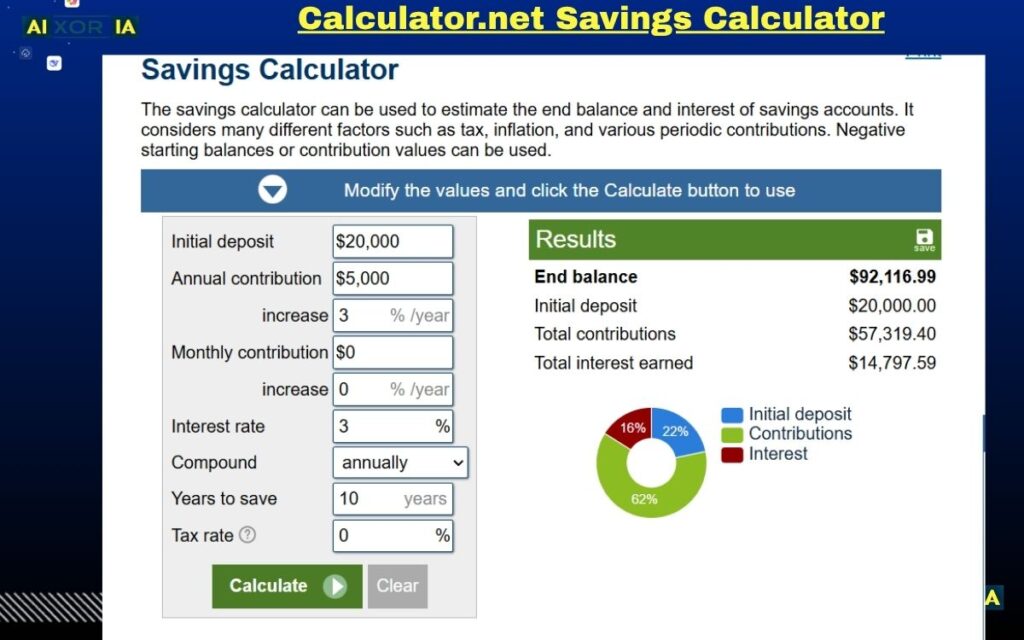
Calculator.net is ideal for users who want full control over every variable. It allows adjustments for compounding frequency, inflation, and irregular contributions.
While it lacks modern design and AI features, it remains one of the most precise tools for detailed calculations.
Pricing: Free
Pros:
- Highly customizable
- Accurate calculations
- No cost
Cons:
- Outdated interface
- No automation
Real experience: It’s my go-to tool for testing detailed financial scenarios.
READ MORE – Best Freelance Hourly Rate Calculator in 2026
The Shift from Calculation to Autonomous Finance
The biggest evolution in 2026 is the move from static formulas to adaptive systems.
Traditional calculators rely on fixed equations. Modern tools use:
- Real-time financial data
- Predictive analytics
- Behavioral modeling
This allows them to:
- Adjust savings recommendations dynamically
- Identify spending inefficiencies
- Automate financial decisions
AI-driven tools are effectively becoming financial assistants, helping users not just plan—but execute.
Final Thoughts
The best monthly savings calculator is no longer just about numbers—it’s about action and consistency.
- If you want automation → Albert or Copilot
- If you want simplicity → NerdWallet
- If you want full control → Calculator.net
- If you want long-term strategy → Empower or SmartAsset
In most cases, combining a calculator with an AI-driven tool provides the best results.
5 thoughts on “Best Monthly Savings Calculator in 2026”