Why Finding the Best Loan Amortization Calculator Changes How You Borrow

Finding the best loan amortization calculator can be the difference between blindly accepting a loan offer and truly understanding what you’re agreeing to pay over the next 10, 20, or 30 years.
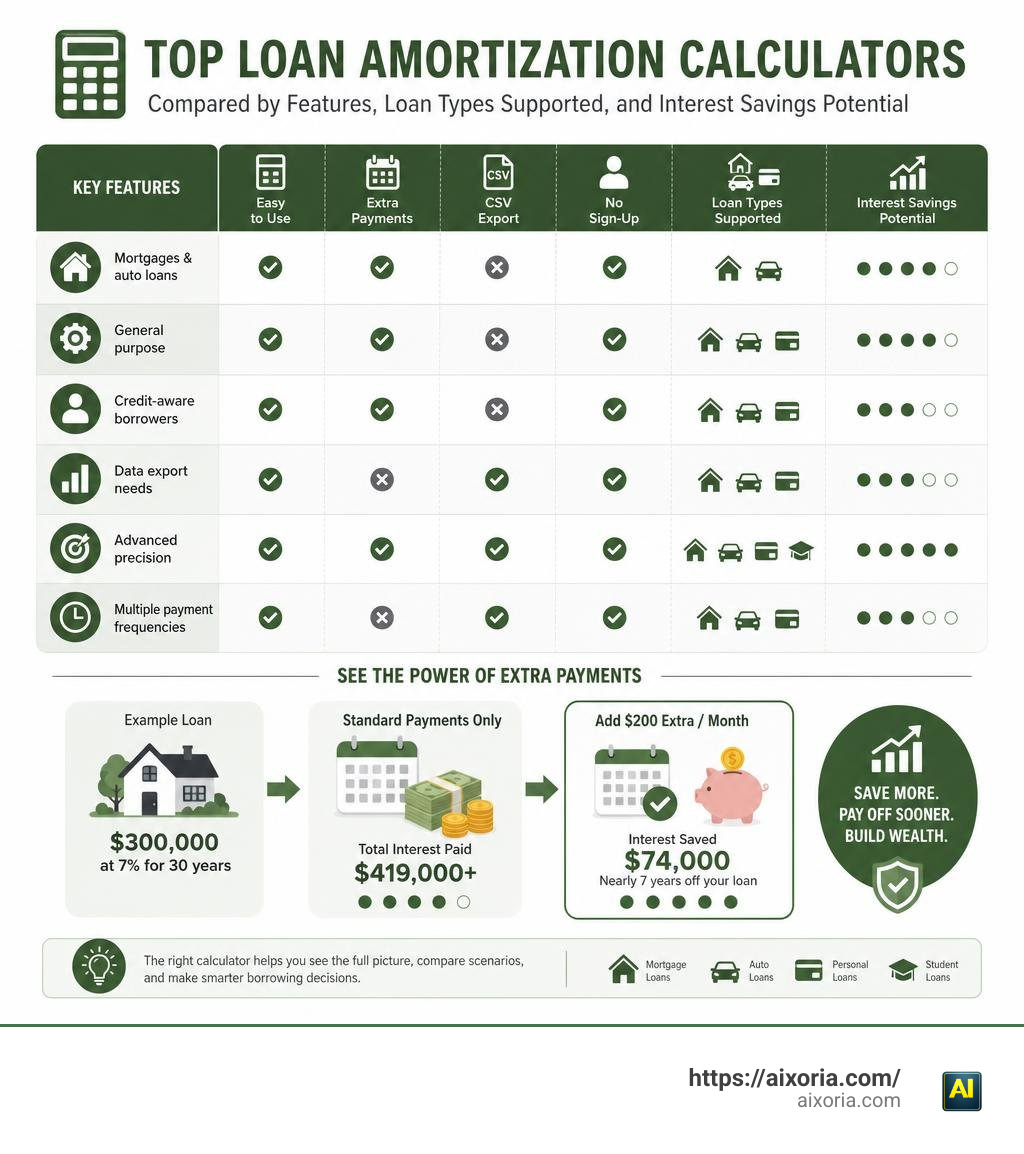
Here are the top free loan amortization calculators available in 2026:
| Calculator | Best For | Extra Payments | CSV Export | No Sign-Up |
|---|---|---|---|---|
| Bankrate Loan Calculator | Mortgages & auto loans | Yes | No | Yes |
| Calculator.net Amortization | General purpose | Yes | No | Yes |
| TransUnion Amortization | Credit-aware borrowers | Yes | No | Yes |
| BasicCalc Amortization | Data export needs | No | Yes | Yes |
| Pine Grove Software | Advanced precision | Yes | Yes | Yes |
| BestCalculator.app | Multiple payment frequencies | No | Yes | Yes |
Most people look at a monthly payment and think they understand their loan. They don’t.
A $300,000 mortgage at 7% for 30 years has a monthly payment of $1,996 — but the total cost is nearly $719,000. That’s more than double what you borrowed.
An amortization calculator shows you the full picture: how much goes to interest each month, how your balance shrinks over time, and exactly how much you’d save by paying even a little extra.
A $300,000 mortgage at 7% — adding just $200/month extra saves $74,000 in interest and cuts nearly 7 years off the loan.
That’s not a small difference. That’s a car, a college fund, or years of retirement savings.
The right calculator makes these numbers visible before you sign anything.
What is a Loan Amortization Calculator and How Does It Work?
At its core, a loan amortization calculator is a financial tool that breaks down your installment debt into a highly structured, chronological payment plan. The word “amortization” itself stems from Middle English and Latin roots meaning “to kill or deaden” — which is quite literal in a financial sense: you are gradually “killing off” your debt over a set period of time.
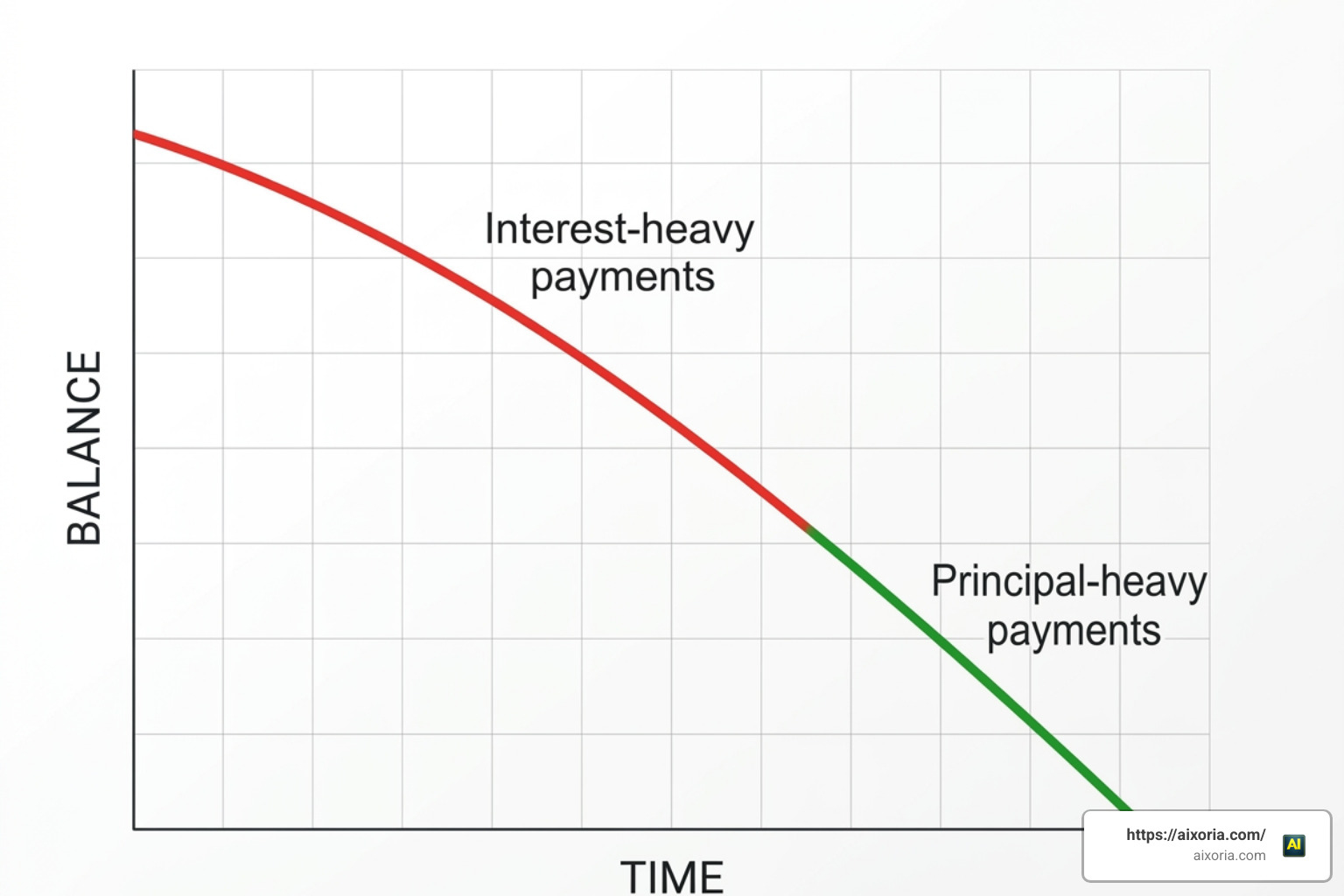
When you take out an amortizing loan, your monthly payment remains fixed. However, the internal mechanics of that payment are constantly shifting. In the early stages of your loan, your outstanding balance is at its highest, meaning the interest charged on that balance is also at its peak. Consequently, the vast majority of your monthly payment goes directly toward paying off interest, leaving only a tiny sliver to reduce the actual principal balance.
As you make payments and the principal balance declines, the interest calculated for the next period shrinks. Because your overall payment remains exactly the same, a larger percentage of your money goes toward principal reduction with each passing month. This is known as a declining balance calculation, and it creates an exponential curve over time.
Amortization Schedule vs. Simple Payment Calculator
Many first-time borrowers confuse a simple payment calculator with a comprehensive amortization schedule maker. A simple payment calculator only tells you one number: your estimated monthly payment. While that is helpful for basic monthly budgeting, it leaves you completely in the dark regarding the long-term cost of borrowing.
An amortization schedule, on the other hand, is a complete table detailing every single periodic payment over the life of the loan. A professional amortization schedule breaks down:
- The Payment Number: Tracking exactly where you are in your repayment timeline.
- Principal Paid: The exact dollar amount of that specific payment that directly reduces your debt.
- Interest Charged: The fee the lender keeps for that month.
- Cumulative Interest: A running total of all interest paid to date, which is often a shocking number to look at in black and white.
- Remaining Balance: Your outstanding debt after that payment is applied.
By visualizing this chronological progression, you can easily identify your “tipping point” — the exact month where more of your payment goes toward your principal than toward the lender’s interest.
The Mathematical Formula Behind Amortization
Behind every digital amortization calculator is a standard algebraic formula used by global financial institutions. The standard formula to calculate a fixed periodic payment ($M$) is:
$$M = P \frac{r(1 + r)^n}{(1 + r)^n – 1}$$
Where:
- $M$ = Your monthly payment
- $P$ = The principal loan amount
- $r$ = Your monthly interest rate (annual interest rate divided by 12)
- $n$ = The total number of payments (months in the loan term)
For example, if you take out a $50,000 personal loan at an annual interest rate of 5% over a term of 5 years (60 months):
- Your monthly interest rate ($r$) is $0.05 / 12 = 0.004167$.
- Your total number of payments ($n$) is $60$.
- Plugging these values into the formula yields a fixed monthly payment of approximately $943.56$.
During the first month, the interest charge is calculated directly on the starting principal: $50,000 \times 0.004167 = 208.33$. Therefore, out of your first $943.56$ payment, $208.33$ goes to interest and $735.23$ goes toward reducing your principal. In month two, the interest is calculated on the new balance of $49,264.77$, and the process repeats. Because of rounding to the nearest cent, almost all amortized loans require a tiny adjustment of a few cents on the final payment to bring the remaining balance to exactly zero.
Key Features of the BEST loan amortization calculator
Not all online calculators are built equal. While many basic tools provide standard estimates, the best loan amortization calculator must offer advanced features that empower you to plan your financial future with absolute precision.
When comparing tools, look for these critical features:
- Client-Side Browser Processing: Your sensitive financial information should never be transmitted over the internet. The best tools process all mathematical equations locally in your browser, ensuring your data remains completely private.
- Multi-Currency Support: A versatile calculator should support global currencies (USD, EUR, GBP, INR, etc.) directly in its interface.
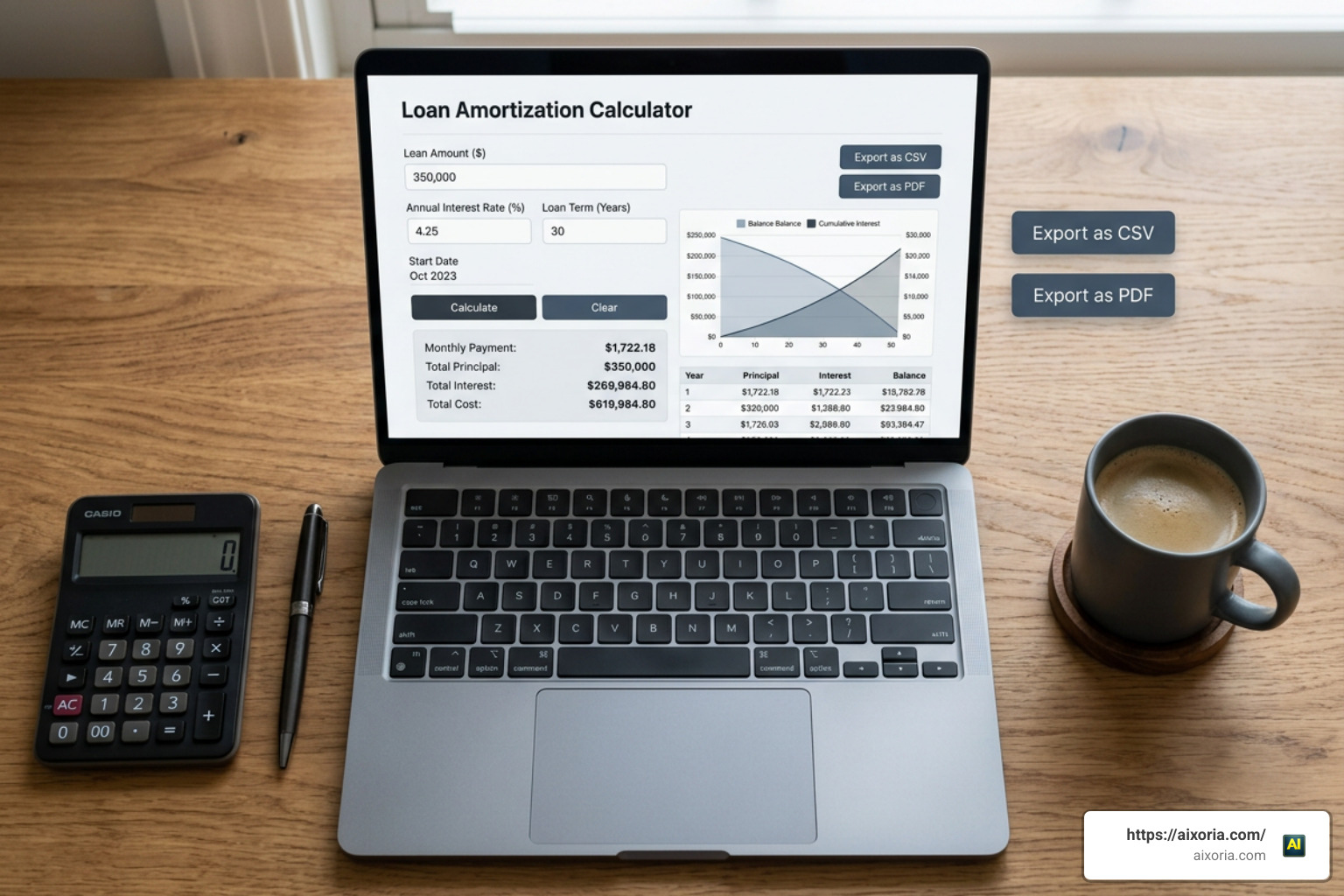
- Data Export (CSV & PDF): The ability to export your generated amortization table to a CSV file allows you to easily import the data into Excel or Google Sheets for custom budget tracking.
- Adjustable Compounding Frequencies: While most consumer loans compound interest monthly, some products compound daily, semi-annually, or continuously. Your calculator should reflect these nuances.
Why the BEST loan amortization calculator Must Support Extra Payments
If a calculator does not allow you to input extra payments, it is not the best loan amortization calculator for your needs. Modeling extra payments is the single most powerful way to visualize how you can save tens of thousands of dollars and shave years off your debt.
A top-tier tool, such as the Amortization Calculator 2026 | Full Schedule, Extra Payments & Yearly Summary or the Amortization Chart Calculator | Free Loan Amortization Schedule Maker 2026, will offer three distinct extra payment options:
- Extra Monthly Payments: Adding a consistent, small amount to your regular payment every month.
- Extra Annual Payments: Simulating a yearly extra payment, such as applying your tax refund or annual work bonus to your loan principal.
- One-Time Lump Sums: Calculating the immediate, long-term impact of applying a single cash windfall directly to your outstanding balance.
By sending extra money explicitly marked to be applied to the “principal balance,” you reduce the base on which your future interest is calculated, triggering a compounding savings effect.
How to Choose the BEST loan amortization calculator for Your Financial Goals
To make smart, pressure-free financial decisions, we recommend using a clean, ad-free calculator that functions as a progressive web app (PWA). This ensures the tool loads instantly and can even be used offline when you are sitting in a dealership or bank office comparing loan offers.
Using a dedicated calculator allows you to establish your maximum budget in a “sales-spin-free” environment before you ever talk to a salesperson. For broader financial planning, you can pair your loan analysis with other specialized tools, such as the Best Monthly Savings Calculator In 2026, to balance your debt payoff strategies against your personal savings goals.
Comparing Loan Scenarios: Terms, Rates, and Payment Frequencies
Using an amortization calculator to run side-by-side comparisons of different loan structures is highly eye-opening. Let’s look at how loan terms, interest rates, and payment frequencies dramatically alter the total cost of borrowing.
On a standard $300,000 mortgage at 6.5% interest, look at how a 15-year term compares directly to a 30-year term:
| Loan Scenario | Monthly Payment | Total Payments Over Term | Total Interest Paid | Interest Savings |
|---|---|---|---|---|
| 30-Year Fixed Mortgage | $1,896 | $682,633 | $382,633 | Baseline |
| 15-Year Fixed Mortgage | $2,613 | $470,413 | $170,413 | $212,220 |
Choosing the 15-year term requires a monthly payment that is about $717 higher, but it completely eliminates 15 years of debt and saves you over $212,000 in pure interest.
How Loan Terms Affect Monthly Payments and Total Interest
Lenders generally charge higher interest rates for longer repayment terms because they are taking on risk for a longer period. This compounding effect makes extended terms incredibly expensive.
Consider these common scenarios across different loan types:
- Auto Loans: The average auto loan interest rate in the US sits around 7.04% for a 60-month new car loan. Many dealerships will try to lower your monthly payment by offering a 72-month or 84-month term. However, extending a $35,000 car loan at 5% from 3 years to 5 years increases your total interest from $2,763 to $4,629, and leaves you “underwater” (owing more than the car is worth) for years. You can check current auto financing trends in our guide on What Are The Best Auto Loan Rates Right Now July 2026.
- Personal Loans: The interest rate you qualify for depends heavily on your credit profile. For customers with a 700 FICO score, a $5,000 loan over three years averages a 12.27% interest rate. For a larger $10,000 personal loan over 36 months, qualifying for an 8% rate versus a 22% rate means saving $2,556 in total interest. If you are consolidating high-interest debt, check out Which Banks Offer Debt Consolidation Loans For Bad Credit In 2026 to find competitive rates.
Modeling Extra Payments and Bi-Weekly Strategies
Another highly effective strategy to model on an amortization calculator is the bi-weekly payment schedule. Instead of making 12 standard monthly payments per year, you make half of your monthly payment every two weeks.
Because there are 52 weeks in a year, you end up making 26 half-payments, which equals 13 full monthly payments. This extra payment is seamlessly integrated into your year without you feeling a major budget squeeze.
On a $400,000 mortgage at 6.5% for 30 years, switching to a bi-weekly payment strategy:
- Saves approximately $90,000 in total interest.
- Shortens your loan term by about 5 years.
To run these customized scenarios yourself, we highly recommend utilizing the interactive features of the Amortization Calculator – Full Loan Payment Schedule | BasicCalc to visualize your accelerated debt-free timeline.
Frequently Asked Questions About Loan Amortization
Can an amortization calculator handle adjustable-rate loans or extra fees?
Standard amortization calculators are designed for fixed-rate installment loans where the interest rate and payment remain constant. If you are modeling an adjustable-rate mortgage (ARM), you will need a specialized ARM calculator that allows you to input rate adjustment caps and adjustment intervals.
Furthermore, basic calculators only compute your Principal and Interest (P&I) payment. They do not account for local property taxes, homeowners insurance, or private mortgage insurance (PMI), which are often held in an escrow account and added to your monthly bill.
When comparing loan offers, always input the Annual Percentage Rate (APR) rather than just the nominal interest rate, as the APR incorporates lender fees and closing costs into the calculation. To compare standard fixed-rate structures with extra payments, you can use the Loan Calculator – Monthly Payment, Amortization & Extra Payments 2026 | FreeUSCalculator.
What types of loans does an amortization calculator support?
An amortization calculator supports any fixed-rate installment loan where the debt is paid down to zero over a set number of periods. This includes:
- Mortgages: 15-year, 20-year, and 30-year fixed home loans.
- Auto Loans: Typically ranging from 24 to 72 months.
- Personal Loans: Used for debt consolidation, home improvements, or emergency expenses.
- Student Loans: Standard 10-year plans can be compared against extended 25-year plans. For example, a $50,000 federal student loan at 6.53% costs $68,040 total on a 10-year plan, but balloons to $102,300 on a 25-year plan. You can read more about student financing options in our Advantage Student Loan Review 2026 Rates Eligibility Pros Explained.
To explore calculators that support advanced structures like deferred student loans or bond-style schedules, check out Loan Calculator | Amortized, Deferred & Bond Schedule | LizoCalc or Loan Calculator – Payment & Amortization | BestCalculator.app.
How do I input data correctly to get accurate amortization results?
To get cent-accurate results that match your actual bank statements, you must input precise data:
- Exact Principal: Input the actual amount borrowed, excluding any down payments.
- Annual Interest Rate: Input your exact contract rate (e.g., 6.49%).
- Loan Term: Enter the exact term in years or total months.
- Critical Dates: For professional-grade accuracy, input your exact Loan Closing Date and First Payment Due Date. If there is a gap between these two dates, lenders charge “stub interest” (or prepaid interest) for the days between closing and the start of your first full payment period, which can slightly alter your initial balance.
Conclusion
Taking control of your personal finances requires looking past the monthly payment and understanding the true, long-term cost of debt. By utilizing the best loan amortization calculator, you can confidently model different terms, compare interest rates, and design an extra payment strategy that saves you thousands of dollars.
Whether you are buying a home, financing a vehicle, or consolidating credit card debt, visual financial planning is your ultimate superpower.
Ready to streamline your personal and business productivity even further? Discover the best AI tools for productivity in 2026 with us at Aixoria, and take charge of your financial and professional future today!