How Much Can You Actually Borrow? Understanding Cost of Attendance Loans

Which loan type allows you to borrow up to the cost of attendance, minus other aid you have received? — here’s the quick answer:
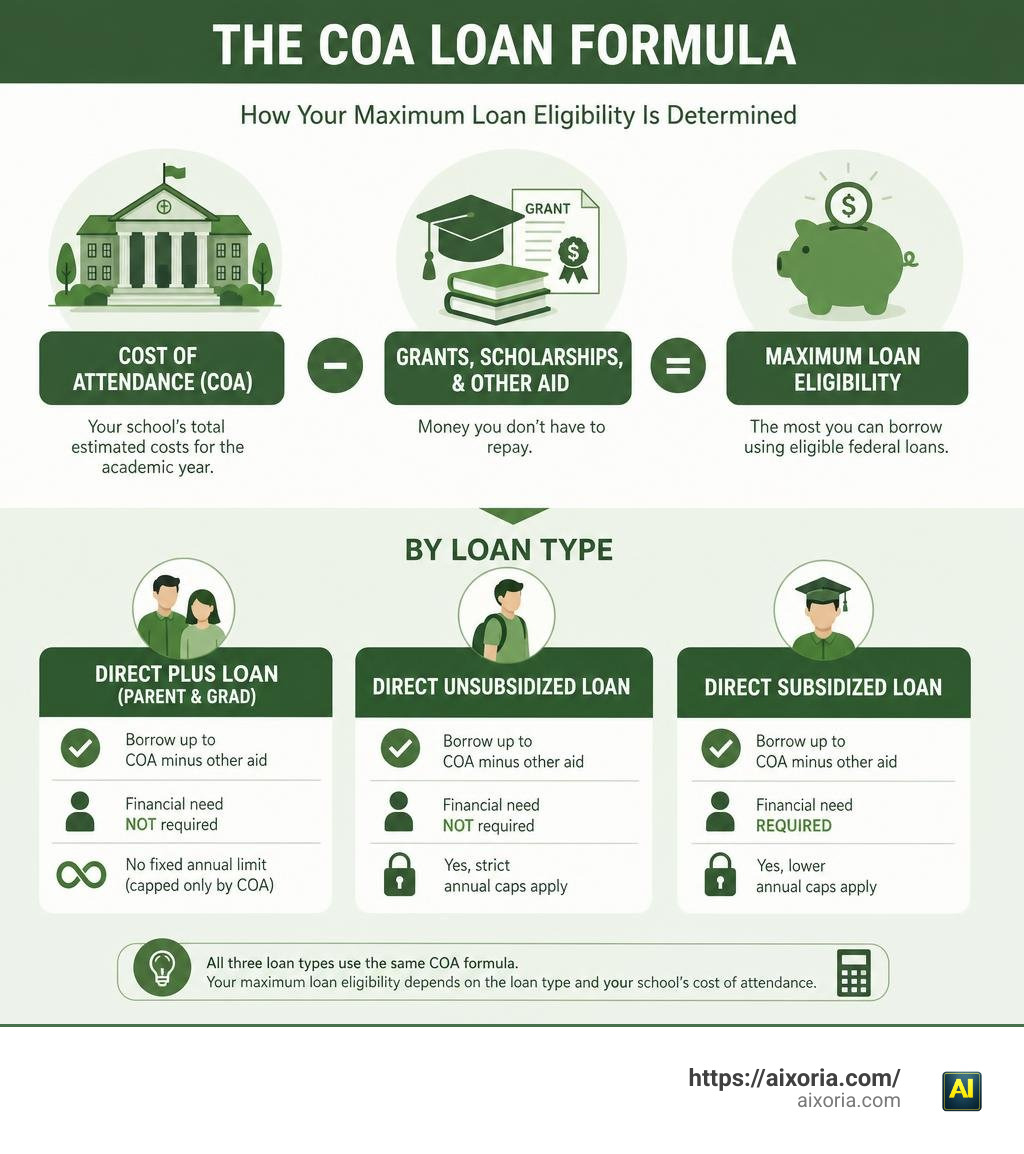
More than one federal loan type uses this formula. Here’s how they compare:
| Loan Type | Borrow Up to COA Minus Other Aid? | Financial Need Required? | Fixed Annual Limit? |
|---|---|---|---|
| Direct PLUS Loan (Parent & Grad) | Yes | No | No — capped only by COA |
| Direct Unsubsidized Loan | Yes | No | Yes — strict annual caps apply |
| Direct Subsidized Loan | Yes | Yes | Yes — lower annual caps apply |
The key distinction: Direct PLUS Loans are the only federal loans with no fixed annual dollar limit — you can borrow all the way up to your school’s full cost of attendance, minus any other aid you’ve already received. Subsidized and Unsubsidized loans use the same COA formula but are capped by strict annual and lifetime limits.
Planning for college costs is genuinely confusing. With over $1.4 trillion in outstanding federal student loan debt, most borrowers could use a clearer map of their options before signing anything.
This guide walks you through exactly which loan types use the cost-of-attendance formula, what the limits are, and how to find the right fit for your situation.
Which Loan Type Allows You Borrow Up to the Cost of Attendance, Minus Other Aid You Have Received?

When we look at how financial aid packages are structured, the term Cost of Attendance (COA) serves as the absolute ceiling for what you can receive in financial assistance. Your school’s financial aid office calculates your COA annually, taking into account tuition, mandatory fees, housing, food, books, supplies, transportation, and miscellaneous personal expenses.
To determine how much you are allowed to borrow, the federal government and school administrators use a deceptively simple formula:
Cost of Attendance (COA) – Other Financial Assistance (OFA) = Your Remaining Financial Need / Maximum Loan Eligibility
Other Financial Assistance (OFA) includes any grants, scholarships, work-study funds, or external awards you have already received.
While multiple federal loans use this formula to establish your maximum eligibility, they handle the final calculation differently. A Federal Student Aid package may include a combination of these loans, but only one category lets you cover the entire remaining gap without a fixed statutory dollar limit.
Direct PLUS Loans: Borrowing Up to the Cost of Attendance, Minus Other Aid You Have Received
Direct PLUS Loans are specifically designed to bridge the entire remaining gap between your existing financial aid and your school’s COA. There are two types of PLUS loans:
- Parent PLUS Loans: Available to eligible parents of dependent undergraduate students.
- Graduate PLUS (Grad PLUS) Loans: Available to graduate and professional students.
Unlike Direct Subsidized and Unsubsidized Loans, PLUS Loans do not have a fixed annual dollar limit set by Congress. Instead, the maximum amount you can borrow is strictly defined as the school’s COA minus all other financial aid received.
However, this flexibility comes with a trade-off. PLUS Loans require a basic credit check to ensure the borrower does not have an “adverse credit history.” Under federal guidelines, an adverse credit history includes having combined outstanding debts greater than $2,085 that are 90 or more days delinquent, or subject to collection or charge-off within the past two years. It also includes severe credit events like bankruptcies, foreclosures, or tax liens within the past five years.
If a parent or graduate student has an adverse credit history, they must secure an endorser (similar to a cosigner) who does not have an adverse credit history, or document extenuating circumstances to the Department of Education to be approved. Additionally, we must note a major regulatory shift occurring as of July 2026: the Graduate PLUS Loan program has stopped accepting new borrowers and is scheduled to be completely phased out by July 1, 2028. For students and families navigating these changes, checking Student and Parent Eligibility for Direct Loans is critical to understanding who can borrow under these evolving guidelines.
Direct Unsubsidized Loans: Limits on Borrowing Up to the Cost of Attendance, Minus Other Aid You Have Received
Direct Unsubsidized Loans also use the “COA minus other aid” formula to determine eligibility, but they are subject to strict annual and aggregate (lifetime) limits.
For example, even if a first-year dependent undergraduate student has a remaining financial gap of $15,000 after scholarships, they cannot borrow that full amount through a Direct Unsubsidized Loan. The federal government imposes a strict annual limit of $5,500 (of which no more than $3,500 can be subsidized) for first-year dependent undergraduates.
These hard caps are detailed in the Direct Loan Program Student Loans: Loan Types and Limits report. While you can borrow “up to” the cost of attendance minus other aid, your actual loan amount will always be capped by the lesser of your remaining gap or the statutory annual limit for your grade level and dependency status.
Federal Direct Subsidized vs. Unsubsidized Loans
To make the best decisions for your financial future, it helps to understand how the two primary federal student loans for undergraduate students compare.
| Feature | Direct Subsidized Loan | Direct Unsubsidized Loan |
|---|---|---|
| Target Audience | Undergraduate students only | Undergraduate, graduate, and professional students |
| Financial Need Required? | Yes | No |
| Who Pays Interest in School? | U.S. Department of Education | The Borrower |
| Interest Accrual Period | Starts after the 6-month grace period | Starts immediately upon disbursement |
| Dependent Annual Limits | $3,500 to $5,500 (based on grade level) | $5,500 to $7,500 (combined with Subsidized) |
| Independent Annual Limits | $3,500 to $5,500 (based on grade level) | $9,500 to $12,500 (combined with Subsidized) |
Always remember the golden rule of student borrowing: accept subsidized loans before unsubsidized loans because the government covers the interest while you are enrolled at least half-time. For a deeper look at evaluating these offers, check out the Top 4 Questions: Direct Subsidized Loans vs. Direct Unsubsidized Loans – Federal Student Aid guide.
Key Differences in Financial Need and Interest Accrual
The fundamental difference between these two loan types comes down to financial need and interest accrual.
Direct Subsidized Loans are reserved exclusively for undergraduate students who demonstrate financial need through the Free Application for Federal Student Aid (FAFSA). Because they are need-based, the federal government pays the interest on these loans while you are enrolled in school at least half-time, during your six-month post-graduation grace period, and during approved periods of deferment.
Direct Unsubsidized Loans do not require you to demonstrate financial need. Anyone enrolled at least half-time in an eligible program can qualify. However, interest starts accruing the moment the funds are disbursed to your school.
A simple mnemonic to help you remember: Unsubsidized starts with “U” because you are responsible for the interest from day one.
If you do not pay the interest while you are in school, that unpaid interest will accumulate and undergo capitalization. This means the accrued interest is added directly to your loan’s principal balance.
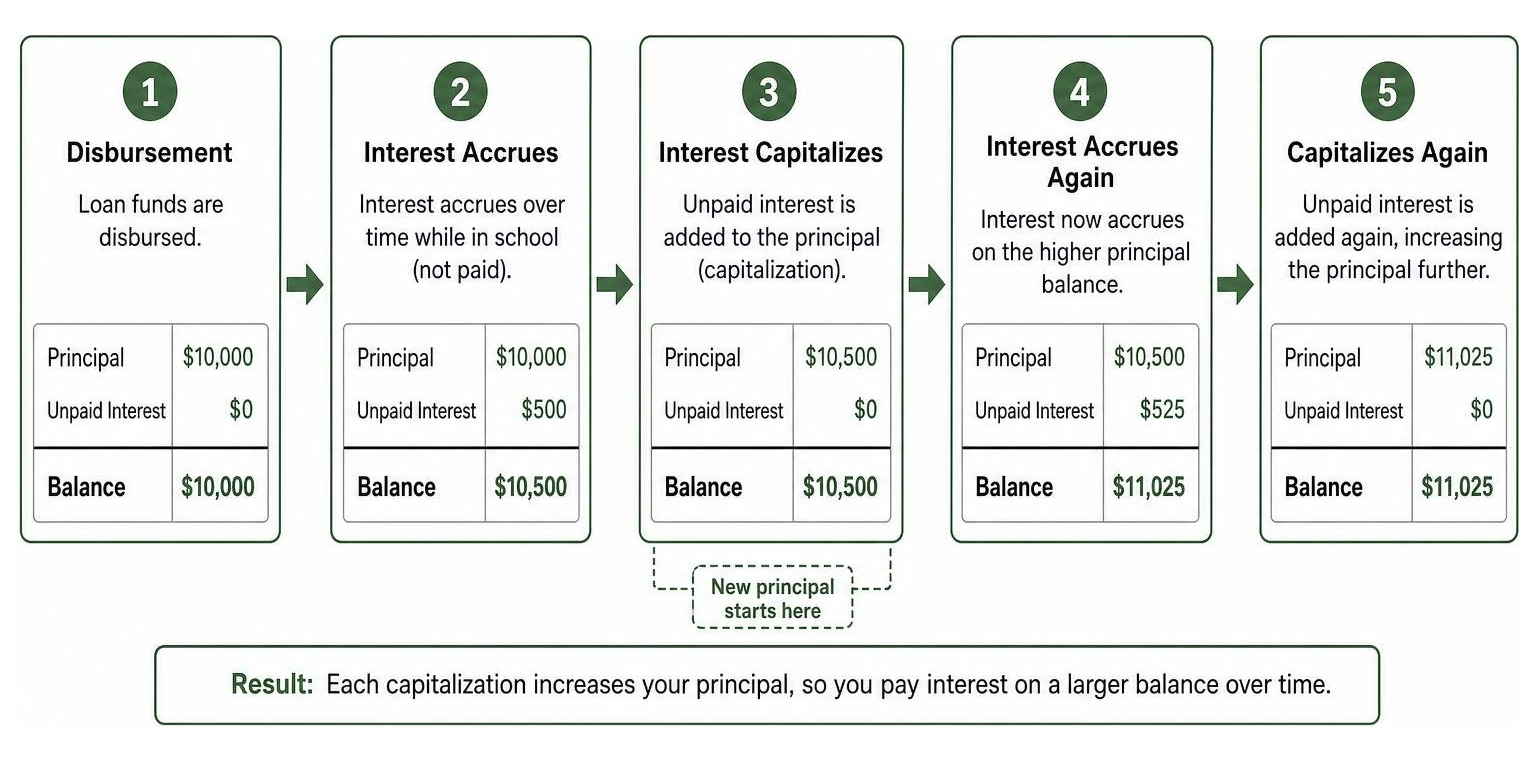
When interest capitalizes, you end up paying interest on top of interest, which significantly increases the total cost of your loan over time. Before signing your promissory note, make sure you understand these terms by reading What Document Explains Your Rights and Responsibilities as a Federal Student Loan Borrower?.
Annual and Aggregate Borrowing Limits for Undergraduate and Graduate Students
The federal government limits how much you can borrow annually and over your lifetime to prevent borrowers from taking on unmanageable debt. These limits depend heavily on your grade level and whether you are a dependent or independent student.
According to the official guidelines on Annual and Aggregate Loan Limits, the borrowing caps for the 2026-2027 academic year are structured as follows:
- Dependent Undergraduates:
- First Year: $5,500 (maximum $3,500 subsidized)
- Second Year: $6,500 (maximum $4,500 subsidized)
- Third Year and Beyond: $7,500 (maximum $5,500 subsidized)
- Aggregate Limit: $31,000 (maximum $23,000 subsidized)
- Independent Undergraduates:
- First Year: $9,500 (maximum $3,500 subsidized)
- Second Year: $10,500 (maximum $4,500 subsidized)
- Third Year and Beyond: $12,500 (maximum $5,500 subsidized)
- Aggregate Limit: $57,500 (maximum $23,000 subsidized)
- Graduate and Professional Students:
- Annual Limit: $20,500 (all Unsubsidized; graduate students are ineligible for Subsidized Loans)
- Aggregate Limit: $138,500 (including undergraduate loans)
Special Borrowing Circumstances and Private Loan Alternatives

While the standard limits cover many students, certain academic tracks and financial situations require unique rules or alternative borrowing options. If federal loans and grants are not enough, some students look into private alternatives. You can read our Advantage Student Loan Review 2026 – Rates, Eligibility, Pros Explained to see how private lenders structure their rates and terms.
Health Professions and Preparatory Coursework Exceptions
Students pursuing careers in medicine, dentistry, and other health professions often face astronomical tuition costs. To accommodate this, the federal government offers significantly higher Direct Unsubsidized Loan limits for health professions students enrolled in specific programs, such as:
- Doctor of Allopathic Medicine (M.D.)
- Doctor of Osteopathic Medicine (D.O.)
- Doctor of Dental Surgery (D.D.S.) / Doctor of Medicine in Dentistry (D.M.D.)
- Doctor of Veterinary Medicine (D.V.M.)
- Doctor of Pharmacy (Pharm.D.)
These students can receive an additional $20,000 to $26,667 in unsubsidized loans per academic year (depending on whether they are in a 9-month or 12-month program), raising their annual limit up to $40,500 or more, with an increased aggregate lifetime limit of $224,000.
There are also exceptions for students taking preparatory coursework (prerequisites required for admission to an eligible program). If you are enrolled in preparatory courses, you may borrow federal student loans for up to one consecutive 12-month period, with limits capped at $2,625 for dependent students and up to $8,625 for independent students.
Private Student Loans vs. Federal Direct Loans
Private student loans are offered by banks, credit unions, and online lenders. Like federal PLUS loans, private student loans allow you to borrow up to the school’s full cost of attendance minus other financial aid. However, they differ from federal loans in several key ways:
- Credit Requirements: Federal Direct Subsidized and Unsubsidized loans do not require a credit check or a cosigner. Private loans are heavily credit-based; you will need a strong credit history or a creditworthy cosigner to qualify and secure a favorable interest rate.
- Interest Rates: Federal student loan interest rates are fixed for the life of the loan and set by federal law. Private loans can have fixed or variable interest rates, which may fluctuate over time.
- Repayment Benefits: Federal loans offer borrower protections like Income-Driven Repayment (IDR) plans, Public Service Loan Forgiveness (PSLF), and generous deferment options. Private loans rarely offer these flexible safety nets.
Frequently Asked Questions About Cost of Attendance Loans
What happens if my parent is denied a Direct PLUS Loan?
If a dependent undergraduate student’s parent applies for a Direct Parent PLUS Loan and is denied due to an adverse credit history, the student is not left entirely empty-handed.
Under federal regulations, a Parent PLUS Loan denial automatically unlocks higher Direct Unsubsidized Loan limits for the student. The dependent student becomes eligible for the higher borrowing limits normally reserved for independent students, allowing them to borrow up to an additional $4,000 to $5,000 per year in unsubsidized loans, depending on their grade level.
If you find yourself with excess funding or need to return funds after a change in your financial aid package, you can consult our guide on Who Do You Contact If You’ve Accepted More Student Loan Money Than You Need? 2026 Guide.
How does the FAFSA determine my borrowing eligibility?
The Free Application for Federal Student Aid (FAFSA) is the gateway to all federal student aid. When you submit the FAFSA, the government calculates your Student Aid Index (SAI).
Your school’s financial aid office uses your SAI, along with your enrollment status and grade level, to build your financial aid package. They subtract your SAI and other aid from the school’s official Cost of Attendance to determine your remaining financial need.
Without a completed FAFSA on file, a school cannot process federal subsidized, unsubsidized, or PLUS loans for you.
What are the repayment options and grace periods for Direct Unsubsidized Loans?
Direct Unsubsidized Loans feature a six-month grace period that begins the day you graduate, leave school, or drop below half-time enrollment. You are not required to make payments during this time, though interest will continue to accrue.
Once your grace period ends, you will enter repayment. The federal government offers several repayment paths:
- Standard Repayment Plan: Fixed monthly payments for up to 10 years.
- Graduated Repayment Plan: Payments start low and increase every two years for up to 10 years.
- Extended Repayment Plan: Allows you to extend payments for up to 25 years (requires more than $30,000 in outstanding Direct Loans).
- Income-Driven Repayment (IDR) Plans: Sets your monthly payments based on your income and family size, with remaining balances forgiven after 20 or 25 years of qualifying payments. Certain legacy plans, like PAYE and ICR, are phasing out for new borrowers as of July 2026.
If you ever experience financial hardship during repayment, do not ignore your bills. Check our guide on Who Should You Contact If You Have Trouble Making Student Loan Payments? 2026 Guide to find resources, deferment options, or forbearance programs to keep your loans in good standing.
Conclusion
At Aixoria, we believe that funding your education shouldn’t mean sacrificing your long-term financial health. Knowing which loan type allows you borrow up to the cost of attendance, minus other aid you have received? is only the first step. The real key is borrowing responsibly—only taking what you truly need to cover your educational expenses and exhausting subsidized federal aid options before turning to PLUS loans or private alternatives.
By taking a proactive approach to your college budget, calculating interest accrual ahead of time, and staying informed about changing federal policies, you can navigate the financial aid system with confidence. For more insights on financial planning, technology updates, and smart borrowing strategies, we invite you to Explore AI Updates and Financial Guides on our platform.