Scr0ll d0wn to D0VVNL0AD
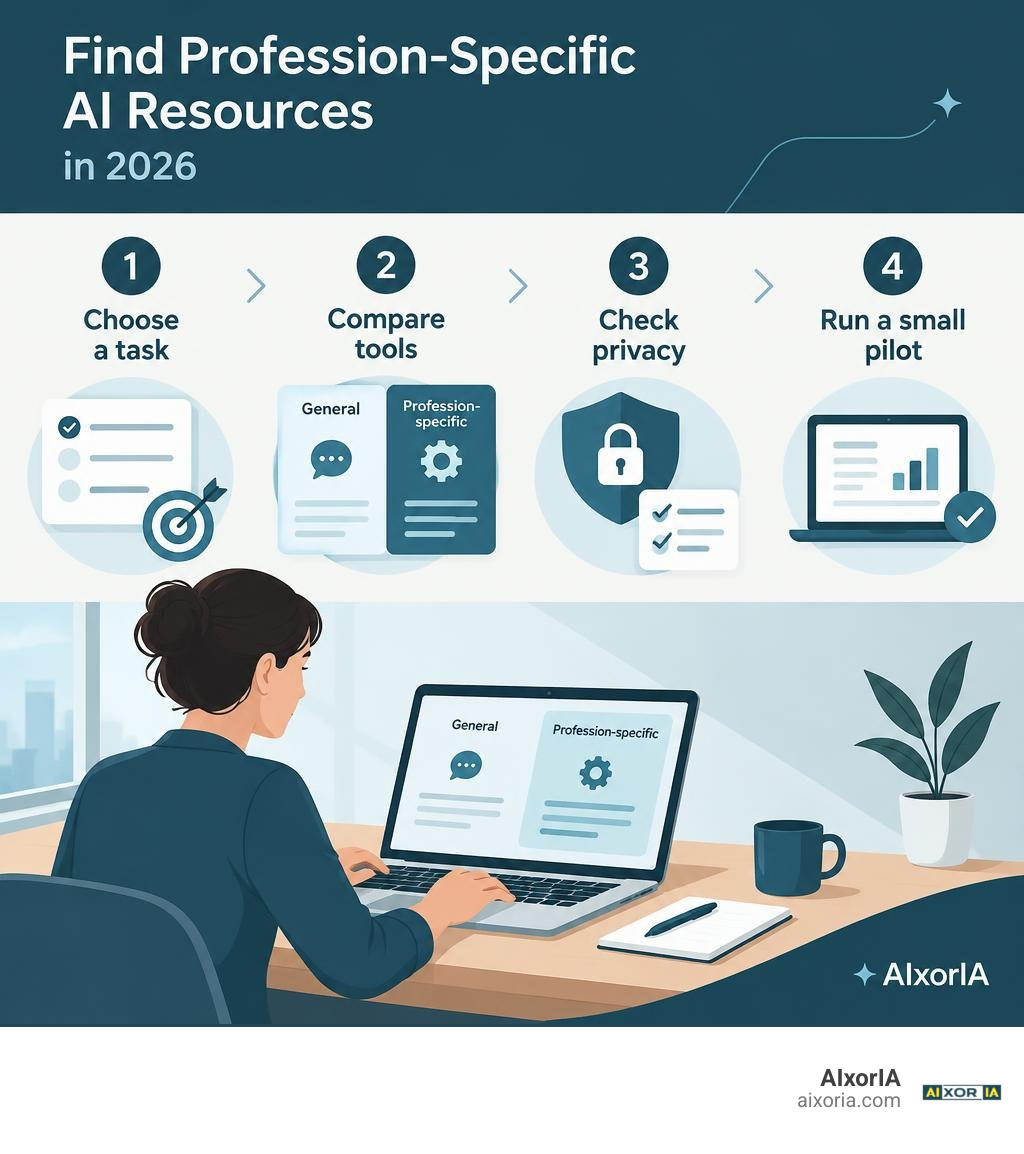
Profession-specific AI resources are tools and guides built around the tasks, software, and standards of a particular job. To find the right ones, start with one task you want to improve. Look for tools that work with your current software, check how they handle sensitive data, and test their output on a real example before paying or rolling them out to your team.
A general chatbot can help draft ideas. A tool built for your workflow may be better suited to tasks such as project updates, data charts, or legal research. The key is to choose by workflow fit, not brand recognition, and keep a person responsible for checking the results.
Why Profession-Specific AI Tools Outperform General Chatbots
Every day, millions of workers ask broad conversational chatbots to summarize documents, outline strategies, and draft messages. While general-purpose chatbots excel at conversational brainstorming, they quickly stumble when faced with rigid domain standards, strict regulatory constraints, and complex file ecosystems.

In professional environments, context is everything. Asking a general chatbot to draft an engineering specification or verify a tax liability often leads to generic fluff or subtle errors. In contrast, specialized systems connect directly to your industry software, index your domain standards, and adhere to specialized formats.
To understand where different solutions shine, we categorize modern productivity software across three distinct operational models:
| Tool Category | Operational Model | Best Suited For | Key Strength |
|---|---|---|---|
| Conversational AI | Chat-based prompt and response | Brainstorming, drafting short text, general queries | Broad versatility across topics |
| Single-App AI Tools | Embedded intelligence inside existing software | Document formatting, formula generation, slide creation | Seamless in-app task efficiency |
| Autonomous AI Agents | Multi-step execution across desktop and browser | Cross-app data entry, end-to-end task execution | Independent problem solving |
When modern teams need complete multi-step task execution, adopting autonomous AI agents within robust business productivity software bridges the gap between simply generating text and actually completing end-to-end assignments.
Evaluating Conversational AI vs. Autonomous Agents
The primary difference between conversational AI and modern autonomous agents lies in execution authority. Conversational AI acts as a reactive sparring partner: you provide a prompt, and it produces text or code. However, you must still copy that output, check it, and paste it into your target application.
Single-app tools embed generative power directly into existing platforms, such as your word processor or spreadsheet editor, reducing context switching for single-step improvements.
Autonomous AI agents execute multi-step workflows across separate programs. For instance, an autonomous agent can gather competitor pricing across multiple browser windows, populate a local spreadsheet, and prepare an email draft for your review. In software engineering benchmarks, top-tier frontier models reach 64.9% accuracy on SWE-bench real-world coding benchmarks, illustrating how execution capabilities handle complex, multi-file code modifications rather than simple snippets. Managing these autonomous pipelines effectively requires structured AI agent orchestration to maintain guardrails and ensure accuracy across complex environments.
Hallucination Rates and Domain Accuracy in 2026
One of the largest risks in deploying generic chatbots for technical workflows is output fabrication. Research indicates that AI hallucination rates fluctuate between 10% and 38% depending on prompt design, context length, and model architecture.
In fields where precision is vital, relying on generic AI without dedicated fact-checking can lead to severe operational errors. Industry-tailored tools reduce these risks by employing Retrieval-Augmented Generation (RAG) and constraining responses to vetted domain libraries. When handling data-heavy tasks, consulting the best AI tools for technical information ensures that your team relies on grounded citations rather than plausible-sounding guesswork.
Top AI Tools Across Key Professional Roles
According to recent enterprise research, 92% of organizations plan to increase their AI investments over the next three years. However, only 1% of businesses currently consider themselves at full AI maturity. This gap presents an opportunity for professionals who learn how to implement tailored tools today.

According to Pew Research, approximately 21% of U.S. workers report that at least some of their job involves AI. To maximize efficiency, teams must identify solutions tailored directly to their role.
Profession-Specific Tools for Healthcare and Legal Experts
Regulated professions require strict data privacy, traceability, and validated sources. General-purpose consumer models can pose risks in these settings; a March 2026 Brown University study revealed that consumer chatbots frequently breach core ethical standards when applied to clinical decision-making.
In medicine, nurses and clinicians rely on ambient clinical documentation systems to capture bedside patient encounters and automatically populate Electronic Health Records (EHR), often saving over 30 minutes of charting per shift. For evidence-based clinical queries, dedicated clinical decision support systems deliver verified, peer-reviewed medical guidance directly at the point of care. Explore our comprehensive healthcare professionals AI guide and our list of medical student study tools for specialized clinical applications.
In legal practice, accuracy is non-negotiable. Specialized legal research platforms connect generative models exclusively to verified case law and statutory databases, preventing fabricated case citations. Legal teams can use analytical platforms for initial contract drafting, provided every clause is cross-checked against primary sources.
Profession-Specific Software for Engineering, Data, and Skilled Trades
Technical disciplines require context-aware software that integrates directly with development environments, data pipelines, and field hardware.
- Software Developers: Development teams utilize dedicated coding assistants and inline editors to handle boilerplate coding, automated refactoring, and inline debugging. Developers using specialized coding tools experience a 35% to 45% reduction in coding time on routine tasks.
- Data Analysts: Analysts use automated business intelligence platforms to translate natural-language questions into interactive visualizations and predictive models. You can explore advanced analytics tools in our guide to data analysis and visualization.
- Industrial & Mechanical Engineers: Engineers deploy simulation-focused platforms to model stress tests, design physical components, and monitor assembly line telemetry. Find top picks in our overview of industrial engineering tools.
- Skilled Field Trades: Even field service operations benefit from tailored workflows. Platforms tailored for electricians, HVAC technicians, and plumbers automatically generate permit-aware estimates and custom invoices that account for trip charges and materials.
Solutions for Marketing, Project Management, and Education
Knowledge workers and creative teams rely on AI to organize unstructured communication and accelerate production timelines:
- Marketing & Content Teams: Copywriters and brand strategists use specialized generation engines to maintain consistent brand voices across high-volume campaigns, as detailed in our guide to content creation platforms. Visual designers utilize generative design suites, benefiting from commercial intellectual property indemnification.
- Project Managers: Modern operations managers leverage automated workflow systems to automatically transcribe meetings, generate action items, and allocate tasks across teams. For progress tracking, teams rely on dedicated project reporting solutions.
- Educators & Trainers: Teachers utilize specialized educational software to build lesson plans, design differentiated grading rubrics, and draft parent communications, which we explore further in our roundup of tools for teachers.
How to Evaluate and Integrate AI Tools into Your Workflow
With hundreds of new applications launching each month, choosing the right software requires a clear evaluation framework rather than chasing brand hype.
When auditing tools for your team, we recommend scoring candidates against five core criteria:
- Workflow Integration: Does the tool embed natively into your existing software (e.g., your IDE, CRM, or document suite), or does it require constant copying and pasting?
- Context Retention & Capacity: Can the platform process large files, complete code repositories, or lengthy client records without dropping contextual details?
- Data Privacy & Training Policies: Does the vendor train its public models on your proprietary inputs? Look for enterprise zero-data-retention agreements.
- Output Verifiability: Does the system provide transparent source citations, audit logs, and clear references for its generated claims?
- Human-in-the-Loop Controls: Does the platform include built-in approval gates before executing high-impact, irreversible actions?
Aligning your technology choices with long-term goals is easier when using proven business strategy tools alongside modern data integration solutions to connect your tool stack securely.
Security, Privacy, and Human-in-the-Loop Governance
Integrating digital tools into enterprise operations introduces serious privacy, compliance, and liability considerations. Unchecked data sharing can inadvertently expose sensitive intellectual property or violate confidentiality laws such as HIPAA or GDPR.
Organizations must implement clear governance frameworks:
- Enforce Human Oversight: Never allow automated systems to publish public communications, execute financial transactions, or submit legal briefs without a human sign-off.
- Anonymize Sensitive Data: Strip personally identifiable information (PII) and proprietary credentials before uploading data to third-party tools.
- Establish Approved Tool Registries: Maintain an explicit catalog of vetted software so employees avoid utilizing unvetted consumer tools for work tasks.
Building a Sustainable Personal Prompt Library
One of the most effective productivity habits is curating a personal prompt library. Professionals who maintain a collection of 20 to 30 tested, reusable prompts report a 3x to 4x improvement in daily output speed compared to drafting prompts from scratch.
To build an effective library:
- Standardize Your Format: Structure prompts with clear roles, precise context, explicit constraints, and target output examples.
- Document Edge Cases: When a prompt generates a hallucination or incorrect formatting, add negative constraints (e.g., “Do not include conversational preamble; return only the structured table”).
- Iterate Regularly: Refine your prompt templates as underlying models receive seasonal updates.
Navigating AI in Career Development and Modern Hiring
AI is also changing how job seekers navigate the employment market, from resume drafting to automated technical interview preparation.
Career platforms offer powerful tools for exploring adjacent professions, identifying skill gaps, and summarizing salary trends. However, navigating modern career development requires balancing automated assistance with genuine personal experience.
Ethical AI Usage in Job Searches and Portfolios
When applying for roles, automated assistants can help analyze job postings for missing keywords, refine bullet points, and simulate practice interviews using advanced voice modes. You can explore practical techniques for job seekers in Oregon State University’s resource on AI Tools for Career Development.
To maintain credibility during your search:
- Avoid Complete Text Automation: Do not rely on AI to write complete cover letters or resumes from scratch. Hiring teams quickly spot generic phrasing, and applications lacking authentic personal voice often get rejected.
- Simulate Roleplays: Use conversational voice modes to run mock interviews, receiving instant critique on your pacing and technical explanations. This aligns with techniques used in modern corporate training roleplays.
- Protect Portfolio Integrity: Hiring managers increasingly use specialized tools to detect resume fraud to identify fabricated experience and automated submissions.
How Employers Evaluate AI Literacy in 2026
Employer perspectives on AI literacy are pragmatic. In an Oregon State University employer survey, 58% of employers stated they plan to maintain entry-level hiring numbers at consistent levels despite workplace automation. Furthermore, only 7% of surveyed employers rated entry-level AI literacy as “very important” or “essential.”
Instead of seeking candidates who simply know how to type prompts into a chatbot, employers prioritize critical thinking, domain knowledge, and the ability to spot technical hallucinations. Meanwhile, technical hiring is pivoting toward specialized implementation; LinkedIn data reveals that dedicated AI engineering roles grew by over 25% year-over-year. Employers value workers who understand their core profession first, using modern tools as an accelerator rather than a replacement for foundational competence.
Frequently Asked Questions About Profession-Specific AI
What criteria should I prioritize when selecting an AI tool for my job?
Focus first on workflow fit and data security. A tool that integrates directly into your daily software (like your IDE, CRM, or project management board) saves more time than a standalone web chat. Ensure the vendor guarantees enterprise data privacy and offers verifiable citations for its outputs.
How can professionals avoid hallucinations when using AI for technical tasks?
Ground the tool’s context by supplying verified source documents directly or using systems with Retrieval-Augmented Generation (RAG). Keep prompts specific, demand source citations, and always maintain a human-in-the-loop review process before using any AI-generated technical data.
Do employers prefer candidates who use AI tools in their daily work?
Employers value productivity, problem-solving, and domain expertise. While practical familiarity with industry-standard software is advantageous, hiring managers place higher value on authentic problem-solving skills, critical thinking, and the ability to validate automated outputs.
Conclusion
The shift from generic chatbots to profession-specific software marks the next era of workplace productivity. Whether you are streamlining clinical documentation, refactoring enterprise software, or building data visualizations, choosing tools designed around your industry’s specific workflows eliminates busywork while keeping output standards high.
At AIxorIA, we curate the top software solutions, in-depth tutorials, and practical productivity guides designed to help businesses optimize performance. To find the right resources for your role, discover curated tools and guides at AIxorIA and take your daily workflow to the next level.
1 thought on “How to Find Profession-Specific AI Resources in 2026”