Understanding AI Agent Orchestration in 2026
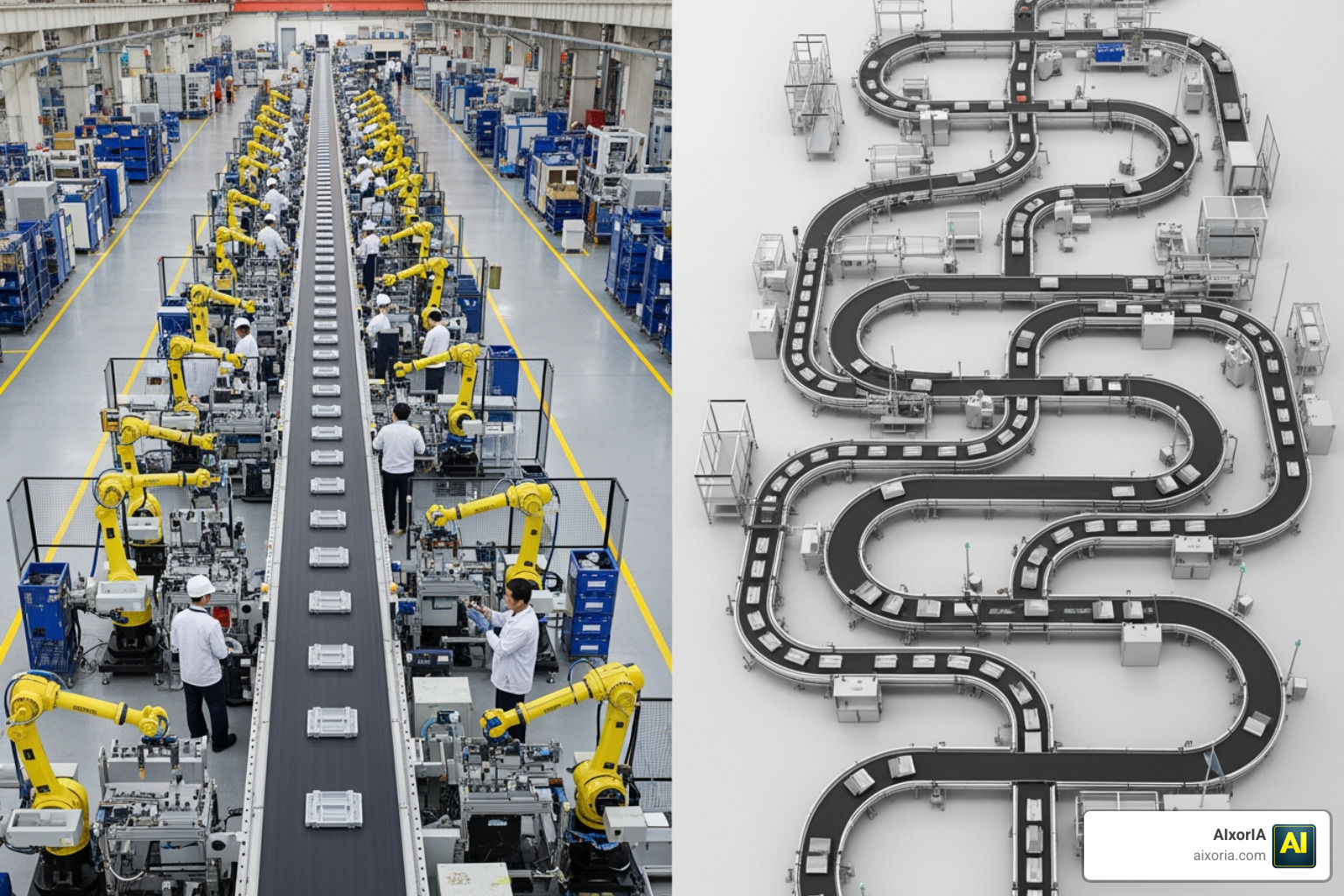
To find the Best AI Agent Orchestration Tool, we first need to understand what we are actually managing. In 2026, the tech world distinguishes clearly between general AI orchestration and agentic orchestration. General orchestration is like a simple assembly line: data goes in, a model processes it, and an output comes out. This linear approach is often referred to as “chaining,” where each step is hard-coded and inflexible.
Agent orchestration is much more dynamic. It involves agentic reasoning, where the system doesn’t just follow a straight line; it stops to think, evaluates its own progress, and adjusts its strategy if it hits a roadblock. It uses task decomposition to break a huge project—like “launch a marketing campaign”—into smaller pieces like “research competitors,” “write copy,” and “schedule posts.” This allows for a level of autonomy previously unseen in enterprise software.
Key technical drivers in 2026 include:
- Function Calling: This is how agents “handshake” with your existing tools, like your CRM or email provider.
- State Management: This ensures the “memory” of a conversation or task isn’t lost as it moves from one agent to another.
- Autonomous Planning: Instead of you drawing a flowchart, the agent looks at the goal and builds its own path.
Research into declarative agent infrastructure shows that treating agents like “infrastructure-as-code” is the new gold standard for reliability. If you want to know more about the foundational tech, check out our guide on What Are the Best Tools for AI Orchestration.
Why Enterprises Need the Best AI Agent Orchestration Tool
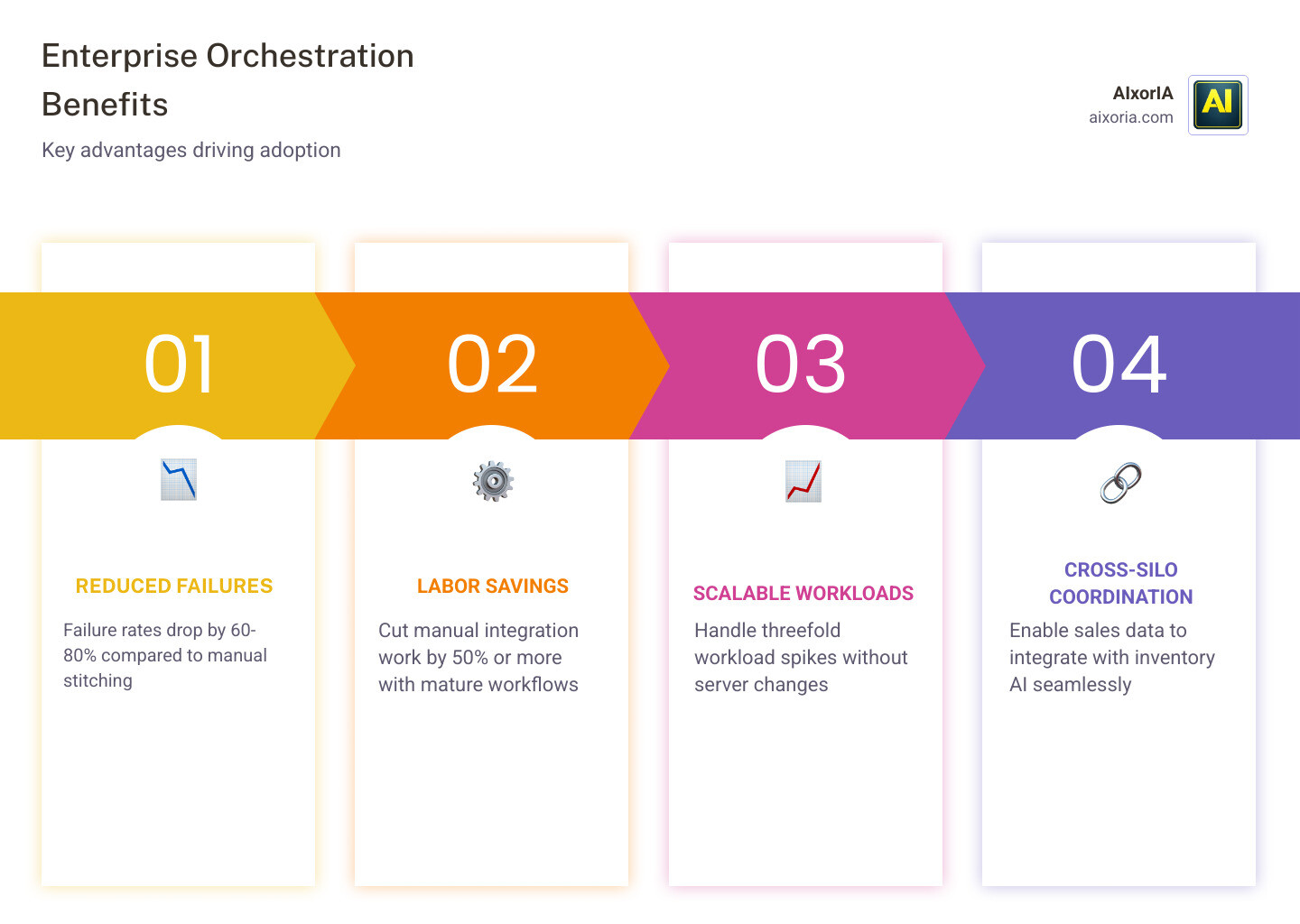
Why is everyone talking about this now? Because the stakes have never been higher. Statistics show that organizations implementing orchestration patterns see failure rates drop by 60-80 percent compared to those trying to stitch things together manually. This is because orchestration tools provide a safety net, catching errors before they cascade through the system.
For a large enterprise, the Best AI Agent Orchestration Tool is a massive cost-saver. Mature workflows can reduce manual integration work by 50% or more. Imagine a retailer during the holiday rush: they can scale their AI recommendation engines to handle a threefold workload increase without touching their underlying servers, then scale back down in January. This elasticity is crucial for maintaining profit margins in a volatile global market.
Beyond just saving money, these tools offer:
- Cross-Silo Coordination: Getting your sales data to talk to your inventory AI.
- Reliability Patterns: Automatic retries if a model “hallucinates” or a server goes down.
- Security: As highlighted in our look at Top AI Orchestration Tools Focused on Security in 2026, keeping your proprietary data safe is now a built-in feature, not an afterthought.
For more on enterprise-specific options, see our list of Top AI Orchestration Tools for Enterprises in 2026.
Core Architectures: Centralized vs. Decentralized Orchestration
Not all orchestration works the same way. Choosing the Best AI Agent Orchestration Tool depends on how you want your “digital employees” to interact.
| Model | How it Works | Best Use Case |
|---|---|---|
| Centralized | One “brain” (orchestrator) gives orders to everyone. | Simple, linear business processes. |
| Hierarchical | A supervisor agent manages several worker agents. | Complex projects like software development. |
| Decentralized | Agents talk to each other directly (Peer-to-Peer). | Highly creative or unpredictable tasks. |
| Federated | Multiple independent systems coordinate. | Multi-cloud or multi-department operations. |
Many modern frameworks, like those found in the Top 9 AI Agent Orchestration Frameworks in 2026, use the planner-worker pattern. Here, one agent creates a plan and others execute it. Others use a swarm-loop topology where agents pass tasks around until the job is done.
When looking at research on parallel agent coordination, we see that the most successful systems use DAG-based (Directed Acyclic Graph) dependency. This is just a fancy way of saying the tool knows exactly which task must finish before the next one can start.
Comparing the Best AI Agent Orchestration Tool Categories
We can group the Best AI Agent Orchestration Tool options into two main camps: those for the “builders” (developers) and those for the “users” (business leaders).
Choosing the Best AI Agent Orchestration Tool for Developers
For the coding crowd, open-source frameworks are king. Tools like LangGraph or the Orloj runtime allow for high-level customization. Developers love these because they can use version-controlled YAML files to define agent behavior—treating AI exactly like they treat software code.
If you are building custom LLM pipelines, you need modular libraries that let you swap models (like moving from GPT-4 to Claude 3.5) without rebuilding the whole system. For a deep dive into these, visit Best AI Tools for Building AI Agents in 2026.
Selecting the Best AI Agent Orchestration Tool for Business Users
If you don’t know how to code, don’t worry. Tools like Zapier and Domo have revolutionized the space with visual editors. You can build a “crew” of agents using natural language—literally just describing what you want them to do.
These platforms often feature 9,000+ app integrations, allowing you to connect your AI to everything from Slack to Salesforce with a few clicks. We’ve tested these extensively in our guide on the Best AI Agent Builder Software in 2026 Tested. For more options, see The 7 Best AI Agent Orchestration Tools in 2026.

Key Features of Top-Tier Orchestration Platforms
When we evaluate the Best AI Agent Orchestration Tool for our clients at AIxorIA, we look for these “must-have” features:
- Human-in-the-Loop (HITL): The system should pause and ask for your approval before doing something big, like sending a wire transfer or publishing a website. This ensures that while the AI is autonomous, it remains accountable to human oversight.
- Observability Dashboards: You need to see exactly what your agents are doing in real-time. If an agent is spending too much money on “tokens” or getting stuck in a logic loop, you need to know immediately to prevent budget overruns.
- Role-Based Access Control (RBAC): Not every agent should have access to your company’s payroll data. Granular permissions are vital for maintaining internal security.
- Low Latency: In 2026, we look for sub-millisecond access for “hot” data to keep agents snappy and responsive during customer interactions.
- Vector Search Integration: This allows agents to quickly “read” your company’s PDFs, manuals, and internal wikis to find answers. By integrating with a vector database, the orchestration tool gives agents a “long-term memory” that is specific to your business context.
Understanding which AI capability enables autonomy planning tool use is vital for picking a tool that won’t get stuck. For a list of the heavy hitters, check out the Top 5 Tools for Building AI Agents for Enterprise in 2026.
Frequently Asked Questions about AI Agent Orchestration
What is the difference between AI orchestration and AI agent orchestration?
Think of general AI orchestration as a script: “Step A happens, then Step B.” AI agent orchestration is more like a conversation. It involves multiple autonomous agents that can change their plans based on new information. While general orchestration handles data flow, agent orchestration handles reasoning and decision-making across complex, multi-step environments.
How do I choose the Best AI Agent Orchestration Tool for my team?
It comes down to three things:
- Technical Skill: Do you have developers (use LangGraph/AutoGen) or just business users (use Zapier/Domo)?
- Integrations: Does the tool connect to the software you already use, such as your ERP or specialized industry databases?
- Governance: Do you need strict security audits, SOC 2 compliance, and human approval gates?
Can these tools handle real-time data and human feedback?
Absolutely. By 2026, the Best AI Agent Orchestration Tool options all include “Human-in-the-loop” checkpoints. This means the AI can do 90% of the work, but a human still hits the “Go” button on the final 10%. This is essential for maintaining accuracy and trust in business processes. Furthermore, these tools now support streaming data, allowing agents to react to live market changes or customer behavior as it happens.
Conclusion
The journey to finding the Best AI Agent Orchestration Tool is about more than just picking a software—it’s about designing a more efficient future for your team. Whether you choose the developer-friendly flexibility of an open-source framework or the “it just works” simplicity of a no-code builder, the goal is the same: reducing chaos and maximizing the power of AI.
At AIxorIA, we specialize in making this transition smooth. We offer custom AI solutions, tool training workshops, and performance audits to ensure your “digital symphony” is playing in perfect harmony. If you’re ready to stop managing a mess of apps and start leading a team of intelligent agents, we’re here to help with simple language and affordable expertise.
For more insights into how these systems work, explore our guide on Conversational AI Tools in 2026 Multimodal Memory Autonomous Intelligence Explained or browse our AI tutorials and workshops to start building today.

1 thought on “Best AI Agent Orchestration Tools in 2026: Top Picks for Developers & Teams”