AI Tools for Teachers to Create Lesson Plans and Quizzes
Scr0ll d0wn to D0VVNL0AD
AI tools for teachers to create lesson plans and quizzes can turn a learning goal into a draft lesson, questions, an answer key, and an exit ticket. To get a useful result, enter the grade, subject, lesson length, learning goal, and exact curriculum standard. Then check the facts, question difficulty, and standards match before sharing anything with students.
The real benefit is less time spent on a first draft, not less need for teacher judgment. This guide shows how to choose a tool, adapt materials for different learners, and protect student data.
The Impact of AI Tools for Teachers to Create Lesson Plans and Quizzes
Teaching has always required balancing classroom instruction with hours of behind-the-scenes administrative preparation. Between curriculum mapping, formative assessment building, and grading, educators frequently work beyond contract hours just to stay afloat. Modern artificial intelligence changes this workload dynamic by taking on the mechanical aspects of instructional design.
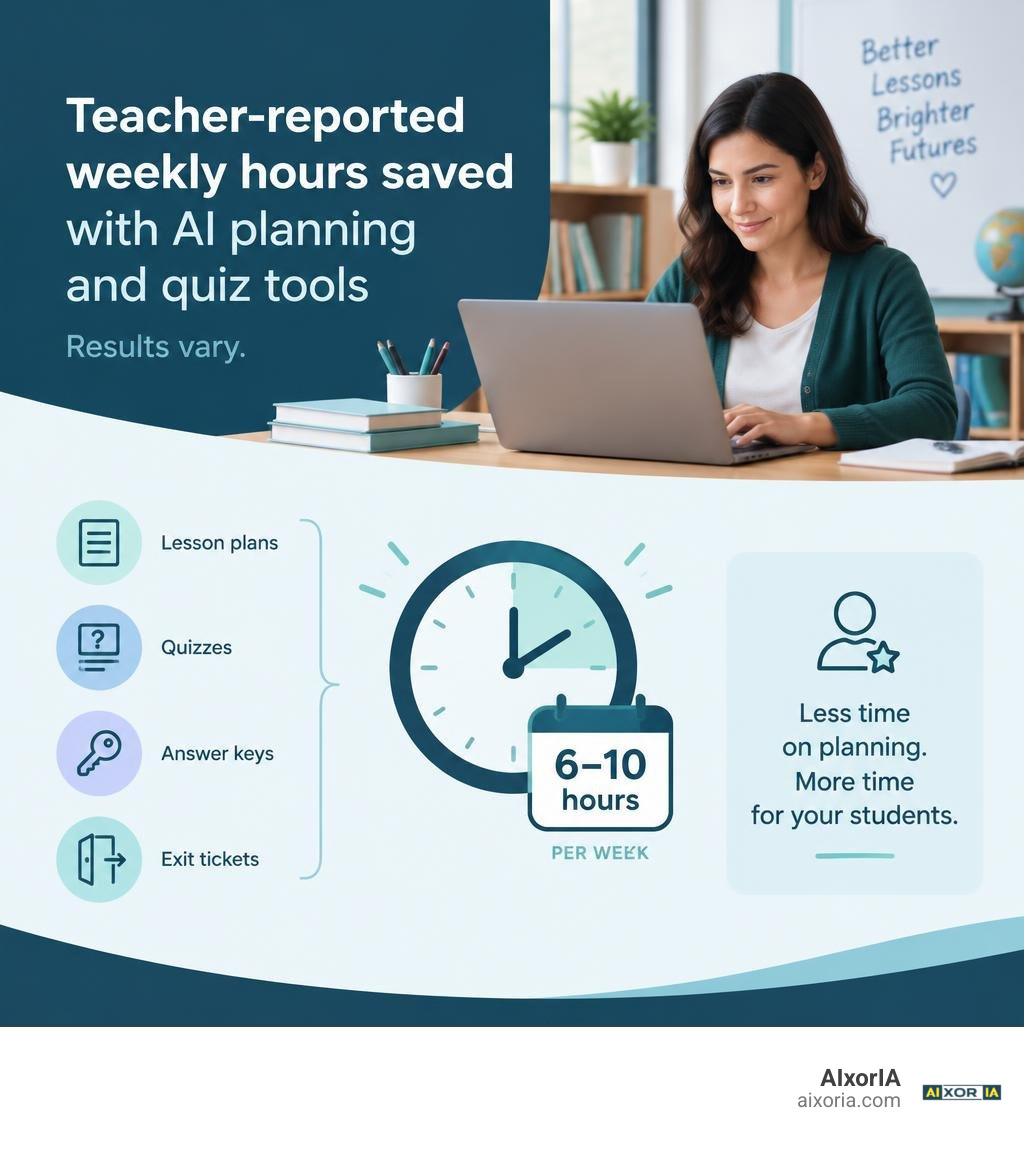
Surveys indicate that over 61% of educators now use artificial intelligence in some capacity. Platforms designed specifically for pedagogy allow teachers to cut routine planning, resource development, and assessment drafting time by 50% to 70%. When teachers reclaim an average of 6 to 10 hours each week, they redirect their energy toward direct student intervention, building relational trust, and refining pedagogical strategies.
Reclaiming those hours begins with choosing the best AI tools for teachers in 2026, giving educators practical systems that produce classroom-ready materials rather than generic chatbot responses.
Core Capabilities of AI Tools for Teachers to Create Lesson Plans and Quizzes
Purpose-built teaching engines differ fundamentally from general-purpose writing software. Instead of generating unformatted walls of text, these platforms provide guided templates that mirror recognized educational design frameworks:
- Structured Lesson Outlines: Generate clear phases including anticipatory sets, direct instruction models (such as “I Do, We Do, You Do”), guided practice, independent activities, and closing wrap-ups.
- Targeted Learning Objectives: Automatically write measurable goals using Bloom’s Taxonomy and Depth of Knowledge (DOK) levels.
- Multi-Format Quiz Generation: Build item banks featuring multiple-choice questions, true/false checks, fill-in-the-blank items, matching exercises, and open-ended constructed responses complete with answer keys and distractor explanations.
- Formative Checks and Exit Tickets: Quickly generate quick 2-to-3 question diagnostic tickets to gauge daily conceptual mastery.
- Rubric and Criteria Builders: Create analytic and holistic grading rubrics with descriptive performance levels aligned with specific learning targets.
- Complementary Worksheets and Handouts: Auto-generate leveled reading passages, graphic organizers, vocabulary lists, and practice worksheets from a single prompt.
Differentiating Instruction with AI Tools for Teachers to Create Lesson Plans and Quizzes
Meeting the individual needs of 25 to 30 students across varied reading levels and learning styles is one of the most time-consuming tasks in education. Specialized classroom AI tools make adaptive learning practical at scale.
For instance, teachers can take a complex historical primary source or scientific article and generate three distinct reading versions—one below grade level, one on grade level, and one for advanced learners—while maintaining identical core vocabulary and conceptual objectives.
For multilingual learners (ELL/ML), platforms can provide instant translation into over 50 languages, build bilingual glossaries, and add sentence starters or visual scaffolding. For students with Individualized Education Programs (IEPs), these tools break down complex multi-step assignments into chunked tasks, generate simplified practice problems, and embed explicit scaffolds without requiring teachers to spend hours rebuilding lessons from scratch.
Key Features of Modern Lesson Planning and Quiz Generators
Selecting the right instructional design tool depends on understanding how various platforms support standards, formatting, and export workflows.
| Feature Category | Basic Chatbots | Specialized AI Lesson Planners |
|---|---|---|
| Curriculum Alignment | Requires manual prompt entry | Built-in drop-down menus for Common Core, NGSS, and state frameworks |
| Output Formatting | Raw markdown or plain text | Structured tables, editable slides, and formatted handouts |
| Assessment Variety | Basic question lists | Distractor rationales, DOK leveling, and multi-format items |
| Differentiation | Manual rewriting required | One-click Lexile/reading level adjustments and bilingual translation |
| Export Integrations | Copy-paste only | Direct export to Google Docs, Microsoft Word, Forms, and LMS platforms |
Standards Alignment and Curriculum Mapping
Educational integrity relies on strict alignment with official standards. Leading lesson planning platforms incorporate official frameworks directly into their architectures. Whether you teach under Common Core State Standards (CCSS), Next Generation Science Standards (NGSS), or regional state frameworks, dedicated generators ensure every activity maps directly to measurable criteria.
Specialized platforms eliminate the guesswork of standards alignment by offering standards-aware drafting across K-12 subjects, generating synchronized units, handouts, and assessments. Some tools allow educators to draft complete, standards-aligned instructional units in under a minute with structured notes and glossaries, while others provide specialized curriculum mapping for international standards and frameworks, ensuring rapid compliance and documentation.
By anchoring AI generations to vetted standards, educators maintain instructional rigor while saving hours of manual curriculum cross-referencing.
Multi-Format Assessment and Automated Grading
A great lesson plan requires accurate assessment to verify student understanding. AI assessment builders analyze your lesson objectives or uploaded reference texts to produce balanced tests that measure both foundational recall and higher-order thinking.
Modern tools construct multiple-choice questions with plausible distractors that pinpoint specific student misconceptions. In addition to creating tests, many platforms now include automated scoring and rubric-based feedback tools. When reviewing student responses, AI grading engines analyze short answers or scanned handwritten work against custom rubrics, generating targeted, constructive feedback for each learner. This gives students rapid input while relieving teachers of weekend grading marathons. Pair these platforms with leading content creation tools to create visually engaging assignments and supplemental media.
Integrating AI into Existing Classroom and Lesson Workflows

Integrating AI into your daily routine should simplify your workflow rather than add another complex system to manage. The most sustainable way to adopt these tools is by establishing a repeatable planning sequence.
For broader classroom efficiency, educators often connect their lesson preparation tools with dedicated productivity tools for educators, streamlining task organization and project timelines.
Step-by-Step Prompting and Context Setting
When generating materials with open workspaces or modular tools, output quality depends directly on your input specificity. Use a clear prompting formula:
- Define the Role and Audience: State your grade level, subject, and any student demographics (e.g., “Act as an 8th-grade physical science teacher designing a lesson for a mixed-ability class with emerging bilingual learners”).
- State the Standard and Objective: Identify the exact standard code and learning target (e.g., “Align with NGSS MS-PS1-2: Analyze and interpret data on the properties of substances before and after the substances interact”).
- Specify Duration and Structure: Detail the class period length and preferred instructional model (e.g., “50-minute lesson using a 5E instructional model”).
- Outline Assessment Needs: Request specific assessment types (e.g., “Include a 4-question formative quiz with multiple-choice items, rationales for incorrect answers, and a 1-question exit ticket”).
Once the draft is generated, turn it into classroom visual aids or slide decks using modern tools for classroom presentations, turning text outlines into student-ready presentations in minutes.
For quick tool selection, practical resource collections and curated roundups provide organized directories of specialized planning and quiz utilities.
Live Assessment Delivery and Real-Time Insights
Modern AI quiz platforms extend beyond paper generation by enabling live, interactive assessment delivery. Teachers can launch web-based quiz sessions where students join via a short link or QR code on their own devices without needing personal accounts.
As students answer questions, the platform aggregates response data in real time, displaying item-by-item difficulty analyses and identifying class-wide conceptual gaps. If data shows that 60% of students missed a question on fraction division, the teacher can immediately pause the class, adjust instruction, and re-teach the concept before moving forward.
Data Privacy, Ethics, and Limitations in Education
While artificial intelligence offers clear efficiency gains, using digital tools in schools requires careful attention to student privacy, data compliance, and ethical standards.

Educators must balance technological convenience with institutional safety guidelines, especially when managing student academic records. For international best practices, review the official UNESCO Generative AI Guidance for Education and Research.
Student Data Protection and Platform Compliance
Protecting student privacy is essential when using AI platforms. Teachers must ensure their chosen software complies with legal regulations, including the Family Educational Rights and Privacy Act (FERPA) and the Children’s Online Privacy Protection Act (COPPA).
- Never Input Personally Identifiable Information (PII): Do not enter student full names, identification numbers, addresses, or sensitive health records into prompt fields.
- Evaluate Zero-Data Retention Policies: Choose platforms with clear privacy terms confirming that user inputs are not used to train public machine learning models.
- Use District-Approved Accounts: Whenever possible, use enterprise or school-licensed accounts that provide institutional data protection rather than personal consumer sign-ups.
Maintaining Teacher Voice and Human-in-the-Loop Oversight
AI models can occasionally generate plausible-sounding but factually incorrect information (known as hallucinations) or perpetuate subtle cultural biases. AI should serve as an assistant rather than an autonomous curriculum designer.
Teachers must review and refine every generated plan before classroom use:
- Verify Factual Content: Check historical dates, mathematical formulas, and scientific explanations for absolute accuracy.
- Assess Question Rigor: Ensure quiz items assess genuine conceptual understanding rather than simple surface-level recall.
- Review for Cultural Relevance: Adjust examples, narratives, and reading passages to reflect the real-world experiences of your student community.
- Maintain Academic Integrity: When monitoring student submissions alongside AI-generated prompts, combine your professional judgment with reliable AI content detectors for educators to guide constructive conversations about ethical tool use.
Frequently Asked Questions About AI Lesson and Quiz Creation
How much planning time do AI teaching tools save each week?
Most teachers report saving between 6 and 10 hours every week by automating routine administrative preparation. By accelerating first-draft generation for lesson plans, vocabulary guides, quiz item banks, and rubrics, teachers can complete their instructional planning within contracted school hours.
Can AI generators align with specific state and Common Core standards?
Yes. Dedicated educational AI tools include native indexing for Common Core State Standards (CCSS), Next Generation Science Standards (NGSS), and specific state curriculum frameworks. Selecting your standard from a built-in menu ensures that learning targets, instructional steps, and quiz items align directly with mandated competencies.
Are free AI lesson planning and quiz tools sufficient for classroom use?
Free tiers on many educational AI platforms provide robust features for drafting everyday lesson outlines and basic quizzes. Upgrading to premium tiers generally unlocks unlimited exports, direct LMS integrations, advanced photo-based grading, and administrative collaboration features for broader school teams.
Conclusion
Artificial intelligence helps solve one of education’s most persistent challenges: the heavy administrative workload that takes time away from direct student instruction. By adopting dedicated lesson plan generators and smart quiz builders, teachers can cut prep time in half while delivering differentiated, standards-aligned instruction for every learner.
Treat AI as a helpful planning assistant. Let it draft your outlines, generate your question banks, and format your rubrics—then apply your professional judgment to bring the lesson to life in the classroom. To explore more practical workflows, productivity strategies, and curated software directories, visit our comprehensive AI platform and elevate your daily teaching workflow.
1 thought on “Best AI Tools for Teachers to Create Lesson Plans and Quizzes”