Why the Search for Top Codex Alternatives Is Heating Up in 2026

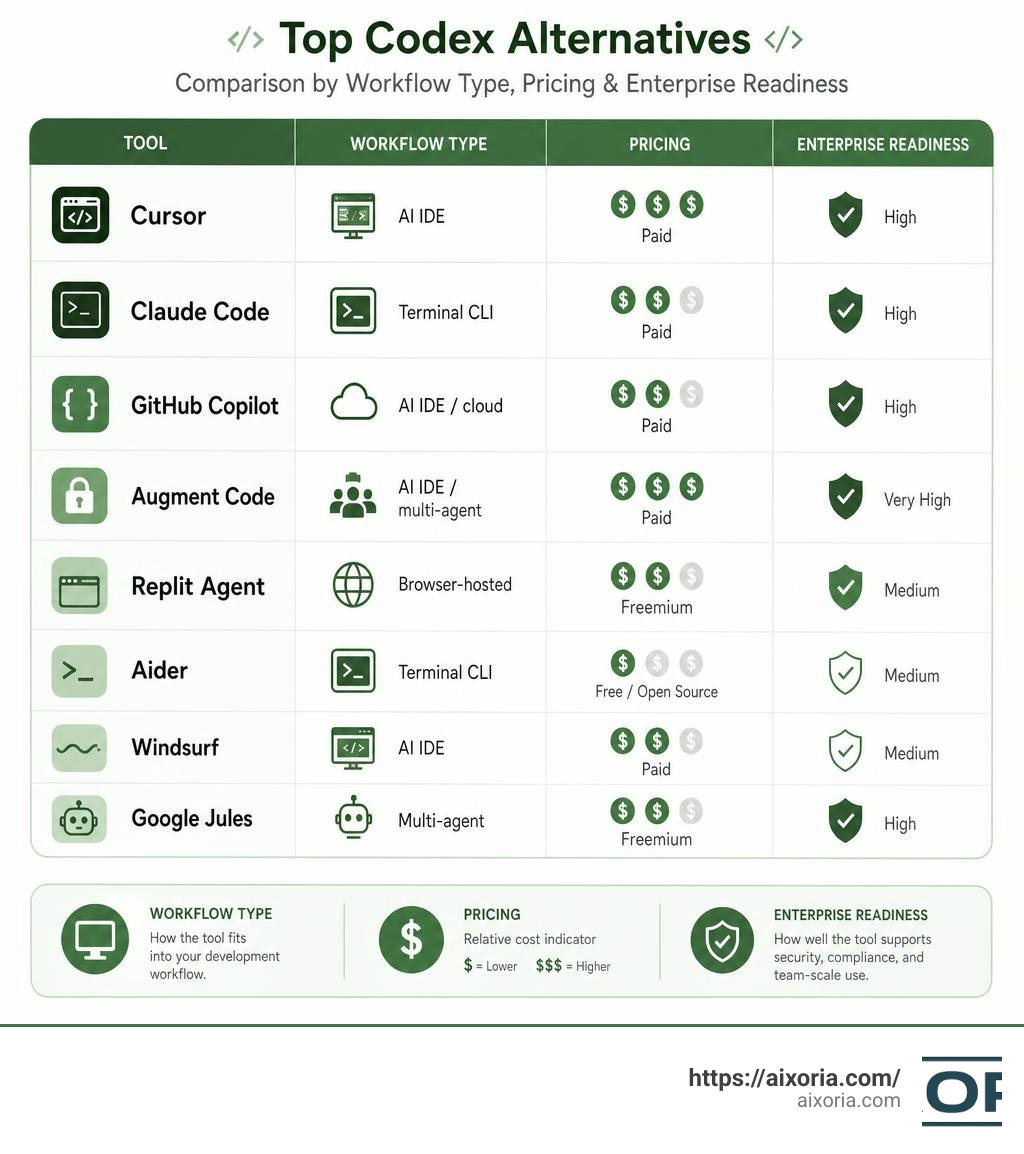
If you need a quick answer, here are the top Codex alternatives worth considering right now:
| Tool | Best For | Workflow Type |
|---|---|---|
| Cursor | AI-native IDE experience | AI IDE |
| Claude Code | Terminal-based codebase reasoning | Terminal CLI |
| GitHub Copilot | Everyday inline suggestions + GitHub integration | AI IDE / cloud |
| Augment Code | Enterprise security and compliance | AI IDE / multi-agent |
| Replit Agent | Browser-based rapid app building | Browser-hosted |
| Aider | Open-source CLI pair programming | Terminal CLI |
| Windsurf | Lightweight AI-native editor | AI IDE |
| Google Jules | Async background agent tasks | Multi-agent |
Something significant happened between 2024 and 2025. Developer trust in AI code accuracy dropped from 43% to 33% — even as usage kept climbing. Today, 84% of developers use or plan to use AI coding tools. But fewer of them trust what those tools produce.
That tension is exactly why so many developers are looking beyond OpenAI Codex.
Codex itself is a capable terminal-native coding agent. It handles agentic tasks, integrates with ChatGPT, and works across real codebases. But capability isn’t the whole story. Workflow fit matters just as much as model quality. Developers leave Codex not because it’s weak — but because the interface, the model, the repo control, or the review structure doesn’t match how they actually work.
And the tools they’re switching to have changed dramatically. These aren’t simple autocomplete engines anymore. Modern Codex alternatives can reason across entire codebases, edit multiple files at once, run CLI commands, and operate as autonomous agents. The shift is from generating snippets to shipping production-ready software.
Why Developers are Seeking Top Codex Alternatives in 2026

The landscape of software development is undergoing a paradigm shift. While OpenAI Codex pioneered the idea of translating natural language into executable code, developers are realizing that raw code generation is only a fraction of the development lifecycle. In 2026, the search for the top codex alternatives is driven by practical, day-to-day friction points rather than a lack of raw model intelligence.
When we look at why engineering teams are migrating, several key themes emerge:
- Workflow Alignment: Developers do not want to copy and paste code from a browser-based chat window into their local IDE. They want the AI to live where they write, test, and commit code.
- Model Preference and Flexibility: Relying on a single model provider can be a bottleneck. Teams want the freedom to swap between Anthropic’s Claude, Google’s Gemini, OpenAI’s GPT models, or even local open-source models depending on the task.
- Repository Control and Context Isolation: Many developers are uncomfortable with cloud-based tools indexing their entire proprietary repository without clear boundaries.
- Review Structure: Trust has declined. Developers are demanding systems that show clear diffs, run local verification tests, and require explicit human approval before making sweeping codebase modifications.
To understand how the broader market is shifting, we can look at the 8 Best Ai Coding Tools For Developers to see how modern workflows prioritize seamless integration over simple autocomplete.
Shifting from Snippets to Full Workflows
The early days of AI coding were dominated by inline autocomplete—predicting the next line of a function. In 2026, that is considered table stakes. Modern developers are looking for tools capable of deep multi-file reasoning and complete codebase context awareness.
If you are refactoring a payment validation system, the AI needs to understand how changes in your validation helper affect your database schemas, your API endpoints, and your test suites. A true Codex alternative must be able to parse these relationships, run background diagnostics, and present a unified pull request rather than a series of disconnected code snippets.
The Trust Gap and Accuracy Challenges
As highlighted by recent industry surveys, developer trust in AI-generated code accuracy dropped to 33% by 2025. This trust gap exists because early tools frequently produced hallucinated library methods, introduced subtle security vulnerabilities, or ignored edge cases.
To bridge this gap, the latest alternatives incorporate automated verification gates. Instead of blindly accepting an output, these platforms run the code in sandboxed environments, execute your existing test suites, and only present the solution once it passes basic syntactic and logical checks.
Evaluating the Best Codex Alternatives by Workflow Fit

Finding the right alternative is not about finding the “best” overall model; it is about choosing the tool that fits your team’s specific workflow. We can categorize the leading tools into three primary buckets: Terminal-first command-line tools, AI-native IDEs, and browser-based rapid application builders.
For those interested in exploring the broader IDE landscape, our breakdown of Cursor Alternatives provides an in-depth look at how various code editors stack up.
Terminal CLI and Agentic Command-Line Tools
For developers who live in the terminal and prefer keyboard-driven development, terminal-native CLI agents are the ultimate fit.
- Claude Code: Developed by Anthropic, Claude Code is a command-line tool that runs directly in your terminal. It is exceptionally strong at codebase reasoning, navigating large repositories, and executing terminal commands to test its own code. It behaves like an interactive, agentic partner that can run git commands, view files, and debug errors in real time.
- Aider: Aider is a highly popular, open-source terminal pair-programming tool. It allows you to chat with several LLMs directly from your command line and automatically commits changes to your git repository with descriptive, AI-generated commit messages. It is an excellent choice for developers who want to bring their own API keys and maintain absolute control over their environment.
If you are looking to explore open-source terminal options further, you can read more about the Best Open Source Alternatives to OpenAI Codex App in 2026 | BSWEN to see how developers are building highly customized, local-first environments.
AI-Native IDEs and Code Editors
If you prefer a visual development environment with deeply integrated AI features, an AI-native IDE is the way to go.
- Cursor: A fork of VS Code, Cursor has quickly become the gold standard for AI-native code editors, earning a 4.5 rating on Gartner Peer Insights. It features an advanced “Composer” mode that allows you to make edits across multiple files simultaneously, a predictive autocomplete engine, and visual diffs that make reviewing AI suggestions incredibly intuitive.
- Windsurf: Another incredibly fast, AI-native editor with a 4.5 Gartner rating, Windsurf offers a highly integrated “Flow” state where the AI assistant can predict your next steps, suggest multi-file edits, and help you debug complex codebases with minimal setup.
- GitHub Copilot: With an estimated annual recurring revenue exceeding $400 million, GitHub Copilot remains the market heavyweight. In 2026, Copilot has evolved far beyond simple autocomplete, offering workspace-aware agent modes that can refactor entire test suites or fix race conditions by analyzing your entire repository.
For a comprehensive review of these editors, check out our guide on the 8 Best Ai Coding Tools For Developers to see how they compare in daily usage.
Browser-Based and Hosted App Builders
For non-technical founders, rapid prototypers, or developers looking to build and deploy full-stack applications directly from a browser, a new class of hosted app builders has emerged.
- Replit Agent: Replit’s autonomous agent can provision complete full-stack development environments, install dependencies, configure databases, and deploy web applications to production—all from simple, natural language prompts in your browser.
- Webtwizz: A standout alternative for those who want actual code ownership. Unlike entirely hosted visual builders, Webtwizz allows you to build full-stack applications (often using Next.js, Supabase, and Stripe) and export the clean, portable source code to run anywhere. You can explore the details in this guide on the 8 Best OpenAI Codex Sites Alternatives in 2026 | Webtwizz.
To see how these tools compare to other generation engines, refer to our analysis of the Best Ai Tools For Generating Code.
Enterprise Readiness: Security, Compliance, and Data Privacy
While solo developers might prioritize speed and clever features, enterprise engineering teams must evaluate tools through the strict lens of security, compliance, and risk management. Adopting an AI coding tool without proper vetting can expose proprietary IP, violate data residency laws, or introduce licensing liabilities.
When evaluating enterprise-grade tools, organizations should prioritize those with robust compliance certifications, such as SOC 2 Type II and ISO/IEC 42001 (which provides specific control objectives for AI systems).
To understand how to integrate these tools safely into an enterprise workflow, read The 7 Best Ai Coding Tools For Developers In 2026.
Security Guardrails for Top Codex Alternatives
The most critical security question for any enterprise is: Is our proprietary code being used to train public AI models?
Leading enterprise alternatives like Augment Code (which maintains a 4.8 rating on Gartner Peer Insights) and Qodo Gen (4.6 rating) provide strict contractual guarantees that your codebase remains private. Furthermore, these platforms offer:
- Zero data retention policies for prompts and outputs.
- Geographic data residency enforcement to comply with regional regulations like GDPR.
- Real-time scanning to ensure the AI does not introduce open-source code with restrictive licenses (e.g., GPL) into your proprietary codebase.
To compare how different platforms stack up on security, you can read the Best OpenAI Codex Alternatives in 2026 | ToolChase and review the OpenAI Codex Alternatives for Developers – Verdent Guides.
Implementation Timelines and Governance Frameworks
Deploying an AI coding assistant across an enterprise is not as simple as buying licenses. Organizations should anticipate 12-24 month implementation cycles to fully establish comprehensive AI governance frameworks.
Furthermore, total cost of ownership (TCO) typically extends 60-70% beyond the base licensing fees due to training, compliance auditing, security reviews, and continuous monitoring for AI-generated technical debt. For a detailed breakdown of these organizational procurement steps, refer to Top Codex Alternatives & Competitors 2026.
Single-Agent Assistants vs. Multi-Agent Workflow Platforms
As AI coding technology matures, we are seeing a clear division in architecture: single-agent assistants versus multi-agent workflow platforms.
- Single-Agent Assistants (e.g., standard Copilot, basic Cursor chat): These operate on a linear, turn-based interaction. You ask a question or highlight a block of code, and the AI suggests an edit. They are incredibly fast for inline completion and localized debugging, but they hit a ceiling when dealing with complex, parallel tasks.
- Multi-Agent Workflow Platforms (e.g., Google Jules, Verdent, Augment Code): These platforms deploy multiple specialized agents that work in parallel. For instance, one agent might plan the architecture, a second agent writes the code, a third agent generates unit tests, and a fourth agent acts as a verification gate, running the code in an isolated container to ensure it passes all checks before presenting it to the human developer.
This structural difference is key to matching a tool to your organizational goals. You can learn more about choosing between these paradigms in our overview of the Best Ai Tools For Developers In 2026.
Choosing Top Codex Alternatives for Your Team Size
- Solo Builders: Prioritize speed, visual editing, and rapid prototyping. Tools like Cursor, Windsurf, or Replit Agent allow a single developer to build and deploy features in a fraction of the time.
- Enterprise Teams: Prioritize security, codebase indexing, and compliance. Augment Code or GitHub Copilot Enterprise are ideal because they offer centralized admin controls, custom context indexing, and zero-data-training guarantees.
- Non-Technical Founders: Prioritize browser-based, visual builders like Webtwizz or Lovable that allow them to build a functional MVP and export standard Next.js code without writing a single line of backend logic.
To explore how these tools fit into modern production codebases, check out the OpenAI Codex Alternatives in 2026: Best Tools for AI Coding | UI Bakery Blog.
Frequently Asked Questions about Codex Alternatives
What is the best free alternative to OpenAI Codex?
For developers looking for a free or open-source option, Codeium is highly recommended. It offers a robust free tier for individual developers, featuring fast autocomplete and in-editor chat across dozens of IDEs. Alternatively, open-source terminal tools like Aider or OpenCode allow you to bring your own API keys, giving you complete control over your costs and data privacy.
Do Codex alternatives allow full code ownership and export?
It depends entirely on the tool. Hosted app builders like Webtwizz, Bolt.new, and v0 generate standard, clean frameworks (like Next.js and Tailwind CSS) that you can fully export and host on your own infrastructure. However, some platforms lean heavily on proprietary, partner-hosted runtimes, meaning you may experience vendor lock-in if you decide to leave their ecosystem. Always verify code export capabilities before committing to a platform.
How do pricing models compare across these AI coding tools?
Most AI coding assistants utilize a flat-rate subscription model, typically ranging from $15 to $20 per month for individual pro tiers, and $39 to $40 per user per month for enterprise tiers. Terminal-based tools and open-source CLI tools often run on a “bring-your-own-key” model, where you pay the model providers (like Anthropic or OpenAI) directly based on token usage. For high-volume developers, using token-optimization services or flat-rate API harnesses can significantly lower monthly costs.
Conclusion
The search for the perfect Codex alternative is not about finding a single, universally superior tool. It is about matching your team’s development workflow, security requirements, and project complexity to the right platform. Whether you need the deep codebase reasoning of Claude Code in your terminal, the visual power of Cursor’s multi-file Composer, or the enterprise-grade security of Augment Code, the options in 2026 are more mature and capable than ever before.
At Aixoria, we are dedicated to helping teams navigate this rapidly evolving landscape. To find the right systems to supercharge your engineering team, explore our curated list of the Best Ai Tools For Productivity In 2026 or dive deep into our comprehensive reviews by visiting our Explore AI Tools on Aixoria category page.