Why Finding the Best AI for Generating Code Can Transform How You Build Software

Finding the best AI for generating coding tasks is no longer just a nice-to-have — it’s quickly becoming a core part of how modern software gets built.
Here’s a quick look at the landscape of available tool categories:
| Tool Category | Best For | Starting Price |
|---|---|---|
| General-purpose assistants | All-around use, IDE integration | Free / $10/mo |
| Agentic coding platforms | Full codebase context | Free / Paid |
| Cloud-integrated assistants | Enterprise teams, cloud workflows | Free / $22/mo |
| Privacy-focused tools | Secure environments | $12/mo |
| Browser-based IDEs | Beginners, quick prototyping | Free / Paid |
| API-based models | Backend automation, PR reviews | Usage-based |
The numbers tell a clear story. According to recent developer surveys, 76% of developers already use or plan to use AI tools in their workflow. And developers using AI coding assistants have reported completing certain tasks up to 55% faster.
This isn’t just hype. The market has exploded — over 1,085 AI coding extensions now exist for VS Code alone, with more than 90% of them released in just the last two years.
But here’s the problem: more options don’t make the choice easier. For a small business owner or non-technical founder, picking the wrong tool can cost you time and money instead of saving it.
This guide cuts through the noise. We compare the top tools on features, pricing, ease of use, and real-world performance — so you can make a smart choice fast.
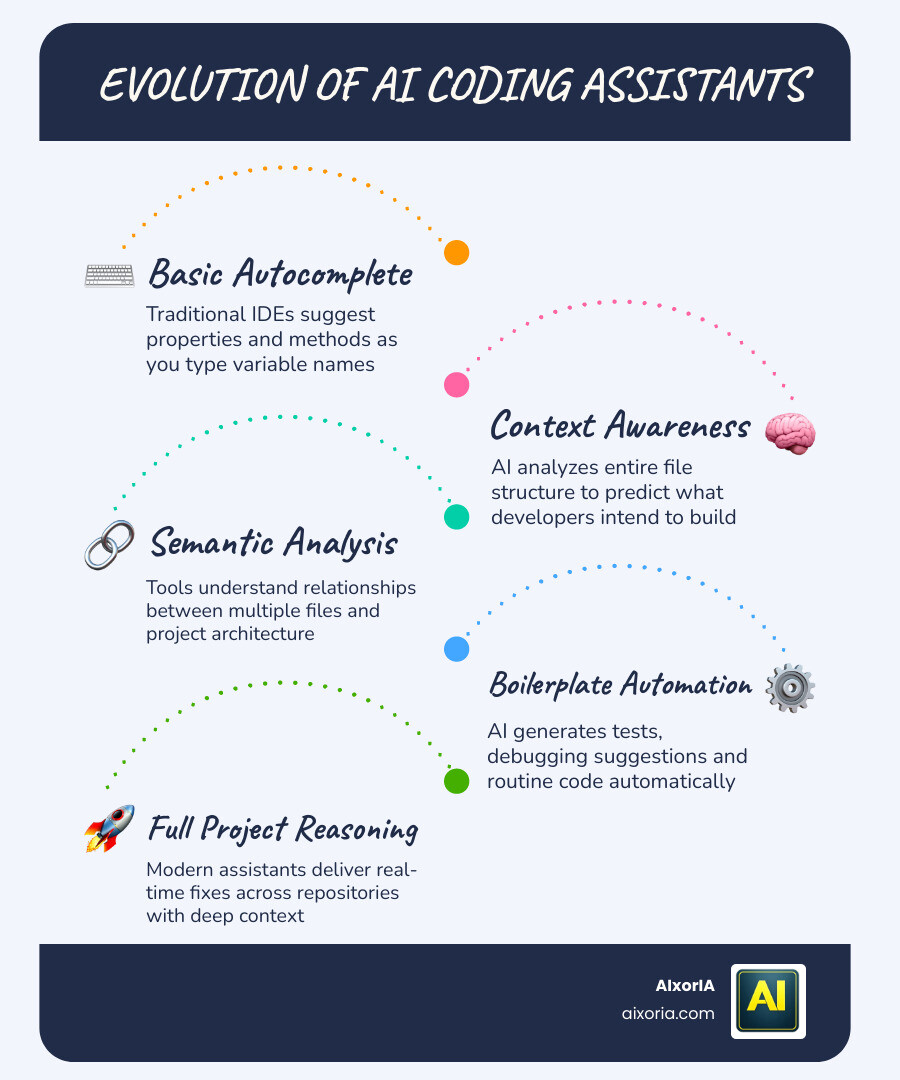
Evolution of AI Coding Assistants vs. Traditional IDEs
In the old days-well, back in 2023-traditional Integrated Development Environments (IDEs) relied on basic autocomplete. You’d type my_variable. and it would give you a list of properties. It was helpful, but it didn’t “understand” your goal.
Today, the best AI for generating coding uses Natural Language Processing (NLP) and probabilistic determination to predict what you want to build next. Instead of just suggesting the next word, modern AI assistants analyze the context of your entire project. They use semantic analysis to understand the relationship between different files, allowing them to automate boilerplate code, write unit tests, and even suggest real-time debugging fixes.
The shift from “autocomplete” to “pair programmer” is massive. Modern AI assistants can interpret a comment like // write a function to calculate the distance between two GPS coordinates and generate the entire logic in seconds. This deep IDE integration, particularly within VS Code extensions, has turned the editor into a collaborative partner rather than just a text box. For a broader look at how modern development platforms work, see Visual Studio Code.
Evaluating the Best AI for Generating Coding in 2026
As we move through 2026, we have to look beyond simple “code generation.” We now measure success using engineering delivery metrics. Does the tool reduce your cycle time (how long it takes to go from an idea to a finished feature)? Does it lower your change failure rate by catching bugs early?
When we look for the The 7 Best AI Coding Tools for Developers in 2026, we evaluate how these tools handle real-world pressure. Some tools shine in the cloud, offering massive processing power, while others run local Large Language Models (LLMs) to keep your data private and secure.
Key Criteria for the Best AI for Generating Coding
To find the best AI for generating coding for your specific needs, you should look at these four pillars:
- Context Window Size: Modern tools now offer up to a 1M token capacity. This means the AI can “read” and remember thousands of lines of code at once.
- Multi-Repository Indexing: For complex teams, the AI needs to understand how your frontend repository talks to your backend repository.
- Language Proficiency: While most tools handle Python and JavaScript well, the best ones are also experts in Go, Rust, and legacy languages.
- Framework Support: Whether you’re using React, Django, or Flutter, the tool should know the latest best practices for that specific framework.
For more on how these impact your day-to-day, check out our guide on the Best AI Productivity Tools for Developers in 2026.
Performance Benchmarks and Productivity Gains
The data doesn’t lie. Research shows that developers using high-end AI assistants can complete tasks up to 55% faster. We’ve seen iteration times drop by 30-50% in early-stage projects. Interestingly, while experienced developers might sometimes be 19% slower when first learning to prompt the AI, they still perceive a 20% improvement in speed because the “boring” work is gone.
SWE-bench scores (a benchmark for software engineering tasks) have also climbed. Some specialized tools are now outperforming general-purpose models by significant margins, leading to higher developer job satisfaction. You can see a full breakdown in our list of the 20 Best AI Software Development Tools in 2026.
Strategic Implementation for Beginners and Enterprise Teams
The best AI for generating coding for a student is very different from what a Fortune 500 company needs. Beginners need guidance and explanations, while enterprises need governance and security.
Choosing the Best AI for Generating Coding for Beginners
If you are just starting, look for tools that offer “learning-centric feedback.” Some assistants, including popular browser-based coding platforms and integrated AI tools, don’t just give you the answer; they explain why the code works. They provide clear error handling and guided refactoring, which acts like a 24/7 tutor. This makes them the Best AI Tools for Business Productivity for those building their first internal apps.
Enterprise Requirements and Scalability
For large teams, the conversation shifts to compliance. You need tools that offer:
- SOC 2 and ISO 42001 Standards: Ensuring your data is handled with enterprise-grade security.
- IP Indemnity: Protecting your company from potential copyright issues.
- On-Prem Deployment: For industries like banking or healthcare that can’t send code to the cloud.
- SSO Integration: So you can manage 500+ developer licenses easily.
Managing the total cost of ownership is vital. While some tools cost $10/month, full enterprise suites can reach $54-$60 per user. It’s a big investment, but the ROI comes from faster shipping and fewer security vulnerabilities.
Security, Quality, and Context in Modern AI Workflows
Security is the biggest “what if” in AI coding. Can the AI introduce a security hole? Yes, it can. That’s why the best AI for generating coding includes built-in vulnerability scanning and code referencing filters. These filters ensure that the AI isn’t accidentally “copy-pasting” public code that might have restrictive licenses.

Many teams are now opting for local LLM execution. By running the AI on your own hardware, you ensure that your proprietary logic never leaves your building. This is a key part of maintaining Best AI Tools for Business Productivity while staying GDPR compliant.
Managing Complex Codebases and Context Awareness
The “holy grail” of AI coding is repository-wide reasoning. Imagine a codebase with 400,000 files. A basic AI will get lost. However, the top-tier tools in 2026 use semantic dependency analysis to understand the architectural context. They can help with legacy migrations (like moving an old jQuery site to React) by understanding how the data flows across the entire system, not just one file.
Combining Multiple AI Tools for Maximum Efficiency
You don’t have to pick just one! Many pro developers use a “stack” of tools:
- Inline assistants for fast, inline autocomplete.
- Agentic refactoring tools for deep, agentic refactoring of entire folders.
- Snippet management tools for saving useful AI-generated patterns.
- CLI Agents for running terminal commands and managing CI/CD pipelines.
By keeping a “human-in-the-loop,” you can manage parallel tasks—letting the AI write the tests while you design the system architecture. This is the peak of AI tools for productivity and time management.
Future Trends: Autonomous Agents and Beyond
The next frontier is “Agentic Development.” We are moving away from the AI waiting for you to type. Instead, autonomous agents can now work in the background. You give them a ticket from Jira, and they work unprompted to triage the issue, create a branch, write the code, and submit a Pull Request for your review.
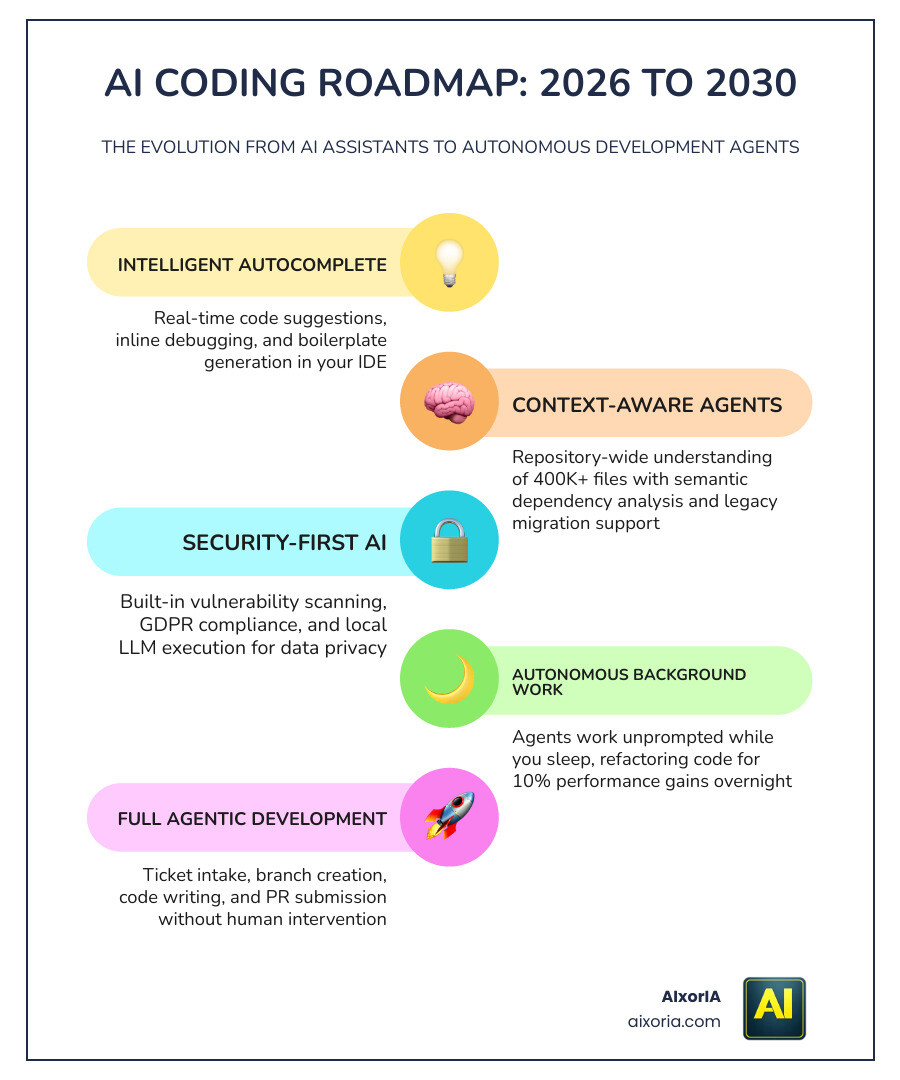
In 2026, we are seeing these agents work in parallel cloud environments. While you sleep, an AI agent could be refactoring your backend to improve performance by 10%. This isn’t science fiction; it’s the current roadmap for the industry’s leaders.
Frequently Asked Questions about AI Coding
What is the difference between an AI coding assistant and traditional autocomplete?
Traditional autocomplete is like a dictionary—it knows the words but not the story. An AI coding assistant is like a co-author; it understands the “story” of your project and can write entire chapters (functions) based on a short description.
Can AI coding tools handle large, multi-repository enterprise projects?
Yes, but only specialized tools. You need an assistant that supports multi-repository indexing and has a large context window (1M+ tokens) to accurately track dependencies across different services.
Are free AI coding tools secure enough for professional use?
Free tiers are great for learning, but they often use your data to train their models. For professional or proprietary work, we always recommend paid tiers or tools that offer local execution to ensure your intellectual property remains private.
Conclusion
The journey to find the best AI for generating coding doesn’t have to be overwhelming. Whether you are a solo founder or leading an enterprise team, the right tool is the one that fits your existing workflow and security needs.
At AIxorIA, we specialize in making these complex transitions simple. We offer custom AI solutions, performance audits to see where your team can save time, and tool training workshops to get your developers up to speed. Our goal is to provide affordable, fast, and simple help to ensure your business stays ahead in this autonomous age.
Ready to supercharge your development? More info about AI tools for business
2 thoughts on “Best AI for Generating Code in 2026 (Tested by Developers)”