How Machine Learning Makes Business Intelligence More Useful
Scr0ll d0wn to D0VVNL0AD
Machine learning in business intelligence helps teams move beyond reports of what happened. It uses business data to forecast demand, spot unusual activity, group customers, and guide decisions. To get started, choose one decision you make often, check that the data behind it is reliable, and put the model’s output where your team already works.
More advanced systems can split data and analysis tasks among specialized agents. A decision agent can then use feedback to adjust its choices without changing the underlying models. In one study of a multi-agent BI framework, this approach improved accuracy and reduced decision latency against a centralized baseline. Those results are promising, but they do not replace testing with your own data.
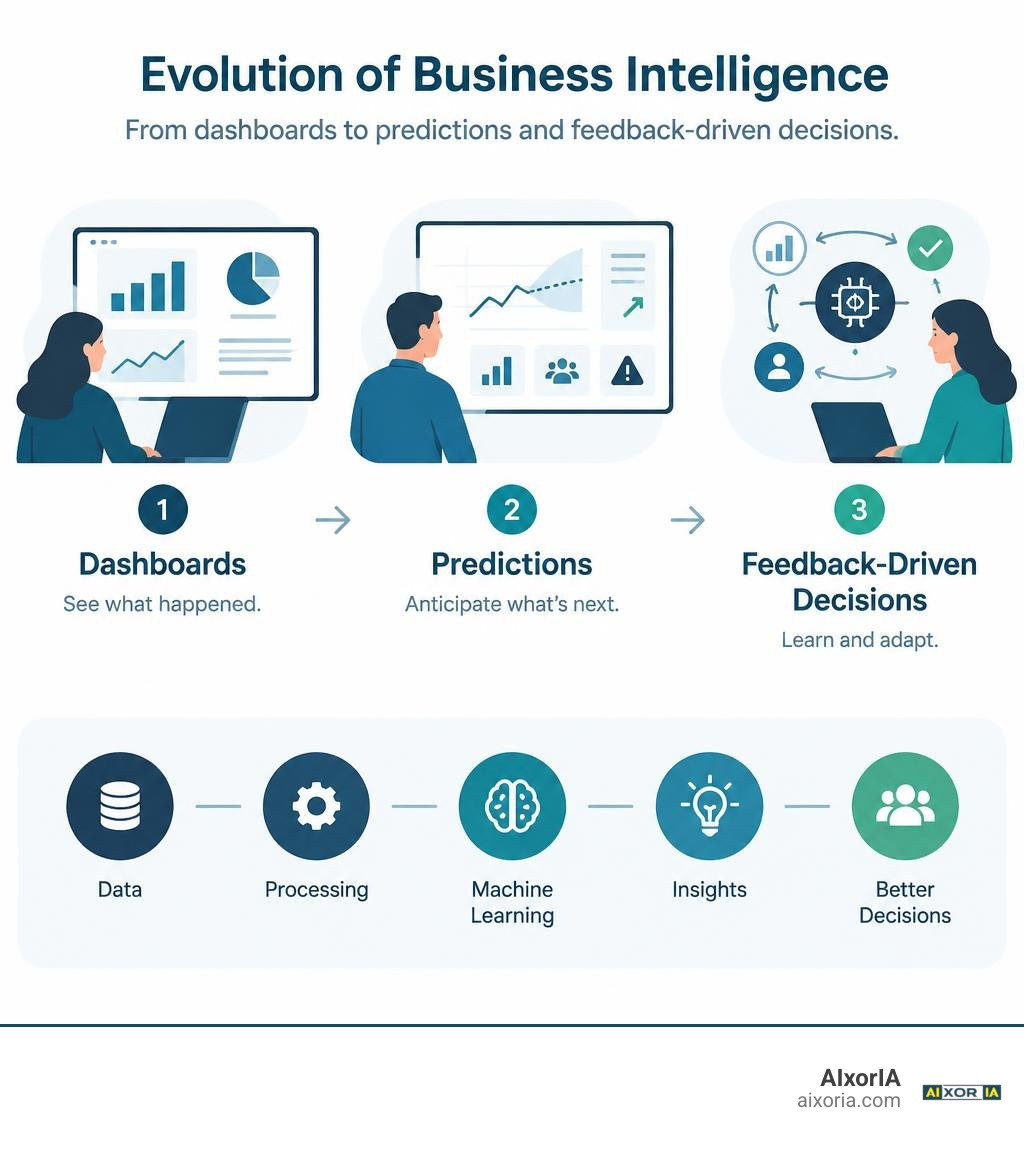
Architectural Evolution: Machine Learning in Business Intelligence

Traditional business intelligence architectures were built around monolithic pipelines. In these setups, centralized Extract, Transform, Load (ETL) jobs run on batch schedules, dumping processed data into static data warehouses for dashboard consumption. While this approach served the era of historical reporting, it chokes under high data volumes and real-time operational demands. A solid foundation begins with understanding what AI and automation represent across distributed computing environments.
When data scales, centralized architectures encounter severe bottlenecks:
- Single points of failure during batch ingestion
- High decision latency due to sequential query execution
- Inflexible analytical models that cannot adapt dynamically to sudden operational shifts
Modern systems shift workloads from centralized processing to modular, distributed designs. By breaking monolithic workflows into autonomous, cooperating components, enterprises achieve low latency and higher system resilience.
Core Foundations of Machine Learning in Business Intelligence Systems
Integrating machine learning into enterprise analytics transforms diagnostic reports into predictive and prescriptive action engines. Rather than merely asking why sales dropped last quarter, organizations use predictive modeling to forecast upcoming inventory needs, anomaly detection to flag transaction fraud instantly, and unsupervised clustering for dynamic customer segmentation.
Recent research on applied machine learning paradigms in enterprise analytics emphasizes that sustainable implementations depend on robust infrastructure. This setup relies on two core pillars:
- Centralized Feature Stores: A feature store standardizes feature engineering across training pipelines and production environments, eliminating train-serve skew and ensuring metric consistency.
- Inference Modality Matching: High-throughput workflows balance batch scoring (pre-computing complex models overnight into warehouse tables) with real-time inference endpoints for latency-critical operations.
Evaluating the 10 best business intelligence tools shows that leading platforms now embed automated ML routines directly into data modeling layers.
Transition from Centralized Pipelines to Multi-Agent Frameworks
Centralized pipelines process data sequentially: ingestion finishes before transformation starts, transformation completes before analytics run, and analytics must conclude before decisions are rendered. When unexpected schema changes or traffic spikes occur, the entire pipeline stalls.
Modern platforms address these bottlenecks by transitioning from static dashboards to agentic decision systems. Instead of executing tasks in a single rigid queue, multi-agent frameworks decompose analytical problems into independent, concurrent tasks handled by specialized agents.
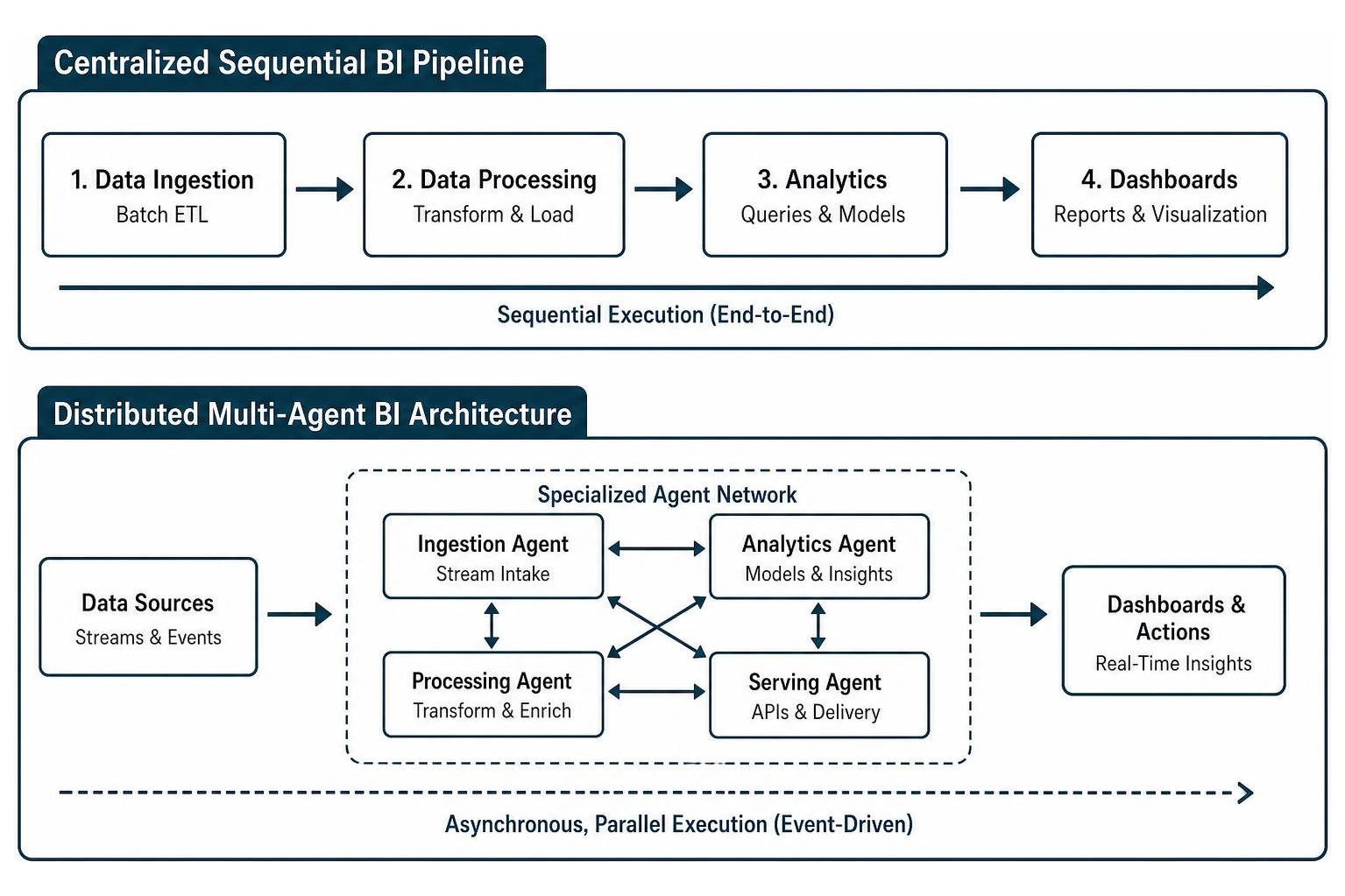
| Architecture Dimension | Centralized BI Pipelines | Distributed Multi-Agent BI Systems |
|---|---|---|
| Execution Flow | Sequential, monolithic batch jobs | Asynchronous, parallel event loops |
| Decision Latency | High (batch-constrained; >130 ms) | Low (sub-100 ms via decoupled routing) |
| Fault Tolerance | Low (pipeline failure halts processing) | High (isolated agent failover and self-healing) |
| Adaptability | Manual query updates and static thresholds | Autonomous policy tuning via feedback |
| Compute Overhead | Concentrated spikes during batch runs | Distributed, elasticity-balanced micro-workloads |
Multi-Agent Reinforcement Learning for Enterprise Decision Systems

Applying multi-agent reinforcement learning (MARL) elevates BI from passive visualization to active operational orchestration. Rather than requiring human operators to evaluate dozens of dashboards before adjusting supply chain thresholds, autonomous agents learn optimal business policies through continuous interaction with operational feedback. By deploying autonomous agents with measurable business ROI, enterprises convert data streams into revenue-generating actions.
Agent Roles and Asynchronous Communication Mechanics
In a modular multi-agent business intelligence (MA-BI) system, responsibilities are cleanly divided across specialized agent roles to prevent cascading failures and manage computational loads:
- Data Collection Agent (DCA): Ingests raw data streams from databases, APIs, and transactional logs, filtering out corrupted records at the boundary.
- Data Preprocessing Agent (DPA): Cleans, normalizes, and shapes ingested records into feature vectors ready for analysis.
- Analytical Agent (ANA): Executes specialized statistical algorithms and deterministic machine learning models (e.g., gradient boosted trees for demand scoring).
- Decision-Making Agent (DMA): Evaluates predictions against business objectives and environmental constraints to recommend or trigger concrete actions.
- Coordinator Agent (COA): Manages message traffic, maintains workflow synchronization, and orchestrates task dependencies across the network.
These agents interact via non-blocking, event-driven message queues (such as Kafka or RabbitMQ). Asynchronous messaging ensures that an analytical agent working through a computationally heavy forecast never blocks the data collection agent from ingesting real-time operational events. Modern teams frequently orchestrate these communication patterns using 5 best business intelligence open source tools.
Integrating Machine Learning in Business Intelligence Decision-Making Layers
A persistent risk in autonomous business systems is instability: if an end-to-end model learns everything simultaneously, its decision policies can drift unexpectedly. To solve this, advanced MA-BI systems isolate learning exclusively within the Decision-Making Agent (DMA), leaving the Analytical Agent (ANA) completely deterministic.
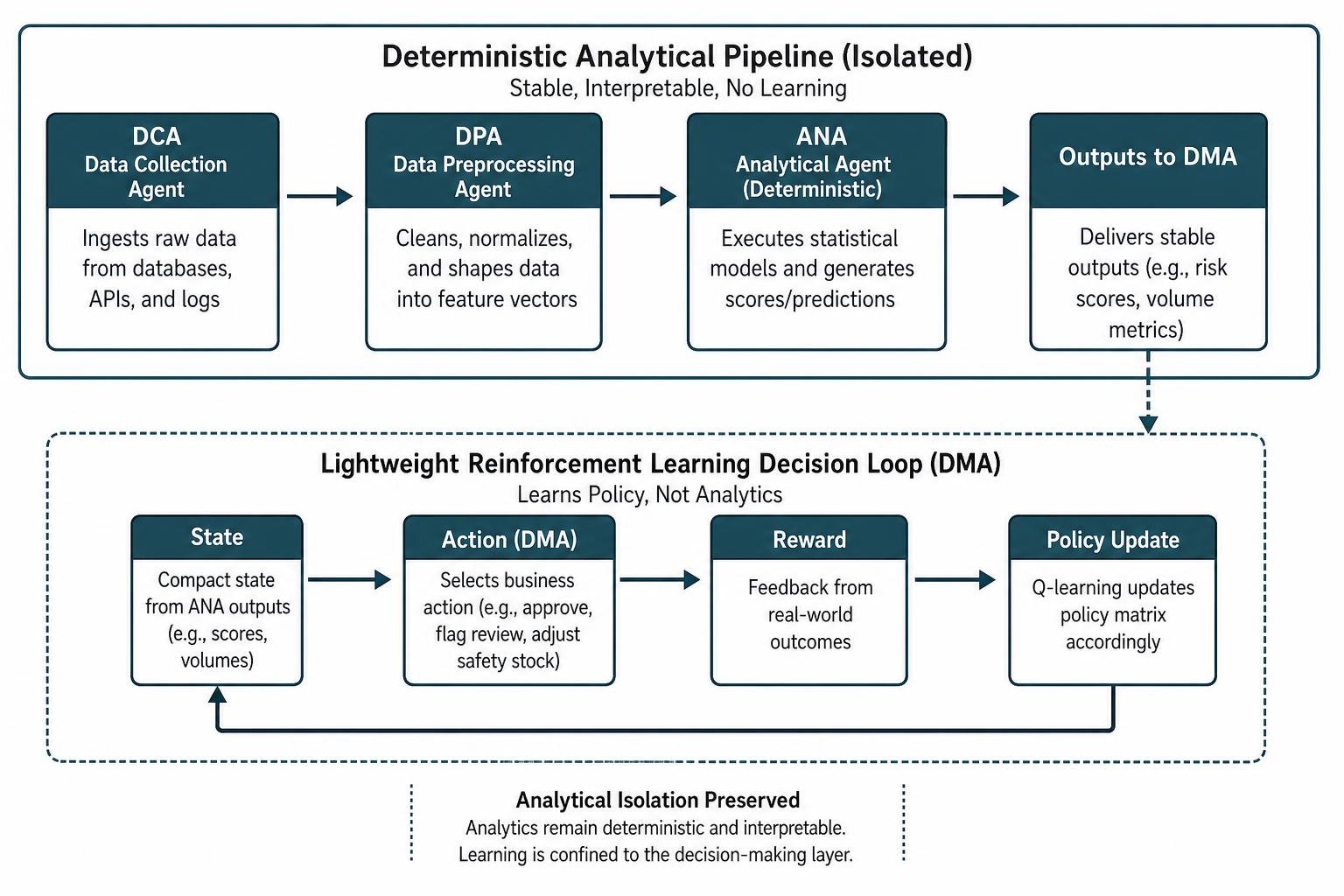
The DMA uses a lightweight Q-learning framework. Rather than ingesting massive raw data tables directly into a neural network, the agent observes a compact state representation derived from the ANA’s stable outputs (such as risk probability scores and historical transaction volume). The DMA selects an action (e.g., approve transaction, flag for human review, adjust dynamic safety stock), receives a reward signal calculated from real-world outcomes, and updates its policy matrix accordingly.
Because analytical modeling remains separate from policy tuning, enterprises preserve model interpretability using post-hoc explainability techniques like SHAP (SHapley Additive exPlanations). Stakeholders can inspect the precise feature weights behind any analytical score while monitoring the DMA’s policy boundaries over time.
Empirical Performance, Validation, and Scalability Benchmarks
Rigorous empirical evaluation confirms the advantages of decomposing BI tasks into distributed agent frameworks. Recent peer-reviewed benchmarks evaluating multi-agent reinforcement learning against legacy centralized architectures on standard transactional data (such as the Online Retail benchmark dataset) demonstrate clear gains in accuracy, latency, and stability. Selecting advanced AI tools for data analysis and visualization allows teams to measure these benchmarks within their own enterprise systems.
Quantitative Evaluation on Enterprise Transaction Datasets
When evaluated under real-world conditions with imbalanced data, the proposed MA-BI framework outperforms traditional centralized pipelines across all core classification metrics.
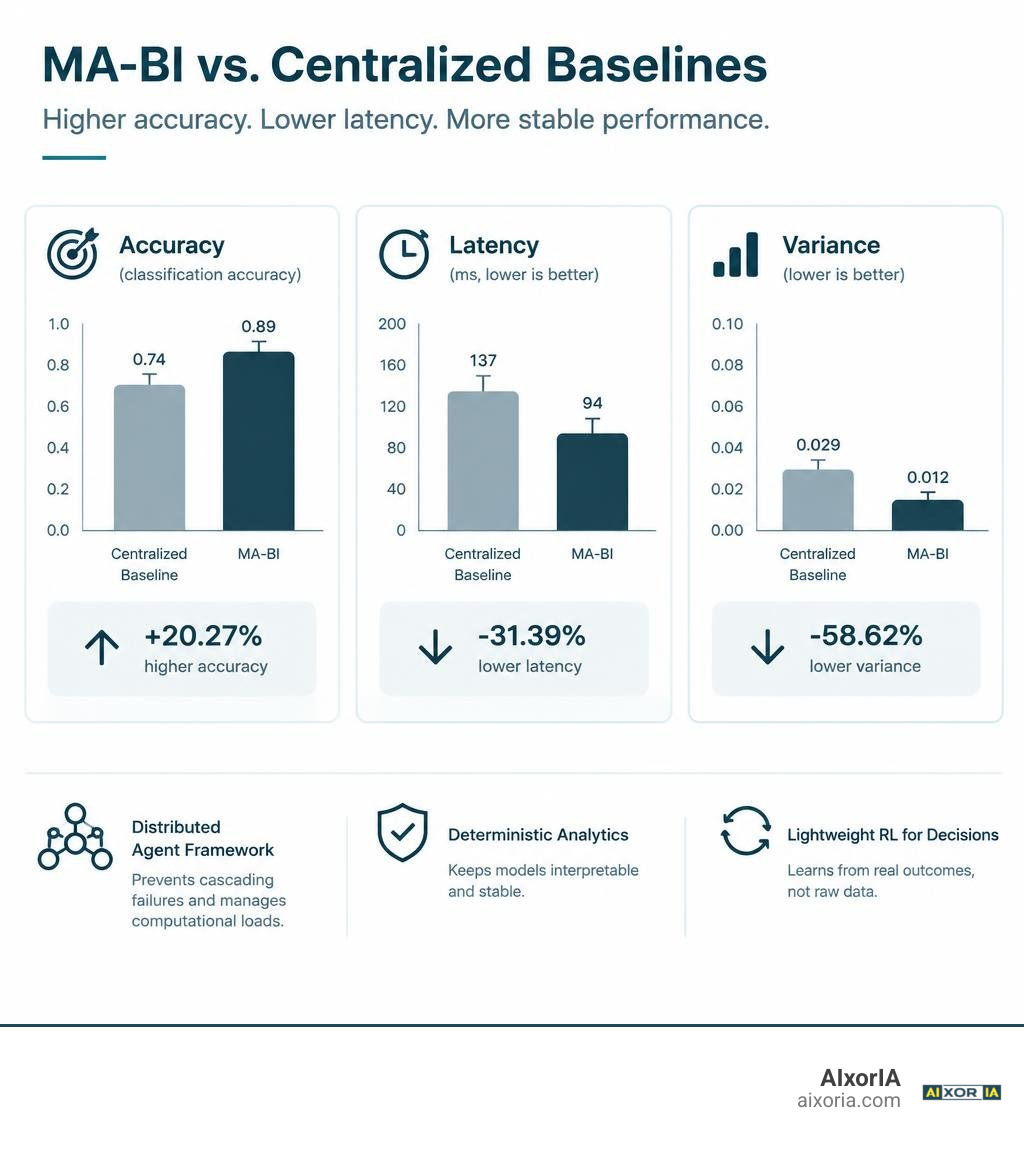
| Metric | Centralized Baseline Pipeline | Multi-Agent BI Framework (MA-BI) | Relative Improvement |
|---|---|---|---|
| Classification Accuracy | 0.74 ± 0.029 | 0.89 ± 0.012 | +20.27% |
| Decision Latency (ms) | 137 ± 16 ms | 94 ± 9 ms | -31.39% |
| ROC-AUC Score | 0.78 ± 0.031 | 0.92 ± 0.008 | +17.95% |
| F1-Score (Macro) | 0.71 ± 0.034 | 0.87 ± 0.011 | +22.54% |
| Run-to-Run Variance | High | Low (Tight CI) | Enhanced Stability |
The framework’s high macro F1-score and ROC-AUC metrics demonstrate that agent-level decomposition handles severe class imbalances effectively, minimizing both false positives and false negatives without requiring manual rebalancing.
Robustness, Variance Reduction, and Decision Latency Analysis
Beyond raw accuracy, production environments require operational stability. Monolithic systems suffer from unpredictable latency spikes when complex joins run alongside analytical scoring.
The MA-BI architecture cuts average decision latency down to 94 ± 9 ms, compared to 137 ± 16 ms for centralized baselines. By offloading resource-intensive transformations to independent preprocessing agents, the decision loop operates with minimal overhead.
The framework also shows lower run-to-run variance (±0.012 vs. ±0.029), delivering stable performance across repeated evaluations. This consistency is essential for top 5 analytics companies managing mission-critical transactional pipelines where unpredictable threshold shifts are unacceptable.
Real-World Implementation Challenges, Governance, and Future Outlook
Deploying autonomous machine learning systems in enterprise production environments introduces operational challenges around data governance, compliance, and lifecycle management. Choosing vetted best AI productivity software in 2026 helps enterprises maintain oversight without slowing operational velocity.
Data Drift, Governance, and Interpretability Constraints
Machine learning systems degrade over time if input data shifts away from training distributions. Enterprise BI implementations must monitor two distinct drift patterns:
- Feature Drift: Changes in the underlying input distributions (e.g., customer spending drops due to macroeconomic conditions).
- Concept Drift: Changes in the relationship between input features and target outcomes (e.g., standard purchasing patterns change during sudden market disruptions).
To address drift, automated data quality frameworks track key dimensions (completeness, uniqueness, validity, and latency) and trigger automated model retraining when statistical thresholds are breached.
As noted in a comprehensive review of BI and process intelligence integrations, integrating process mining with analytical dashboards establishes reliable data lineage and comprehensive audit trails. Maintaining rigorous governance protects customer privacy and ensures adherence to strict corporate compliance standards.
Hybrid Integration with Generative AI and Conversational BI
The frontier of modern BI combines predictive multi-agent pipelines with Large Language Model (LLM) interfaces, creating intuitive conversational systems. Instead of navigating static dashboards, analysts ask complex natural language questions that are dynamically compiled into database queries.
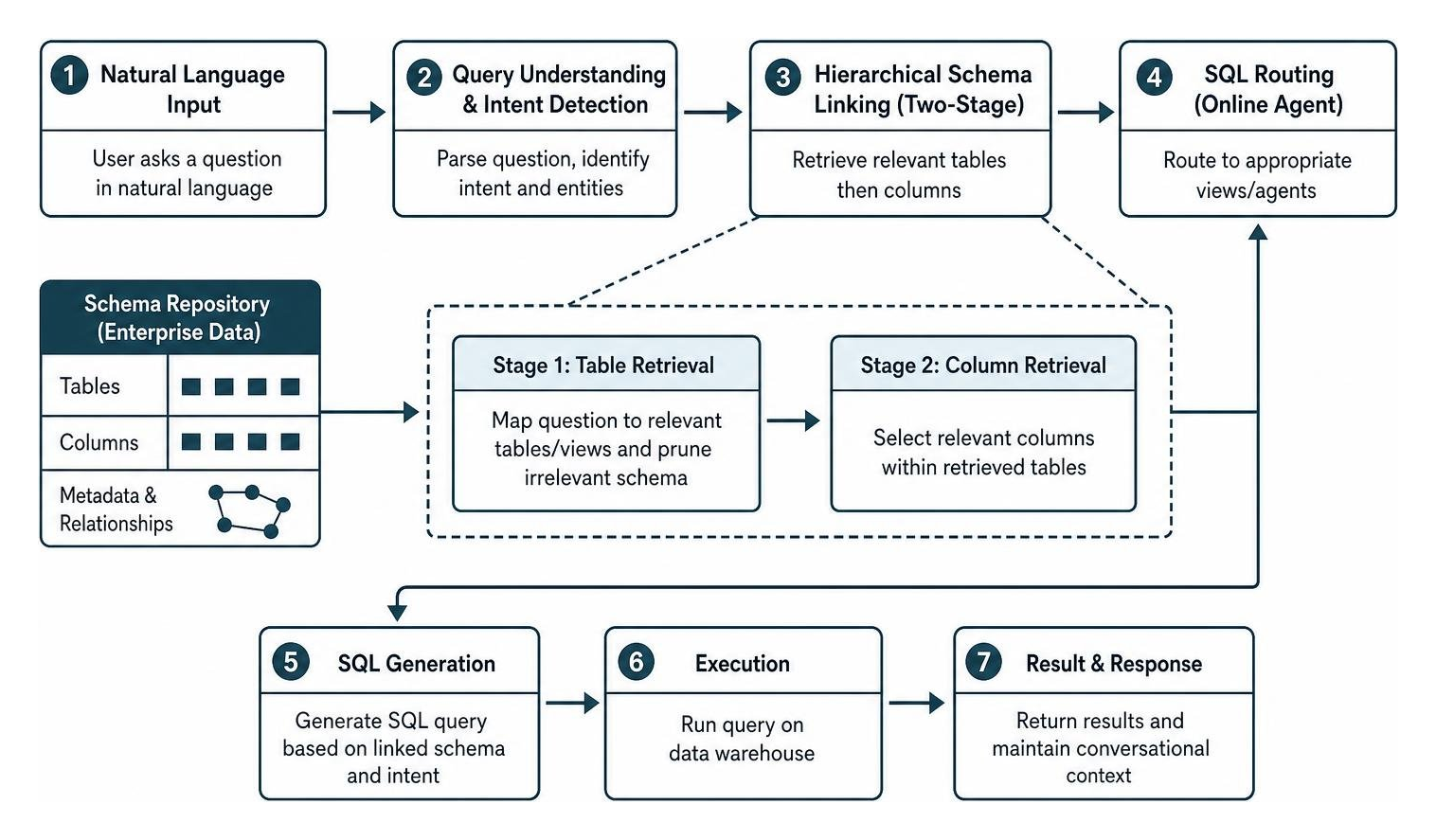
Key advancements powering this hybrid paradigm include:
- Dual-Agent LLM Architectures: As highlighted in research on dual-agent LLM systems for interactive BI, separating offline view generation from online routing agents reduces SQL JOIN complexity and prunes wide enterprise schemas.
- Hierarchical Schema Linking: Two-stage retrieval maps natural language queries to relevant tables and columns, keeping token usage low and preventing hallucinations.
- Multi-Round Context Tracking: Advanced conversational data analytics frameworks allow systems to ask clarifying questions and preserve conversational context across multi-turn interactions.
Combining conversational interfaces with multi-agent reinforcement learning equips teams using top AI productivity tools for enterprise workflows with both rapid exploratory querying and fast autonomous decision-making.
Frequently Asked Questions About Machine Learning in Business Intelligence
How does multi-agent reinforcement learning reduce latency in BI pipelines?
Multi-agent reinforcement learning reduces latency by breaking monolithic sequential pipelines into parallel, asynchronous micro-tasks. Specialized agents handle data ingestion, feature transformation, and deterministic scoring independently across non-blocking message queues. By isolating policy optimization to a lightweight Decision-Making Agent operating over compact state representations, the system avoids recalculating entire pipelines for routine operational decisions.
How do organizations preserve model explainability in autonomous decision systems?
Organizations preserve explainability by decoupling analytical scoring models from decision-making policies. Analytical models remain deterministic and can be audited using post-hoc explainability frameworks such as SHAP or LIME. Meanwhile, decision agents operate within defined, human-configured action spaces with explicit reward metrics, preventing opaque end-to-end drift while generating transparent audit trails for every automated action.
What are the primary data infrastructure prerequisites for ML-driven BI?
Implementing ML-driven business intelligence requires four core architectural components:
- End-to-end data lineage tracking to guarantee data provenance and reproducibility.
- A unified semantic layer and centralized feature store to prevent train-serve data skew.
- Automated monitoring pipelines that track feature drift, concept drift, and baseline data quality dimensions.
- An asynchronous messaging backbone (e.g., Kafka) capable of handling real-time, event-driven data flows without blocking analytical workloads.
Conclusion
The shift from descriptive reporting to predictive, agentic decision intelligence represents the most significant architectural evolution in modern analytics. By transitioning from rigid, centralized pipelines to distributed multi-agent systems enhanced with reinforcement learning, enterprises achieve higher accuracy, lower decision latency, and greater operational stability.
As organizations scale their data initiatives, pairing deterministic analytical models with adaptive, explainable decision loops ensures systems remain robust, scalable, and audit-compliant. To accelerate your organization’s transition to modern analytics, explore curated AI enterprise tools and frameworks on AIxorIA to build faster, smarter, and more reliable decision workflows.
1 thought on “Machine Learning in Business Intelligence: Benefits & Uses”