What AI Performance Review Software Does for Your Team
Scr0ll d0wn to D0VVNL0AD
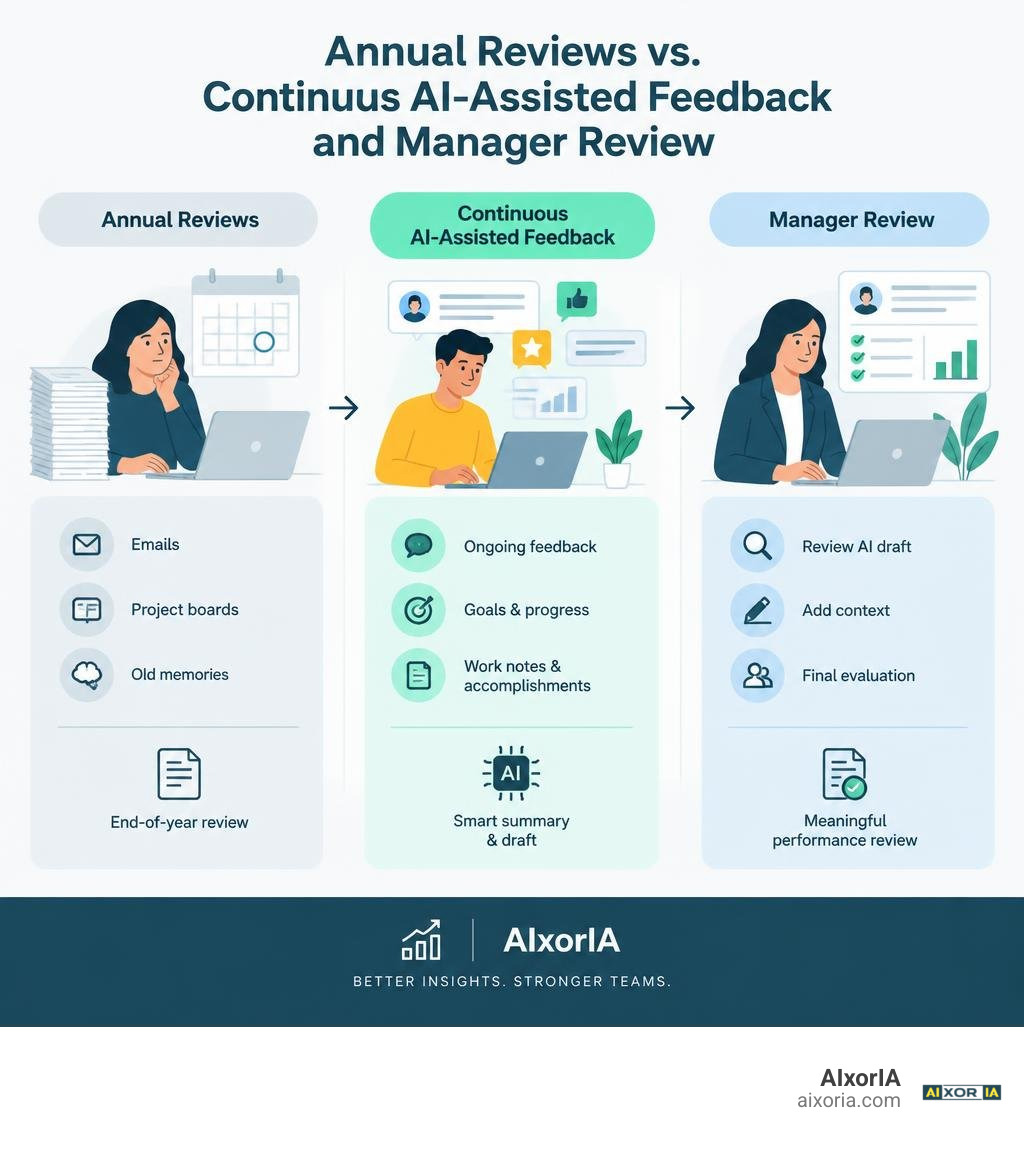
AI performance review software helps managers collect feedback, summarize work, and draft employee reviews. Instead of starting from memory at the end of the year, managers can use notes, goals, and feedback gathered over time. That can save work and make reviews more specific.
It does not make evaluations fair on its own. The best approach is to choose a tool that shows where its claims came from, protects employee data, and lets a manager correct every draft. This guide will help you compare those features and decide whether an AI review tool fits your team.
What Is AI Performance Review Software and How Does It Work?
Traditional performance evaluations often feel like an archaeological dig through buried emails, forgotten sprint boards, and vague memories from nine months ago. AI performance review software changes this dynamic by acting as an intelligent aggregation and synthesis layer across all employee touchpoints.
At its core, this software leverages Natural Language Processing (NLP) and machine learning models to analyze qualitative feedback (such as 360-degree peer reviews, customer shout-outs, and manager 1:1 notes) alongside quantitative metrics (such as completed project milestones, sprint velocities, and sales targets). Instead of replacing human discernment, the software synthesizes unstructured data into structured, actionable insights.
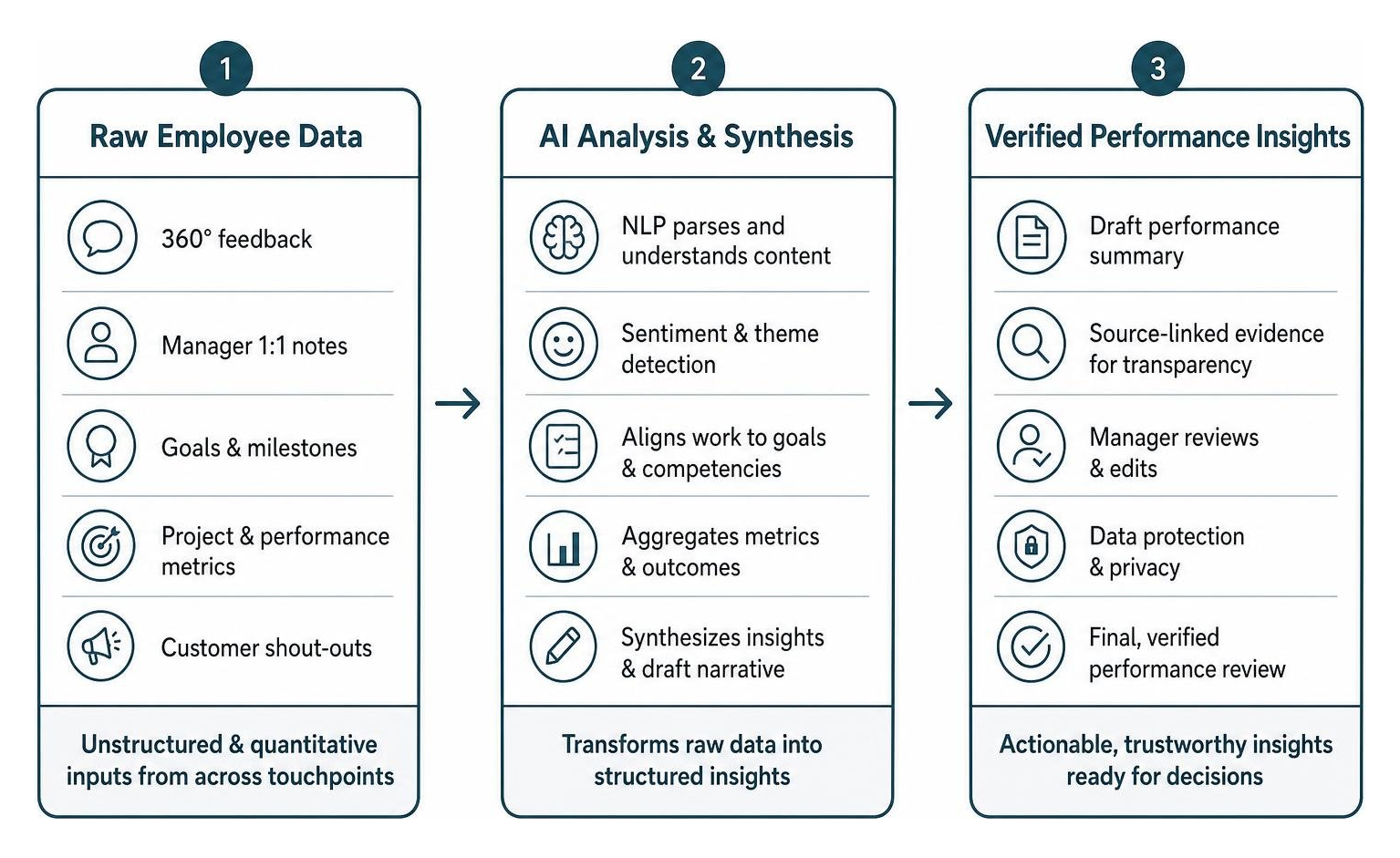
The underlying engine parses comments, tags sentiment, aligns accomplishments with specific competency rubrics, and creates a draft narrative of an employee’s contributions over time.
Core Features of Modern AI Performance Evaluation Platforms
When evaluating modern evaluation tools, specific architectural capabilities separate basic text-generators from robust enterprise platforms:
- Narrative Summarization & Synthesis: Generative algorithms condense dozens of peer feedback entries and 1:1 records into coherent summaries of strengths and areas for growth. Platforms like AI performance reviews software by Effy AI use AI form builders and draft assistants to turn qualitative notes into structured review sections.
- Evidence and Citation Tracking: Advanced systems maintain clear lineage between an evaluation statement and underlying source data. Platforms operating on AI performance intelligence architecture link directly to resolved Jira tickets, GitHub pull requests, or Confluence documentation, creating citation-backed claims.
- Competency & Skills Mapping: Tools automatically categorize unstructured feedback into predefined company competency matrices. For instance, Branco.ai for employees maps individual contributions to clear role levels and dynamic action plans, ensuring quiet contributors get recognized for their impact.
- Autonomous HR Workflows: Specialized systems like Atlas – AI Agent for HR & Manager can draft reviews, surface early burnout indicators, and track overdue review submissions while keeping human managers in control of final approvals.
- Objective & Key Results (OKR) Alignment: Real-time synchronization links daily outputs with broader organizational objectives, preventing goal detachment.
How AI Performance Review Software Integrates with Enterprise HR Systems
A standalone appraisal tool is only as good as the information it receives. Leading platforms sit directly within your existing technology ecosystem rather than demanding manual data entry.
These solutions dock via secure APIs into core Human Resource Information Systems (HRIS) such as Workday, BambooHR, and Rippling, as well as communication channels like Slack and Microsoft Teams. When choosing the best software to communicate with employees, integrating conversational feedback prompts directly into existing chat workflows eliminates the friction of navigating external appraisal portals.
Key Benefits: AI-Driven Appraisals vs. Traditional Annual Reviews
The annual review cycle is notorious for high administrative costs and low employee satisfaction. Traditional reviews force managers to spend an average of 2 to 5 hours per direct report gathering evidence and writing evaluations. For a mid-sized organization, this represents thousands of lost productivity hours every review cycle.
| Evaluation Metric | Traditional Annual Appraisals | AI-Driven Continuous Evaluations |
|---|---|---|
| Data Collection | Manual, retrospective, reliant on memory | Continuous, ambient, automated via tool integration |
| Feedback Frequency | Annual or bi-annual marathons | Weekly conversational check-ins and real-time nudges |
| Evaluation Bias | High risk of recency, halo, and proximity bias | Algorithmic normalization and evidence-backed citations |
| Admin Time per Report | 2 to 5 hours per employee | Less than 1 hour per employee (up to 70% reduction) |
| Defensibility | Subjective manager recollection | Tied to verifiable logs, tickets, and peer submissions |
| Career Development | Reactive and backward-looking | Proactive, showing skill mapping and forward growth paths |
Eliminating Recency Bias and Administrative Overhead
Human memory is inherently susceptible to recency bias—the tendency to weigh events from the past three weeks far more heavily than contributions made nine months earlier. This often results in the “halo or horns” effect, where an employee’s recent success or misstep overshadows their overall body of work.
AI evaluation engines continuously ingest feedback, objective completions, and peer accolades. Connecting these evaluation pipelines to structured employee recognition software tools ensures that quiet achievements, cross-functional support, and consistent micro-wins throughout the entire year are preserved and factored into evaluations.

Transforming Real-Time Feedback into Continuous Growth
Rather than treating performance reviews as a high-stakes annual event, modern software turns performance management into a continuous growth loop.
Platforms such as Zinc offer weekly automated check-ins and real-time feedback logging, allowing managers to conduct structured 1:1 meetings with context-rich talking points. Incorporating these continuous rhythms alongside the best AI tools for business coaching feedback in 2026 helps managers shift their focus from grading past work to coaching future performance.
Ethical Frameworks, Bias Mitigation, and Regulatory Compliance
Automating workplace evaluations introduces significant ethical responsibilities. In 2024, PitchBook research revealed that 22% of newly funded startups claimed to be AI companies. However, speed to market must not compromise algorithmic fairness.
A 2026 NBC News Decision Desk poll highlighted this challenge: while 52% of American adults use AI tools regularly, only 18% trust AI-generated information most or almost all of the time. When applied to compensation, promotions, and careers, trust must be built into the system.
Mitigating Algorithmic Bias and Ensuring Explainability
Language models trained on historical organizational data can inherit human prejudices, favoring assertive communication styles or reinforcing gendered language in reviews.
To prevent these issues, performance software developers use several key guardrails:
- Demographic Parity Checks: Text-analysis filters identify and flag gender-coded phrases (e.g., labeling assertive women as “abrasive” or quiet men as “lacking leadership”).
- Explainability via Chain-of-Thought (CoT): Emerging reasoning models explain why a particular summary was generated, showing the exact source data used for each claim.
- Human-in-the-Loop Governance: AI systems should never assign final ratings or determine compensation autonomously. The platform serves as an assistant, leaving final decisions to managers.
GDPR Compliance and Data Privacy Standards
Under the European Union General Data Protection Regulation (GDPR) and the EU AI Act, automated systems that evaluate workplace performance are classified as high-risk AI applications. This classification requires strict data sovereignty and operational transparency:
- Data Minimization: AI models must only process performance-relevant inputs. Personal communications, private browsing habits, or health data must be excluded.
- Zero-Day Retention for Model Training: Enterprise platforms must guarantee that client data is not used to train public foundation models.
- The Right to Explanation: Employees have the legal right to understand the logic behind any algorithmic assessment affecting their employment status.
- Security Standards: All data in transit and at rest must be secured using protocols such as AES-256 encryption, TLS, and SOC 2 Type II certified infrastructure.
Overcoming Limitations, Risks, and Hallucinations in Automated Appraisals
AI models, particularly Large Language Models (LLMs), can occasionally generate convincing yet inaccurate claims—known as hallucinations. In a performance appraisal, an unverified hallucination could misattribute a project failure or invent an accomplishment that never happened.
Preventing Model Inaccuracies and Hallucinations
To eliminate hallucinations, modern performance software avoids relying on open-ended model generation. Instead, platforms use Retrieval-Augmented Generation (RAG) linked to vector databases containing company-approved project logs, peer reviews, and self-assessments.
Every output statement must be tied to an underlying verifiable citation. If an evaluation draft claims an engineer resolved 40 pull requests with high code quality, it provides clickable links to those specific repositories. If a claim lacks underlying source data, the system flags it for manager verification.
Best Practices for Training AI on Performance Data
Building fair and reliable evaluation models requires rigorous training and fine-tuning protocols:
- Historical Debiasing: Historical performance ratings often reflect past managerial biases. Training data should be audited and rebalanced across demographic cohorts.
- Competency-Tied Prompts: Prompt templates should instruct models to evaluate specific behaviors rather than abstract personality traits.
- Synthetic Edge-Case Testing: Systems should be tested against diverse synthetic profiles to verify that identical performance metrics yield equitable evaluations across different identities.
Organizations can refine their feedback culture by reviewing the best AI feedback tools for training programs to establish structured, bias-free evaluation habits.
Step-by-Step Implementation and Enterprise Adoption Strategies
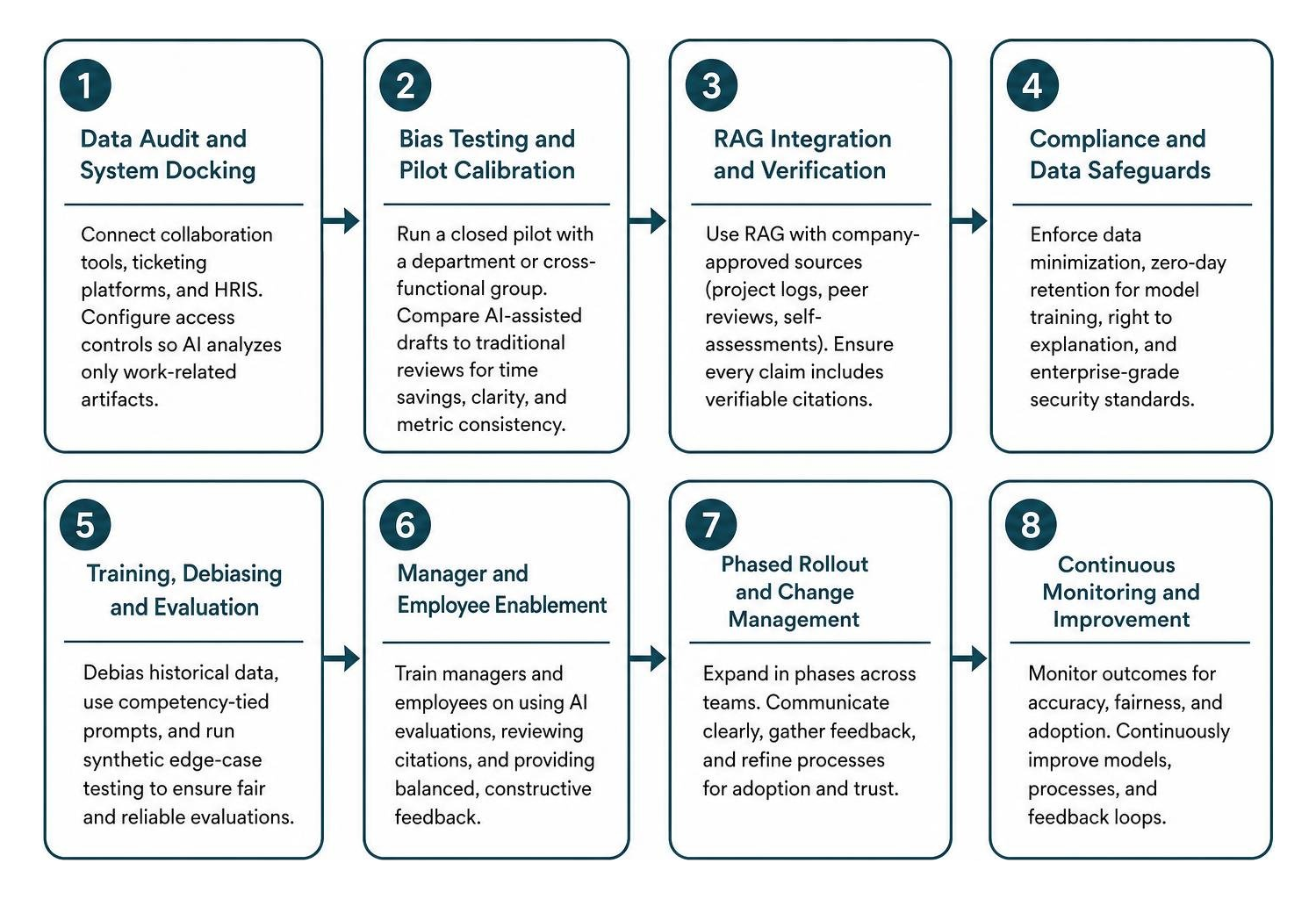
Deploying an AI evaluation platform requires thoughtful change management to ensure adoption and trust across your organization.
1. Data Audit and System Docking
Connect your collaboration tools, ticketing platforms, and core HRIS to the software. Configure access controls to ensure the AI engine only analyzes work-related artifacts within authorized directories.
2. Bias Testing and Pilot Calibration
Run a closed pilot with a single department or cross-functional group. Compare AI-assisted draft reviews against traditional reviews to measure time savings, clarity, and metric consistency.
3. Manager and Employee Training
Train managers on effective review editing, fact-checking citations, and using AI summaries to guide constructive development conversations.
4. Continuous Feedback Loops
Enable weekly conversational check-ins to replace annual review preparation marathons. Use enterprise AI productivity tools to keep your workflows efficient and aligned.
How Leading Tech Giants Approach AI Performance Management
Enterprise technology leaders have shifted away from forced-ranking systems and annual review marathons toward continuous, data-informed models:
- Google: Google uses continuous feedback frameworks supported by internal analytics tools. These systems aggregate project achievements, peer feedback, and objective progress to streamline calibration meetings and reduce managerial overhead.
- Microsoft: Through initiatives like Microsoft Viva, Microsoft incorporates analytics into daily workflows. The platform tracks productivity trends, collaboration patterns, and goal progress, helping managers focus on well-being, coaching, and career development.
Selecting the Right AI Performance Review Software for Your Culture
When choosing an AI review platform, evaluate vendors across these four primary criteria:
- Architecture and Transparency: Does the tool offer clear citations for generated claims, or is it an opaque system?
- Security and Compliance: Does the platform hold SOC 2 Type II certification, support GDPR compliance, and offer clear data-retention controls?
- Integration Flexibility: Does it integrate natively with your current HRIS, project management systems, and workplace communication tools?
- Pricing Model: Does the pricing scale reasonably per user per month as your organization grows?
Frequently Asked Questions About AI Performance Reviews
Can AI performance review software completely replace human managers?
No. AI software handles data gathering, sentiment synthesis, and drafting, but it lacks empathy, moral responsibility, and deep context. Final evaluations, promotion decisions, and sensitive career conversations require human judgment and accountability.
How do AI review tools ensure compliance with the EU AI Act and GDPR?
Compliant tools adhere to strict data-minimization principles, use EU-hosted servers with zero-day training guarantees, and offer audit trails. This ensures employees can see, challenge, and request corrections for any data used in evaluations.
What steps reduce hallucinations and errors in automated evaluations?
Leading platforms use Retrieval-Augmented Generation (RAG) tied to verified corporate systems (such as HRIS records and project management logs). Every claim is linked to source citations and requires manager review before being shared.
Modernizing Performance Management
The shift toward AI-assisted performance reviews represents a meaningful evolution in workplace operations. By automating administrative tasks, aggregating feedback continuously, and anchoring reviews in verifiable evidence, modern tools help organizations eliminate recency bias and save valuable management time.
When implemented with clear governance, strong data privacy protections, and human oversight, these platforms turn annual administrative burdens into continuous, growth-focused feedback loops. Discover how AIxorIA curates vetted AI tools, practical implementation tutorials, and enterprise strategies to help your teams work smarter.