What It Means When Student Loans Move to a Treasury Management System
Scr0ll d0wn to D0VVNL0AD
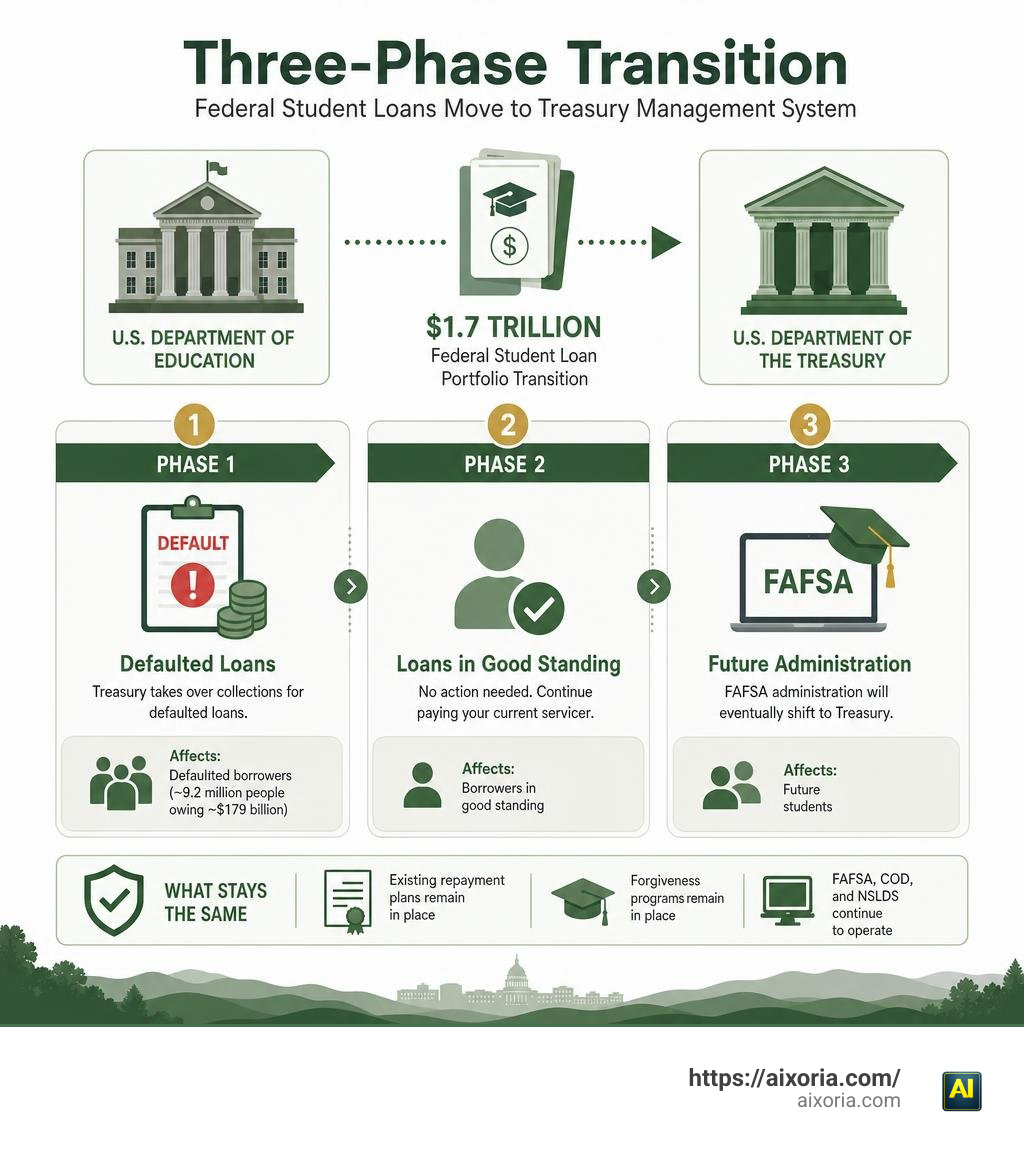
The student loans move to treasury management system is one of the biggest shifts in federal financial policy in decades. Here’s the short version:
What’s happening:
- The U.S. Department of Education is transferring operational control of the $1.7 trillion federal student loan portfolio to the Department of the Treasury
- A 17-page interagency agreement was signed on March 19, 2026
- The transition happens in three phases, starting with defaulted loans

Who it affects right now:
- Defaulted borrowers (roughly 9.2 million people owing ~$179 billion) — Treasury is taking over collections
- Borrowers in good standing — no action needed; keep paying your current servicer
- Future students — FAFSA administration will eventually shift to Treasury in Phase 3
What stays the same:
- Existing repayment plans and forgiveness programs remain in place
- Systems like FAFSA, COD, and NSLDS continue to operate normally for now
The scale of this is hard to overstate. The federal student loan portfolio is now larger than all U.S. credit card debt and auto debt combined — and roughly twice the size of every university endowment in America put together. Yet fewer than 40% of borrowers are actively repaying, and nearly one in four is in default.
Treasury Secretary Scott Bessent described the portfolio as having been “badly mismanaged for years.” The administration’s argument is simple: the Department of Education was never built to run what has effectively become the fifth-largest commercial bank in the United States. Treasury, with its deep expertise in government-wide debt collection and complex financial systems, is better equipped for the job.
Whether that turns out to be true is a much harder question — and one with real consequences for millions of borrowers.
The Historic Shift: Why Federal Student Loans Move to Treasury Management System
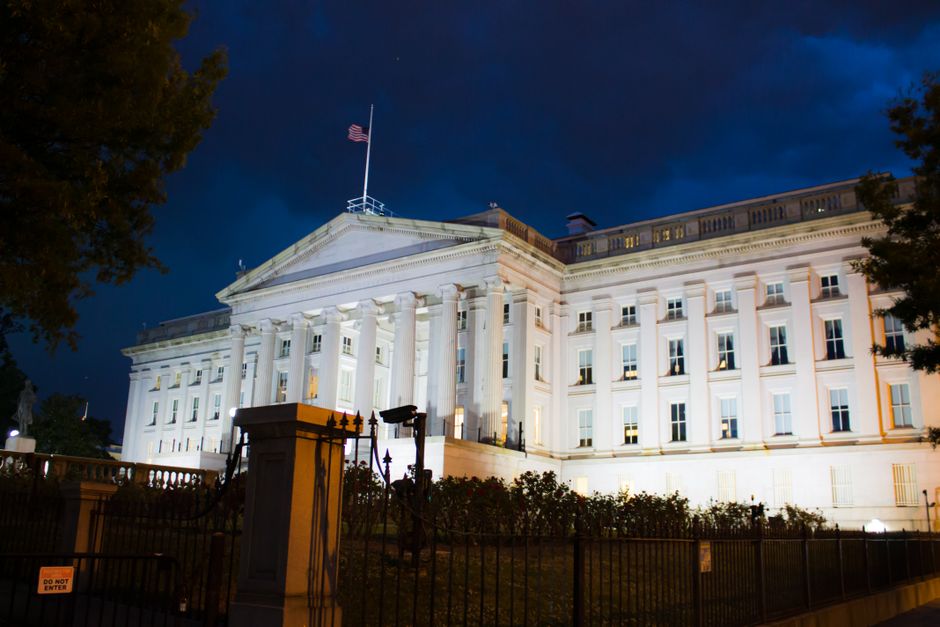
The decision to transition the nation’s massive educational lending portfolio is both a structural administrative pivot and a highly charged political statement. Under the leadership of Education Secretary Linda McMahon and Treasury Secretary Scott Bessent, the federal government has initiated a sweeping plan to move federal student loan operations out of the Department of Education (ED) and into the Department of the Treasury’s financial infrastructure.
For decades, the Department of Education has overseen the lending, servicing, and collection of student debt. However, as outlined in recent reports on how Federal student loans will move to Treasury, further shrinking Education Department, proponents of the transition point to a long history of portfolio mismanagement. With nearly a quarter of all borrowers in default and cash collections on defaulted debt dropping a staggering 91% from $6.56 billion in FY2019 to just $560 million in FY2025, officials argue that the educational bureaucracy lacks the financial discipline and technical systems required to run a $1.7 trillion lending operation.
By integrating these accounts into a centralized treasury management system, the administration hopes to leverage the Treasury’s specialized debt-resolution capabilities, bringing corporate-grade fiscal discipline to a portfolio that has struggled under administrative pauses, vendor contract terminations, and staffing shortages.
The Legal Authority and Political Strategy Behind the Move
This transition is not happening in a political vacuum. It is a central piece of a broader administrative strategy to downsize, and eventually dismantle, the Department of Education. Because completely dissolving a cabinet-level agency requires an explicit act of Congress—which faces steep legislative hurdles—the administration is using executive authority to systematically disperse the department’s responsibilities to other federal entities.
The legal mechanism driving this migration relies heavily on the Economy Act and the Debt Collection Improvement Act (DCIA). The DCIA generally mandates that federal agencies transfer non-tax debts that are delinquent for 180 days or more to the Treasury Department for centralized collection. Interestingly, the Department of Education had operated under a special waiver since 2001 that allowed it to manage its own defaulted debt. Under the new interagency agreement, this exemption is effectively being revoked.
As reported by the Federal News Network in their analysis of how the Education Dept hands federal student loan portfolio to Treasury, in latest step to dismantle agency, this partnership represents the tenth major interagency agreement used by the administration to shift educational programs to other departments, such as Labor, Interior, and Health and Human Services. By transferring the financial operational reins of the student loan portfolio to the Treasury, the administration is stripping the Department of Education of its largest operational footprint without needing to pass new legislation through a divided Congress.
The Three-Phase Transition Plan
To prevent immediate systemic shock to the financial markets and the higher education sector, the interagency agreement outlines a graduated, three-phase transition plan:
- Phase 1: Defaulted Loans and DMCS: The Treasury Department assumes immediate operational responsibility for collecting defaulted federal student loan debt. This includes managing Federal Student Aid’s (FSA) Default Resolution Group and taking over the Default Management and Collections System (DMCS).
- Phase 2: Non-Defaulted Debt Servicing: Treasury will expand its operational footprint to oversee the servicing of non-defaulted federal student loans. While the actual customer-facing loan servicers may remain private contractors, their administrative oversight and contract management will shift to the Treasury.
- Phase 3: FAFSA and Institutional Eligibility: In the final and most complex phase, the Treasury Department will assume administrative control over the Free Application for Federal Student Aid (FAFSA) and the evaluation of institutional eligibility for higher education funding.
This phased approach, detailed in the Student Loans Are Moving to Treasury | CollegeHelpGuide analysis, aims to ensure that critical IT integrations and data-sharing systems can be thoroughly tested before expanding the Treasury’s role to active, non-defaulted accounts.

Analyzing the Operational Impact on Borrowers and Default Collections

The operational scale of this transfer is unprecedented. As of late 2025, the Department of Education’s defaulted federal student loan portfolio alone comprised approximately 7.8 million borrowers owing a combined $179 billion. When the transition is fully realized, adding these accounts to the Treasury’s existing Cross-Servicing Program will cause its debtor pool to balloon from 1.9 million to nearly 9.7 million, while the total debt under its management will surge from $119.1 billion to roughly $298.2 billion.
For borrowers, especially those facing financial hardship, this operational shift represents a fundamental change in how their accounts are managed. Under the Department of Education, default resolution was historically designed to guide borrowers toward rehabilitation, consolidation, and income-driven repayment options. If you find yourself struggling to navigate these changes, our guide on who should you contact if you have trouble making student loan payments 2026 guide can help you identify the right points of contact during this transitional period.
How the Student Loans Move to Treasury Management System Affects Defaulted Debt
The primary tool the Treasury will use to manage this massive influx of defaulted debt is its Cross-Servicing Program. Unlike the Department of Education, which historically relied on a gentler, borrower-supportive approach to help individuals exit default voluntarily, the Treasury’s institutional strength lies in involuntary, highly structured debt recovery.
Under the Treasury’s oversight, collections will be facilitated through:
- Private Default Resolution Agencies: The Treasury will leverage contracted private collection firms to conduct outreach and establish repayment agreements.
- The Treasury Offset Program (TOP): This system automatically intercepts federal payments, such as tax refunds and Social Security benefits, to offset delinquent debts.
- Administrative Wage Garnishment (AWG): The Treasury has the direct authority to instruct employers to garnish up to 15% of a borrower’s disposable wages without obtaining a court order.
As highlighted by Treasury’s first move to tackle the $1.7 trillion student loan problem – Troib News, there is a significant operational tension between the Treasury’s hard-edged collection methods and the specialized, borrower-friendly pathways required for student loan rehabilitation. Critics worry that the Treasury’s systems are not naturally optimized to handle the complex statutory relief options—such as Public Service Loan Forgiveness (PSLF) or income-driven repayment calculations—that make student loans unique compared to standard government debts like unpaid taxes or customs duties.
Navigating Your Rights and Responsibilities During the Transition
With the transition underway, it is more important than ever for borrowers to understand their legal rights and administrative options. If you are unsure of your standing, you should start by reviewing the Master Promissory Note (MPN). For a detailed breakdown of what this document entails, read our article on what document explains your rights and responsibilities as a federal student loan borrower.
If your loans are currently in default, you should proactively visit myeddebt.ed.gov to review your accounts and explore default resolution options, such as loan consolidation or rehabilitation, before aggressive Treasury collections resume. Additionally, for those who may have taken on more debt than necessary, our guide on who do you contact if youve accepted more student loan money than you need 2026 guide offers actionable steps to return excess funds.
Furthermore, keep an eye on active legal challenges that could impact your repayment terms or eligibility for debt relief. To stay informed on the latest legal precedents, check our update on the federal student loan discharge lawsuit 2026 who qualifies how to win.
Benefits, Risks, and Lessons from the 2016 Pilot Program
This is not the first time the federal government has attempted to route student loans through the Treasury’s collection systems. In 2015 and 2016, the two departments launched a joint pilot program to test the Treasury’s capability to service defaulted student debt. The results of that pilot, detailed in the Congressional Research Service report on the Transition of Servicing Defaulted Federal Student Loans to the Department of the Treasury: Background and Observations – EveryCRSReport.com, raise significant caution flags.
The pilot program revealed that the Treasury’s centralized Cross-Servicing Program struggled to match the performance of private collection agencies (PCAs) working directly under the Department of Education. Because student loans feature highly specialized statutory options like rehabilitation (which requires making nine consecutive on-time payments based on discretionary income), the Treasury’s standardized, automated collection systems were simply too rigid to guide borrowers through the process. In fact, a separate 2015 joint pilot resulted in only 8 out of 5,729 referred borrowers successfully completing account rehabilitation within a year.
| Servicing Entity | Resolution Rate (2016 Pilot) | Primary Methodology |
|---|---|---|
| FSA-Contracted Private Collection Agencies (PCAs) | 5.46% | Borrower-facing outreach, voluntary rehabilitation, and loan consolidation. |
| Treasury Bureau of the Fiscal Service | 4.14% | Involuntary offsets, standardized letters, and automated recovery. |
This historical data suggests that while the Treasury is highly efficient at recovering funds through involuntary means like tax offsets, it has historically underperformed in helping borrowers return to good standing through voluntary repayment and rehabilitation programs.
Why the Student Loans Move to Treasury Management System Faces Capacity Concerns
Beyond historical performance, experts are deeply concerned about the Treasury’s current operational capacity to handle this massive portfolio. Managing a $1.7 trillion portfolio with millions of active accounts requires vast customer service infrastructure, robust IT systems, and significant personnel.
However, a review of federal staffing data reveals a stark reality: the number of employees within the Treasury’s Bureau of the Fiscal Service (BFS) decreased by approximately 40% between September 2024 and February 2026. This severe workforce reduction has prompted warnings from policy analysts who fear that the Bureau may be under-resourced to handle a sudden, massive influx of student loan portfolios.
To mitigate this risk, the interagency agreement outlines a graduated referral approach rather than a single, massive data dump. Additionally, as noted in the federal audit of Federal Student Aid’s Transition to the Next Generation Loan Servicing Environment, previous attempts to modernize and migrate loan servicing systems failed due to bypassed protocols and premature vendor acquisitions. Ensuring that the Treasury does not repeat these IT governance mistakes is critical to preventing widespread system crashes and account processing delays.
Stakeholder Concerns: Service Quality and Staffing Shortages
The transition has drawn sharp criticism from a wide range of stakeholders, including financial aid professionals, borrower advocates, and lawmakers. Melanie Storey, President of the National Association of Student Financial Aid Administrators (NASFAA), warned that steep federal staff reductions and rapid structural changes could make a transition of this magnitude highly disruptive for students and families. Similarly, Representative Bobby Scott and union leaders like Rachel Gittleman of AFGE Local 252 have expressed deep concern that the move will add administrative barriers to an already opaque student loan repayment process.
These concerns are further compounded by recent Government Accountability Office (GAO) findings, which revealed that:
- Four out of five major student loan servicers failed to meet federal performance standards for maintaining accurate payment records.
- Federal Student Aid (FSA) completely suspended its customer service quality assessments for loan servicers in February 2025 due to severe internal staffing shortages.
With record-keeping errors already high and oversight mechanisms weakened, critics argue that transferring operational control to an understaffed Treasury Department could lead to widespread administrative chaos. For borrowers evaluating their options in this volatile environment, private alternative options may warrant consideration; you can read our comprehensive advantage student loan review 2026 rates eligibility pros explained to see how private lending options compare to the changing federal landscape.
Frequently Asked Questions about the Treasury Student Loan Transition
Do I need to take action if my student loans are in good standing?
No. If your federal student loans are current and in good standing, you do not need to take any action. You should continue making your monthly payments directly to your assigned loan servicer. The initial phases of the transition focus primarily on defaulted debt and backend administrative systems, meaning your day-to-day repayment experience should remain unchanged for the time being.
What is the legal authority allowing this transfer?
The administration is executing this transfer through Interagency Agreements (IAAs) authorized under the Economy Act and the Debt Collection Improvement Act (DCIA). While critics and union representatives argue that permanently moving cabinet-level programs requires explicit congressional approval, the administration is utilizing these statutory sharing provisions to shift operational control and system management without needing to pass new legislation.
How does this transition affect student loan forgiveness programs?
The transition to a treasury management system is an administrative and operational shift, not a change in federal law. Existing statutory benefits—including Public Service Loan Forgiveness (PSLF), income-driven repayment (IDR) plans, and teacher loan forgiveness—are established by the Higher Education Act and remain legally intact. The Treasury Department is obligated to administer the portfolio in accordance with these existing statutory guidelines.
Conclusion
The student loans move to treasury management system represents a monumental shift in how the federal government manages public debt. While the transition promises to bring corporate-grade fiscal discipline and advanced financial technology to a historically mismanaged portfolio, it also introduces significant risks regarding operational capacity, service quality, and borrower support.
As federal agencies navigate this complex migration, organizations and individuals alike must look for ways to optimize their own financial workflows and administrative processes. To stay ahead of the curve and ensure maximum efficiency in your financial management, Discover the best AI for productivity in 2026 to streamline your financial workflows and learn how cutting-edge technology can help you navigate shifting economic landscapes with ease.
1 thought on “Student Loans Move to Treasury Management System in 2026: What Borrowers Need to Know”