How AI Tools Help CPAs and Tax Preparers During Tax Season
Scr0ll d0wn to D0VVNL0AD
To get value from ai tools for cpas and tax preparers during tax season, start with the work that slows your team down most. Use AI to sort client documents, pull figures from W-2s and 1099s, flag missing items, and draft routine client messages. Add research or return-preparation tools only after testing them on your firm’s actual returns and tax software.
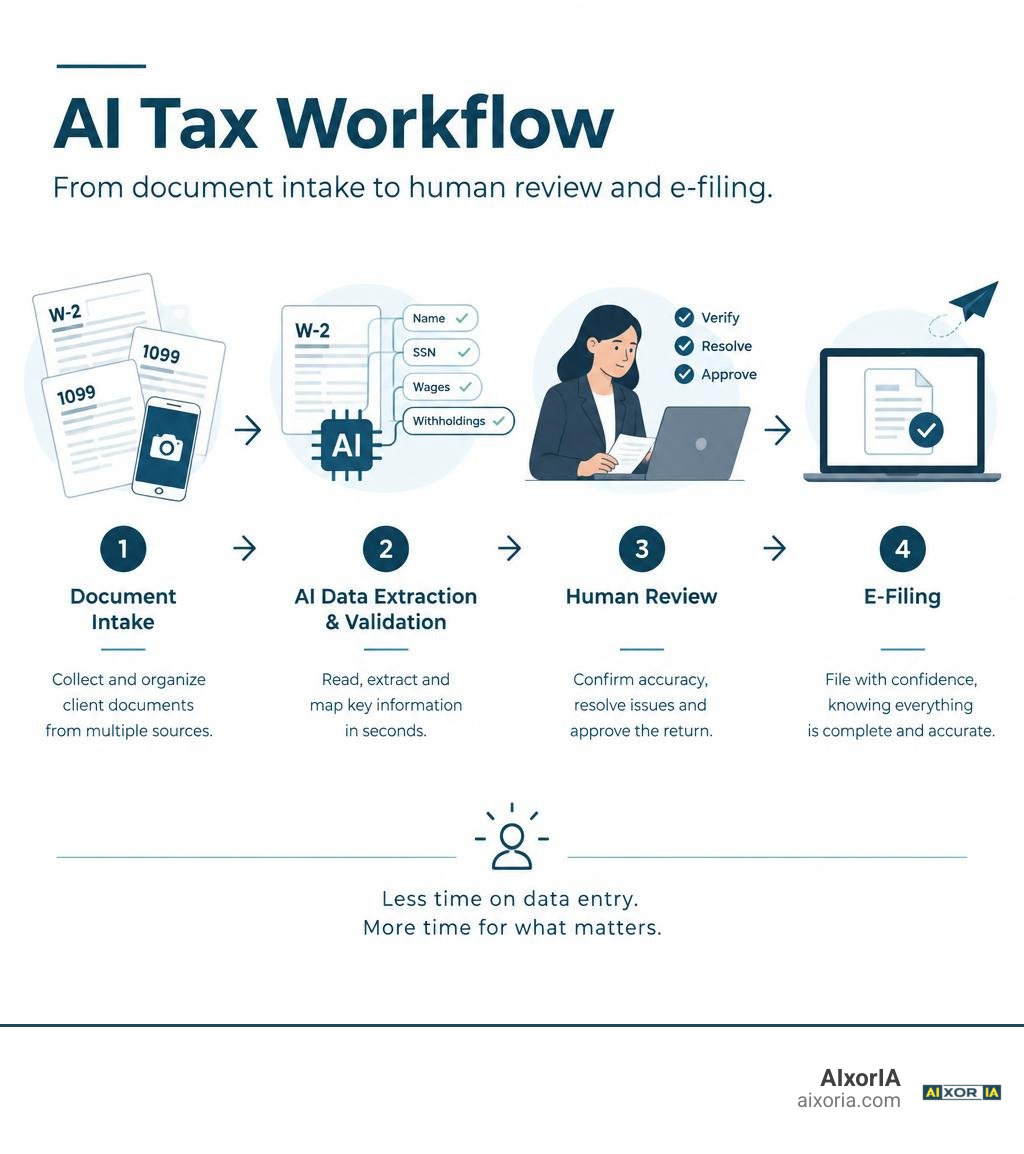
Keep a person in charge. A tax professional must check figures, resolve conflicting records, verify tax guidance, and approve the return before filing. The goal is less time on data entry and more time for review and client advice.
Core Benefits of AI Tools for CPAs and Tax Preparers During Tax Season
Tax season workload spikes by 30% to 40% compared to the rest of the year. For decades, practitioners accepted that the first 60 days of every calendar year would be swallowed by manual keyboard entry. In 2026, modern artificial intelligence has shifted this reality.
Large Language Model (LLM) parsing systems read tax source documents semantically. Instead of relying on rigid templates, modern models can parse a wrinkled W-2 or a photographed 1099, extract federal identification numbers, wages, and withholdings, and map them in under 45 seconds per document. Deploying modern accounting workflow automation software eliminates repetitive manual transcription, enabling firms to cut busy season overtime significantly and reallocate saved hours toward proactive advisory services.
Automated Intake and Document Organization
Standard Optical Character Recognition (OCR) tools often fail when tax documents have non-standard layouts or skewed scans. AI-driven document extraction reads context dynamically, recognizing distinct tax schedules and tables across unstructured multi-page PDFs.
Modern client portals leverage this technology to automatically compare uploaded forms against prior-year return records. If a client filed a Form 1099-INT last year but hasn’t uploaded one this season, the intake portal automatically flags the missing document. Using dedicated document management software for accounting firms creates an organized, searchable workpaper file before a human preparer even opens the return.
Semantic Categorization and Anomaly Detection
Categorizing business expenses for Schedule C and pass-through entities traditionally demands hours of manual ledger cleanup. AI categorization tools understand semantic context. For example, instead of leaving a charge from “Adobe Systems” uncategorized, the engine recognizes the vendor, routes it to “Dues and Subscriptions,” and flags it for human review.
Connecting these systems with multi-source reconciliation tools allows firms to automatically cross-reference bank records against general ledger entries. The software detects anomalies—such as flipped birthdates, mismatched Social Security numbers, or cross-schedule inconsistencies—before draft returns move to the review stage.
Real-Time Workflow Visibility and E-Filing Validation
AI-powered practice management dashboards monitor filing progress in real time. These platforms track return status, surface operational bottlenecks, and identify overdue client requests.
During pre-filing checks, automated validation routines inspect client data to verify required schedules, calculations, and identity fields. For Electronic Return Originators (EROs), catching validation errors before transmission drastically lowers IRS e-file rejection rates and prevents identity mismatch issues.
Comprehensive Comparison of Professional AI Tax Platforms

Selecting the right AI platform requires matching software capabilities with your firm’s specific return profile and existing software stack.
| Tool Name | Primary Function | Supported Return Types | Integration Focus | Public Pricing (2026) |
|---|---|---|---|---|
| CPA Pilot | Integrated Research & Workflow | 1040, 1065, 1120, 1120-S | Tax Research & Document Workflow | Starts at $29/month |
| TaxGPT | Autonomous Return Preparation | 1040, 1065, 1120 | Web-based Tax Software via Browser Automation | Custom / Tiered pricing |
| Juno | Return Automation & Review | 1040, Entity Returns | Direct Tax Prep Platform Integrations | 5 free trial preps; usage tiers |
| Blue J | Tax Research & Predictive Analysis | Federal & State Tax Code | Independent Platform (CPA.com Partner) | $1,498/year per user (7-day trial) |
| TaxPlanIQ | Advisory & Strategy Modeling | 1040, 1065, 1120-S | Engagement & Client Deliverables | Starts at $397/month (Basic) |
| Bizora | Technical Research & Drafting | 1040, Business Returns | Research API & Web App | $29.99 to $119.99/month per seat |
| Hive Tax | Tax Research & Planning | Individual & Entity Scenarios | Standalone Planning Engine | Research: $79/mo; Planning: $699/yr |
| Filed | Extraction & Review Verification | 1040, 1041, 1065, 1120, 1120-S, 990 | CCH Axcess, UltraTax, Lacerte, Drake | Custom firm licensing |
Evaluating Top AI Tools for CPAs and Tax Preparers During Tax Season
Autonomous workflow engines are changing return production. As highlighted in coverage by CPA Practice Advisor, autonomous tax agents are evolving to handle complex, multi-step preparation workflows. Newer platforms use browser automation to open web-based tax software, populate forms from source workpapers, and complete first-pass data entry without manual typing.
Pairing autonomous data entry engines with specialized finance automation software allows firms to scale return volume without increasing seasonal staff headcount.
Dedicated Tax Research and Citation Grounding
Generic chatbots often invent legal authorities or combine disparate statutes incorrectly. Professional tax research tools eliminate this risk by grounding their generative models in primary sources, including the Internal Revenue Code, Treasury Regulations, IRS Revenue Rulings, and relevant court precedent.
Platforms such as Blue J maintain a 99.7% answer agreement rate among professional users. These engines cross-reference statutory citations and provide direct links back to original tax authorities. Practitioners can review the actual legal code rather than trusting an unverified summary, satisfying professional due diligence standards.
Proactive Tax Planning and Scenario Modeling
Tax season creates valuable touchpoints where practitioners can uncover year-round tax reduction opportunities. Planning platforms like TaxPlanIQ provide access to over 130 structured, CPA-vetted tax strategies.
Integrating planning systems with advanced financial statement analysis tools allows firms to model multi-year tax scenarios, evaluate S-Corporation salary-to-distribution splits, and generate clear, client-ready advisory deliverables that justify value-based pricing.
Data Security, IRS Compliance, and Human Review Protocols

Handling taxpayer data requires rigorous security safeguards. The Federal Trade Commission (FTC) Safeguards Rule and the Gramm-Leach-Bliley Act (GLBA) require accounting firms to maintain written information security plans and verify that third-party vendors protect non-public personal information.
Firms must demand SOC 2 Type II compliance, TLS encryption in transit, AES-256 encryption at rest, and zero-data-retention agreements to ensure client data is never used to train public machine learning models. Desktop-first AI tools that process files locally provide an additional layer of data protection for sensitive documents.
Adhering to IRS Circular 230 and June 2026 Guidance
The IRS Office of Professional Responsibility issued guidance clarifying the use of artificial intelligence in tax practice. This guidance reinforces that Circular 230 obligations remain entirely with the human practitioner:
- Non-Delegable Responsibility: A tax professional cannot blame software for mathematical miscalculations, missing schedules, or omitted income.
- Verification of Factual Accuracy: Practitioners must review source documents to verify that figures imported by AI accurately reflect client records.
- Due Diligence on Legal Positions: AI-drafted positions, memos, and citations must be validated against primary authorities before delivery or submission.
Human-in-the-Loop Verification and Exception Handling
AI is a productivity co-pilot, not an authorized return signer. Experienced professional judgment remains essential for complex tax matters:
- Complex K-1 Parsing: Multi-state apportionment schedules, partner capital account adjustments, and footnote allocations require human interpretation.
- Ambiguous or Conflicting Documents: When a client submits contradictory records, such as an amended 1099 alongside a broker statement, the preparer must evaluate and resolve the discrepancy.
- Gray-Area Legal Classifications: Determining whether an activity qualifies as a business or a hobby under Section 183 requires human evaluation of facts and circumstances.
Strategic Roadmap for Firm-Wide AI Implementation
Rolling out new software during peak season requires a phased strategy to avoid operational disruptions.
Step-by-Step Implementation Timeline
- Audit Primary Bottlenecks: Identify where your firm loses the most time (e.g., document sorting, receipt classification, or initial 1040 data entry).
- Standardize Intake Workflows: Implement AI-enabled client portals to automate initial document collection and flag missing items before files reach preparers.
- Conduct Prior-Year Return Testing: Run completed prior-year client returns through the prospective AI tool to benchmark extraction accuracy and identify software quirks.
- Create a Firm Prompt and Review Playbook: Establish standard prompt templates and review checklists for research, client communications, and workpaper documentation.
- Phase-In Live Preparation: Roll out automated preparation to straightforward Form 1040 returns first, maintaining mandatory human review before expanding to complex entity filings.
Measuring ROI, Time Savings, and Advisory Capacity
Measuring software return on investment should focus on capacity gained and error reduction:
- Direct Time Savings: Autonomous preparation tools save 30 to 45 minutes per Form 1040 by eliminating first-pass data entry.
- Research Acceleration: Grounded tax search engines reduce statutory research and memo drafting time from hours to minutes.
- Communication Efficiency: AI drafting tools reduce the time spent explaining return adjustments from 15 minutes per email to under two minutes.
Reallocating 10 to 15 hours per preparer each week toward advisory planning creates higher-margin revenue streams that protect firms against the commoditization of standard compliance work.
Frequently Asked Questions about Tax Season AI Tools
How do professional AI tax tools differ from consumer filing assistants?
Consumer filing software is built for straightforward, self-prepared single returns. Professional AI tax tools support multi-client workflows, batch document ingestion, audit trail creation, integration with professional tax suites (like CCH Axcess, UltraTax, Drake, and Lacerte), and compliance tracking required by licensed CPAs and EAs.
Can AI tax tools reliably handle multi-state business returns and K-1s?
AI tools can accurately extract standard K-1 line items, but complex multi-state allocations, partner basis adjustments, and footnote disclosures still require human oversight. Firms should treat AI extraction on pass-through entities as a draft workpaper that requires human sign-off.
What should a firm do when AI flags missing or contradictory client records?
When an AI engine detects conflicting numbers or missing schedules, the item should remain marked as unresolved in the workflow dashboard. The practitioner should use automated client portal requests to gather clarification, keeping a complete audit trail of the resolution in the firm’s document archive.
Conclusion
Artificial intelligence has transformed tax season from a manual typing marathon into an automated, review-focused workflow. By adopting proven AI tools for document intake, transaction categorization, and authoritative tax research, accounting practices can eliminate operational bottlenecks and protect staff from seasonal burnout.
At AIxorIA, we provide curated AI technology guides, practical software tutorials, and actionable implementation frameworks designed to help modern accounting firms scale their capacity and modernize their operations. Explore our resources to build an efficient, advisory-focused tax practice.