The Best AI-Powered Finance Automation Software in 2026: A Quick Answer

The best AI-powered finance automation software tools available right now are:
| Tool | Best For | Key Strength |
|---|---|---|
| Vic.ai | AP automation | 99% invoice accuracy, 5x faster processing |
| ChatFin | Month-end close | Reduces close from 10 days to 3 days |
| Numos | Full-cycle accounting | Agentic workflows, SOC 1 & 2 certified |
| Maximor | Revenue recognition | ASC 606/IFRS 15 compliance, audit-ready output |
| Seapoint | Small business payroll & AP | Gmail integration, Xero sync |
| Payvo | Back-office automation | 90%+ AP/AR auto-processed |
Finance teams today are buried. Invoices pile up. Month-end close drags on for weeks. Spreadsheets break. And the people who should be making strategic decisions are stuck doing data entry instead.
The numbers tell the story clearly. Nearly 72% of businesses are already piloting or using AI in financial reporting. And adoption is expected to hit 99% within three years. This isn’t a distant trend — it’s happening right now, in companies just like yours.
But here’s the uncomfortable truth: 96% of CFOs want AI, yet only 14% actually trust it. That gap exists because choosing the wrong tool — or implementing it badly — can create more problems than it solves.
This guide cuts through the noise. Whether you’re a small business owner, a controller, or a CFO, you’ll find a clear comparison of the top tools, what they actually do well, and how to pick the right one for your situation.
What is AI-Powered Finance Automation Software?
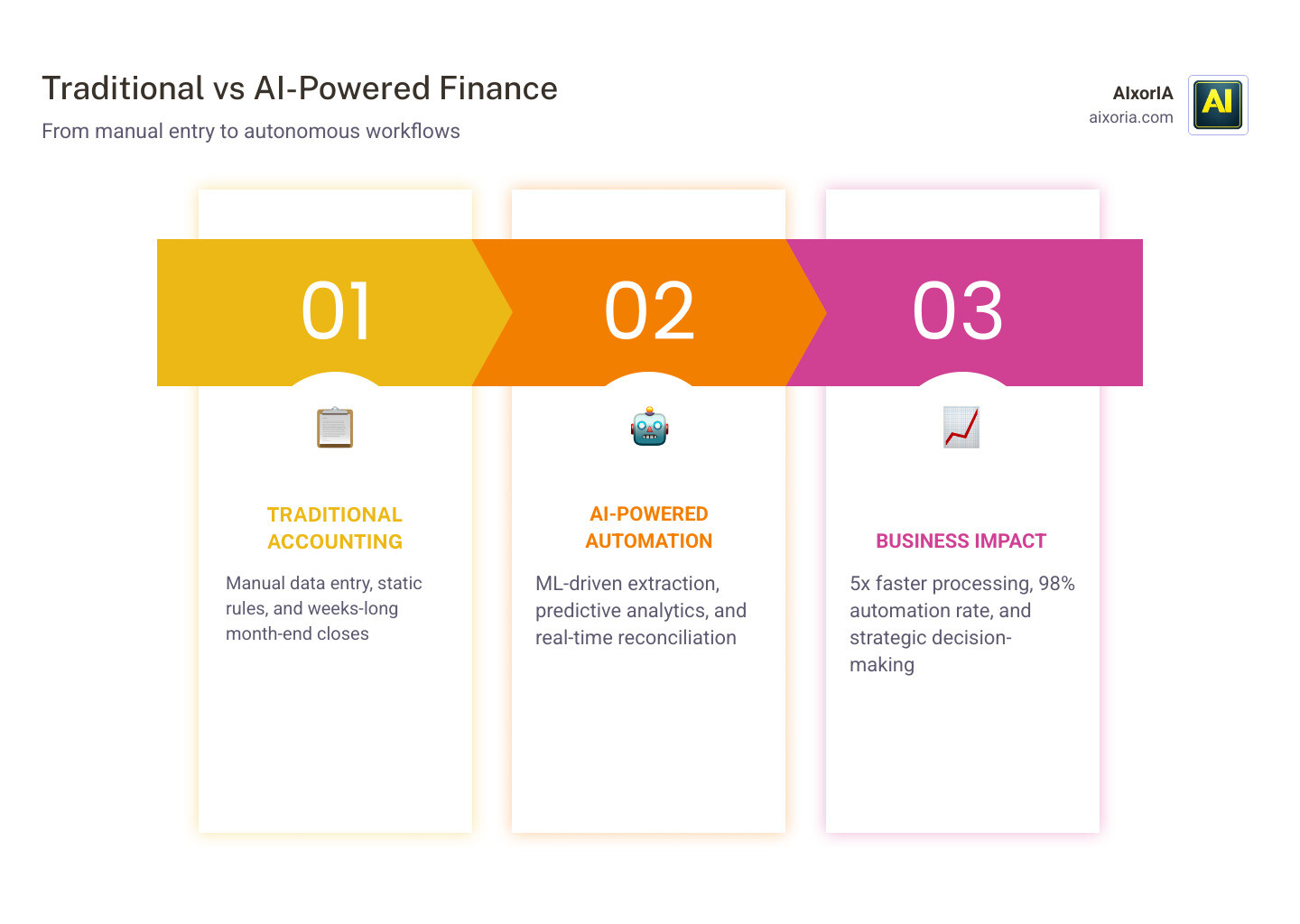
Traditional accounting software is great at keeping records, but it is fundamentally passive. It waits for you to enter data, click buttons, and run reports. If you want to reconcile a bank statement, you have to write static rules or manually match line items.
The Best AI-Powered Finance Automation Software changes the game by introducing machine learning, predictive analytics, and semantic understanding. Instead of relying on rigid, easily broken rules, AI-powered tools read invoices like a human would, extract context, predict transaction categories, and flag anomalies before they become costly audit headaches.
According to a Pearson report, generative AI can handle 30% to 46% of manual tasks typically done by white-collar workers. In the accounting world, that means shifting from retrospective record-keeping to real-time financial intelligence. These tools continuously learn from your historical ledger data, automatically adjusting to new vendor layouts, identifying duplicate billings, and modeling future cash flows.
To explore the foundational shift in how companies manage these processes, check out our Benefits of Finance Automation Software 2026 Guide.
The Best AI-Powered Finance Automation Software Solutions in 2026
To help you find the right fit, we have broken down the market’s leading platforms into their primary use cases.

Autonomous AP/AR and Invoice Processing with Best AI-Powered Finance Automation Software
Accounts Payable (AP) and Accounts Receivable (AR) are notorious for eating up valuable hours. Fortunately, modern autonomous agents are turning these workflows into hands-off operations.
- Vic.ai: If you are looking to eliminate manual invoice entry entirely, Vic.ai is a powerhouse. It achieves a 99% invoice accuracy rate without requiring tedious template setups. By month six of deployment, most businesses reach an 85% no-touch rate, resulting in 5x faster invoice processing and a rapid 7-month payback period.
- Payvo: Designed as a virtual back-office team, Payvo | AI-Powered Financial Operations runs 24/7. It automatically extracts supplier invoices from your emails, schedules payments based on cash position, and handles collections. Payvo helps businesses automate over 90% of their AP/AR processes, reducing Days Sales Outstanding (DSO) by 10 to 15 days.
For a deeper dive into enterprise-grade financial operations, read our list of the 9 Best Corporate Finance Automation Software in 2026.
Month-End Close and Ledger Management using Best AI-Powered Finance Automation Software
The month-end close is often a multi-week sprint of manual reconciliations, journal entries, and variance analyses. These tools act as “agentic” team members to handle the heavy lifting.
- ChatFin: ChatFin uses specialized AI agents that execute workflows directly inside your ERP. Instead of bouncing between systems, ChatFin reads and writes via native APIs, reducing the typical month-end close from 10 days to just 3 days. It also boasts a 75% reduction in manual touchpoints for AP processing, delivering an average break-even ROI within 4 to 8 months.
- Numos: Numos unifies your ERP, billing platforms, and bank accounts into a single semantic layer. It deploys agentic AI to handle complex accounting workflows, from cash coding to balance sheet reconciliations. Numos has processed over $300B in transaction volume while maintaining a 100% auditable trail across more than 150 native integrations.
To compare more close-management platforms, take a look at The 9 Best Finance Automation Software Tools in 2026.
Revenue Recognition and Compliance Automation
For mid-market and enterprise companies with complex subscription models or multi-entity structures, managing revenue recognition under strict standards like ASC 606 and IFRS 15 is highly challenging.
- Maximor: Built specifically to eliminate risky spreadsheet workarounds, Maximor : AI Automation Platform for Accounting & Finance Ops automatically ingests customer contracts, extracts complex terms, and drafts audit memos. It reduces the revenue close process from 5+ days to 1–2 days, ensuring that 100% of contracts are auto-prepared with compliant amortization schedules.
For a broader evaluation of compliance-focused tools, see our analysis of the Best Finance Automation Software Tools 2026.
Multi-Currency Payroll and Small Business Automation
Smaller businesses and accounting firms need lightweight, highly integrated tools that play nicely with popular platforms like Xero and QuickBooks.
- Seapoint: Finance automation | Seapoint is a fantastic fit for growing startups and small businesses. By connecting directly to your Gmail and bank accounts, Seapoint automatically extracts invoices, flags duplicates, and syncs everything to Xero. It also automates multi-currency payroll, turning your recurring monthly pay runs into simple, one-click templates.
To discover more tools that boost day-to-day efficiency, explore our guide on the Best AI Tools for Business Productivity.
Key Benefits and ROI of Implementing AI in Finance
Implementing the Best AI-Powered Finance Automation Software is not just about adopting new technology; it is about driving measurable business outcomes.

According to an Intuit QuickBooks study, 98% of accountants and bookkeepers have already used AI accounting software to serve their clients. Furthermore, 27% of professionals view keeping pace with these technological advancements as “survival-critical” for their firms.
When we look at the actual data from businesses using these tools, the return on investment is clear:
- Substantial Time Savings: Teams regularly save 80% of the time previously spent on invoice data entry.
- Faster Closings: Close management agents like ChatFin and Maxima consistently shave 2 to 7 days off the monthly close window.
- Fewer Errors: With AI models achieving up to 99% accuracy rates, the risk of human copy-paste errors is virtually eliminated.
- Audit Readiness: Modern tools log every decision, reasoning step, and source document, providing a flawless audit trail for internal and external reviewers.
To see how advanced AI can also help you analyze the resulting data, read our review of the Best AI Tools for Financial Statement Analysis in 2026.
Challenges, Risks, and How to Choose the Right Solution
Despite the incredible benefits, implementing AI in finance does come with hurdles. As the statistic highlights, only 14% of CFOs fully trust AI. This skepticism is often justified. If an AI tool encounters poor-quality historical data, it can make incorrect assumptions and quietly post flawed journal entries.
When evaluating solutions, keep these best practices in mind:
- Prioritize Auditability: Never buy an AI tool that acts as a black box. You must be able to click on any AI-generated transaction and see the exact reasoning and source document behind it.
- Verify ERP Integration: Ensure the software integrates natively with your existing ERP (such as NetSuite, SAP, or Sage Intacct) via robust APIs, rather than relying on manual file uploads.
- Evaluate Security: Look for platforms that carry SOC 1, SOC 2, and ISO 27001 certifications to protect your sensitive financial data.
For specialized industries like construction, where project-based billing and subcontractor compliance add unique layers of complexity, choosing the right tool is even more critical. Read our guide on the Top AI Tools for Managing Construction Finances to find tailored recommendations.
Frequently Asked Questions about AI Finance Automation
How does AI-powered finance automation differ from traditional accounting software?
Traditional software relies on static, user-defined rules (e.g., “If vendor is X, code to expense Y”). If an invoice format changes slightly, the rule breaks. AI-powered software uses machine learning and semantic understanding to read documents contextually, adapt to changes automatically, and execute multi-step workflows without human intervention.
What are the security and compliance standards for AI finance tools?
Top-tier AI finance platforms are built to meet enterprise security standards. They typically feature SOC 1 and SOC 2 certifications, ISO 27001 compliance, GDPR alignment, and role-based access controls. They also maintain comprehensive, unalterable audit logs for every action taken by the AI.
How do AI finance tools integrate with existing ERP systems?
Most modern AI platforms connect via native, secure APIs to systems like NetSuite, SAP, Microsoft Dynamics, QuickBooks, and Xero. This allows the AI to read ledger data, post journal entries, and reconcile accounts in real time without disrupting your core system of record.
Conclusion
The era of manual data entry, missing receipts, and grueling 10-day month-end closes is coming to an end. Embracing the Best AI-Powered Finance Automation Software allows your finance team to step out of the weeds and take on the strategic, forward-looking advisory roles they were hired for.
At AIxorIA, we specialize in helping businesses navigate this digital transformation. We provide custom AI solutions, hands-on tool training workshops, practical tutorials, and performance audits designed to empower your team. We pride ourselves on offering simple language help, highly affordable services, and incredibly fast customer support.
Ready to bring autonomous efficiency to your finance department? Contact us today to explore how we can help you implement and master the perfect AI tools for your business!
2 thoughts on “7 Best AI Accounting Automation Tools for Businesses in 2026”