How AI Tools Simplify Moving Quotes and Scheduling

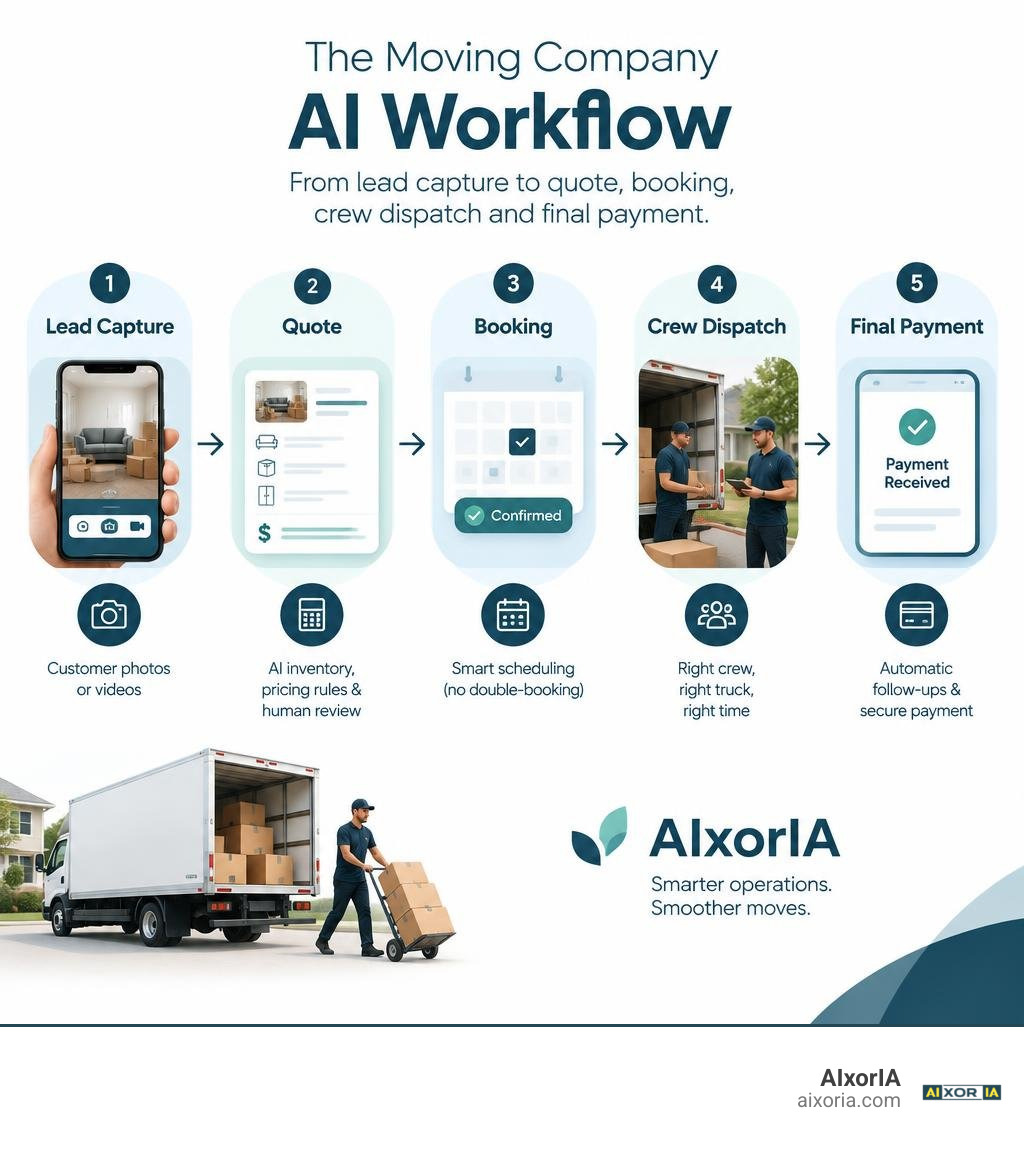
AI tools for quotes and scheduling at moving companies can turn customer photos or videos into a draft inventory, apply your pricing rules, and help find an available crew and truck. Start by looking for self-service intake, a human review step before quotes go out, scheduling that prevents double-booking, and automatic follow-ups. If you handle interstate moves, check that the software supports your tariff and required documents.
The goal is not just a faster quote. It is a quote your team can stand behind and a move you can staff.
Running a modern moving operation involves continuous logistical challenges. In the United States alone, the moving sector spans over 7,000 active carriers generating roughly $18 billion in annual revenue. According to U.S. Census Bureau mobility data, approximately 27 million Americans relocate each year.
To serve those customers, moving operators rely on a massive workforce: federal labor statistics show nearly 3 million material movers working across transportation and warehousing, with a median wage above $19 per hour. When your labor costs are steady and consumer demand fluctuates, administrative bottlenecks can erode your profit margins. Traditional quoting requires hours of phone calls or manual home visits, which diverts skilled estimators from closing deals.
Adopting specialized software helps eliminate these bottlenecks. In this guide, we break down how automated estimating, virtual surveys, smart dispatching, and automated workflows can transform your moving operations.
Why Moving Businesses Need AI Tools for Moving Companies for Quotes and Scheduling
The moving industry moves quickly. When a homeowner decides to move, they rarely contact just one company. They typically submit online quote requests to three or four carriers simultaneously or call the first few businesses they find on Google Maps.
In this environment, lead decay happens fast. If your office takes four hours—or until the next business day—to return a phone call or send an estimate, that prospect has often already booked with a competitor. Moving businesses adopting ai tools for moving companies for quotes and scheduling capture, qualify, and quote incoming prospects in minutes, protecting conversion rates around the clock.
Integrating lead follow-up automation into your customer intake ensures that inquiries receive instant attention rather than sitting in an unread inbox.
Speed to Lead and Response Time Dynamics
Research consistently shows that responding to an inquiry within five minutes makes a sales team drastically more likely to qualify a prospect compared to waiting even half an hour. In moving, speed to quote is often the deciding factor in winning the job.
Nearly half of all residential moving inquiries arrive after standard business hours, on weekends, or during holidays when office dispatchers are off the clock. Deploying dedicated AI voice agents for movers and automated web responders allows your business to engage leads instantly. These systems gather essential move parameters:
- Origin and destination postal codes
- Target moving dates or acceptable date ranges
- Dwelling types (single-family home, third-floor walkup, high-rise apartment)
- Bulky, fragile, or specialty inventory (pianos, pool tables, safes, commercial gym setups)
By qualifying prospects immediately, the system reserves prime move dates on your calendar and delivers accurate pricing ranges before competitors even review their voicemails.
Transforming Traditional Quoting into Automated Estimates
The conventional estimating workflow is labor-intensive:
- A sales rep spends 15 minutes on an initial phone call.
- An estimator travels to the client’s home for a 45-minute on-site walkthrough.
- The estimator returns to the office to calculate total cubic footage and apply access fees.
- The office drafts and emails a formal estimate hours later.
AI quoting software condenses this entire workflow into roughly 5 minutes. Rather than scheduling an in-person visit, the customer captures their home inventory through a guided smartphone interface or a quick phone consultation.
The software automatically generates an itemized cube sheet, applies hourly or weight-based rates, calculates travel fees, and flags access obstacles. Your office staff simply reviews the pre-built estimate, adjusts special line items if necessary, and sends it out for digital signature.
How AI Photo and Video Quoting Works in Modern Moving Operations

Modern visual quoting tools utilize computer vision and deep learning models to identify household goods from photos and video walkthroughs.
Instead of an estimator pacing through bedrooms with a paper clipboard, the customer opens a browser link on their phone and pans the camera around each room. The visual AI system:
- Identifies individual pieces of furniture (e.g., three-seater sectional, king mattress, dining table, desk).
- Calculates dimensions, bounding boxes, and cubic volume based on standard industry cube sheets.
- Tallies boxed items and estimates loose miscellaneous goods.
- Identifies challenging physical environments, such as narrow hallways, tight spiral staircases, and steep outdoor stairs.
For more technical background on how photogrammetry and spatial scanning convert 2D imagery into accurate 3D volumetric data, see CroJFE’s research on automated volumetric measurements.
Evaluating AI Quoting Accuracy
A frequent concern among moving company owners is whether automated estimates are accurate enough to support binding quotes.
Leading visual recognition systems are trained on datasets containing hundreds of thousands of household items. In practice, they often capture smaller items that a human estimator might overlook during a hurried in-person walk-through, such as floor lamps, wall art, and patio furniture.
To ensure accuracy, the best platforms use a human-in-the-loop workflow:
- The customer records a video or uploads photos through a simple browser-based link. No app download is required, which keeps customer completion rates high.
- The AI vision engine compiles a draft inventory list, room-by-room cubic footage, and estimated truck weight.
- A sales consultant reviews the draft on their dashboard, verifies specialty items (like high-value artwork or oversized grandfather clocks), adjusts the crew size if needed, and approves the quote.
Independent coverage in AI booking software research highlights how automated intake reduces quote generation times from over 30 minutes to under 5 minutes without compromising pricing accuracy.
Handling Local and Interstate FMCSA Tariff Regulations
Local moving quotes usually rely on simple hourly crew rates, travel fees, and basic materials charges. Long-distance and interstate moves, however, require strict regulatory compliance under the Federal Motor Carrier Safety Administration (FMCSA).
Interstate moves must comply with:
- Formal published 400-N or custom carrier tariffs
- Weight-based or cubic-foot-to-weight converted rate schedules
- Valuation coverage selections (Released Value vs. Full Value Protection)
- Mandatory federal documentation, including formal written Estimates, Orders for Service, and Bills of Lading
Modern AI quoting engines incorporate your USDOT number and tariff rules directly into their price calculation engines. When calculating an interstate relocation, the system determines the mileage between zip codes, applies your rate schedule, adds fuel surcharges and accessorial fees (long carries, shuttle fees, stair carries), and outputs an FMCSA-compliant estimate ready for digital signature.
AI-Driven Scheduling, Dispatch, and Crew Management
Generating an accurate estimate is only half the battle; your operations team must also staff the job, assign the right vehicle, and coordinate daily transit. Modern moving platforms streamline this with intelligent dispatch engines.
For dispatchers managing larger fleets, our guide on dispatch management software details how AI platforms automate resource matching across commercial vehicles.
Core Capabilities of Quoting and Scheduling Software
When evaluating moving platforms, make sure they support the essential scheduling platform capabilities required for daily fleet management:
- Conflict Prevention: The system blocks accidental double-bookings of trucks, drivers, and specialized equipment (such as piano skids and liftgates).
- Smart Crew Sizing: The platform automatically recommends optimal crew sizes (e.g., 2 movers vs. 4 movers) based on cubic footage, heavy items, flight carries, and target completion windows.
- Drag-and-Drop Operations Boards: Dispatchers can reassign team members or shift trucks in real time as jobs finish early or hit unexpected delays.
- Automated Customer & Crew Alerts: The system sends automated SMS arrival notifications, daily crew schedule updates, and digital job briefings directly to field personnel.
Dynamic Route Optimization and Real-Time Availability
Fuel and transit labor represent major operating expenses for moving carriers. Dynamic route planning groups jobs by geographic sectors—known as route density zones—to minimize empty miles.
If your crew finishes an unloading job in a specific suburb by 1:00 PM, the platform can prioritize quoting and scheduling afternoon deliveries or smaller apartment moves within that same zone.
Real-time GPS tracking continuously updates estimated arrival times (ETAs) and automatically notifies customers via text message if their crew is ahead of schedule or delayed by traffic.
Comparing All-in-One Operating Platforms vs. Specialized AI Tools
Moving business owners typically choose between two primary software approaches: adopting a unified, all-in-one moving operating system or integrating specialized AI micro-tools via APIs.
| Feature / Consideration | All-in-One Moving CRM Platforms | Specialized AI Micro-Tools (Surveys/Voice) |
|---|---|---|
| Primary Scope | Complete ecosystem (Intake, CRM, Dispatch, BOL, Invoicing) | Point solution (AI Video Survey, Voice Bot, or Call Answering) |
| Estimating & Quoting | Built-in rules, visual intake widgets, tariff engines | Deep computer-vision surveys or conversational voice capture |
| Dispatch & Fleet | Built-in drag-and-drop boards, crew apps, GPS tracking | Requires API export to a separate dispatch CRM |
| Payments & Invoicing | Unified single ledger (Estimates to BOL to Card Processing) | Third-party payment gateway integration required |
| Setup & Complexity | Higher initial configuration, all data centralized | Fast setup, but requires connecting multiple software subscriptions |
| Best For | 2-to-20+ truck carriers seeking a single operating platform | Established operations wanting to upgrade an existing legacy CRM |
If your team is evaluating broader organizational automation, our breakdown of sales automation solutions explains how to select platforms that balance deep features with everyday usability.
Feature Breakdown and Software Architecture
Specialized AI tools focus on excelling at a single task:
- Standalone video survey tools deliver detailed room-by-room inventories.
- Specialized voice bots field after-hours phone calls and transcribe intake notes.
- Niche missed-call responders prevent lost leads, similar to missed call response systems used across home service trades.
However, using multiple standalone tools can create fragmented data silos. If an AI receptionist takes an intake call on one app, a separate video tool handles the survey, and your office manages dispatch in spreadsheets, someone has to re-type data at every step.
All-in-one moving operating systems solve this by maintaining a unified ledger. The cubic footage calculated during customer intake automatically populates the job quote, converts directly into the digital Bill of Lading, generates the crew’s daily work order, and creates the final invoice upon job completion.
Pricing Models and Total Cost of Ownership
Software vendors serving the moving industry generally use one of three pricing structures:
- Flat Monthly Subscription: Predictable tiers (e.g., $99 to $499 per month) that include core AI features and unlimited or bundled user seats. This model is ideal for small-to-midsize local movers.
- Per-User / Per-Truck Fees: Subscriptions that scale based on active dispatchers, administrative seats, or active vehicles in your fleet (often $49 to $150 per user per month).
- Enterprise Van-Line Licensing: Customized packages with dedicated API integrations, tailored corporate tariffs, and compliance reporting, often running $800+ per month for multi-branch organizations.
When evaluating software costs, calculate your total cost of ownership by factoring in credit card processing rates, SMS gateway fees, and setup charges alongside the base subscription.
Implementation Best Practices and Avoiding Common Software Mistakes

Upgrading your moving company’s software requires a structured rollout to ensure field crews and office staff adapt smoothly.
Streamlining Follow-Ups, Invoicing, and Review Generation
Once an estimate is generated, automated follow-up sequences help move the customer toward booking:
- Timed Quote Follow-Ups: Send automated, personalized SMS and email reminders at 24 hours, 72 hours, and 5 days after quoting, offering to answer questions or lock in their preferred move date.
- One-Click Deposits: Include a direct link within digital quotes so clients can pay deposits via Apple Pay, Google Pay, credit card, or ACH transfer.
- On-Site Invoicing: Provide foremen with mobile apps that support QR-code payments or tap-to-pay functionality on the driveway as the last box is unloaded.
- Review Generation: Trigger automated review requests via SMS to satisfied clients immediately after job sign-off, routing them directly to your Google Business Profile.
Avoiding Costly Selection and Integration Errors
When modernizing your technology stack, watch out for these common implementation mistakes:
- Selecting Apps Without an Offline Mode: Moving foremen frequently work in apartment basements, freight elevators, or remote rural areas without reliable cell coverage. Make sure your crew’s mobile app operates offline and automatically syncs data once connectivity returns.
- Forcing Customers to Install Native Mobile Apps: Requiring homeowners to download an app from an app store just to receive an estimate drastically reduces completion rates. Use browser-based video and photo upload links instead.
- Overlooking Tariff and Regulatory Fit: If you run interstate routes, avoid generic field service software that cannot handle formal tariff rate tables, binding estimate language, or mandatory FMCSA valuation disclosures.
- Skipping the Supervised Rollout Phase: When deploying an AI sales assistant or automated quoting engine, run it in “supervised mode” for the first week. Have your sales staff review AI-drafted responses and estimates before sending them to ensure rate accuracy and tone consistency.
Frequently Asked Questions About Moving Company AI Tools
How accurate are AI photo and video surveys compared to in-person estimates?
Visual AI estimators are highly accurate when trained on standard moving cube sheets. By analyzing room dimensions, standard furniture classifications, and spatial depth, they consistently match or exceed the accuracy of in-person estimates.
Because computer vision systematically inventories every item visible in the frame, it frequently flags items—such as wall hangings, small end tables, or patio chairs—that estimators might miss during a manual walk-through.
To maintain quality control, modern platforms allow your sales team to review and adjust the AI-generated cube sheet before finalizing the quote.
How much do AI quoting and scheduling tools cost for moving businesses?
Software pricing varies depending on your operational size and required features:
- Entry-level AI quoting and website chat widgets typically start between $99 and $199 per month.
- Comprehensive all-in-one platforms that combine CRM, visual surveys, dispatching, crew mobile apps, and automated follow-ups generally range from $200 to $699 per month.
- Enterprise software designed for large van lines and multi-location fleets operates on custom per-seat or per-truck pricing, often exceeding $800 per month.
Most carriers recoup their software investment by booking one or two additional moves per month through faster response times and eliminating hours of manual data entry.
Can AI software handle FMCSA compliance for interstate long-distance moves?
Yes. Dedicated moving software platforms are designed to support FMCSA regulations for interstate household goods transport.
These platforms let you input your published tariff rate tables, mileage multipliers, and accessorial fees. When a customer requests an interstate move, the system generates binding or non-binding estimates with your USDOT number, required valuation coverage options, and standard Bills of Lading automatically attached.
Conclusion
Automating your moving company’s quoting and scheduling workflows helps your business respond faster, price accurately, and manage daily dispatch smoothly. By adopting automated lead capture, browser-based visual surveys, smart calendar dispatching, and automated review generation, moving operators can eliminate administrative drag and focus on delivering excellent customer service.
At AIxorIA, we provide practical AI tools, tutorials, and productivity guides designed to help growing businesses navigate digital transformation. Whether you are looking to streamline customer communications, optimize dispatch logistics, or upgrade your sales workflows, explore the AIxorIA business resource hub for actionable guides and strategies to grow your business.