How to Choose AI Missed-Call Answering Software for Plumbers and HVAC Companies
Scr0ll d0wn to D0VVNL0AD
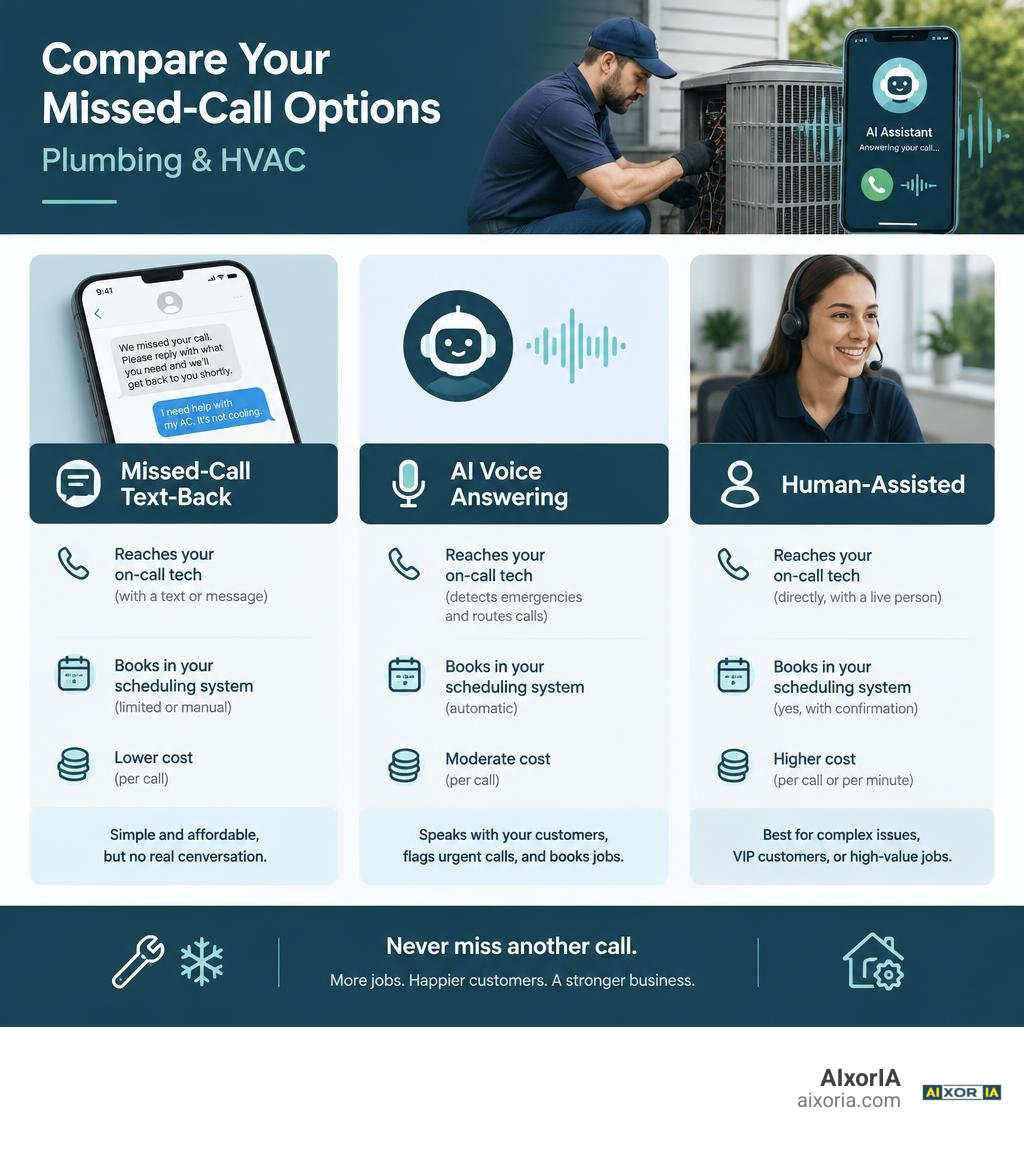
The best option depends on what happens after the call is answered. Some tools only text back or take a message. Others speak with the caller, flag emergencies, and book jobs. Compare them on three points: whether they can reach your on-call tech for a burst pipe or no-heat call, whether they can book in your scheduling system, and what a busy month will cost.
Start by forwarding unanswered calls to a short trial. Test a routine booking, an after-hours emergency, and a caller who needs a person. Then check what your team receives and whether the appointment actually appears on the schedule.
Why Contractors Need AI Missed Call Answering Software for Plumbers and HVAC Companies
Field service businesses run on incoming phone calls, but technicians cannot answer the phone while navigating a crawl space, soldering copper pipe, or troubleshooting a furnace on a residential rooftop. Across the home services sector, businesses fail to answer 62% of incoming calls. During peak winter freezes or summer heatwaves, that number climbs even higher.
When a homeowner faces water pouring through a drywall ceiling or a failed air conditioner in 95-degree heat, they rarely leave a voicemail. Research indicates that 85% of callers who reach voicemail hang up immediately and dial the next contractor listed on Google. Furthermore, 78% of service customers hire the first company that answers and confirms availability. If your shop misses the call, your competitor wins the job.
Deploying dedicated ai missed call answering software for plumbers and hvac companies bridges the gap between field work and office operations. Modern conversational AI tools in 2026 operate as full-fledged digital receptionists capable of holding natural, context-aware conversations. They answer on the first ring, screen callers, log diagnostic notes, triage emergencies, and book appointments directly on your calendar.
| Shop Profile | Monthly Inbound Calls | Average Missed Call Rate | Average Ticket Value | Estimated Annual Revenue Lost |
|---|---|---|---|---|
| Solo Operator | 80 | 40% (32 calls) | $450 | $43,200 |
| 3-Tech Plumbing Crew | 200 | 35% (70 calls) | $550 | $80,850 |
| Mid-Sized HVAC Shop | 450 | 30% (135 calls) | $1,800 | $218,700 |
| Multi-Crew Enterprise | 1,200 | 25% (300 calls) | $2,200 | $594,000 |
Calculations assume a conservative 25% closing rate on qualified missed leads across combined service calls and system replacements.
The Real Cost of Missed Inbound Calls in Field Services
The financial drain of unanswered calls in the skilled trades is staggering. The average residential plumbing service ticket ranges from $300 to $1,500, while the average HVAC job value—blending minor repairs with complete equipment changeouts—sits at $4,200. A single missed call regarding a failing 18-year-old heat pump can wipe out a $12,000 system replacement opportunity.
General plumbing businesses lose an estimated $50,000 or more per year solely from uncaptured inbound calls. For shops serving high-density metro areas, missed emergency calls can cost upwards of $247,000 in lost gross revenue annually.
Speed to lead dictates conversion rates in emergency home services. Calling back a prospect within five minutes makes you 21 times more likely to qualify that lead than waiting thirty minutes. By answering immediately using voice AI, contractors eliminate lead decay and capture demand at the precise moment customer intent peaks.
Capturing High-Ticket After-Hours Emergencies and Weekend Spikes
Standard office hours do not match consumer plumbing and HVAC breakdowns. Approximately 55% of all home service call volume arrives between 5:00 PM and 9:00 AM or over the weekend. For HVAC contractors specifically, 62% of calls happen outside standard 9-to-5 operating windows.
Weekend call volume spikes by 340% compared to average weekday afternoons. Homeowners notice dripping valves, clogged mainlines, or failing cooling systems when their families are home on Saturdays and Sundays.
Approximately 6.2% of all inbound home service calls represent true, high-ticket emergencies:
- Active slab leaks and burst supply lines
- Backed-up municipal sewer mains flooding living areas
- Complete heating failure during sub-freezing weather
- Gas odors or suspected carbon monoxide leaks near furnaces
- Total air conditioning breakdown in homes with elderly residents or medical needs
These high-margin jobs carry significant emergency dispatch fees and replacement ticket values. An AI agent handles these critical windows 24/7/365 without demanding holiday overtime pay or suffering from operator fatigue.
Core Capabilities of AI Phone Agents Built for Trade Contractors
Generic virtual receptionists designed for corporate offices or dental practices fail in the home service trades. Trade-specific voice engines are pre-trained on technical diagnostic vocabularies, regional equipment norms, and urgency workflows. Using deterministic logic alongside conversational verification tools, these agents screen callers methodically without sounding scripted or rigid.
Trade-Specific Technical Knowledge: Plumbing vs. HVAC Terminology
A caller rarely explains their breakdown using formal textbook phrasing. A homeowner might say, “My outside unit is buzzing and blowing lukewarm air,” or “There’s water bubbling up through the floorboards near the laundry room.”
Purpose-built trade AI platforms identify technical nuances instantly:
- HVAC Terminology & Diagnostics: Identifies heating vs. cooling modes, tonnage requirements, system age, SEER2 energy efficiency ratings, split systems vs. package units, heat pumps, mini-split ductless heads, condenser fan motors, evaporator coils, auxiliary heat strips, and refrigerant leaks.
- Plumbing Terminology & Diagnostics: Differentiates between PEX, copper, CPVC, and galvanized iron piping; recognizes tankless water heaters versus standard atmospheric gas storage tanks; categorizes mainline sewer root intrusions, hydro-jetting requirements, garbage disposal failures, pressure-reducing valve (PRV) blowouts, and emergency whole-home water shutoff locations.
The AI captures these details systematically, assembling a structured dispatch note for your technicians before they roll a van.
Emergency Triage and Real-Time Dispatch Escalation
Not every after-hours call requires waking up an on-call technician. If a customer calls at 11:30 PM requesting a routine seasonal air conditioning maintenance check, the AI books the appointment for the following Tuesday morning.
However, if the system detects emergency indicators—such as active water gushing from a ruptured supply line or freezing indoor temperatures—it initiates immediate escalation. The software pairs automated customer service rules with emergency routing protocols, using automated customer service solutions to keep the homeowner calm while simultaneously alerting your on-call staff via SMS dispatch, automated telephone warm transfers, or push notifications with full audio transcripts.
Bilingual Intake and Real-Time Language Detection
In the United States, more than 42 million people speak Spanish at home. Missing calls from non-English speakers cuts off a substantial segment of residential service demand.
Leading trade AI systems feature real-time language detection. When a caller begins speaking Spanish, the AI switches dialects instantly without requiring the customer to press keypad extensions. The agent gathers the homeowner’s name, address, and equipment symptoms in Spanish, translates the information, and logs the service ticket in English inside your dispatch software.
How to Evaluate AI Missed Call Answering Software for Plumbers and HVAC Companies
Selecting an AI phone answering platform requires analyzing voice latency, booking accuracy, integration reliability, and total cost of ownership.
| Evaluation Metric | AI Answering Software | Traditional Live Call Center | Standard Voicemail |
|---|---|---|---|
| Pickup Speed | Instant (First ring) | 30–90 seconds (Queue delays) | Rings 4–6 times before recording |
| Concurrent Call Capacity | Unlimited simultaneous lines | Limited by agent staffing | Single caller per line |
| Average Cost Structure | $0.20–$0.40/min or flat monthly | $1.50–$3.50 per live minute | Free (Included with carrier) |
| Trade Technical Accuracy | High (Configured knowledge base) | Low (Generalist human agents) | None (Depends on caller message) |
| Direct CRM Booking | Real-time direct API sync | Manual message taking / email | None |
| Caller Drop-Off Rate | Under 10% | 15%–25% (Hold times) | 80%–85% hang-up rate |
Comparing AI Missed Call Answering Software for Plumbers and HVAC Companies Against Traditional Services
Traditional live human answering services have long been standard for contractors, but they carry significant operational drawbacks. Live call centers rely on low-wage operators who manage calls for dozens of disparate industries simultaneously—from medical clinics to tow trucks. These operators frequently misspell equipment terms, fail to identify true mechanical emergencies, and transfer unqualified calls to off-duty technicians.
Furthermore, traditional answering services charge punitive per-minute rates. When summer heat spikes call volume by 500%, contractors face massive overage invoices. In contrast, voice AI agents handle hundreds of calls at the exact same moment without hold times, staffing shortages, or billing surprises.
Field Service Management Software Integrations and Automated Booking
An answering tool should never create extra administrative overhead. If an assistant simply emails an audio recording to your office manager, your team still spends hours playing phone tag the next morning.
Leading solutions integrate natively with trade field service management (FSM) platforms, including ServiceTitan, Housecall Pro, Jobber, FieldEdge, and Workiz. When a customer calls:
- The AI queries your scheduling engine to review available appointment windows.
- It verifies that the customer’s property sits within your defined service territory.
- It assesses technician skills to match specific repair needs (e.g., booking a boiler specialist for hydronic heating jobs).
- It places the job directly on the dispatch board, following essential scheduling software features such as drive-time buffer zones.
- It logs the customer history inside your field service CRM software and sends an SMS confirmation to the homeowner.
Pricing Models: Flat Fee vs. Usage Credits vs. Per-Minute Rates
Software providers use three primary billing models:
- Flat Monthly Subscription: Fixed cost (typically $99 to $249 per month) covering a baseline volume of calls or unlimited basic intake. Many contractors prefer this model for predictable overhead. Some standalone automated missed call solutions use flat tiers focusing on instant text-back and basic triage.
- Usage-Based Minute Metering: Rates range from $0.09 to $0.35 per voice minute. This is cost-effective for smaller plumbing crews that only need after-hours and overflow coverage.
- Credit-Based Systems: Monthly plans allocate a pool of credits (for example, 125 credits per minute of AI call time) shared across voice calls, automated text confirmations, and follow-up sequences. Unused credits may roll over or be topped up as needed.
Buyer’s Guide: Implementation Steps and Vendor Vetting Checklist
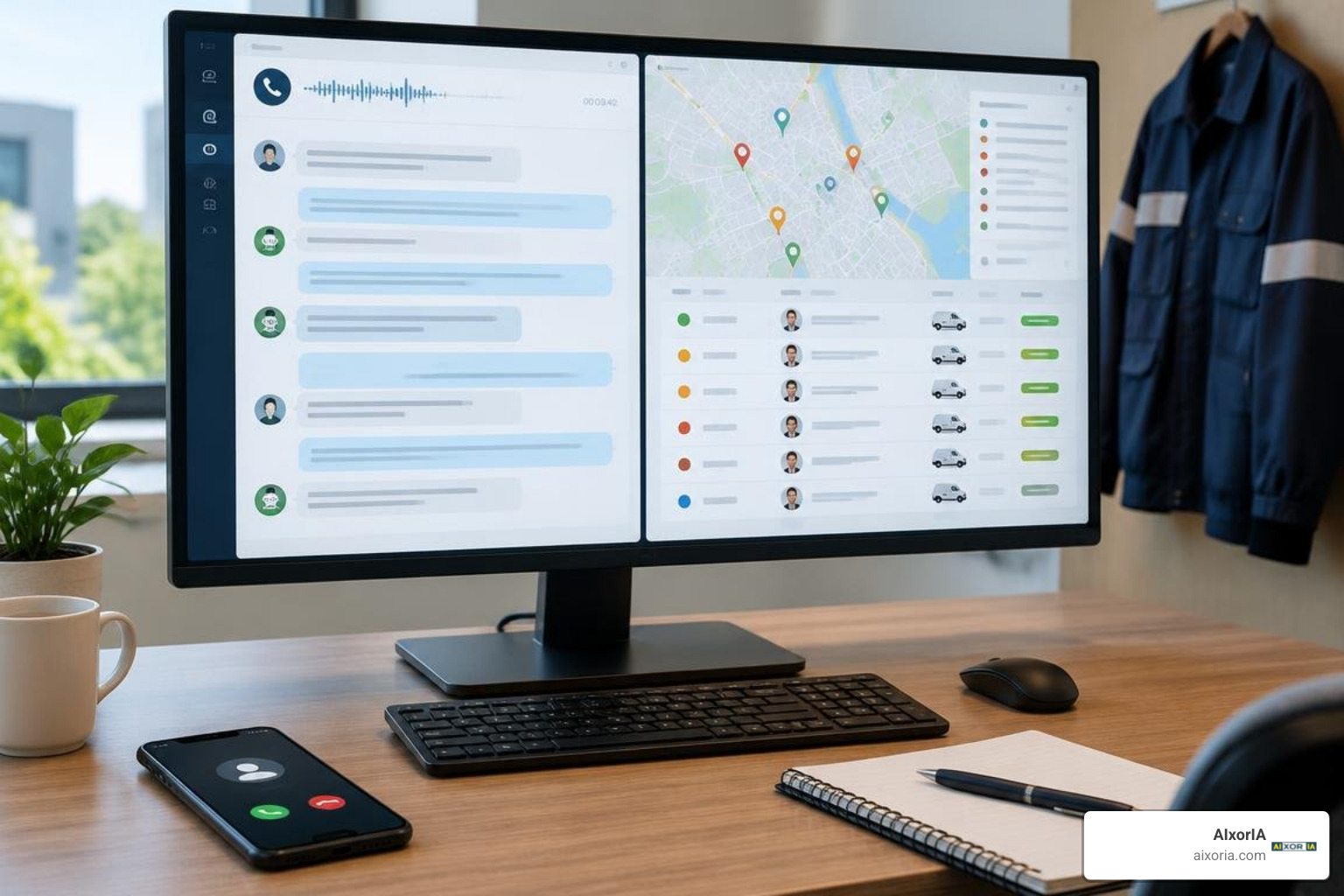
Rolling out an AI receptionist does not require overhauling your existing telecommunications infrastructure or changing your advertised business telephone number.
- Keep Your Existing Phone Number: Retain your established company phone number. Use carrier-level conditional call forwarding (such as standard
*71or*72dial codes) to route calls to the AI assistant only when your office lines are busy, unanswered after four rings, or closed for the night. - Define Your Service Catalog and Pricing Boundaries: Specify your diagnostic dispatch fees, standard operating hours, warranty policies, and service boundaries by zip code.
- Establish Emergency Escalation Protocols: Set exact criteria for what constitutes a dispatchable emergency and establish technician contact trees with backup escalation numbers.
- Connect Downstream Field Tools: Link your voice platform to your dispatch system and contractor invoicing software to ensure unified customer record tracking across every operational department, ensuring you have the right software small businesses need to scale.
Critical Questions to Ask Software Providers Before Implementation
Before signing a contract or deploying a solution, vet the vendor with these ten technical questions:
- How does your engine handle voice latency and interruptions? (Look for sub-800-millisecond response latency so conversations feel fluid and callers can naturally interject.)
- Does the platform integrate natively with my specific FSM (e.g., ServiceTitan or Housecall Pro), or does it rely entirely on third-party webhook connectors?
- What happens if an emergency call drops or the caller hangs up abruptly? (The system should immediately send an automated SMS follow-up to recover the lead.)
- Can I customize trade diagnostic questions based on specific customer problem types?
- How does the AI prevent double-booking on my dispatch board?
- Does the system support bilingual Spanish intake with automatic language switching?
- What is the exact escalation path if our on-call technician fails to acknowledge an emergency notification?
- Are call recordings and full word-for-word transcripts accessible instantly in a web dashboard and mobile app?
- How are spam, robocalls, and sales solicitation calls filtered and billed?
- What onboarding support and script testing do you provide prior to live customer call forwarding?
Common Pitfalls Home Service Contractors Make When Deploying AI
Avoid these common operational mistakes:
- Using Generic Prompts: A generic prompt intended for general office use will not ask the right diagnostic questions (such as asking for the water heater brand, fuel source, or breaker status). Train your AI with trade-specific terminology.
- Failing to Define Strict Service Territories: If your AI books a job 45 miles outside your standard service radius, you waste fuel and technician drive time. Configure explicit zip code whitelists.
- Neglecting Transcript Reviews: During the first two weeks of deployment, spend ten minutes each morning reviewing call transcripts to fine-tune answers and update your knowledge base.
- Over-Automating Complex Quotes: Never allow an AI to guess pricing on major structural jobs like whole-home repiping or duct replacement over the phone. Restrict the AI to providing standard diagnostic dispatch fees, reserving complex estimates for your field estimators.
Frequently Asked Questions About AI Answering for Trades
Can AI reliably distinguish true plumbing and HVAC emergencies from routine service requests?
Yes. Modern AI assistants use natural language processing to evaluate caller intent, urgency keywords, and situational severity in real time. Phrases like “water is pouring through the ceiling,” “I smell raw gas,” or “my furnace stopped and it’s 18 degrees inside” trigger immediate priority status. The AI captures the homeowner’s street address and shuts off standard scheduling logic, routing the call immediately to your on-call technician via direct phone transfer or priority SMS alert.
Will an AI phone agent integrate directly with ServiceTitan, Jobber, or Housecall Pro?
Yes. Leading trade-focused AI systems connect via native APIs and webhooks to major field service management platforms. The AI reads real-time technician availability, respects capacity limits, checks service zones, and places booked jobs directly onto your dispatch board with full transcripts and diagnostic notes attached.
How quickly can a plumbing or HVAC contractor set up and deploy an AI answering system?
Most contractors launch an AI receptionist within 24 to 48 hours. Setup involves uploading your company knowledge base (service areas, diagnostic pricing, technician rotations), connecting your calendar, and configuring conditional call forwarding through your cellular or VoIP phone provider. You can thoroughly test the system with simulated emergency calls before turning on live forwarding.
Conclusion
Every unanswered phone call represents lost revenue walking directly to another contractor. With more than half of all customer calls arriving outside standard business hours and over 80% of voicemail callers refusing to leave a message, relying on legacy phone setups is no longer viable in competitive markets.
Deploying specialized AI answering software ensures your plumbing or HVAC business captures every high-margin emergency, qualifies every replacement lead, and keeps dispatch boards full around the clock. At AIxorIA, we curate practical AI tools, automation resources, and operational playbooks designed to help service businesses streamline operations, eliminate administrative bottlenecks, and capture sustainable growth. Examine your shop’s missed call volume today, forward your lines to an automated voice agent, and stop losing high-ticket jobs to your competitors.
3 thoughts on “Best AI Missed-Call Answering Software for Plumbers & HVAC”