How AI Tools for Lead Follow-Up at Car Dealerships Work
Scr0ll d0wn to D0VVNL0AD
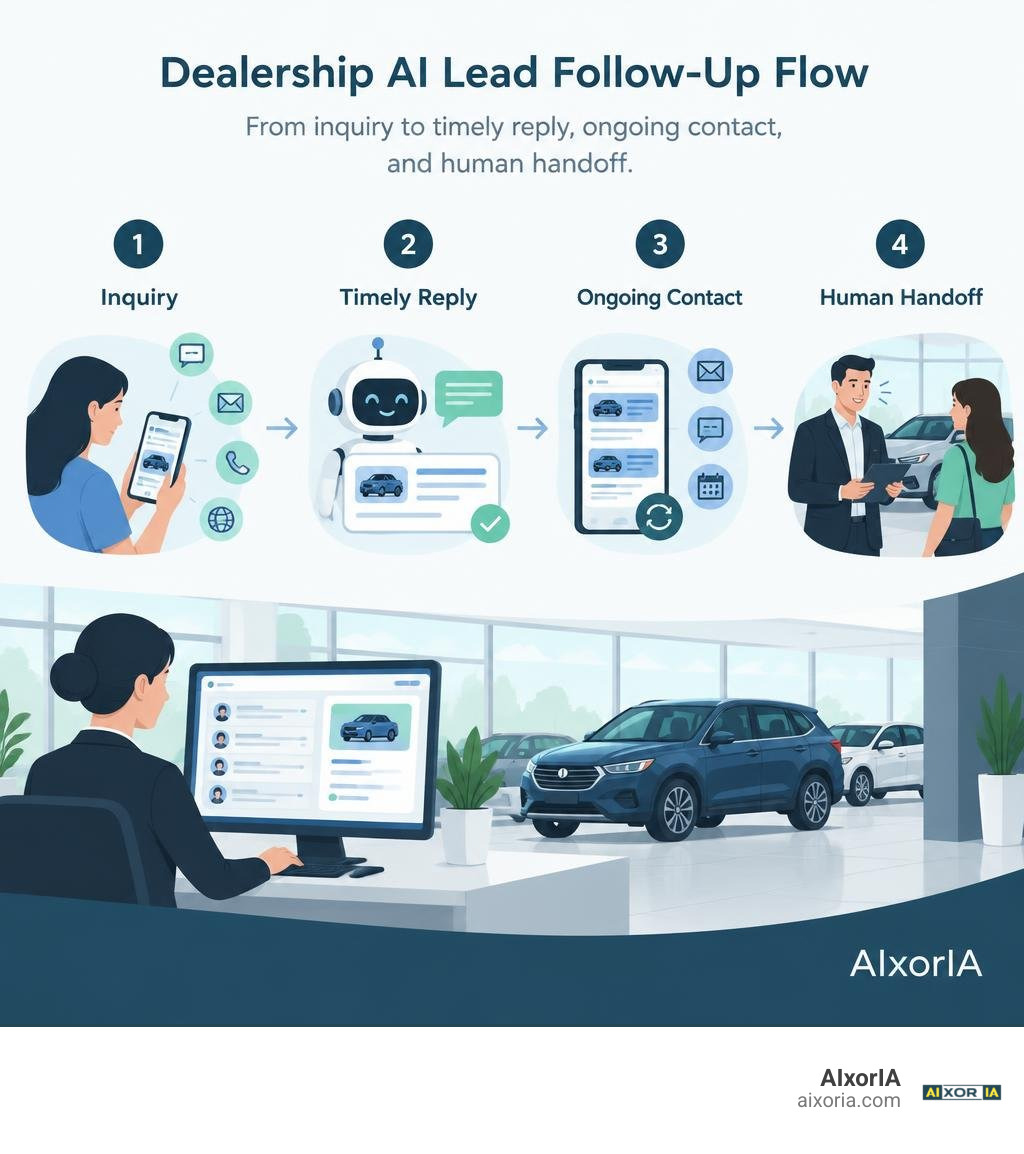
AI tools for lead follow-up at car dealerships answer new inquiries quickly, keep conversations going, and alert staff when a shopper needs personal help. When choosing one, look for a tool that works with your CRM and live inventory, handles the channels your customers use, records consent, and gives sales reps the full conversation when they take over.
The first reply matters, but it is only the start. A useful system can answer an after-hours question, follow up later with a relevant vehicle update, and stop messaging when a customer opts out or a rep steps in.
At AIxorIA, we curate and provide practical AI software guides and actionable workflows. We see dealerships constantly struggling to bridge the gap between incoming web traffic and actual showroom appointments. Understanding the modern AI follow-up tech stack is essential for keeping your sales board full.
Why Traditional Dealership Follow-Up Fails (and the Follow-Up Gap)
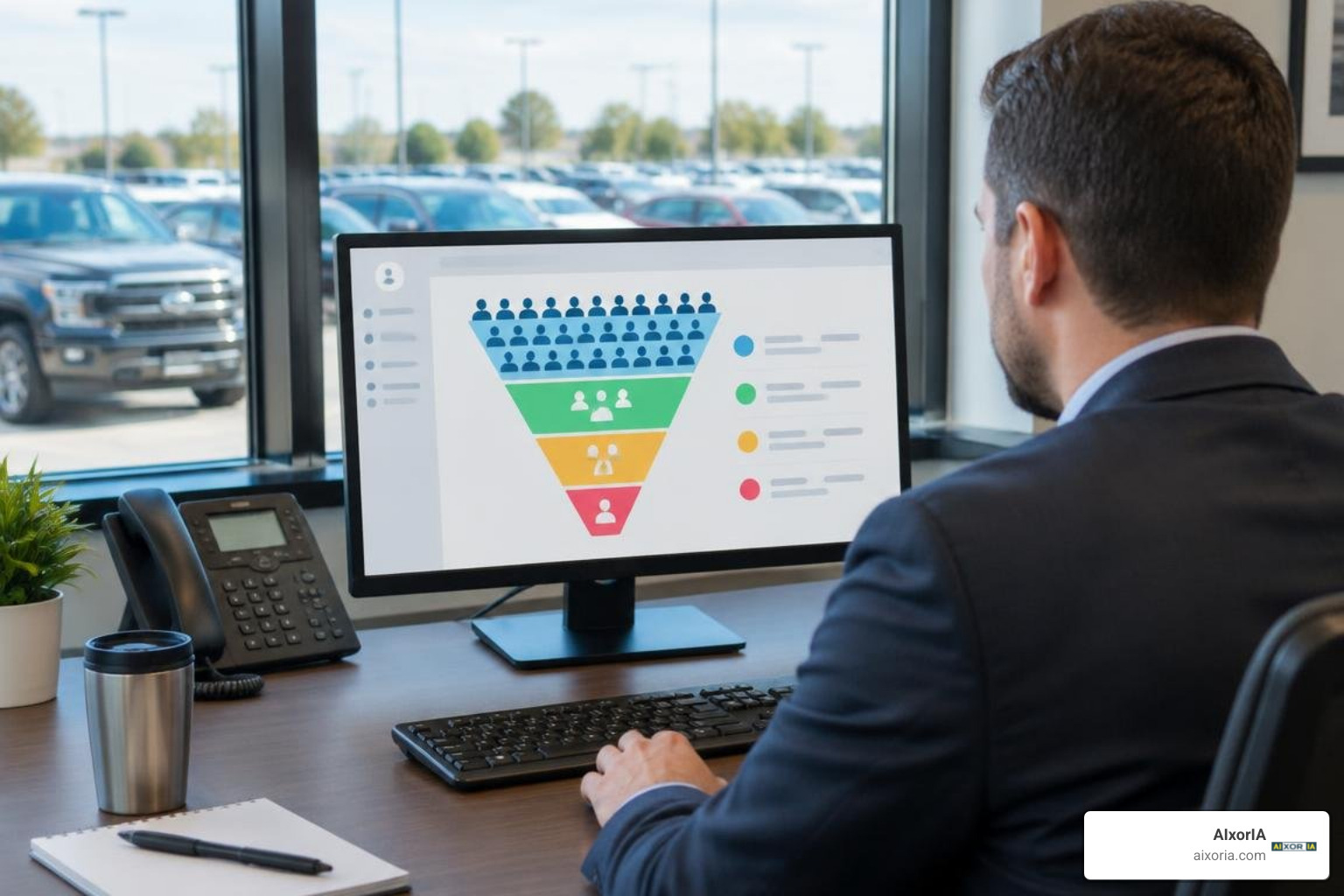
Most auto dealerships do not suffer from a lead generation problem; they suffer from a lead execution problem. In auto retail, thousands of internet inquiries flow into Customer Relationship Management (CRM) databases every month from OEM portals, third-party marketplaces, paid search campaigns, and social media ads.
Yet, industry data shows that approximately 30% of dealership leads drop off after the initial contact attempt, and up to 80% of digital shoppers move on to a competing store if their inquiry is not answered within five minutes.
Traditional Business Development Center (BDC) teams and sales floors hit hard operational bottlenecks when attempting to keep pace:
- Staffing Capacity Limits: A typical BDC representative can effectively manage around 150 to 200 active leads per month. When inquiry volumes spike, representatives must prioritize fresh leads, abandoning older prospects who are still actively shopping.
- CRM Bloat and Dormant Archives: A standard store database often contains 30,000+ past contacts. For a single employee reviewing 10 records a day, it would take roughly 12 years to manually touch every past lead once.
- Inconsistent Execution: Representatives often stop chasing a prospect after two or three days of unanswered emails or phone calls, despite modern buying cycles lasting weeks or months.
- After-Hours Disconnect: Nearly 50% of automotive digital leads arrive when the dealership showroom is closed—during evenings, late nights, and Sundays.
When leads sit unanswered overnight or over holiday weekends, appointment conversion rates collapse. Studies on dealership responsiveness, such as the Infiniti tops dealership customer engagement ranking in Pied Piper study, highlight how fast, consistent digital engagement directly impacts customer sentiment and showroom foot traffic.
The Response Time Crisis and After-Hours Lead Leakage
The speed-to-lead benchmark in automotive retail is measured in seconds, not hours. When a car shopper submits an inquiry on a digital retailing tool or third-party vehicle detail page (VDP), they expect immediate validation. If your team takes two hours to reply, the prospect has already submitted inquiries to two other competing stores.
Meeting OEM response time requirements (which frequently mandate contact within minutes) is virtually impossible through manual staff alone, particularly during peak weekend hours or late evenings. When dealerships rely solely on manual floor coverage, after-hours leads sit in an unassigned CRM queue until the morning shift arrives at 8:30 AM. By that time, the shopper’s buying impulse has cooled, or another store using automated messaging has already scheduled them for a 10:00 AM test drive.
Why AI Tools for Car Dealerships for Lead Follow Up Beat Auto-Responders
For years, dealerships attempted to solve the response crisis with automated CRM auto-responders. However, traditional auto-responders are static, impersonal, and easily spotted by consumers. A generic email stating “Thank you for contacting ABC Motors! A representative will be in touch shortly” offers zero value, answers none of the shopper’s specific vehicle questions, and creates a dead end in the conversation.
Deploying specialized ai tools for car dealerships for lead follow up changes the dynamic from a one-way notification to a two-way, intelligent conversation. Modern systems parse the incoming lead notes, detect the shopper’s exact intent (such as asking about a vehicle’s out-the-door price, trim level differences, or trade-in value), and craft an immediate, tailored response.
Implementing modern automated customer service for CSI scores ensures that every customer touchpoint remains prompt, polite, and accurate, which safeguards customer satisfaction scores from the first digital touch. Using behavioral triggers, intelligent platforms stay active across long buying cycles, nurturing prospects over 30, 60, or 90 days with contextual vehicle updates rather than robotic check-ins.
Core Architecture: How AI Tools for Car Dealerships for Lead Follow Up Operate
Modern automotive AI platforms rely on an integrated data architecture rather than simple script-based branching. The system acts as a conversational layer that sits on top of your existing dealership software stack, unifying your Customer Data Platform (CDP), Dealership Management System (DMS), CRM, and live inventory feeds.
| Feature / Capability | Legacy Rules-Based Automation | Agentic Automotive AI Platform |
|---|---|---|
| Response Latency | Instant, but rigid and generic | 9 to 45 seconds with contextual personalization |
| Inventory Awareness | None (references static links or templates) | Real-time VIN-level sync (in-transit, on-lot, sold status) |
| Conversation Lifespan | Drops off after 3–7 days of scheduled emails | Operates persistent nurture cadences for 50–90+ days |
| Channel Orchestration | Isolated channel blasts (email only or SMS only) | Unified memory across SMS, email, web chat, and voice |
| Handoff Mechanism | Blind CRM task creation without context | Rich action briefs with intent, sentiment, and summary |
| Language Understanding | Keyword matching; fails on compound questions | Deep natural language understanding (NLP) and reasoning |
Agentic Reasoning vs. Rigid Automation Rules
Legacy marketing automation relies on “if-this-then-that” rules. If a customer replies with something outside the pre-programmed tree—such as asking if a specific truck has a fifth-wheel prep package or whether a price includes regional dealer fees—the legacy tool breaks or sends an irrelevant canned message.
In contrast, agentic AI systems use large language models trained specifically on automotive retail data. These systems possess psychological intelligence, allowing them to decode customer sentiment, emotional urgency, and buying readiness. Instead of mindlessly blasting out a scheduled text message, an agentic AI evaluates recent shopper activity, looks up live inventory availability, and autonomously determines the optimal next action.
Dealerships using modern AI sales automation tools can automate complex objection handling, calculate estimated payment ranges based on store guidelines, and adapt outreach frequency based on whether a buyer seems highly engaged or hesitant.
Omnichannel Coordination Across SMS, Email, Voice, and Webchat
Automotive buyers jump across channels constantly. A buyer might start by chatting on your website, receive an SMS follow-up, send an email asking for a window sticker, and later call the dealership switchboard after work.
Dedicated automotive platforms, including solutions like Drivee AI Operating System, Matador AI, and SimpSocial Sarah AI, orchestrate these interactions under a single conversational brain:
- Two-Way SMS Engagement: Serves as the primary channel for rapid, high-engagement conversations, answering inventory questions and securing test drive appointments.
- Context-Rich Email Nurturing: Delivers digital dossiers, CARFAX reports, window stickers, and personalized video walk-arounds.
- 24/7 Inbound and Outbound Voice Agents: Answers inbound phone calls instantly, handles routing, and books service or sales appointments without long hold times.
- Website Chat Integration: Engages shoppers directly on vehicle detail pages, capturing shopper information and syncing it directly with CRM lead records.
Deploying comprehensive AI customer engagement software ensures that when a shopper switches from webchat to text message, the AI maintains conversational memory, eliminating repetitive questions and awkward conversational resets.
Contextual Re-Engagement and Dormant Lead Activation
One of the highest-ROI capabilities of automotive AI is reviving aged CRM records. Dealership databases are full of leads marked as “lost” or “unresponsive” that simply bought elsewhere or delayed their purchase decision.
Platforms such as Indiqator LeadDriver and Silx specialize in automated, long-tail database mining. Rather than sending generic promotional blasts, the AI scans customer records against live inventory and external triggers:
- Price Drops: Automatically alerting a dormant lead that the specific vehicle they viewed 45 days ago received a $1,200 price reduction.
- Alternative Inventory Arrivals: Identifying when a fresh unit lands on the lot matching the trim, color, and budget requirements of a past shopper whose original unit was sold.
- Lease-End and Equity Milestones: Reaching out to past buyers nearing the end of their financing cycle or entering a positive equity position with personalized trade-in offers.
In real-world applications, automated re-engagement campaigns have delivered significant results. For example, Volvo Cars Markham activated an AI-driven outreach campaign targeting 1,500 older CRM records, achieving a 15% reply rate and directly securing six vehicle sales in a single week.
Buyer’s Framework: Selecting, Integrating, and Guardrailing Dealership AI
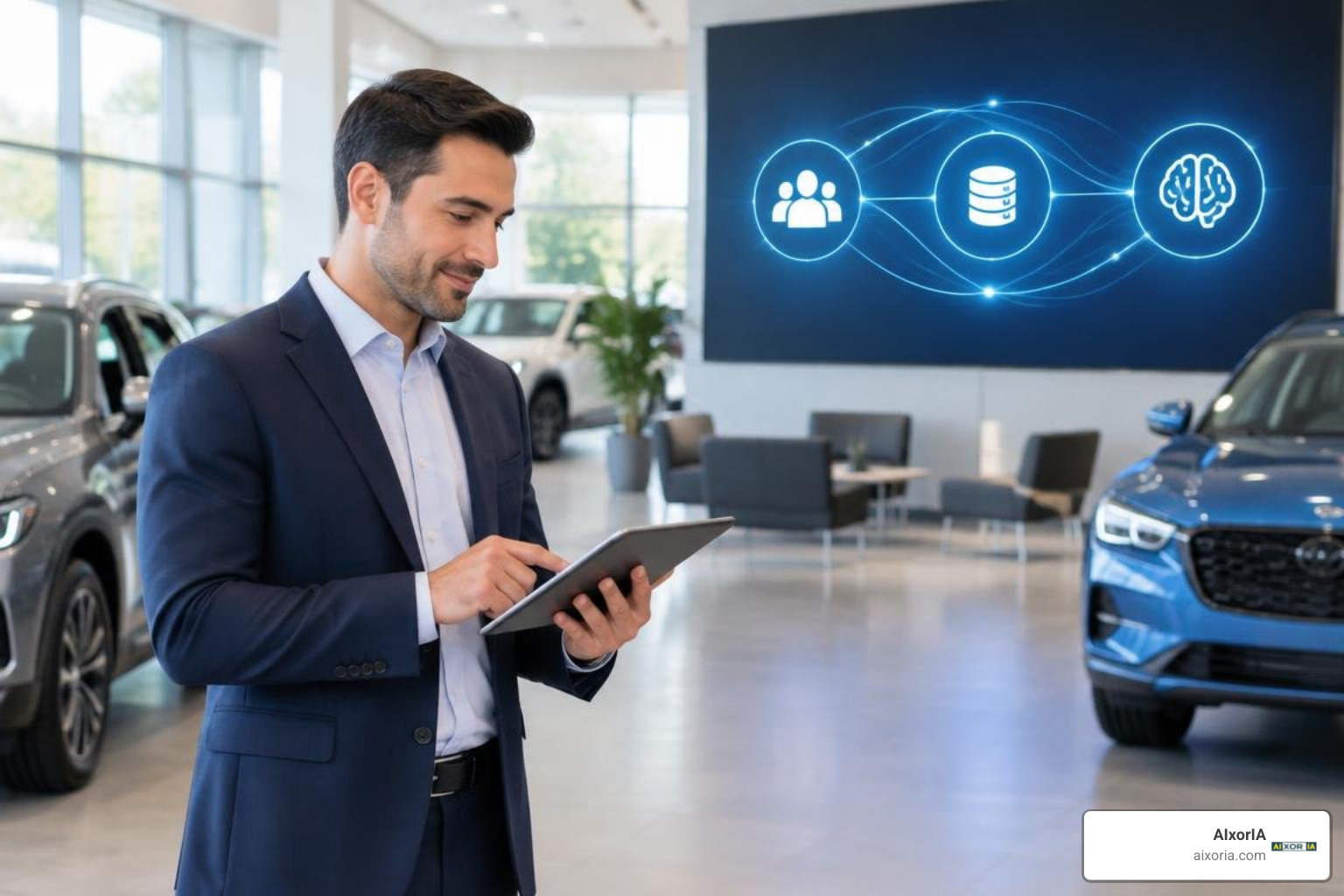
Choosing the right platform requires looking beyond marketing promises to examine architectural compatibility, safety controls, and daily workflows. Dealerships should avoid purchasing standalone point tools for every individual department, as disconnected systems create data silos and disjointed customer experiences.
Evaluating AI Tools for Car Dealerships for Lead Follow Up: 5 Essential Criteria
When evaluating vendors, General Managers and Dealer Principals should score platforms against these five core benchmarks:
- Native DMS and CRM Integration Depth: The platform must support true bi-directional synchronization across systems like VinSolutions, Elead, DealerSocket, CDK Global, and Reynolds & Reynolds, reading and writing communication history in real time.
- Live Inventory and Pricing Synchronization: The AI must ingest real-time lot inventory and in-transit data to ensure it never quotes, promises, or sets appointments on units that have already been sold.
- Automotive Knowledge Bank: The platform must feature a customizable digital vault containing your store’s unique policies, financing incentives, dealer fees, warranty programs, and “Why Buy Here” value propositions.
- Hallucination Prevention Guardrails: The software must employ multi-layer verification safeguards to prevent the model from inventing non-existent discounts, quoting incorrect vehicle specifications, or promising unapproved trade values.
- Multi-Rooftop Scalability: For dealer groups, the tool must allow enterprise-level reporting, centralized compliance management, and brand voice standardization across multiple rooftops.
CRM and DMS Integration, Compliance, and Guardrails
Compliance in automated outreach is non-negotiable. Dealerships face strict legal liabilities under the Telephone Consumer Protection Act (TCPA) and CAN-SPAM regulations. Uncontrolled automated texting can expose stores to severe regulatory fines.
Robust automotive AI solutions enforce rigorous compliance safeguards by default:
- Explicit Consent Management: The system only initiates automated SMS sequences with leads who have opted in through web forms or digital retailing portals.
- Automated Opt-Out Processing: If a customer texts “STOP”, “unsubscribe”, or expresses clear disinterest, the AI immediately halts all automated outreach and updates the CRM contact status.
- Time-of-Day Window Controls: Messaging cadences are strictly locked to permissible local daytime hours (typically 8:00 AM to 9:00 PM local time), queuing after-hours inquiries for intelligent next-morning processing where required.
- Enterprise Data Security: Top-tier vendors maintain SOC 2 Type II certifications and end-to-end data encryption to safeguard sensitive customer credit and contact information.
Smart Escalation and Seamless Human-in-the-Loop Handoffs
AI follow-up tools are not designed to close complex automotive negotiations entirely on their own. Their primary objective is to warm up prospects, answer preliminary questions, and guide them into a confirmed showroom appointment or live sales conversation.
Specialized tools like AdaptLead manage this transition through intelligent human handoffs. When the AI detects strong buying signals—such as a shopper agreeing to visit the showroom, asking for a firm finance pencil, or requesting a manager callback—it pauses automated messaging and alerts the sales desk.
Rather than dumping a blind notification into the CRM, the AI generates a concise Contextual Action Brief containing:
- Summary of customer vehicle preferences (year, make, model, trim, stock number)
- Customer budget, trade-in details, and financing readiness
- Complete transcript of all preceding AI interactions across SMS, email, and chat
- Recommended next action for the sales representative (e.g., “Confirm trade-in appointment for Thursday at 2:00 PM and have keys ready for Stock #T4082”).
Business Impact, Pricing Models, and ROI Benchmarks in 2026
Implementing automotive AI follow-up generates clear, quantifiable returns across sales volume, operational efficiency, and fixed overhead reduction.
Proven Conversion Lifts and Cost Reduction Metrics
Real-world dealer deployments provide distinct operational benchmarks:
- Response Time Reduction: Automated tools reduce first-touch response times by up to 99%, taking average response delays from over four hours down to 9–36 seconds.
- Appointment Setting and Show Rates: Impel Sales AI benchmarks show a 33% lift in appointment set rates and a 26% lift in overall lead-to-close rates. Furthermore, Matador AI reports appointment show rates reaching 86.4% to 87% at partner dealerships due to automated, persistent appointment reminders.
- BDC Productivity Gains: Automated lead qualification increases sales rep capacity from an industry average of 150–200 leads per month up to 300+ leads per rep (a 2.5x increase), driving a 33% reduction in BDC overhead costs per vehicle sold.
- After-Hours Conversion: Dealerships utilizing automated scheduling tools frequently capture 40% to 45% more after-hours test drive bookings compared to manual desks.
Automotive retail groups utilize specialized AI BDR tools for scaling outreach to automate high-volume outbound campaigns and maximize operational leverage without ballooning their payroll expenses.
Cost Breakdown and ROI Calculation Framework
Dealership software investments in AI follow-up typically follow predictable commercial models:
- Single-Rooftop Point Solutions: Basic SMS or chat follow-up tools generally range from $1,000 to $2,500 per month per rooftop.
- Full Dealership AI Operating Systems: Comprehensive multi-department platforms (covering Sales, Service, BDC, and Voice AI) range from $3,000 to $6,000+ per month per rooftop.
To evaluate ROI, stores measure the net gross profit generated from recovered deals against the monthly software cost:
- Showroom Sales Lift: If an average dealership sells an additional 5 to 10 vehicles per month through faster response times and dormant CRM re-engagement, at an average front/back gross profit of $2,500 per unit, the store generates $12,500 to $25,000 in monthly gross revenue.
- Fixed Ops Recapture: Incorporating voice and messaging AI for service drive follow-up (such as declined service recall campaigns) often recovers thousands in additional monthly repair order revenue.
Coupled with optimized email drip campaign software strategies, the combined multi-channel efficiency consistently yields a 10x to 15x return on monthly software spend.
Frequently Asked Questions About Dealership AI Follow-Up
Can AI lead follow-up tools replace an automotive BDC team?
AI lead follow-up tools are best deployed to augment and empower your BDC team rather than eliminate it. The AI functions as a 24/7 digital assistant that handles high-volume, repetitive tasks: instant sub-minute lead qualification, answering basic inventory and spec questions, managing after-hours inquiries, and nurturing dormant leads over 60+ days.
This automated screening frees human BDC representatives and sales consultants from chasing unresponsive leads, allowing them to focus entirely on high-value interactions—such as desk negotiations, personalized walk-around videos, and in-person showroom appointments.
How long does it take to implement and train dealership AI tools?
Most modern automotive AI platforms connect to existing CRMs and DMS systems in under an hour via standard APIs. Full onboarding, custom playbook alignment, and go-live deployment typically take between 3 to 10 business days. During this period, the vendor configures the store’s pricing policies, brand voice persona, and escalation rules within the system’s Knowledge Bank.
How do AI follow-up tools maintain TCPA and data privacy compliance?
Automotive AI platforms maintain strict regulatory compliance by integrating automated consent checks before sending SMS messages. The software operates strictly within permissible local daytime communication windows, includes clear opt-out language, and instantly processes opt-out keywords like “STOP”. Additionally, reputable vendors maintain SOC 2 Type II certifications, utilizing end-to-end encryption to safeguard customer records.
Conclusion
Automotive retail has entered an era where speed, continuity, and hyper-personalization determine which stores win the market. Leaving internet leads unattended for hours or relying on generic auto-responders creates massive revenue leakage that modern dealerships can no longer afford.
By integrating intelligent, inventory-aware AI follow-up tools, dealerships provide instant 24/7 responsiveness, maintain persistent multi-channel nurturing across the entire shopper journey, and empower their sales teams with rich, high-intent showroom appointments.
To explore more comprehensive breakdowns, software benchmarks, and implementation strategies for cutting-edge business automation, visit AIxorIA for our latest guides and curated AI resources.
2 thoughts on “AI Tools for Lead Follow-Up at Car Dealerships: 2026 Guide”