HubSpot AI vs. Salesforce Einstein vs. Zoho AI for CRM: The Quick Answer
Scr0ll d0wn to D0VVNL0AD
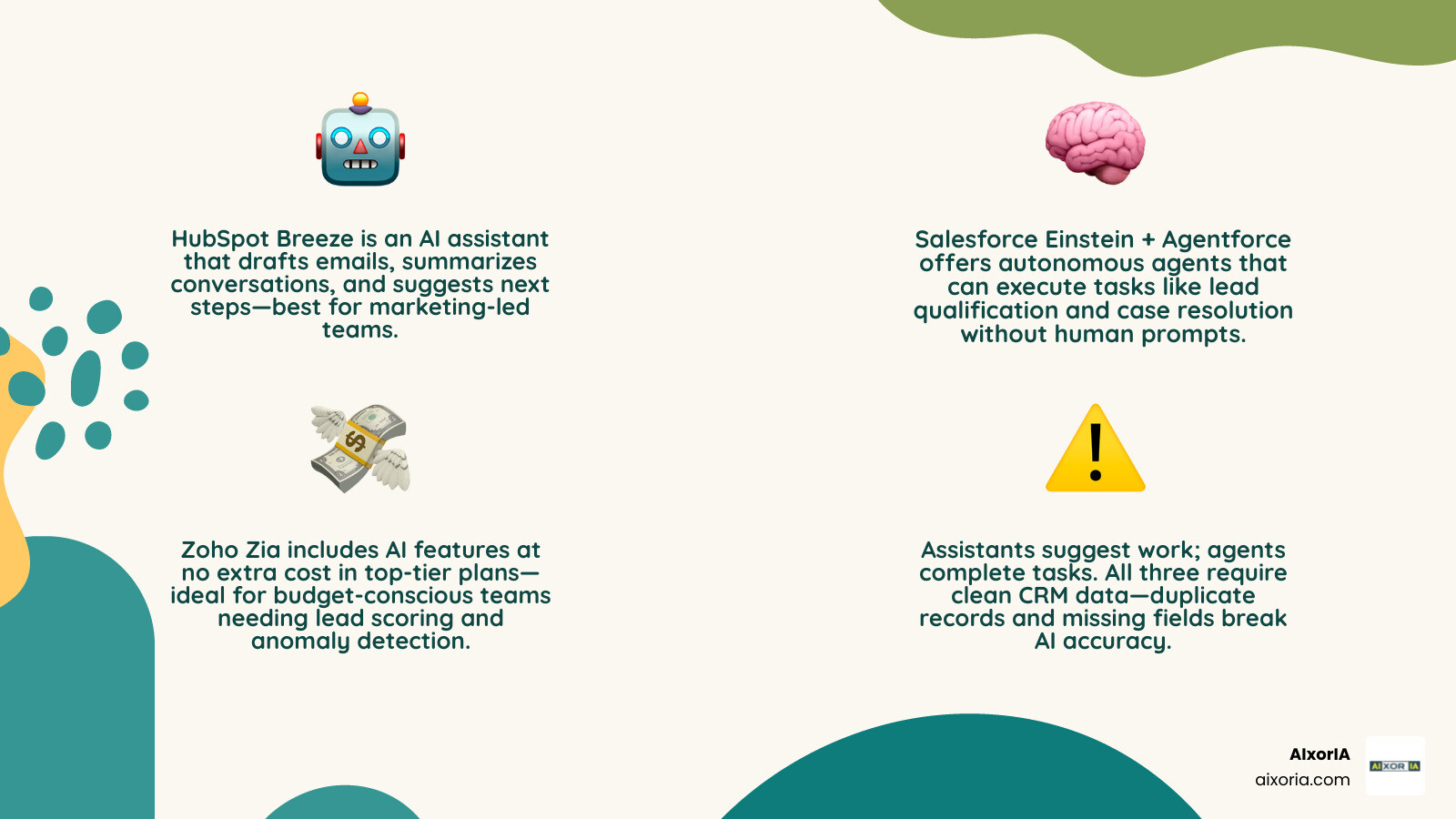
HubSpot is the easiest fit for marketing-led teams. Zoho offers strong AI features at a lower starting price. Salesforce is the best fit for large teams that need deeply customized AI workflows. That is the practical answer to HubSpot AI vs. Salesforce Einstein vs. Zoho AI for CRM.
The names can be confusing: HubSpot calls its AI Breeze, Salesforce pairs Einstein features with Agentforce agents, and Zoho calls its AI Zia. All three can help with everyday CRM work, but an AI assistant that drafts an email is not the same as an agent that can act on a record. Before you buy, check which features your plan includes, what extra usage costs, and whether your CRM data is clean enough to trust the results.
HubSpot AI vs Salesforce Einstein vs Zoho AI for CRM: What Actually Differs
Evaluating modern platforms requires looking past vendor marketing. In November 2026, comparing HubSpot AI vs. Salesforce Einstein vs. Zoho AI for CRM is less about counting features on a checklist and more about understanding architecture, autonomy, and real-world deployment complexity.

Every vendor uses different nomenclature and packaging. HubSpot Breeze organizes its tools into embedded copilots, pre-built agents, and Breeze Intelligence for data enrichment. Salesforce combines Einstein predictive and generative layers with its agentic engine, Agentforce (built on the Atlas Reasoning Engine and grounded in Data Cloud). Zoho bundles predictive scoring, sentiment analysis, and Zia Agent Studio directly into its broader product ecosystem.
| Platform | Primary AI Engine | Autonomy Level | Key Strengths | Core Limitations |
|---|---|---|---|---|
| HubSpot | Breeze (Copilot + Agents) | Assistant to Task-Specific Agent | Fast setup, intuitive UI, unified data model | Credit consumption on heavy agent runs |
| Salesforce | Einstein + Agentforce | Advanced Autonomous Agent | Deep customization, complex logic, enterprise scale | High cost, complex configuration, requires dedicated admin |
| Zoho CRM | Zia + Zia Agent Studio | Assistant to Low-Code Agent | Unbeatable price-to-feature ratio, built-in anomaly alerts | Interface is less polished, sprawling ecosystem settings |
For a breakdown of native features across tiers, consult the official Feature-wise comparison of Zoho CRM Editions | Zoho CRM.
HubSpot AI vs. Salesforce Einstein vs. Zoho AI for CRM: Assistant or Agent?
The biggest functional leap in recent CRM development is the transition from assistants to autonomous agents.
An AI assistant (such as Breeze Copilot, standard Einstein Generative AI, or basic Zia) acts as a passive collaborator. It suggests an email subject line, summarizes a recent meeting transcript, or displays an opportunity score. However, a human rep must review the output, click send, or update the deal stage manually.
An autonomous AI agent operates independently within pre-configured guardrails:
- Lead Qualification: Salesforce Agentforce and HubSpot Prospecting Agent can monitor incoming web leads, evaluate buying committee intent signals, verify contact records, draft contextual emails, and route qualified opportunities to reps without manual intervention.
- Customer Support Resolution: HubSpot Customer Agent and Agentforce Service Agents can converse with customers, query internal knowledge bases, resolve support tickets end-to-end, and update ticket properties automatically.
- Content & Campaign Execution: Modern agents generate multi-channel campaigns, schedule follow-ups, and trigger workflow automations across connected apps.
Zoho Zia Agent Studio enables teams to build prompt-based conversational agents connected to over 700 pre-built actions across Zoho’s ecosystem, making agentic workflows accessible to smaller teams without enterprise engineering budgets.
Native AI vs. Bolted-On AI: Why CRM Context Matters
Why does architecture matter for output quality? The answer lies in data grounding.
Native AI sits directly inside the CRM’s unified codebase. It has real-time read and write access to contact timelines, deal histories, product usage, previous support tickets, and custom properties. When an agent drafts an email, it automatically pulls the lead’s industry, recent page views, and last interaction notes without requiring an external prompt to reconstruct the context.
Bolted-on AI is typically an external large language model (LLM) wrapper layered over an API. It lacks direct, bidirectional synchronization with customer records. As a result, bolted-on systems frequently produce generic outputs, miss crucial lifecycle context, and introduce hallucination risks because they cannot verify whether a customer already spoke with another representative.
How Breeze, Agentforce, and Zia Handle Everyday CRM Tasks
When applied to daily sales operations, the differences between these engines become clear:
- Predictive Lead & Opportunity Scoring: Zoho Zia offers predictive scoring starting at its Enterprise tier ($40 to $52 per user per month), analyzing historical wins to prioritize leads. Salesforce Einstein delivers sophisticated predictive scoring that can boost conversion rates significantly, though it requires sufficient data volume. HubSpot blends predictive deal scoring with intent data via Breeze Intelligence.
- Email & Content Generation: HubSpot Breeze excels at intuitive, one-click content generation inside the email composer. Salesforce Einstein GPT generates hyper-personalized outreach based on CRM records, while Zia provides subject line suggestions and optimal send-time recommendations.
- Anomaly Detection & Pipeline Health: Zoho Zia shines with proactive anomaly detection, automatically notifying managers when deal velocity drops or win rates deviate from historic trends. Salesforce provides deep pipeline forecasting, replacing rep self-reporting with objective milestone metrics.
- Conversation Intelligence: All three platforms transcribe sales calls, detect competitor mentions, and highlight customer sentiment to assist with manager coaching.
To explore how these capabilities compare across leading platforms, review our guide to the top-rated AI CRM tools.
AI Pricing, Total Cost of Ownership, and CRM Readiness
Purchasing CRM software based purely on the advertised per-user license is a recipe for budget overruns. The true cost of AI includes seat licenses, consumption-based usage credits, implementation consulting, and data preparation.

| Pricing Model | How It Works | Platform Example | Impact on Budget Scaling |
|---|---|---|---|
| Included AI | Core features bundled into standard tier license | Zoho CRM (Professional/Enterprise) | Highly predictable; zero usage surcharges |
| Credit-Allocated | Plans include a set pool of credits; overages billed per unit | HubSpot Breeze (Professional/Enterprise) | Predictable baseline; costs rise with heavy agent automation |
| Consumption-Based | Pay per action or per resolved conversation | Salesforce Agentforce (Flex Credits) | Scales directly with business volume; requires careful monitoring |
What CRM AI Costs at Real Usage Volumes
Each platform handles usage and agent fees through a distinct metering model:
- HubSpot Breeze: Standard AI assistant features are included in paid Professional and Enterprise seats. Autonomous agents use credit pools. For instance, the Prospecting Agent consumes approximately 100 credits (~$1.00) per recommended lead, while the Customer Agent consumes around 50 credits (~$0.50) per resolved conversation. Extra credits run roughly $0.01 each.
- Salesforce Agentforce: Core Sales Cloud Enterprise runs around $159 to $165 per user per month. Agentforce features can be billed as an add-on (~$125 per user per month) or metered via Flex Credits ($500 per 100,000 credits). A standard agent action takes 20 credits ($0.10), meaning a multi-step service interaction costing 8 to 15 actions works out to roughly $0.80 to $1.50 per resolved conversation.
- Zoho Zia: Included directly in Enterprise tier licenses ($40 to $52 per user per month) without hidden per-query fees for standard predictive tools, providing 30 million monthly tokens for custom agent tasks on hosted models.
Conducting a detailed AI CRM pricing comparison across expected inquiry volumes is essential before finalizing an annual contract.
Estimate Three-Year TCO, Not Just the Monthly License
When calculating Total Cost of Ownership (TCO) for a 20-user sales deployment over three years, implementation complexity and required administrative headcount dramatically alter the financial picture:
- Zoho CRM (Professional/Enterprise): A 20-user deployment typically totals roughly $48,000 over three years, including basic onboarding.
- HubSpot (Professional): A 20-user deployment averages approximately $104,000 over three years, factoring in mandatory onboarding ($1,500 to $3,000) and standard credit allocations.
- Salesforce (Professional/Enterprise): A 20-user deployment often reaches $110,000 to $165,000+ over three years once implementation partner fees ($50,000 to $150,000+), premium 24/7 support (+30% of contract), and Agentforce consumption are tallied.
Prepare CRM Data Before Turning on Agents
AI agents act as multipliers of your underlying database. If your CRM contains duplicate contacts, unstandardized lifecycle stages, or outdated notes, your autonomous agents will simply automate errors faster.
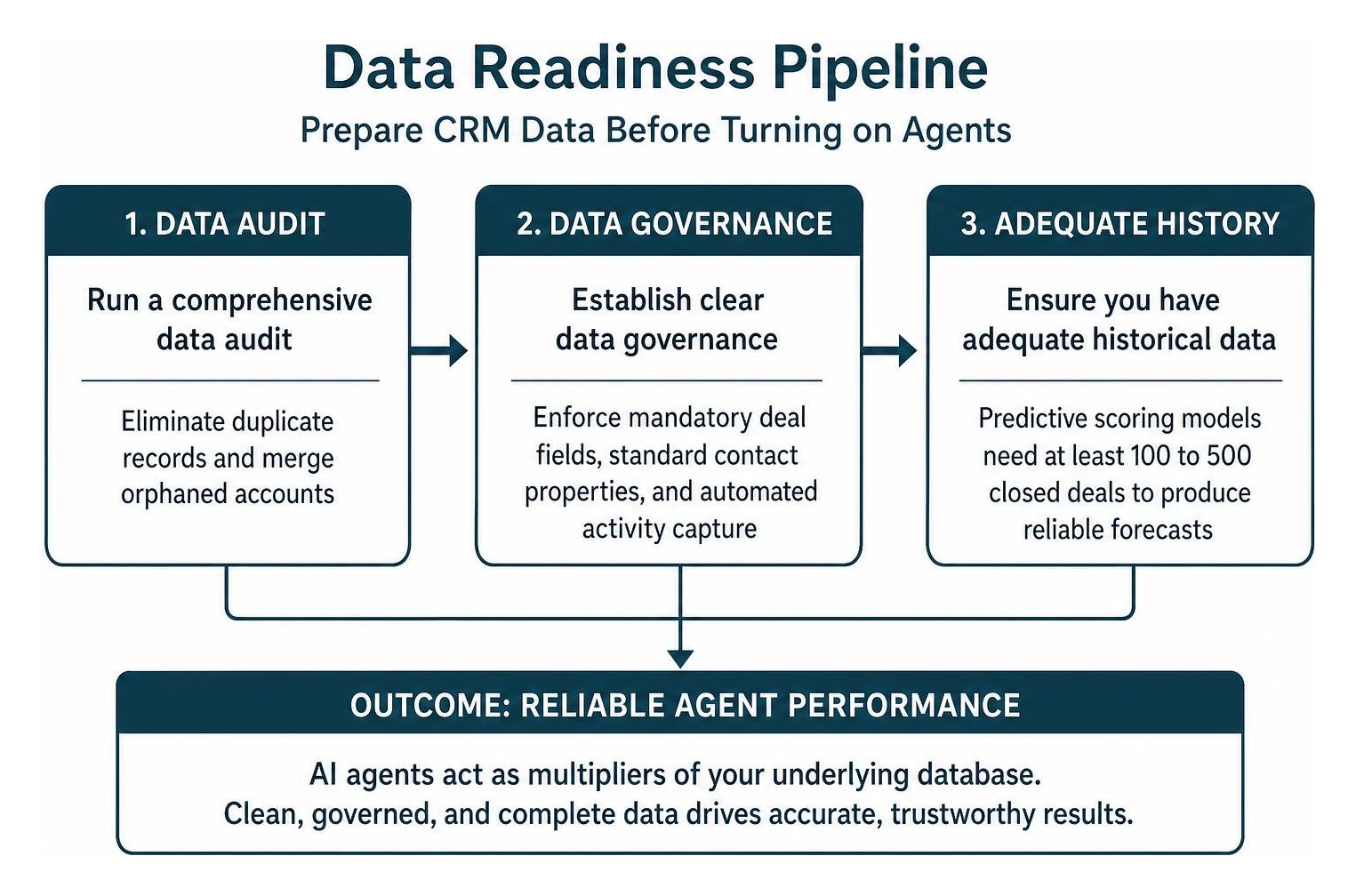
Before launching autonomous agents:
- Run a comprehensive data audit to eliminate duplicate records and merge orphaned accounts.
- Establish clear data governance: enforce mandatory deal fields, standard contact properties, and automated activity capture.
- Ensure you have adequate historical data. Predictive scoring models generally need at least 100 to 500 closed deals to produce reliable forecasts.
Which CRM Fits Your Team, Workflow, and Growth Stage?
Choosing between these three systems requires evaluating your operational structure, technical resources, and growth targets.
| Business Profile | Recommended CRM | Why It Fits | AI Deployment Strategy |
|---|---|---|---|
| Lean Teams & Bootstrapped SMBs | Zoho CRM | Maximum feature-per-dollar ratio, low TCO | Use built-in Zia predictive scoring and anomaly alerts |
| Scaling Mid-Market (Unified GTM) | HubSpot | High adoption, intuitive interface, single codebase | Deploy Breeze Copilot and inbound Customer Agents |
| Large Enterprise & Complex Sales | Salesforce | Deep customization, Data Cloud unification, governance | Build custom Agentforce workflows via Apex and Flows |
HubSpot AI vs Salesforce Einstein vs Zoho AI for CRM: Best by Business Type
- Marketing-Led & Scaling Mid-Market Teams: HubSpot remains the premier choice for organizations where marketing and sales operate in lockstep. Because HubSpot built its platform from the ground up on a single codebase, data passes smoothly between marketing campaigns and sales pipelines. If you are assessing entry-level systems, check out our beginner-friendly CRM guidance as well as our curated list of small-business CRM options.
- Cost-Conscious SMBs & Operational Hubs: Zoho CRM punches well above its weight class. For small businesses seeking advanced automation without five-figure consulting invoices, Zoho Enterprise offers the best functionality per dollar. Furthermore, businesses using the wider Zoho One suite gain native access to accounting, desk, and project management data.
- Large Enterprise with Complex Hierarchies: Salesforce remains the gold standard for global enterprises managing multi-tiered sales teams, intricate compliance mandates, and heavily customized quoting processes. If you have in-house Salesforce administrators and data engineers, Agentforce provides unmatched customization depth.
Match AI Maturity to the Work You Need Done
Do not deploy autonomous agents simply because the technology exists. Match your AI rollout to specific operational bottlenecks:
- Phase 1 (Assistant Tools): Activate email drafting, meeting summarization, and automatic call logging. Measure adoption to ensure reps actually use the recommendations.
- Phase 2 (Predictive Scoring & Triage): Turn on lead scoring, anomaly detection, and support ticket categorization. Compare AI predictions against actual historical conversion rates.
- Phase 3 (Autonomous Task Execution): Launch targeted agents for low-risk, high-volume tasks (e.g., Tier-1 website FAQ support or basic outbound prospecting). Implement strict human escalation paths for complex inquiries.
Compare Integrations, Ecosystems, and Data Unification
An AI agent is only as capable as the systems it can reach:
- Salesforce AppExchange: The largest enterprise marketplace (7,000+ apps), enabling Agentforce to pull data from ERPs, data lakes, and specialized third-party tools via Salesforce Data Cloud.
- HubSpot App Marketplace: Over 1,500 native apps engineered for clean data exchange, minimizing technical debt for mid-market revenue operations.
- Zoho Marketplace: Features 500+ third-party connectors alongside deep, seamless native integrations with 50+ Zoho business applications.
Common CRM AI Buying Mistakes—and How to Avoid Them
- Buying AI Before Establishing Clean Data: Activating automated outreach on outdated contact lists damages domain reputation and customer relationships.
- Falling for Demo Flash Over Daily Utility: Flashy conference keynotes often disguise complex implementation requirements. Test platforms using your real pipeline data during a proof of concept.
- Ignoring Consumption Overage Models: Failing to forecast agent resolution volumes can lead to unpleasant end-of-quarter invoice surprises.
- Over-Engineering Workflows: If a sales process can be managed on a simple board, do not purchase enterprise infrastructure. If you need clean, straightforward pipeline tracking, explore simple CRM options for small businesses.
For teams building early sales stacks, reviewing the best small-business CRM software can help clarify essential baseline features. If your organization relies on automated outbound funnels, examine our guide to free CRM platforms with marketing automation, and ensure your setup connects with the best email marketing tools for CRM software. Additionally, teams looking for broader industry context can consult our complete overview of the best CRM software features and types, while niche operators can explore specialized tools like CRM software for restaurants.
Frequently Asked Questions About HubSpot, Salesforce, and Zoho AI
Which CRM has the best AI-to-price ratio?
Zoho CRM delivers the highest AI capability per dollar. At $40 to $52 per user per month (Enterprise/Ultimate tiers), Zoho includes predictive lead scoring, anomaly detection, sentiment analysis, and Zia Agent Studio access without requiring expensive add-on subscriptions.
Does AI in a CRM require clean data to work well?
Yes. AI models, predictive algorithms, and autonomous agents rely directly on underlying CRM data. Incomplete contact records, missing activity logs, and duplicated entries lead to inaccurate lead scores and flawed automated outreach.
Can CRM AI agents replace sales or support teams?
No. Modern CRM AI agents excel at automating repetitive administrative tasks, summarizing records, scoring pipeline velocity, and resolving routine Tier-1 inquiries. High-value negotiations, relationship management, and complex problem resolution still require human empathy and strategic judgment.
Conclusion: Choose the CRM Your Team Can Use Well
Selecting the right AI-powered CRM is not about picking the platform with the longest feature list—it is about choosing the system your team will actively adopt.
HubSpot Breeze offers an accessible, unified workspace for fast-moving mid-market companies. Zoho Zia gives budget-conscious teams enterprise-grade intelligence at a fraction of the cost. Salesforce Agentforce provides large enterprises with the custom horsepower needed to automate complex operational ecosystems.
At AIxorIA, we help businesses evaluate emerging technologies with practical, clear guidance. Before committing to a long-term contract, clean your customer data, model your expected AI usage costs, and pilot a single AI workflow to confirm real-world ROI. Explore our practical resources on AI-powered business productivity to build a modern software stack that drives lasting growth.