Scr0ll d0wn to D0VVNL0AD
Understanding Modern CRM Systems: Core Types and Business Benefits

A modern platform for customer relationship management serves as the central brain for customer interactions and institutional memory across an enterprise. Almost half of organizations rely on third-party software tools, 18% still track data in static spreadsheets, and 21% have no formal system at all. This fragmentation costs thousands of hours in lost productivity, causes communication gaps, and damages customer relationships.
Deploying the best customer relationship management software helps businesses systematically manage interactions, organize contacts, track communication histories, and automate repetitive operational workflows. Modern platform architectures generally fall into three core operational profiles:
- Operational CRM: Focuses on streamlining and automating daily front-office activities across sales, marketing, and customer service. It handles automated lead distribution, email campaign execution, account activity logging, and service ticket routing.
- Analytical CRM: Analyzes customer data collected across disparate operational touchpoints. It provides data-driven customer insights, estimates customer lifetime value (LTV), pinpoints behavioral patterns, and builds predictive sales forecasting models.
- Collaborative CRM: Unifies cross-departmental communication and contextual history. It ensures that sales representatives, customer service agents, account managers, and marketing teams share the exact same real-time customer profile, effectively breaking down organizational data silos.
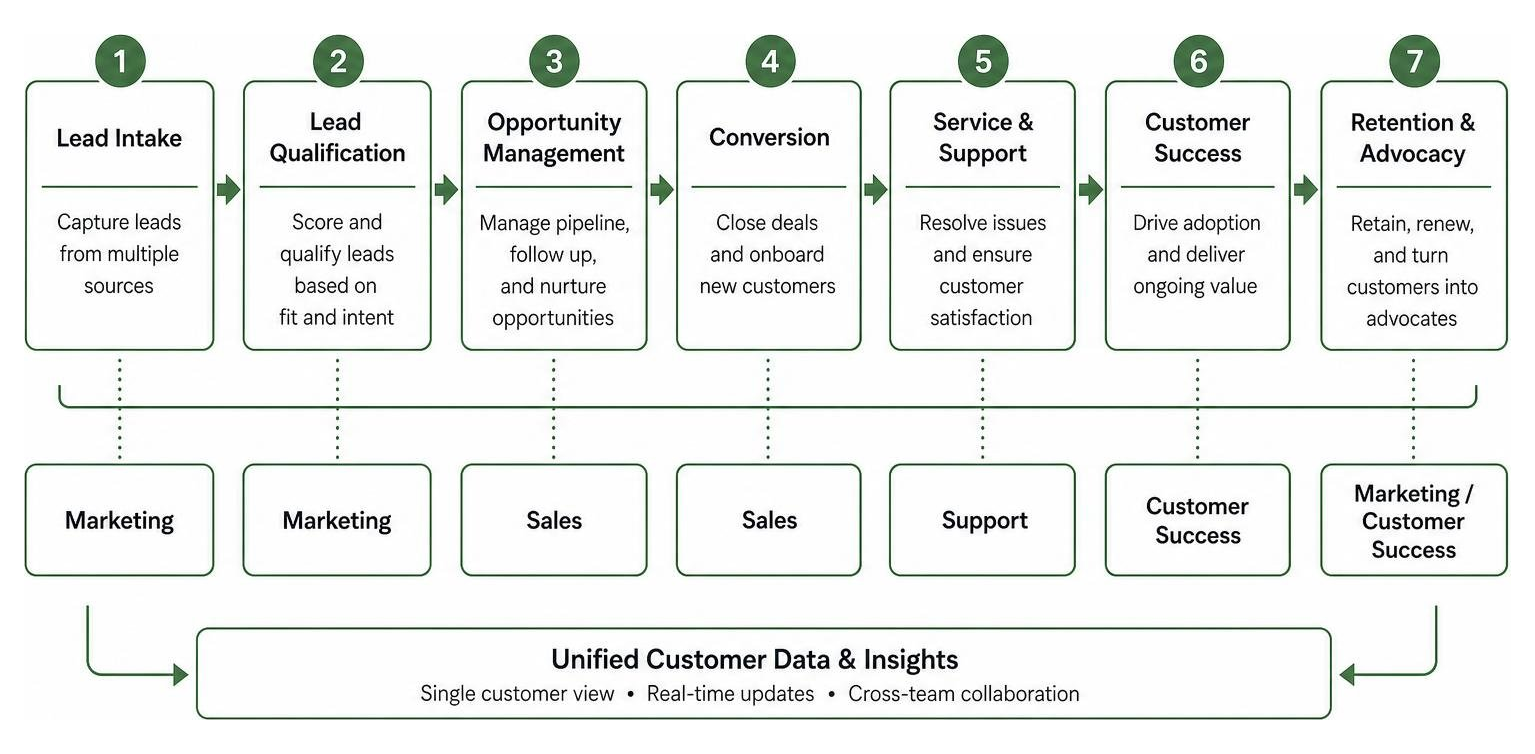
Alignment across sales, marketing, and support teams
Fragmented systems force team members to jump across isolated applications to gather historical context, resulting in inconsistent messaging and frustrated customers. Centralizing data into a single operational interface fundamentally transforms internal handoffs and cross-functional synergy:
- Marketing: Captures and qualifies leads through personalized multi-channel campaigns, automatically passing full engagement history, source attribution, and intent signals directly to appropriate sales reps.
- Sales: Tracks deal stages in visual pipelines, schedules intelligent follow-ups, and accesses rich context without needing to interrupt marketing managers for background details.
- Support: Views past purchase histories, subscription tiers, and open account tickets instantly, resolving customer inquiries with speed, context, and genuine empathy.
Moving to a unified platform eliminates data entry fatigue, reduces human error, and dramatically increases team alignment, directly boosting customer retention rates and net promoter scores.
Key Features of the Best Customer Relationship Management Software in 2026
Evaluating software options requires looking closely at core features, customizability, operational scalability, and modern technological capabilities.
| CRM Architecture Type | Core Operational Focus | Primary Business Benefits | Key Feature Examples |
|---|---|---|---|
| Operational | Process automation across front-office teams | Reduces manual tasks, accelerates deal closures | Lead scoring, email templates, ticket routing |
| Analytical | Data processing, pattern recognition, and reporting | Delivers actionable business insights, accurate forecasting | Custom dashboards, churn prediction, cohort analysis |
| Collaborative | Centralizing cross-department communication | Eliminates organizational silos, unifies context | Shared inboxes, activity streams, integrated chat |
Agentic AI and autonomous workflow automation
CRM environments have evolved from simple static databases into proactive, intelligent systems. Leading platforms in 2026 utilize agentic AI—autonomous digital co-workers capable of executing multi-step workflows based on preset business rules and dynamic environmental triggers.
Rather than waiting for manual user input, AI agents actively analyze customer sentiment, conduct preliminary background research on inbound leads, update pipeline stages based on email responses, draft highly personalized follow-ups, and trigger targeted escalation routines autonomously. Users interact with these advanced tools through intuitive conversational interfaces using natural language, making complex custom reporting, database queries, and routine administrative work as simple as sending a chat message to a colleague.
Seamless ecosystem integrations and communication
A modern CRM should never exist as an isolated island. It must sit at the exact center of your tech stack, featuring robust native integrations with critical communication channels, email providers, billing software, and project management tools.
Two-way data synchronization ensures that when an update occurs in an external project board, payment gateway, or email inbox, the central database reflects it instantly. Essential productivity capabilities include:
- Email Tracking & Context Overlay: View complete customer records, active deal values, and past support tickets directly inside your email client interface.
- Shared Team Inboxes: Allow multi-functional teams to collaborate on customer queries without duplicating responses or dropping critical context.
- Slash Commands & In-Chat Actions: Retrieve instant account summaries, update deal stages, and assign action items directly within team messaging tools.
Categorizing Top CRM Platforms for Business Growth

Selecting the best customer relationship management software requires carefully matching platform capabilities to your organization’s specific operational complexity, team structure, and growth target.
Evaluating the Best Customer Relationship Management Software for Startups
Startups and growing small businesses need quick time-to-value, predictable transparent pricing, and minimal technical overhead to ensure swift adoption without disrupting daily momentum.
- Budget-Friendly Options: Free-forever tiers and low-cost starter subscriptions allow lean teams to establish organized pipelines and contact management without heavy upfront capital investment.
- Spreadsheet Migration: Simple CSV import wizards and automated field mapping tools enable teams to transition completely out of scattered spreadsheets in minutes.
- Visual Pipeline Management: Intuitive drag-and-drop Kanban boards give immediate operational visibility into deal stages, deal velocity, and expected revenue projections.
- Low Technical Overhead: Cloud-based (SaaS) deployments offload server hosting, security updates, and routine maintenance entirely to the vendor, requiring zero dedicated IT personnel.
Choosing the Best Customer Relationship Management Software for Enterprise Scaling
Large enterprises face intricate cross-functional operations, multi-product sales pipelines, strict compliance frameworks, complex governance requirements, and massive user bases.
- No-Code Architecture: No-code visual builders allow non-technical business administrators to adapt UI layouts, custom objects, and business logic rapidly. Industry studies show no-code implementations deliver up to a 70% reduction in deployment timelines and cut total cost of ownership (TCO) by 37%.
- Enterprise-Grade Customization & APIs: Robust open APIs and developer SDKs enable custom software application development and seamless deep integration with legacy enterprise resource planning (ERP) platforms.
- Omnichannel Communication Queues: Centralizes incoming customer touchpoints across email, phone systems, web chat widgets, and social media channels into unified, intelligent agent routing queues.
- Security & Governance Controls: Sophisticated role-based access control (RBAC), multi-factor authentication, granular audit logging, and global regulatory compliance certifications (such as GDPR, HIPAA, and SOC 2) protect enterprise data assets.
Overcoming Implementation Challenges and Harnessing AI
Deploying a new CRM platform successfully requires managing both technical system configuration and internal organizational change management. Without strategic planning, software projects often face friction, low user engagement, or slow ROI realization.
Managing data migration and software adoption
Implementation delays and low software utility usually stem from migrating unclean data or encountering poor employee buy-in. To ensure a seamless transition and long-term organizational success, follow these actionable steps:
- Clean Existing Data Records: Thoroughly audit, standardize, and deduplicate legacy database records before importing any information into the new system repository.
- Establish Clear Governance Permissions: Implement strict role-based access permissions to safeguard confidential deal details, enterprise financial data, and customer personal information.
- Appoint Internal Change Champions: Designate respected department power users to host hands-on onboarding sessions, create customized documentation, and answer daily peer questions.
- Monitor Adoption & Engagement Metrics: Track system activity logs, daily login frequencies, record updates, and sales pipeline progress to measure adoption rates and identify friction points quickly.
- Standardize Automated Workflows: Utilize standardized, AI-enhanced email templates and automated task triggers to eliminate manual data entry. For example, platform users cut manual data entry by 17%, freeing up representatives for high-value strategic sales conversations and relationship building.
Frequently Asked Questions About CRM Software
What is the primary purpose of a CRM system?
The primary purpose of a CRM system is to centralize, track, and optimize all interactions across the entire customer lifecycle within a single platform. It acts as a single source of truth for prospect and customer data, automates repetitive administrative tasks, streamlines deal management through visual pipelines, and generates actionable reporting dashboards that improve strategic decision-making across sales, marketing, and customer service teams.
How much does CRM software cost for small businesses?
CRM software costs typically range from $10 to $100 per user per month for standard small business subscription tiers. Many software vendors offer free entry-level plans that include fundamental contact management and pipeline tracking tools. Higher pricing tiers unlock advanced multi-step workflow automation, custom reporting, enterprise integrations, and agentic AI capabilities as your organizational requirements grow.
Can a CRM integrate with Slack and email platforms?
Yes. Modern CRM solutions offer robust native integrations and marketplace app connectors for major email platforms, team messaging tools, and office productivity suites. These integrations support real-time two-way data syncing, display contextual customer record cards directly inside your email inbox, and deliver automated workflow notifications and interactive deal actions directly inside your team’s everyday chat channels.”https://www.mediafire.com/file/rw6lktnzlpx5khu/Archeologeist_BY_MCMPDL%25E2%2580%25A2COM.mcpack/file“;
Conclusion
Selecting the best customer relationship management software comes down to matching your current operational workflows with a platform flexible enough to scale alongside your long-term business goals. Whether you are a startup migrating away from manual spreadsheets or a global enterprise deploying autonomous agentic AI workflows, centralizing customer data creates clearer internal accountability, speeds up team communication, and drives predictable operational growth.
As CRM technology continues to advance, pairing your platform strategy with modern AI productivity solutions ensures your organization works efficiently, automates routine administrative workloads, and delivers exceptional, personalized customer experiences at every touchpoint.