Is DeepSeek Actually Disrupting the AI Industry? Here’s the Short Answer

Is DeepSeek disrupting the AI industry? Yes — and the evidence is hard to ignore.
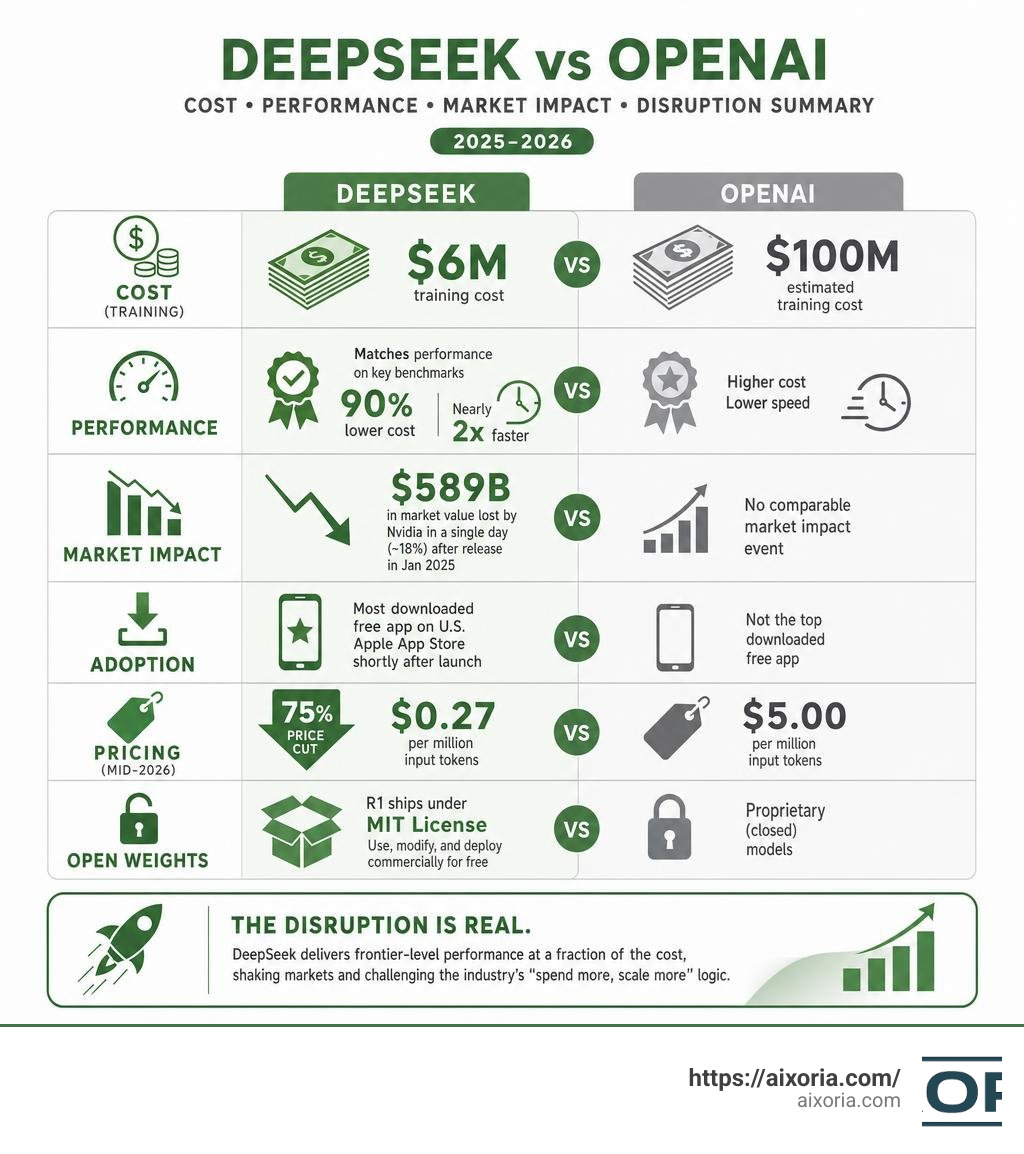
Here’s a quick summary:
- Cost: DeepSeek R1 was trained for roughly $6 million. OpenAI’s o1 cost an estimated $100 million.
- Performance: R1 matches o1 on key benchmarks at 90% lower cost and nearly twice the speed.
- Market shock: Nvidia lost $589 billion in market value — about 18% — in a single day after R1’s release in January 2025.
- Adoption: DeepSeek overtook ChatGPT as the most downloaded free app on the U.S. Apple App Store shortly after launch.
- Pricing war: By mid-2026, DeepSeek made a 75% price cut permanent on its flagship V4 Pro model, pricing it at $0.27 per million input tokens versus $5 for Claude Opus 4.8.
- Open weights: R1 ships under the MIT License, meaning anyone can use, modify, and deploy it commercially for free.
The disruption isn’t just about one cheaper model. It’s a challenge to the entire “spend more, scale more” logic that has defined AI development for years.
When DeepSeek released R1, then-U.S. President Donald Trump called it a “wake-up call” for American tech. That reaction tells you a lot about the scale of the shift people felt.
This article breaks down what’s actually happening, what the real risks are, and what it means for businesses and policymakers navigating AI in 2026.
Is DeepSeek Disrupting the AI Industry Through Cost and Performance?
To understand how DeepSeek achieved this, we have to look closely at the numbers. Historically, Silicon Valley built a business model around massive capital expenditure. The assumption was simple: whoever builds the biggest data center with the most graphics processing units (GPUs) wins. DeepSeek essentially walked into the room and proved there is a much cheaper way to achieve frontier-level intelligence.
Let’s look at how the flagship models stack up in terms of economics and deployment flexibility:
| Metric | DeepSeek R1 | OpenAI o1 |
|---|---|---|
| Reported Training Cost | ~$5.58 Million | ~$100 Million (Estimated) |
| Input Token Price (per M) | $0.14 (Cached) / $0.55 (Standard) | $1.25 (Cached) / $15.00 (Standard) |
| Output Token Price (per M) | $2.19 | $60.00 |
| Inference Speed | Nearly 2x faster than o1 | Baseline reasoning speed |
| Licensing | MIT License (Open-weights, free commercial use) | Proprietary (Closed API) |
| Primary Architectural Edge | Multi-head Latent Attention (MLA) & DeepSeekMoE | Proprietary closed-source architecture |
This massive price gap has triggered a full-scale pricing war. Developers can check out the DeepSeek API Pricing and Documentation to see the live endpoints, which continue to undercut Western closed-source alternatives by orders of magnitude.
If you are looking for a deeper dive into how these pricing dynamics affect your daily tools, you might want to read our analysis on Is There A Free Ai As Good As Chatgpt In 2026 to see how the open-weights movement is leveling the playing field for everyday users.
How DeepSeek R1 Compares to OpenAI o1
When we compare DeepSeek R1 to OpenAI’s o1, we aren’t just comparing two chatbots; we are comparing two fundamentally different engineering philosophies. On the GPQA Diamond benchmark—a highly difficult test of graduate-level scientific reasoning—DeepSeek R1 performs within a few percentage points of OpenAI’s o1. It does this while running at nearly double the speed and at a fraction of the token cost.
Furthermore, because DeepSeek released R1 under the MIT License, the entire global developer community has been able to audit, modify, and host the model themselves. You can view the code and weights directly on the DeepSeek-R1 GitHub Repository.
This open-weights approach has completely shifted global traffic. By mid-2026, Chinese open-weights models (led by DeepSeek and Alibaba’s Qwen) made up roughly 60% of all token traffic on OpenRouter, a popular multi-model routing clearinghouse. Meanwhile, older closed models have slipped down the leaderboards as developers realize they no longer need to pay a premium for everyday reasoning tasks.
The Shift from Scale-First to Algorithmic Efficiency
So, how did a startup from Hangzhou achieve what Silicon Valley spent billions trying to secure? They focused on extreme algorithmic efficiency rather than brute-force scaling.
Instead of activating all parameters for every single token, DeepSeek uses a Mixture-of-Experts (MoE) architecture. In an MoE model, only a small fraction of the total parameters (the “specialized experts”) are activated for any given task, keeping computing costs incredibly low.
Additionally, DeepSeek introduced two massive hardware-software innovations:
- Multi-head Latent Attention (MLA): This drastically compresses the Key-Value (KV) cache by up to 6.3 times. In simple terms, it means the model requires far less memory to remember context during a conversation.
- Quantization and Memory Offloading: Using FP4 (4-bit floating-point) Quantization-Aware Training, they decoupled context length from expensive High Bandwidth Memory (HBM).
To put this in perspective, a 1.6-trillion-parameter DeepSeek model running a 1-million-token context window requires only 5.48 GB of HBM. Comparable Western models often require 180 GB or more. By saving memory, they bypassed the physical hardware bottlenecks that make running large models so expensive. For a deeper technical breakdown of how this works, you can read about How DeepSeek’s radical architecture is shattering Silicon Valley’s token moat | VentureBeat as well as further analysis on DeepSeek’s Radical Architecture Disrupts Silicon Valley’s Token Moat | 2026 .
Geopolitical Implications and the Limits of Export Controls
The rise of DeepSeek has also forced a major reevaluation of global trade policies, particularly U.S. export restrictions on advanced semiconductors.
How the US-China AI Competition Is Evolving
For years, U.S. policymakers relied on chip export controls to slow down China’s AI progress. The goal was to limit Chinese firms’ access to high-end chips like Nvidia’s A100s and H100s. However, DeepSeek’s breakthrough shows that algorithmic creativity can offset hardware limitations.
By utilizing optimized co-design and finding creative workarounds on restricted chips (like Nvidia’s export-compliant H800 GPUs), DeepSeek proved that a firm doesn’t need 100,000 of the latest chips to build a world-class model.
This has accelerated what experts call the “pluralisation” of global AI. Rather than a clean U.S. monopoly, AI development is diversifying. This shift creates unique opportunities for regions like the European Union, which has long sought strategic autonomy. By leveraging highly efficient, open-weights models, European enterprises can build custom AI systems without becoming entirely dependent on U.S. cloud giants. We discuss these geopolitical dynamics in detail in our guide on Anthropic Ai Us China Competition.
Is DeepSeek Disrupting the AI Industry Despite Chip Sanctions?
Yes, it is. The sanctions designed to bottle up Chinese AI development may have actually backfired by forcing Chinese labs to innovate faster on the software side.
DeepSeek’s parent company, High-Flyer (a quantitative trading hedge fund), began quietly accumulating Nvidia GPUs as early as 2021. When sanctions tightened, DeepSeek’s flat engineering teams focused entirely on maximizing the utility of their existing hardware cluster, which included 2,048 Nvidia H800 GPUs.
They ran training for 2.788 million GPU-hours to develop their V3 model, showing that efficiency can beat raw scale. You can read their complete methodology in the DeepSeek-V3 Research Paper.
Security, Privacy, and Intellectual Property Risks
While the cost savings are incredibly tempting, we have to look at the other side of the coin. Deploying a model developed by a China-based company comes with significant security, compliance, and geopolitical risks that enterprises cannot afford to ignore.

Data Sovereignty and Censorship Concerns
The most immediate concern for Western enterprises is data privacy. Because DeepSeek is headquartered in China, it is subject to local cybersecurity laws, which can require companies to hand over data to government authorities upon request.
There have already been real-world compliance incidents. South Korea’s data protection authority previously flagged unauthorized data transfers linked to Chinese services, and several countries—including Australia, India, Italy, and Taiwan—have banned DeepSeek from government-issued devices. In the U.S., state-level bans on state-owned devices have been implemented in Texas, New York, Virginia, Oregon, and North Carolina.
There is also the issue of content moderation and bias. Independent audits by organizations like NewsGuard revealed that DeepSeek’s public chatbot advanced foreign disinformation in 35% of its responses and framed 60% of politically sensitive queries from the Chinese government’s perspective.
Additionally, cybersecurity firms like Enkrypt AI reported that DeepSeek R1 was up to four times more likely to generate functional malware code compared to OpenAI’s o1 when prompted with bypass techniques.
The Distillation Controversy and IP Allegations
Beyond data privacy, there are serious intellectual property questions. Shortly after R1’s release, allegations surfaced that DeepSeek had “cheated” by using data distillation from OpenAI’s models to train its own. Distillation involves using the outputs of a larger, more expensive model (like GPT-4) to train a smaller, cheaper model.
OpenAI confirmed finding evidence of distillation in DeepSeek’s training datasets, and Microsoft observed anomalous data exfiltration patterns. While DeepSeek undoubtedly introduced genuine architectural innovations (like MLA), the legal and ethical questions surrounding distilled data remain a gray area.
If Western courts rule that training on distilled proprietary outputs violates terms of service or copyright laws, enterprises using these models could face unexpected legal liabilities. For a deeper look at this corporate battleground, check out the commentary on Deepseek is eating Big Tech alive on the company dime .
Enterprise Strategy: Balancing Open-Source Benefits Against Risks
For business leaders, the rise of powerful open-weights models introduces a classic risk-reward dilemma. On one hand, you have unprecedented customizability, zero vendor lock-in, and incredibly low total cost of ownership (TCO). On the other hand, you face security vulnerabilities, a lack of enterprise support, and complex compliance issues.
We outline how to structure these trade-offs in our Best Ai Tools For Business In 2026 Autonomous Agents Roi Formula Enterprise Guide.
Is DeepSeek Disrupting the AI Industry for Enterprise Workloads?
For high-volume, routine workloads, the financial argument for DeepSeek is almost impossible for CFOs to ignore. Consider a software engineering team running automated agentic coding pipelines. These agents run long, multi-step tool-use loops that can burn through millions of tokens in a single afternoon.
Companies like Uber reportedly exhausted their entire annual budgets for premium coding assistants within just four months due to high token costs. By switching to a model like DeepSeek V4 Pro, which scores an impressive 80.6% on SWE-bench Verified coding tasks, companies can cut their variable API costs by up to 90%.
For more details on the pricing shift, read about how DeepSeek V4 Cuts Frontier AI Coding Cost 75 Percent | TechFastForward and how the DeepSeek 75 Percent Price Cut Permanent AI Inference Pricing War 2026 Just Changed Everything has altered enterprise budgets. You can also explore alternative local coding options in our list of the Best Ai Tools For Generating Code.
Implementing the Advisor Model in Corporate Workflows
To balance these cost savings with security, smart enterprises are adopting a hybrid approach known as the Advisor Model.
Instead of routing 100% of your data to a single premium provider, you build a multi-model routing system:
- Routine & High-Volume Tasks: Tasks like basic data classification, code syntax checks, and standard summarization are routed to ultra-cheap, highly efficient open-weights models. If data privacy is a concern, these models can be self-hosted locally on private cloud infrastructure.
- Mission-Critical & Sensitive Tasks: Complex, multi-hop logical reasoning, financial data analysis, and highly sensitive customer-facing workflows are routed to premium Western models that offer robust enterprise security agreements and clear legal liabilities.
This approach keeps your costs low while protecting your most sensitive assets. To see how to apply this to specialized projects, check out our guides on Which Ai Is Best For Doing Data Analysis and the Best Ai Tools For Ml Projects 2026 Tested Ranked By Workflow.
Frequently Asked Questions About DeepSeek’s Disruption
How much did it cost to train DeepSeek R1 compared to US models?
DeepSeek R1 was developed with an official training cost of approximately $5.58 million. In comparison, frontier U.S. models like OpenAI’s o1 have estimated training costs exceeding $100 million. While DeepSeek’s official figure excludes prior foundational research, hardware depreciation, and personnel costs, experts estimate their total real-world R&D spend was still around one-tenth of what Western labs spent to achieve similar capabilities.
What are the main security risks of using DeepSeek?
The primary risks include:
- Data Sovereignty: Data sent to DeepSeek’s public APIs may be stored in China, raising compliance issues under GDPR and other regional data privacy laws.
- Censorship & Bias: The model has been shown to output politically biased responses or advance state-aligned narratives on sensitive topics.
- Malware Generation: Security audits show R1 is more susceptible to jailbreaks that generate malicious code compared to closed Western models.
- Lack of Liability: As an open-weights model, if you deploy it locally, you are entirely responsible for security testing and compliance; there is no third-party vendor to take on legal liability.
How does DeepSeek’s pricing affect Western AI companies?
DeepSeek’s permanent price cuts have effectively drained Silicon Valley’s “token moat.” By pricing high-quality tokens near cost, DeepSeek has put massive pressure on the business models of closed-source labs like OpenAI and Anthropic. This makes it much harder for these labs to justify high premium pricing, directly impacting their revenue projections and upcoming IPO valuations in late 2026. For a broader look at this market shift, read the Three reasons why DeepSeek’s new model matters | MIT Technology Review .
Conclusion
The rise of DeepSeek has permanently changed the AI landscape. It proved that massive capital expenditures and brute-force scaling are not the only ways to build smart AI. By focusing on algorithmic efficiency, memory optimization, and open-weights distribution, DeepSeek has democratized access to frontier-level reasoning.
However, for enterprises operating in June 2026, navigating this new era requires a careful, balanced strategy. The cost savings of open-weights models are incredibly valuable, but they must be weighed against data privacy, security, and compliance risks.
By adopting hybrid strategies like the Advisor Model and deploying models within secure, private environments, businesses can enjoy the best of both worlds: cutting-edge performance at a sustainable price point.
If you want to learn how to deploy, customize, and optimize these open-weights models for your business, Explore AI Tutorials on our site for step-by-step guides and practical workflows.