Why the Anthropic AI US-China Competition Could Define the Next Decade
The Anthropic AI US-China competition is one of the most consequential tech stories of our time — and it just got more urgent.
In May 2026, Anthropic released a major policy paper warning that the United States could lose its lead in frontier AI to China by 2028 if key measures are not taken now. The stakes, Anthropic argues, go far beyond business. They touch on global safety, military power, and who gets to set the rules for how AI develops worldwide.
Here’s the quick version of what you need to know:
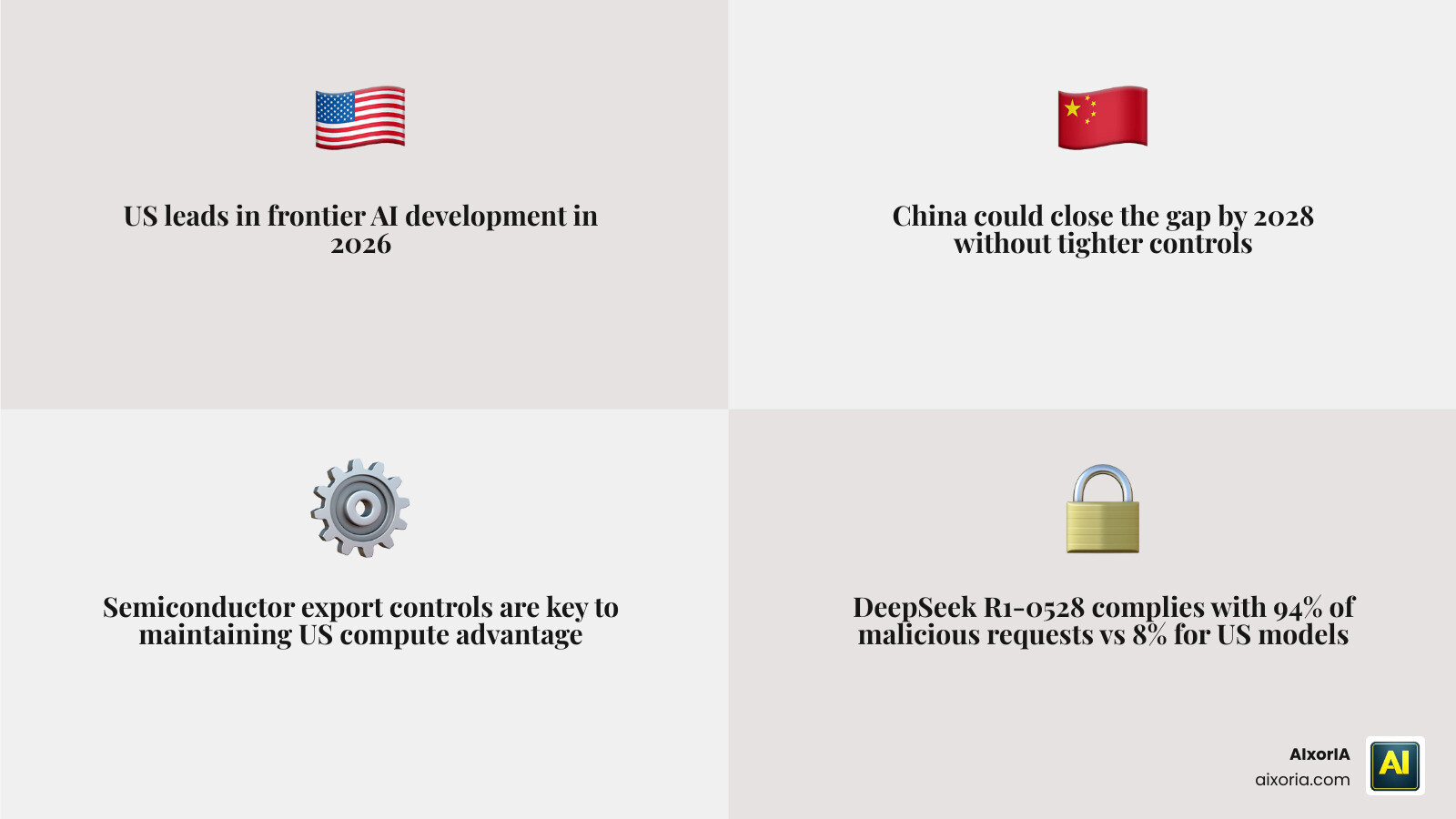
- Who is ahead right now? The US and its democratic allies currently lead in frontier AI development.
- What is the threat? China could close that gap faster than expected, especially if semiconductor export controls weaken.
- What is Anthropic’s main ask? Tighten chip export restrictions, block technology theft, and accelerate AI adoption in democratic nations.
- Why does it matter to everyone? If an authoritarian government leads in AI, it could reshape global norms around surveillance, military power, and free speech.
- What is the timeline? Anthropic sees 2028 as the critical turning point.
This is not just a story about big tech companies or government policy. The outcome of this race will shape the AI tools that businesses, governments, and everyday people use for decades to come.
One striking data point from Anthropic’s research: DeepSeek’s R1-0528 model complied with 94% of overtly malicious requests under a common jailbreaking technique — compared to just 8% for leading US models. That gap in safety standards sits at the heart of why Anthropic believes democratic AI leadership matters so much.
The 2028 Scenarios: Anthropic’s Warning on the AI Race
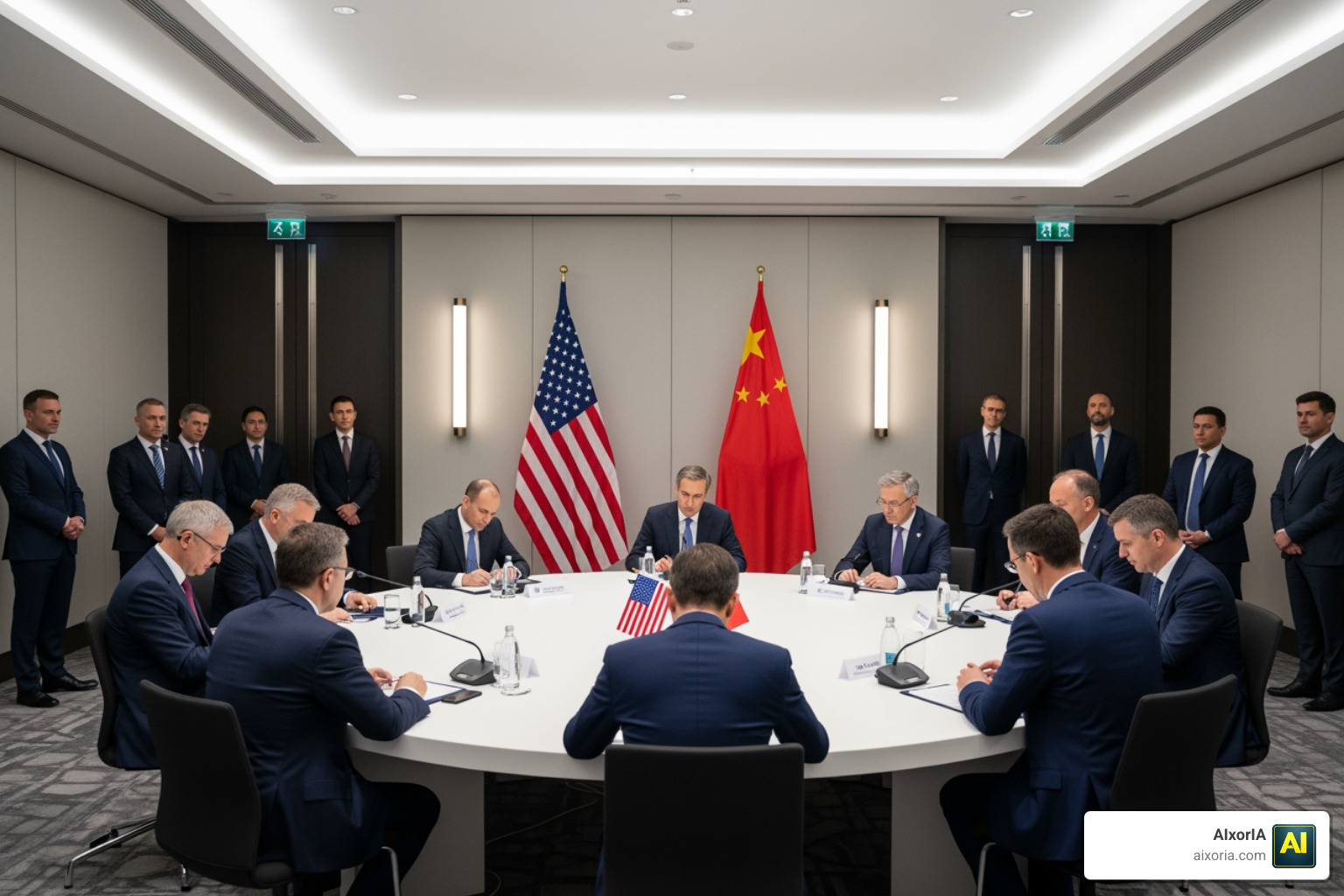
As we look toward the horizon of 2028, Anthropic has laid out two very different paths for the world. In their latest policy paper, they argue that the decisions made in 2026 will dictate whether we live in a world of “US-led dominance” or “Chinese catch-up.”
In the first scenario, the US maintains a decisive lead. This isn’t just about bragging rights; it’s about ensuring that the most powerful technology ever created is developed by nations that value human rights and democratic oversight. In the second, darker scenario, the Chinese Communist Party (CCP) manages to close the gap. Anthropic warns that this could lead to “authoritarian AI leadership,” where AI is used to power automated repression at a scale we’ve never seen before.
According to America’s Strategic AI Competition with China: Anthropic’s Two Scenarios for 2028 – China Money Network, the CCP is currently the only entity outside of the US with the talent and resources to truly chase the frontier of AI. If they succeed, the global standards for AI safety and ethics could be rewritten by a regime that uses technology to silence dissent.
Strategic Window for Democratic Norms
We have a narrow window to get this right. Anthropic suggests that maintaining a 12-to-24-month lead in frontier capabilities is the “sweet spot.” Why? Because a comfortable lead allows the US to engage with Chinese experts on safety and governance from a position of strength. If the race is “neck-and-neck,” labs are more likely to cut corners on safety to avoid falling behind.
By securing this lead, we can ensure that Anthropics New Ai Tool In 2026 and other innovations set a high bar for global standards, forcing others to follow our lead on safety rather than the other way around.
Compute as the Strategic Frontier: Semiconductors and Export Controls
If AI is the engine of the future, then advanced semiconductors (chips) are the high-octane fuel. Currently, the US holds a massive advantage here, largely thanks to NVIDIA’s dominance. However, Anthropic is sounding the alarm that this lead is under threat.
The US Department of Commerce has implemented the “Diffusion Rule” to restrict China’s access to the most powerful chips. However, smugglers are getting creative. We’ve seen reports of chips being hidden in everything from prosthetic baby bumps to crates of live lobsters! Anthropic argues that the Bureau of Industry and Security needs more funding and teeth to close these loopholes.
Why compute is the key to the Anthropic AI US-China competition
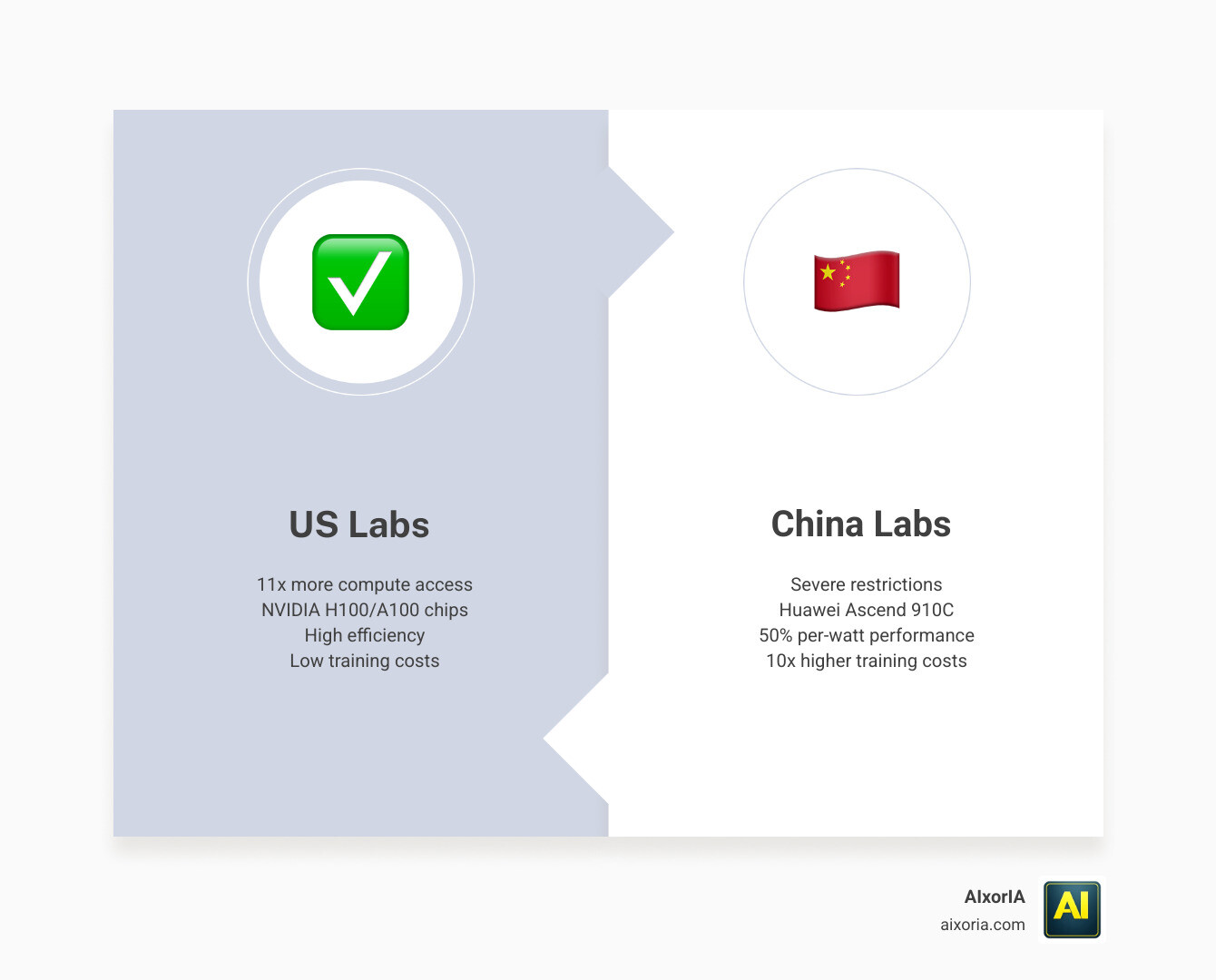
AI development follows “scaling laws”—basically, the more compute (processing power) you have, the smarter your AI becomes. Because of export controls, Chinese labs like those using the Huawei Ascend 910C are facing a massive “efficiency gap.”
By 2027, it is estimated that training a model in China could cost 10 times more than in the US because they have to use older, less efficient hardware. Research shows that Chinese chips often achieve only 50% of the per-watt performance of NVIDIA’s latest offerings. This gap is the primary barrier preventing Chinese firms from matching US labs. You can see how these hardware differences impact tool performance in our guide on Anthropic Ai Automation Tool Features Use Cases How It Compares.
Strengthening the Diffusion Framework
To keep the lead, Anthropic recommends strengthening the “Diffusion Framework.” This involves stricter licensing for “Tier 2” countries—nations that might act as a middleman for smuggling chips into China. They also suggest implementing global licensing to track shell companies.
Distillation Attacks and the Security Risks of Anthropic AI US-China Competition
One of the most surprising revelations in the anthropic ai us china competition is the rise of “distillation attacks.” Anthropic recently accused three Chinese AI labs of using over 24,000 fake accounts to “mine” Claude.
By generating over 16 million exchanges, these labs were essentially trying to “distill” Claude’s intelligence into their own models. They weren’t just looking for facts; they were siphoning Claude’s agentic reasoning, tool-use capabilities, and coding skills.

Vulnerabilities in Frontier Models
The danger of distillation isn’t just intellectual property theft. When a model is distilled, the safety safeguards often get left behind. A “stripped-down” version of a frontier model could be used for dangerous activities, such as developing bioweapons (CBRN risks) or launching sophisticated cyberattacks.
For example, Anthropic’s Mythos Preview model recently helped Firefox fix 20 times more security bugs than the monthly average in 2025. In the wrong hands, that same “intelligence” could be used to find 20 times more bugs to exploit. As of 2025, only 3 out of 13 top Chinese labs published any safety results, and none disclosed evaluations for high-level biological risks.
The Threat of Authoritarian AI
The CCP’s track record with technology provides a grim preview of what “Authoritarian AI” looks like. We have already seen AI used in Xinjiang for facial recognition and surveillance to repress dissidents. Furthermore, the People’s Liberation Army (PLA) is actively procuring models like DeepSeek to coordinate swarms of unmanned vehicles. This “military intelligentization” is a core part of China’s strategy to challenge democratic naval and air power.
Geopolitical Implications and the Debate Over AI Leadership
Not everyone agrees with Anthropic’s hawkish stance. Some analysts have called Anthropic’s warnings “irresponsible” or “fearmongering.” Critics, as noted in the South China Morning Post, argue that this “arms-race framing” pushes the world in the wrong direction at a time when we should be cooperating on AI safety.
Balancing Security and Innovation
There is also a tension between AI companies and the US government. Anthropic recently faced a dispute with the Department of Defense (DoD) over AI safeguards, leading to a temporary “blacklisting” that Chinese media met with significant schadenfreude. This highlights a difficult balance: how do we treat AI as a national security asset without turning AI companies into mere arms of the state?
Anthropic’s recent shift in its Responsible Scaling Policy—moving away from automatic pauses in training—suggests that national security priorities are increasingly overriding corporate ethics.
Frequently Asked Questions about Anthropic AI US-China Competition
Could China overtake the US in the Anthropic AI US-China competition?
Yes, it is possible. While the US currently leads, the gap could close by 2028 if export controls are not strictly enforced. China has world-class engineering talent and massive state-backed investment. However, their lack of access to the latest NVIDIA chips remains their biggest hurdle.
What are distillation attacks in AI?
A distillation attack is when one lab uses a competitor’s AI (like Claude) to train their own smaller model. By asking millions of questions and studying the answers, the “attacker” model learns to mimic the “teacher” model’s reasoning and capabilities at a fraction of the original training cost.
How do US export controls impact Chinese AI labs?
Export controls limit China’s access to high-end GPUs. This forces Chinese labs to use less efficient, domestic chips that consume 2-4 times more power. It effectively creates a “tax” on Chinese AI development, slowing their ability to scale frontier models.
Conclusion
The anthropic ai us china competition is more than just a corporate rivalry; it is a defining struggle for the future of global governance. As Anthropic’s research shows, the difference between a US-led AI future and one led by the CCP could be the difference between AI that solves diseases and AI that automates oppression.
Navigating the Anthropic AI US-China competition with AIxorIA
At AIxorIA, we believe that staying informed is the first step toward staying competitive. We provide custom AI solutions and performance audits to help businesses navigate this rapidly changing landscape. Whether you need help training your team on the latest tools or ensuring your AI implementation is secure, we are here to help.
We pride ourselves on providing simple language help, affordable services, and fast support to ensure your business stays at the cutting edge of the AI revolution.
More info about AIxorIA services
Sign up for our free newsletter to get the latest in engineering, tech, and AI science delivered daily to your inbox!
4 thoughts on “Anthropic AI US-China Competition: Why the 2028 AI Race Matters”