The AI Market Has Two “Big 5” Lists — Here’s What You Need to Know

What are the big 5 AI tools? The honest answer is: it depends on who you ask.
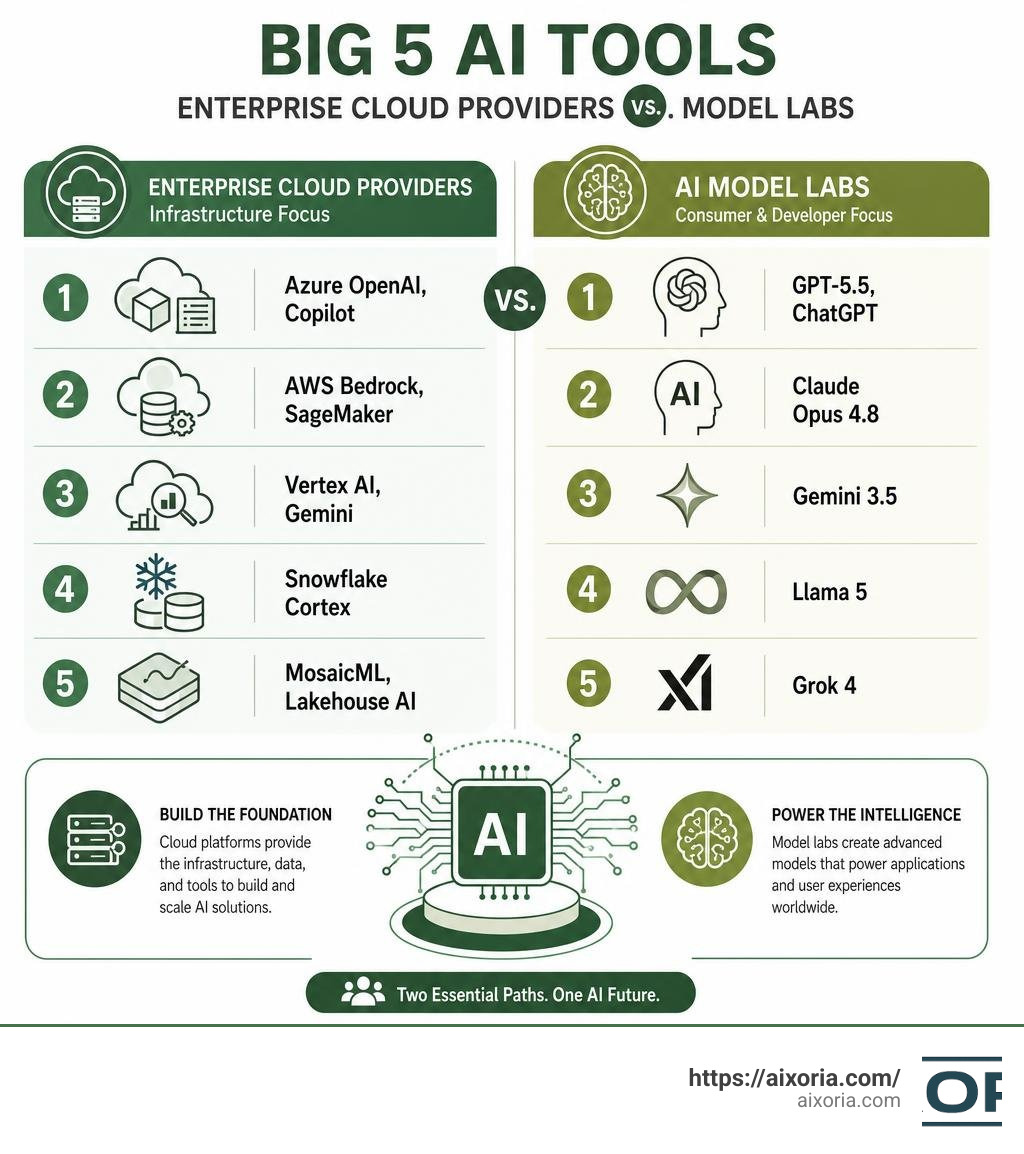
There are actually two widely used “Big 5” lists in AI right now:
The Big 5 Enterprise Cloud Providers (infrastructure focus):
| # | Company | Core AI Offering |
|---|---|---|
| 1 | Microsoft | Azure OpenAI, Copilot |
| 2 | Amazon | AWS Bedrock, SageMaker |
| 3 | Vertex AI, Gemini | |
| 4 | Snowflake | Snowflake Cortex |
| 5 | Databricks | MosaicML, Lakehouse AI |
The Big 5 AI Model Labs (consumer and developer focus):
| # | Company | Flagship Model |
|---|---|---|
| 1 | OpenAI | GPT-5.5, ChatGPT |
| 2 | Anthropic | Claude Opus 4.8 |
| 3 | Google DeepMind | Gemini 3.5 |
| 4 | Meta | Llama 5 |
| 5 | xAI | Grok 4 |
Most people searching for the “Big 5 AI tools” are thinking about one of these two groups — or both.
The AI landscape in 2026 has grown fast. There are now over 14,000 active AI tools worldwide. ChatGPT alone has reached 900 million weekly active users — more than 10% of the entire global population. Enterprise AI budgets average $86,000 per month. This is no longer a niche technology.
But size and hype don’t always point you to the right tool for your needs.
This guide breaks down both Big 5 lists clearly — what each player does, where they’re strong, and how to choose between them.
What Are the Big 5 AI Tools? Defining the 2026 Landscape
The modern artificial intelligence ecosystem is no longer a wild west of experimental startups. By mid-2026, it has matured into a highly structured, multi-billion-dollar market dominated by two groups of giants. To understand where your business fits, we must first separate the builders of AI from the backbone that powers them.
When people ask about the “Big 5,” they are often looking at either the foundational labs creating the advanced models or the cloud giants offering enterprise-grade integration. In this section, we will define both of these landscapes so you can see how they work together. If you want a quick primer on how these dynamics have evolved recently, check out our guide on Which Are The Top 5 Ai Tools In 2026.
What Are the Big 5 AI Tools for Enterprise Cloud Infrastructure?
For enterprise tech leaders, the “Big 5” represents the massive cloud data platforms where corporate data is stored, processed, and secured. These five giants are Microsoft, Amazon, Google, Snowflake, and Databricks.
Instead of just building consumer chatbots, these companies focus on the infrastructure and application layers of the AI stack. They make it possible for a multinational bank or a healthcare provider to run large language models (LLMs) over private, highly sensitive data without risking leaks. They provide the raw computing power, the secure pipelines, and the orchestration tools needed to scale AI from a fun prototype to a core business operation.
What Are the Big 5 AI Tools and Labs Shaping Consumer Tech?
On the other side of the coin are the frontier model builders. These are the research labs pushing the boundaries of what machine intelligence can actually do. The Big 5 model labs of 2026 are OpenAI, Anthropic, Google DeepMind, Meta, and xAI.
These labs are responsible for the software that interacts directly with consumers and developers every day. They build the underlying “brains” — like GPT-5.5, Claude Opus 4.8, and Gemini 3.5 — that power everything from coding assistants to customer service agents.
While they compete fiercely for users, their relationship with the enterprise cloud providers is deeply collaborative. OpenAI runs on Microsoft Azure; Anthropic is heavily backed by Amazon AWS and Google Cloud; and Meta’s open-weight Llama models are distributed across almost every major cloud catalog. For a deeper look at which of these consumer-facing platforms reigns supreme for day-to-day tasks, take a look at our detailed breakdown of What Is The Best Ai Tool For General Use In 2026.
The Enterprise Big 5: Cloud Infrastructure and AI Stacks
To truly understand how the enterprise Big 5 operate, we have to look at the three distinct layers of the AI stack:
- The Model Layer: The actual neural networks (e.g., GPT-5.5, Claude, Llama 5) that process text, images, and code.
- The Infrastructure Layer: The physical servers, graphics processing units (GPUs), tensor processing units (TPUs), and cloud databases where models are trained and hosted.
- The Application Layer: The user-facing software (like Microsoft Copilot or Google Workspace AI) where employees actually do their work.

Each of the enterprise Big 5 has chosen a slightly different path across these three layers. Let’s look at how they compare:
| Provider | Model Layer Strategy | Infrastructure Layer | Application Layer Focus |
|---|---|---|---|
| Microsoft | Exclusive OpenAI partnership + selective open-source | Azure AI & Fabric | Deeply integrated Copilots across Office & Windows |
| Amazon | Multi-model optionality (AWS Bedrock) + Anthropic | SageMaker HyperPod & Custom Chips (Trainium) | Developer-centric tools & Amazon Q |
| First-party Gemini models | Vertex AI & Google TPUs | Google Workspace AI & Android integrations | |
| Snowflake | Managed open-source models via Snowflake Cortex | Secure Enterprise Data Cloud | No-code/low-code enterprise search & data apps |
| Databricks | Custom model training (MosaicML) + open-weight models | Unified Lakehouse platform | Developer-focused data pipelines & custom LLMs |
Microsoft: The Full-Stack Pioneer
Microsoft remains the only Big 5 enterprise provider with a dominant, highly successful presence across all three layers of the AI stack. Their strategy is anchored by their massive, exclusive partnership with OpenAI, which runs entirely on Azure infrastructure.
To solidify their leadership, Microsoft made waves in March 2024 by hiring Mustafa Suleyman, the co-founder of DeepMind and former CEO of Inflection AI, as the CEO of Microsoft AI. Under his guidance, Microsoft has refined its application layer, embedding Copilot deeply into Windows, Office 365, and GitHub. For teams looking to maximize their daily workflows, understanding Microsoft’s ecosystem is crucial. You can explore how these integrations function in our guide on What Are The Best Ai Tools For Work.
While their partnership with OpenAI is incredibly lucrative, it has faced growing pains. As OpenAI eyes its own commercial paths, Microsoft has diversified, offering alternative models like Mistral and Meta’s Llama on Azure to keep customers from feeling locked in.
Amazon: The Infrastructure Giant
Amazon Web Services (AWS) has taken a fundamentally different approach. Rather than betting on a single model builder, Amazon’s strategy is built on pure optionality. Through Amazon Bedrock, AWS allows enterprises to choose from a wide menu of models, including Anthropic’s Claude, Meta’s Llama, Mistral, and Cohere.
Amazon has backed this up with a massive investment in Anthropic, positioning AWS as Anthropic’s primary cloud provider. At the same time, Amazon is rumored to be developing its own 2-trillion-parameter model, codenamed Olympus, to reduce its long-term reliance on external labs. AWS excels at the infrastructure layer, using SageMaker HyperPod to optimize training costs on custom silicon like Trainium and Inferentia chips.
Google: The Integrated Powerhouse
Google occupies a unique position. It is the only cloud provider that is also a top-tier model builder. Google DeepMind’s Gemini models (ranging from Ultra to Nano) are built, trained, and served entirely on Google’s own hardware, specifically their custom Tensor Processing Units (TPUs).
This tight vertical integration gives Google a massive advantage in pricing and performance. For example, Gemini’s industry-leading context window allows users to process millions of tokens of data (such as hours of video or entire codebases) in a single prompt. Google’s Vertex AI platform makes it incredibly easy for developers to deploy these models securely alongside their existing Google Cloud data.
Snowflake: The Enterprise Data Hub
Snowflake has approached the AI revolution from a data-first perspective. Recognizing that enterprise AI is only as good as the data feeding it, Snowflake launched Snowflake Cortex, a fully managed service that allows businesses to run LLMs directly inside their secure data perimeter.
Under the leadership of CEO Sridhar Ramaswamy (the former founder of AI search engine Neeva), Snowflake has focused on security and ease of use. Instead of building massive foundation models from scratch, Snowflake makes it easy to run open-weight models like Llama 5 over structured corporate data. This means a company can build a custom search tool or data analyst agent without their proprietary information ever leaving Snowflake’s secure cloud.
Databricks: The Open-Source Champion
Databricks is the ultimate champion of open-source and custom AI development. Their strategy centers on the belief that enterprises should own their intellectual property rather than renting proprietary models from cloud giants.
To make this a reality, Databricks acquired MosaicML for $1.3 billion in July 2023—one of the largest and most influential acquisitions of the generative AI era. This acquisition allows Databricks customers to train custom, highly specialized models on their own private data lakehouses for a fraction of the cost of traditional training. For developers and data scientists who want complete control over their weights and pipelines, Databricks is the gold standard.
Consumer vs. Enterprise: Standalone Tools vs. Cloud Giants
While the enterprise Big 5 build the behind-the-scenes infrastructure, consumer-facing standalone tools dominate daily public conversation. Understanding the gap between these two worlds is essential for building a modern tech stack.

According to recent data, the consumer AI space is still heavily dominated by OpenAI. ChatGPT is roughly 2.7 times larger than Google’s Gemini on web traffic and 2.5 times larger on mobile monthly active users (MAU). However, competitors are growing at an astronomical rate. As of early 2026, Claude’s paid subscribers have grown by over 200% year-over-year, and Gemini’s paid tier has surged by 258%.
For most business professionals, deciding between a standalone tool like ChatGPT Plus or an integrated cloud suite comes down to workflow. If your goal is to quickly draft marketing copy, analyze a PDF, or brainstorm ideas, standalone tools are incredibly powerful. To see which of these platforms are currently driving the most value in corporate environments, take a look at our review of the Best Ai Tools For Business Productivity.
The Rise of Multi-Model Workspaces and Agentic AI
One of the most fascinating trends of 2026 is “multi-tenanting.” Approximately 20% of weekly ChatGPT web users also use Gemini in the same week. Users are realizing that different models excel at different tasks:
- Claude is widely praised for producing natural, human-sounding writing and handling complex document analysis.
- ChatGPT remains the ultimate all-rounder, offering robust web browsing, advanced voice modes, and seamless image generation.
- Perplexity has become the default search tool for real-time research with inline citations.
At the same time, we are moving away from single-turn chat boxes toward Agentic AI—autonomous agents that can execute multi-step workflows. Tools like Claude Code and the open-source OpenClaw project allow developers to give AI agents access to terminal environments and databases to write, test, and deploy code autonomously.
For entrepreneurs and small business owners, these agentic tools are massive force multipliers. To understand how to leverage these automated workflows to save hours every week, read our guide on the Best Ai Tools For Entrepreneurs In 2026.
Frequently Asked Questions About the Big 5 AI Tools
Which of the Big 5 AI tools is best for small businesses?
For most small businesses, the best approach is to use AI tools that are already integrated into the software they use daily. If your business runs on Microsoft 365, subscribing to Microsoft Copilot is a natural choice because it connects directly to your emails, documents, and calendar. If you use Google Workspace, Gemini for Workspace offers a similar, seamless experience.
If you are looking for a standalone writing and brainstorming assistant, ChatGPT Plus or Claude Pro offer the best value for money at roughly $20 per month.
How do the Big 5 AI tools handle data privacy and security?
Data privacy is the main dividing line between consumer AI and enterprise AI.
When you use free, consumer-facing versions of ChatGPT or Gemini, your inputs may be used by the parent companies to train future models. However, when you access these same models through enterprise cloud providers—such as Azure OpenAI, AWS Bedrock, or Snowflake Cortex—your data is fully protected.
Under enterprise agreements, your proprietary data is never used to train public models, is encrypted both in transit and at rest, and remains entirely within your secure cloud perimeter.
What is the difference between an AI model builder and an AI infrastructure provider?
Think of model builders (like OpenAI and Anthropic) as the architects who design the engine. They write the algorithms and train the neural networks.
Infrastructure providers (like Amazon AWS, Microsoft Azure, and Google Cloud) are the factories and roads. They provide the massive server farms, custom silicon, and security frameworks required to run those engines at a global scale.
While some companies like Google do both, most of the industry relies on partnerships between builders and infrastructure providers to deliver AI to the public. For a complete look at the numbers and market share behind these providers, you can refer to industry reports from organizations like Gartner.
Conclusion
The AI landscape of 2026 is no longer about finding a single “perfect” tool. Whether you are an entrepreneur looking to automate your marketing, a developer building custom agents, or an enterprise leader securing your corporate data, success lies in choosing the right combination of model builders and infrastructure providers.
At Aixoria, we believe that the best way to stay ahead is through hands-on learning and strategic adoption. Don’t let tool fatigue hold you back—start with one clear workflow problem, choose a tool that fits your existing ecosystem, and build from there.
Ready to master these technologies and put them to work for your business? Explore our comprehensive AI tutorials and guides to stay ahead of the curve.
1 thought on “What Are the Big 5 AI Tools? (2026 Complete Guide)”