The Best Finance Automation Software Tools Compared (2026)

The best finance automation software tools can save your team 30-40% of the time they currently spend on repetitive financial tasks — freeing them up to focus on growth instead of admin.
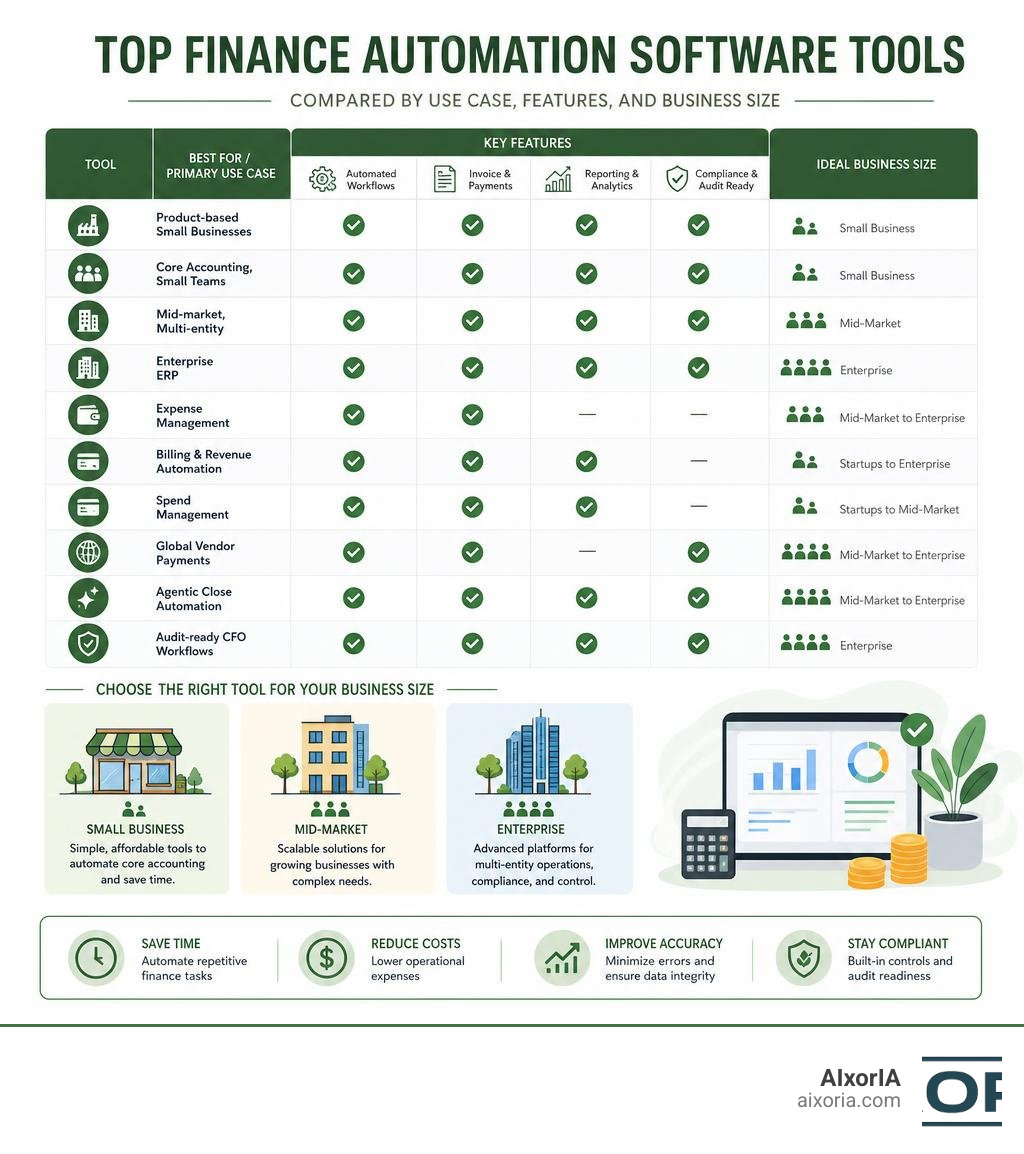
Here’s a quick look at the top options by use case:
| Tool | Best For | Starting Price |
|---|---|---|
| QuickBooks Enterprise | Product-based small businesses | ~$235/month |
| Xero | Core accounting, small teams | From $20/month |
| Sage Intacct | Mid-market, multi-entity | Custom pricing |
| NetSuite | Enterprise ERP | Custom pricing |
| SAP Concur | Expense management | Custom pricing |
| Stripe | Billing and revenue automation | Pay-as-you-go |
| Ramp | Spend management | Free plan available |
| Tipalti | Global vendor payments | From $99/month |
| Maxima AI | Agentic close automation | Custom pricing |
| Maximor | Audit-ready CFO workflows | Custom pricing |
If you’re a small business owner, the honest truth is this: manual finance processes are costing you more than you think. Between chasing invoices, fixing payroll errors, and trying to close the books every month, your team is stuck doing work that software can handle automatically.
Finance automation isn’t just for big corporations anymore. Tools now exist for every budget and business size — from simple invoicing apps to AI-powered platforms that close your books in days instead of weeks.
This guide compares the best tools available in 2026 so you can find the right fit without needing a technical background or a big IT team.
What is Finance Automation and How Does It Work?
At its simplest, finance automation is the use of software to run financial processes with minimal human intervention. Instead of manually copying data from invoices into a spreadsheet or tracking down receipts via email, these tools handle the heavy lifting for you.
Modern finance automation works by connecting several advanced technologies into a single, cohesive system:
- Robotic Process Automation (RPA): Software “bots” handle repetitive, rule-based tasks like moving files or matching purchase orders.
- Artificial Intelligence (AI) & Machine Learning (ML): These tools learn from your historical data to categorize transactions, predict future cash flows, and spot unusual spending patterns.
- Optical Character Recognition (OCR): This technology reads scanned receipts or PDFs and extracts key fields—like vendor name, tax, and total amount—with up to 95% accuracy.
- Cloud-Based Solutions & ERP Systems: By centralizing your data in the cloud, all systems sync in real time, giving you a single source of truth.

The real-world impact of these technologies is massive. Industry data shows that finance automation can cut the time spent on routine tasks by 30-40%. For example, businesses that automate their accounts payable reduce invoice processing costs by up to 81% and cut approval times by 73%. Furthermore, automating payroll processes can reduce payroll errors by up to 67%, saving companies from costly compliance headaches. To dive deeper into how these benefits can transform your bottom line, check out our More info about the benefits of automation.
Evaluating the Best Finance Automation Software Tools
Choosing the right software can feel like navigating a maze. With so many platforms claiming to be the “all-in-one” solution, how do you actually compare them?
When evaluating the best finance automation software tools, we look at three core pillars:
- AI Depth: Is the platform using real, predictive AI that drives ROI, or is it just a basic chatbot?
- Integration Ecosystem: Does it connect natively to your existing systems, or will you spend thousands of dollars building custom APIs?
- Security Standards: Does it protect sensitive financial data with audit trails, role-based access, and SOC 1/2 compliance?
To help you narrow down your search, we have categorized the top market-leading tools into core accounting platforms and specialized AI agents. For a comprehensive review of these tools, take a look at our guide on More info about top tools in 2026.
Core Accounting and the Best Finance Automation Software Tools
For most businesses, the general ledger is the heart of their financial operations. These established platforms serve as the core accounting layer, but they also offer robust automation features:
- QuickBooks Enterprise: The gold standard for product-based small-to-midmarket businesses. It acts like a reliable Toyota Corolla—practical, sturdy, and packed with over 200 reporting templates, advanced pricing, and inventory management.
- Xero: Perfect for small teams and startups. It is highly intuitive, connects seamlessly with hundreds of apps, and offers simple, budget-friendly invoicing.
- Sage Intacct: This is an AICPA-preferred, cloud-native ERP designed for scaling companies. It uses specialized AI agents to handle AP automation, continuous closes, and multi-entity consolidations across different currencies in minutes. Learn more about how it works by visiting Sage Intacct: AI-Powered Accounting & Financial Management Software | Sage US.
- NetSuite: A powerful, comprehensive ERP designed for larger enterprises. While it is incredibly robust, it can be highly complex to customize—sometimes making smaller businesses feel like they have been “jettisoned to Mars” without a map.
- SAP Concur: The undisputed leader in expense management. Large enterprises use it to automate travel bookings, track employee spending, and eliminate manual expense reporting.
- Stripe: Beyond credit card processing, Stripe offers modular billing, tax, and revenue recognition tools. In 2023 alone, Stripe’s revenue recovery tools salvaged more than €3.42 billion for its users. Additionally, 87% of Stripe invoices are paid within 24 hours, and for every €1 spent on Stripe Billing, users recover an average of €9.39.
- Wise Business: A fantastic tool for saving time and money on international payments. It allows businesses to pay global vendors in multiple currencies without the high markup fees of traditional banks.
To see how these platforms fit into a broader corporate strategy, read our breakdown of the More info about corporate finance tools.
Specialized AI and Agentic Close Platforms
While traditional software relies on rigid, static rules, a new wave of “agentic” AI platforms is redefining autonomous finance. These tools build a semantic understanding of your business—your contracts, policies, and GL structure—to execute complex workflows autonomously.
- Maxima: An enterprise-grade platform that unifies disconnected systems into a single context model. It uses agent-prepared, accountant-reviewed workflows to automate journal entries, reconciliations, and flux analysis. Discover more by visiting Maxima | AI Accounting & Financial Close Automation Platform.
- Seapoint: Designed for fast-growing startups, Seapoint connects directly to your bank accounts and Gmail. Its AI automatically extracts invoices from emails, populates payment details, and handles multi-currency payroll templates for global teams. Learn more at Finance automation | Seapoint.
- Maximor: Purpose-built for mid-market and enterprise CFO offices. It addresses a major industry gap: while 96% of CFOs want AI, only 14% trust it. Maximor builds that trust by generating detailed audit trails and reviewer notes by default. Explore their platform at Maximor Brings Autonomous Finance to the CFO Office.
- Accountfy: An AI-first financial management platform featuring an “AI Solutions Builder.” This allows finance teams to build custom operational apps using plain-English prompts, eliminating the need for IT developers. See it in action at Accountfy – The AI First financial management platform.
For a deeper dive into these cutting-edge autonomous tools, read our comprehensive guide on More info about AI-powered finance software.
Key Features and Benefits of Modern Financial Systems
When shopping for the best finance automation software tools, look for these non-negotiable features:
- Real-Time Data Syncing: Your bank transactions, ERP, and billing platforms must sync continuously to prevent discrepancies.
- Robust Fraud Detection: AI algorithms can spot anomalies instantly. For example, Danske Bank achieved a 50% improvement in fraud detection rates and a 60% reduction in false positives after implementing AI-driven automation.
- Automated Tax & Compliance: Modern tools track tax obligations across thousands of jurisdictions. Stripe users, for instance, report that they have reduced the resources allocated to compliance by 50% or more.
- Audit Trails & Role-Based Access: Every transaction should have a clear lineage. This ensures that your books are always audit-ready.
For teams managing complex, multi-source data, we highly recommend reading our AI Finance Tools for Multi Source Reconciliation Complete 2026 Guide to learn how to keep your reconciliations flawless.
How to Choose the Best Finance Automation Software Tools for Your Business
To pick the right tool, start by mapping your current financial workflows and identifying your biggest bottlenecks. If your team spends days manually matching invoices, prioritize AP automation tools like Tipalti or BILL. If you are struggling with complex multi-entity reporting, look toward Sage Intacct or Accountfy.
Always check integration capabilities first. If a tool doesn’t connect natively with your existing ERP or bank, the manual data-entry headache will simply shift elsewhere rather than disappear.
Implementation Best Practices and ROI
To ensure a smooth transition from manual to automated processes, follow these three steps:
- Start Small: Don’t try to automate your entire finance department overnight. Begin with a single process, like expense management or invoice matching, and scale up once your team is comfortable.
- Maintain Human-in-the-Loop Controls: AI is incredibly powerful, but it should prepare work for human review, not run entirely unsupervised. Set up clear checkpoints where a controller or manager must approve high-value transactions.
- Invest in Change Management: Provide proper training. Reassure your team that automation is not a threat to their jobs—it is a tool designed to free them from boring, repetitive tasks so they can focus on strategic work.
By tracking key metrics like processing times and error rates, you will quickly see a return on investment. For more advice on using AI to analyze your financial health post-implementation, read our guide on the More info about financial statement analysis.
Frequently Asked Questions
How does finance automation reduce errors and processing costs?
By eliminating manual data entry. Software automatically extracts invoice data, matches it against purchase orders, and flags duplicates or discrepancies before any money leaves your account. This prevents human typos and drastically cuts down processing times.
Can finance automation tools integrate with existing ERP systems?
Yes. Most modern automation tools connect to popular ERPs (like NetSuite, Sage, and QuickBooks) via native APIs or secure browser agents. This ensures that your financial data flows smoothly between platforms without manual file uploads.
What is agentic accounting automation?
Agentic accounting automation uses specialized AI agents that can reason, make decisions, and execute multi-step workflows (like a month-end close) autonomously. Instead of just following basic “if-this-then-that” rules, these agents understand the context of your business and flag anomalies for human review.
Conclusion
The financial revolution is here, and manual spreadsheets are quickly becoming a thing of the past. By adopting the best finance automation software tools, you can turn your finance department from a bottleneck into a strategic growth catalyst.
At AIxorIA, we help businesses navigate this transition smoothly. We provide custom AI solutions, tool training workshops, practical tutorials, and performance audits designed to empower your team with the latest technology. We explain complex financial tech in simple language, offer affordable services, and back it all up with fast, friendly customer support.
Ready to unlock your team’s full strategic potential? Explore AIxorIA’s custom AI solutions and services today and let us help you build a smarter, automated future.
4 thoughts on “10 Best Finance Automation Software Tools in 2026 (Compared)”