Why Choosing the Right Home Accounting Software Matters More Than You Think
Scr0ll d0wn to D0VVNL0AD
Which accounting software is best for home use? It depends on what you actually need — here’s a quick breakdown:
| Goal | Best Option |
|---|---|
| Pure personal budgeting | Simplifi by Quicken or YNAB |
| Full household bookkeeping | QuickBooks Home |
| Home + side business | Quicken Business & Personal |
| Microbusiness basics (free) | Wave |
| Service-based freelance work | FreshBooks |
| Privacy-first, no subscription | Moneydance or Steward |

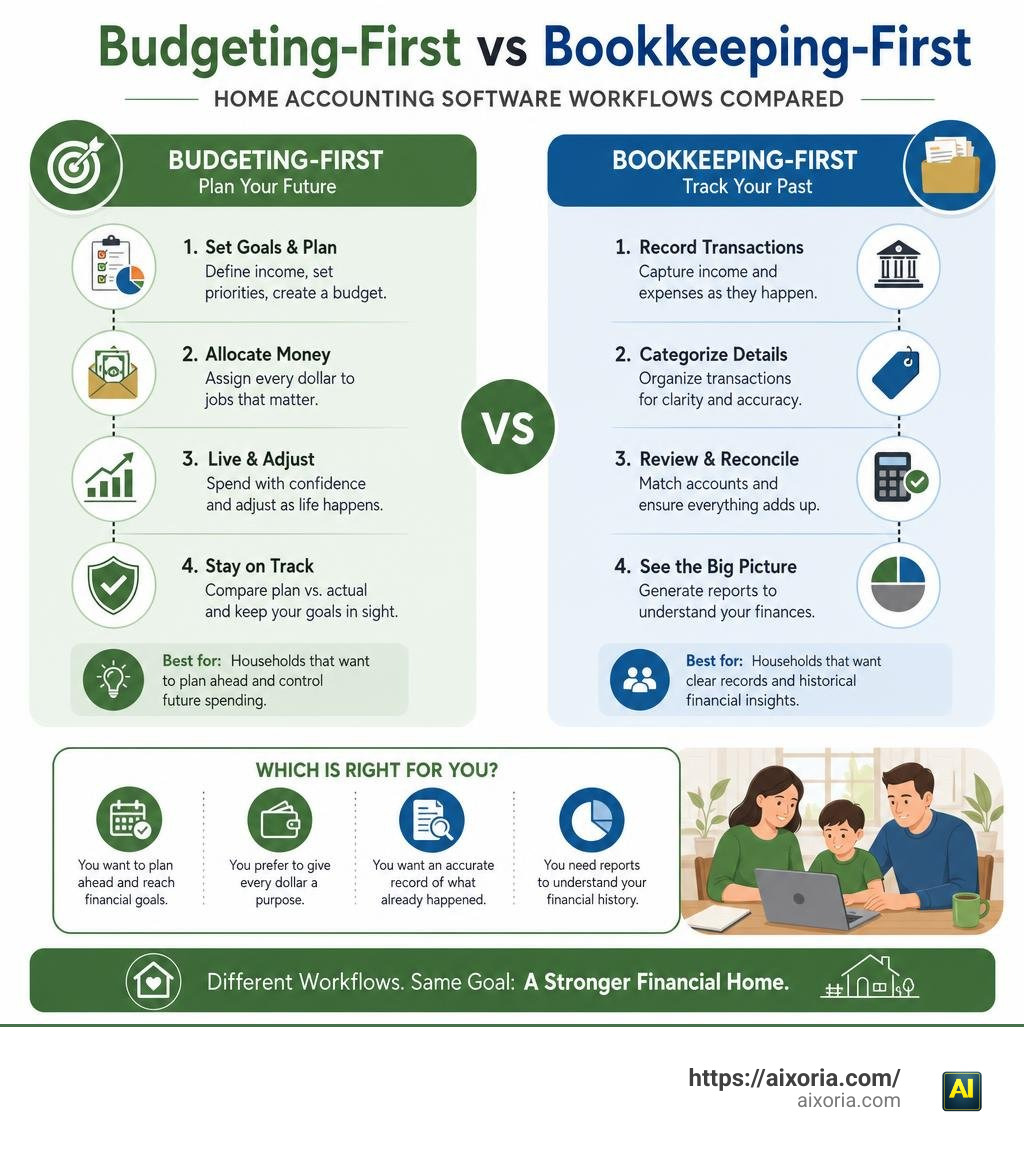
Most people assume managing home finances means picking the most popular app. But the right choice depends on a fundamental question: do you want to plan future spending (budgeting-first) or track past transactions (bookkeeping-first)?
Those are two very different workflows — and picking the wrong one is the most common mistake home users make.
Personal finance software has come a long way. Today’s tools connect directly to your bank, auto-categorize transactions, and generate reports without you needing to understand double-entry accounting. PCMag has been testing these apps for over 30 years, and even their editors note that the best tools are the ones that work for non-experts.
Whether you’re managing a household budget, tracking rental income, or running a small side business from home — there’s a tool built for exactly that.
Key Differences Between Home and Business Accounting Software

When we start looking for tools to manage our money, it is incredibly easy to accidentally buy an enterprise-grade sledgehammer to crack a walnut. We see glowing reviews for corporate financial suites and think, “Perfect, that will keep my household budget squeaky clean!”
But corporate bookkeeping and household money management are entirely different beasts.
The most significant difference lies in the accounting method. True business systems rely on double-entry bookkeeping. In a double-entry system, every single transaction must balance across a general ledger, tracking assets, liabilities, equity, accounts payable, and accounts receivable. If you buy a carton of milk, you do not want to worry about balancing your “grocery asset” account against your “cash liability” ledger. You just want to know that $4.50 left your wallet.
Furthermore, corporate tools are built to handle:
- Complex inventory tracking and cost of goods sold (COGS).
- Payroll management, employee tax withholdings, and benefits.
- Multi-user permissions for accounts department staff.
- Compliance with corporate tax requirements rather than personal tax schedules.
For home use, our financial goals are much more straightforward. We want to track where our money goes, ensure we are saving for the future, and make tax season as painless as possible. Instead of tracking corporate balance sheets, we are tracking household expenses and preparing personal tax schedules (like Schedule A for itemized deductions or Schedule B for interest and dividends).
If you run a small side hustle or manage a rental property, your needs might bridge this gap. But for the vast majority of households, forcing yourself to use a complex business tool will only lead to frustration, abandoned spreadsheets, and a waste of money. If you do happen to run a small venture from your kitchen table, exploring the 7 Easiest Accounting Software for Small Business 2026 can help you find a tool that balances simplicity with business functionality.
Which Accounting Software Is Best for Home Use?
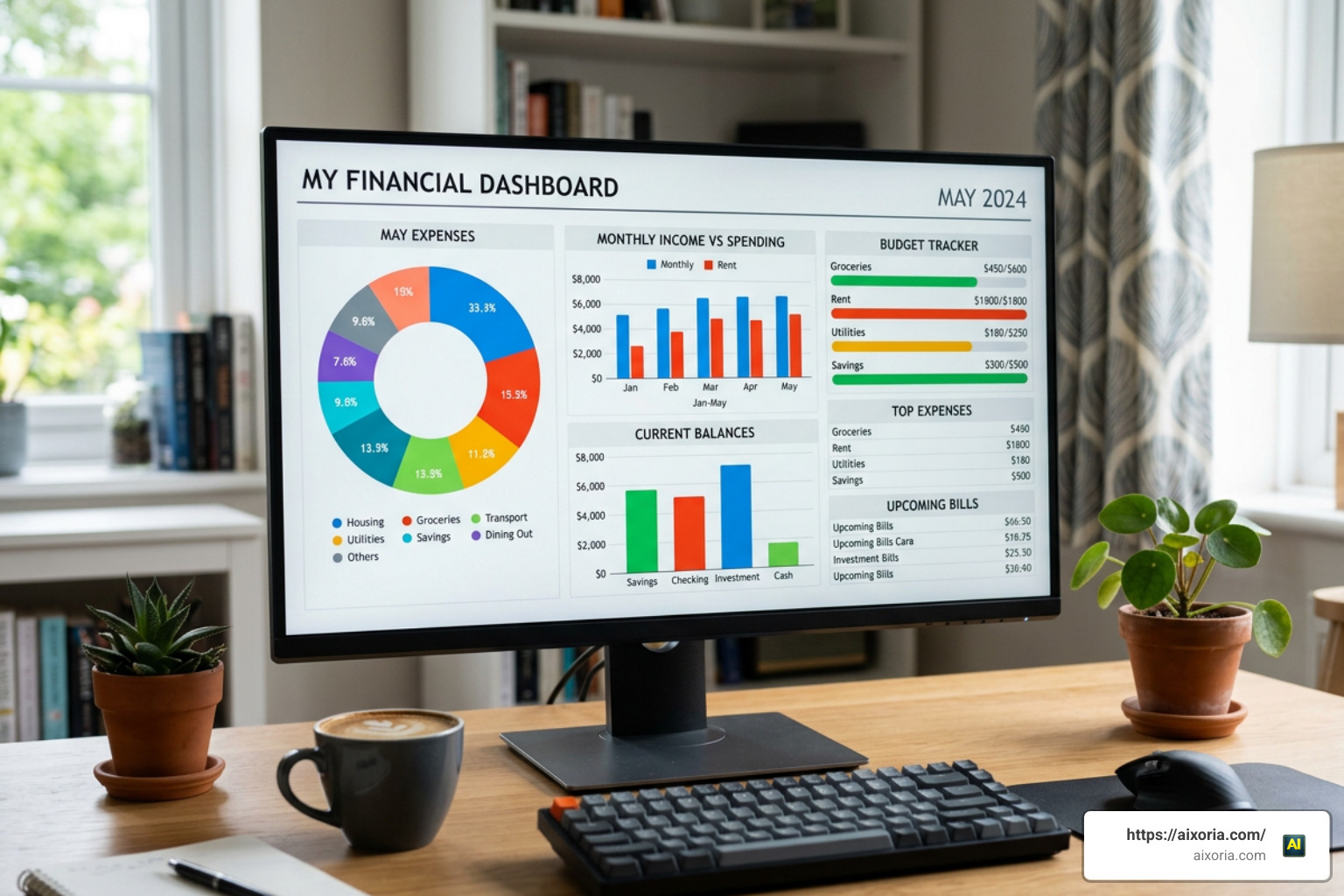
Now that we understand the difference between business ledgers and home budgets, let us look at the top contenders. When evaluating which accounting software is best for home use?, we must look at how these applications align with your personal habits and goals.
According to comprehensive market analyses, such as the Best Home Bookkeeping Software | 2026 Edition , the top-rated software options generally fall into distinct categories based on their design philosophy.
1. Quicken Simplifi (Best Overall for Pure Budgeting)
If your primary goal is to understand your daily cash flow and build a reliable nest egg, Quicken Simplifi App: Reach money goals the smart & easy way | Quicken is the gold standard. For a highly reasonable promotional price of $2.99 per month (regularly $5.99, billed annually), Simplifi connects to more than 14,000 financial institutions.
Instead of forcing you into a rigid, old-school budgeting category system, Simplifi uses a dynamic “Spending Plan.” It automatically subtracts your fixed bills and savings goals from your monthly income, giving you a real-time view of exactly what you have left to spend. It is flexible, beautiful, and incredibly easy to use.
2. YNAB (Best for Strict Savings and Debt Payoff)
YNAB (You Need A Budget) is built entirely around the philosophy of zero-based budgeting. The core rule of YNAB is to “give every dollar a job.” When you get paid, you allocate every single cent to a specific category—whether that is immediate bills, future car repairs, or savings.
While YNAB has a slightly steeper learning curve and requires a shift in financial behavior, it is incredibly effective for anyone trying to claw their way out of debt or save for a major milestone, like a down payment on a home.
3. QuickBooks Home (Best for Detailed Bookkeeping)
For those who prefer a “bookkeeping-first” approach—meaning you want deep transaction reconciliation, ledger-grade tracking, and robust reporting—Best Personal & Home Accounting Software | QuickBooks stands out. While QuickBooks is natively a business tool, many households use its entry-level plans to track complex family offices, manage domestic staff payroll, or organize shared family assets.
4. Moneydance (Best for Offline Privacy)
If you dislike the idea of a cloud-based subscription and want to keep your financial data strictly on your own hard drive, Moneydance is a fantastic desktop alternative. It excels at multi-currency support, investment portfolio tracking, and traditional checkbook-style register management.
5. TaxTank (Best for Australian Users)
If you live down under, managing personal taxes can be notoriously complex. Australia’s Best Personal Accounting Software is specifically tailored to navigate the 6,000+ pages of Australian tax law. TaxTank uses a unique “Tanks” metaphor (separating Work, Property, and Sole Trader income) to calculate your real-time tax position throughout the year, ensuring you maximize your deductions safely.
How to Decide Which Accounting Software Is Best for Home Use
Choosing the right tool is a personal decision. To make the process easier, we recommend focusing on four essential features:
- Transaction Import Quality: Does the software connect reliably to your specific bank and credit card issuers? Manual data entry is the number one reason people abandon their home accounting routines.
- Custom Category Rules: The software should allow you to set up automated rules (e.g., automatically categorizing any transaction containing “Chevron” as “Gas & Fuel”) to save you time.
- Split Transactions: This is a non-negotiable feature for household budgets. If you spend $200 at a big-box retailer, you need to be able to split that single transaction into $150 for “Groceries” and $50 for “Household Supplies.”
- Device Compatibility: If you are a dedicated Apple user, you will want to ensure the software has native desktop and iOS apps. For a curated list of Apple-friendly options, take a look at our guide on the Best Personal Accounting Software for Mac 2026.
Which Accounting Software Is Best for Home Use with a Side Business?
What happens if you are managing a household budget but also running a freelance business, a consulting gig, or a couple of rental properties on the side?
If this sounds like you, using a pure personal budgeting app like YNAB will leave you frustrated because you cannot send professional invoices or track business write-offs. Conversely, using a full business platform like QuickBooks Online can feel like paying for features you do not need.
For this hybrid scenario, Quicken Business & Personal: all-in-one app | Quicken is an exceptional choice. Priced at $129.99 for a one-year subscription for new users, it allows you to manage up to 10 separate business entities alongside your personal household budget under a single subscription. You can send customized invoices, track business expenses, and automatically pre-populate Schedules C, E, and F for tax season.
Other excellent hybrid choices include:
- Wave: A fantastic free option for sole traders. It provides basic double-entry bookkeeping, invoicing, and receipt scanning without a monthly subscription fee. You can read our detailed comparison of how it holds up against the industry giant in our article on QuickBooks vs Wave Which is Better in 2026.
- FreshBooks: If your side business is entirely service-based (like consulting, copywriting, or design), FreshBooks is the ultimate tool. It makes tracking billable hours and sending professional invoices incredibly simple. To explore your invoicing options further, read our guides on What is the Best Invoicing Software for Small Business and the 7 Best Invoicing Software for Sole Traders in 2026.
Cloud-Based vs. Desktop Software for Household Ledgers
One of the most important decisions you will make is whether to host your financial data in the cloud or keep it stored locally on your desktop computer. Both approaches have clear advantages and disadvantages.
| Feature | Cloud-Based Software (e.g., Simplifi, Wave) | Desktop / Self-Hosted (e.g., Moneydance, Steward) |
|---|---|---|
| Accessibility | High (Access from any phone, tablet, or web browser) | Low (Typically restricted to the host computer) |
| Data Privacy | Moderate (Stored on third-party secure servers) | High (You own and control 100% of your database) |
| Bank Syncing | Seamless and automated | Often manual imports (QIF/OFX/CSV) |
| Pricing Model | Recurring monthly or annual subscriptions | One-time purchase or free open-source |
| Backup Management | Automatic cloud backups | Manual backups required to prevent data loss |
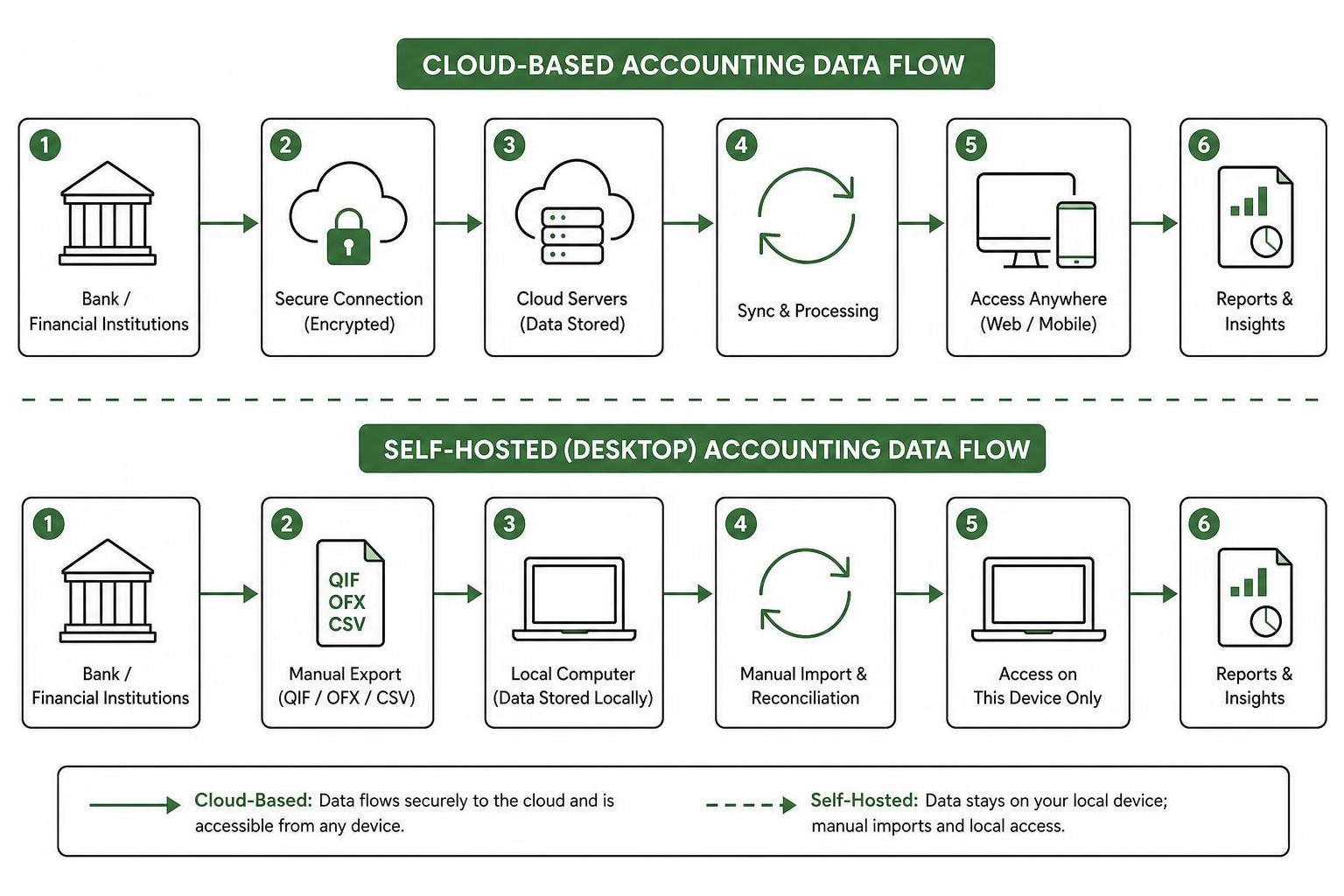
For most busy households, cloud-based software wins because of sheer convenience. Being able to snap a picture of a receipt on your phone while standing in the hardware store parking lot, knowing it will instantly sync with your desktop ledger, is a massive time-saver.
However, for privacy advocates, the cloud comes with trade-offs. You are trusting a third-party company with your bank credentials and detailed spending history.
If you prefer absolute privacy and want to avoid recurring subscription fees, a self-hosted option like $teward: Self-hosted personal finance, without the middleman – 7312.us is an incredible alternative. Steward allows you to run a complete, private financial portal on your own local server. It supports checking, credit cards, loans, and advanced investment portfolio tracking (including DRIP merging) without any ad trackers or middleman fees.
If your home accounting needs also involve tracking real estate investments, you might want to compare how these setups handle property portfolios by reading our analysis on Which Accounting Software Should a Landlord Use in 2026 Best Options Compared.
Frequently Asked Questions about Home Accounting
Can I use free accounting software effectively for home finances?
Yes, absolutely! If you have a straightforward financial situation and do not mind a bit of manual work, free software can be highly effective. Tools like Wave offer robust, free bookkeeping and invoicing. You can also find free desktop downloads, such as Express Accounts Free, which provide basic ledger features at no cost.
However, “free” usually comes with trade-offs. Most free platforms do not offer automated, live bank feeds, meaning you will need to manually download CSV or QIF files from your bank and import them. Free tools also generally rely on community-supported forums rather than dedicated customer support teams when things go wrong.
How does home accounting software integrate with tax preparation tools?
Most modern personal finance applications are designed to make tax season as painless as possible. They allow you to export your categorized transaction history in standard formats like QIF, OFX, or CSV.
These exported files can be directly uploaded into popular tax preparation software (like TurboTax or H&R Block). If you use a hybrid tool like Quicken Business & Personal, the software will even organize your expenses directly into tax categories throughout the year, meaning you can hand a perfectly formatted report straight to your accountant.
What are the common pitfalls to avoid when choosing home financial software?
The most common mistake is overcomplicating your system. If you choose a tool that requires hours of manual reconciliation every week, you will eventually stop using it.
Other pitfalls include:
- Ignoring Data Ownership: Ensure the software you choose allows you to easily export your data in a standard format. If the company goes out of business or raises its prices, you do not want your financial history held hostage.
- Assuming Bank Categories Are 100% Accurate: Automated bank syncing is wonderful, but algorithms make mistakes. Always review your transactions periodically to correct miscategorized items.
- Failing to Separate Accounts: If you run a side business, never mix your personal and business transactions in a single checking account. Even if you use a single piece of software to track both, keep the actual bank accounts strictly separated.
Conclusion
At the end of the day, which accounting software is best for home use? The answer is simple: it is the software that you will actually use consistently.
If you love the feeling of checking your phone and seeing exactly how much “fun money” you have left for the weekend, a cloud-based budgeting tool like Quicken Simplifi is your perfect match. If you are running a bustling side hustle from your kitchen table and need to send invoices while tracking household bills, a hybrid suite like Quicken Business & Personal or Wave will save you hours of administrative headache.
Taking control of your household finances is one of the most productive things you can do for your peace of mind. By automating your bookkeeping, you free up mental bandwidth to focus on what truly matters.
If you are looking to optimize your entire life and business workflow, we invite you to explore our comprehensive guide on https://aixoria.com/what-is-the-best-ai-for-productivity-in-2026/. At Aixoria, we are dedicated to helping you find the smartest tools, systems, and automations to streamline your day, boost your productivity, and secure your financial future. Let us make organization effortless!