Why Finding the Right Mortgage Lender Can Save You Thousands
Scr0ll d0wn to D0VVNL0AD
Knowing how to find the best mortgage lender is one of the most valuable financial skills you can have as a homebuyer — and most people skip it entirely.
Here’s the quick answer:
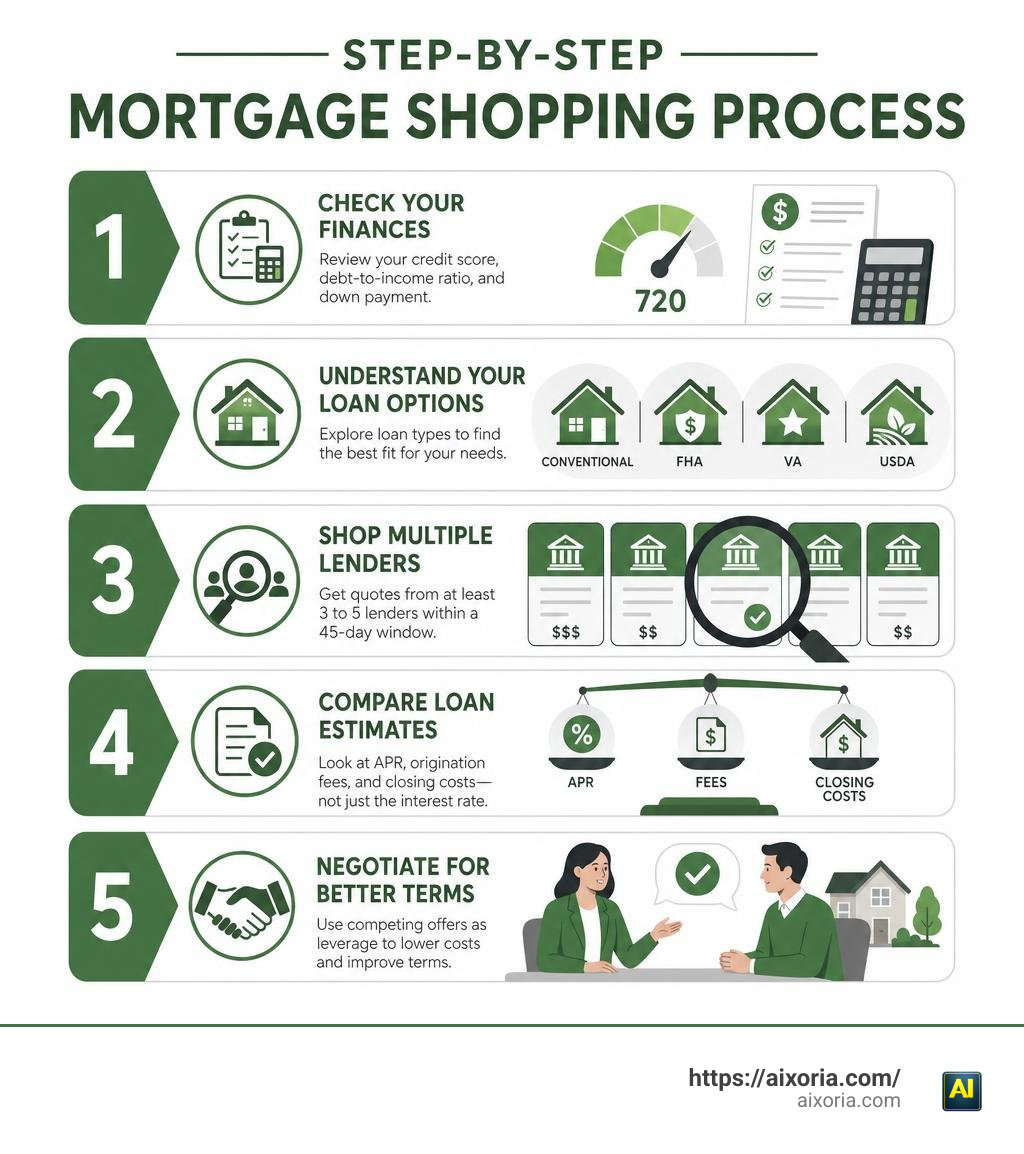
- Check your finances first — know your credit score, debt-to-income ratio, and how much you can put down.
- Understand your loan options — conventional, FHA, VA, or USDA, depending on your situation.
- Shop multiple lenders — get quotes from at least 3 to 5 lenders within a 45-day window.
- Compare Loan Estimates — look at APR, origination fees, and closing costs, not just the interest rate.
- Negotiate — use competing offers as leverage to get better terms.
- Watch for red flags — avoid lenders who pressure you or won’t provide a written Loan Estimate.

Nearly three quarters of all homebuyers need a mortgage to purchase a home. Yet most accept the first rate they’re offered.
That’s a costly mistake. According to Freddie Mac, borrowers who get at least four quotes can save as much as $1,200 per year — and potentially $10,000 to $30,000 or more over the life of their loan.
Think of a mortgage the same way you’d think about buying a car. It’s a retail product. The price and terms are negotiable. The lender who gets your business should earn it.
This guide walks you through exactly how to do that.
How to Find the Best Mortgage Lender: A Step-by-Step Guide
Finding the right mortgage partner is a journey that begins long before you start browsing home listings or attending open houses. If you want to secure the most favorable interest rates and terms, you need a systematic game plan. Treating this process like a structured financial project will yield massive dividends over time.

Step 1: Analyze Your Finances and Credit Score
Before we even think about talking to a mortgage professional, we have to look in the mirror. Lenders will dissect your financial history, so it is vital that you inspect it first to clean up any potential errors or red flags.
Your FICO credit score is the single most influential factor in determining your mortgage interest rate. While FHA loans can accept credit scores as low as 500 with a 10% down payment (or 580 with a 3.5% down payment), conventional loans typically require a minimum score of 620. If you can raise your score to 740 or higher, you will unlock the absolute best tier of interest rates.
To get organized, we recommend using the 2-2-2 rule for document preparation. This means gathering:
- Two years of W-2 forms.
- Two years of complete federal tax returns.
- Two months of your most recent, consecutive pay stubs.
In addition to these, compile your last two months of bank statements for all checking, savings, and investment accounts.
Lenders will also calculate your Debt-to-Income (DTI) ratio. This is the percentage of your gross monthly income that goes toward paying debts like credit cards, student loans, auto loans, and your future housing payment. Most conventional guidelines prefer a housing-only DTI under 28% and a total DTI under 36%, though some programs allow total DTIs up to 43% or even 50% with automated underwriting approvals.
If you want to map out your monthly budget and see how your savings goals align with your future mortgage payment, check out our Best Monthly Savings Calculator In 2026 to model your financial trajectory before you apply.
How to Find the Best Mortgage Lender by Comparing Loan Estimates
Once your financial house is in order, it is time to start rate shopping. The golden rule is to apply to multiple lenders so you can receive official Loan Estimates.
There is a common myth that applying with multiple lenders will destroy your credit score. Fortunately, credit bureaus understand that consumers need to shop around for major loans. Under modern credit-scoring models, all mortgage inquiries made within a 45-day window (or 14 to 45 days depending on the scoring model) are treated as a single hard inquiry. This means you can apply with five different lenders in a three-week span and only experience the credit score impact of one single inquiry.
When you apply, each lender is legally required to provide a standardized, three-page document called a Loan Estimate within three business days of receiving your application. This document is a consumer protection masterpiece because it lists your projected interest rate, monthly payment, closing costs, and loan terms in an identical format across all companies.
To learn more about comparing these options, you can read expert insights on How to Choose a Mortgage Lender or study the credit impacts on How to Choose a Mortgage Lender. For a thorough breakdown of how to organize your search, take a look at How to choose a mortgage lender – NerdWallet.
Key Factors to Consider When Comparing Mortgage Lenders
Comparing mortgage offers is about much more than just looking at the lowest advertised interest rate. Some lenders bait borrowers with a rock-bottom interest rate only to bury thousands of dollars in hidden fees on page 2 of the Loan Estimate. To avoid this trap, you must look at the complete financial picture.

When evaluating any mortgage offer, pay close attention to:
- The Interest Rate: The actual percentage cost of borrowing the principal balance.
- The Annual Percentage Rate (APR): A broader measure of the cost of the loan. The APR includes the interest rate plus other upfront lender charges, mortgage points, and broker fees, expressed as a yearly rate. Always compare the APR to see the true cost of borrowing.
- Origination Charges (Section A): This is where lenders hide their profit. Look closely at Page 2, Section A of your Loan Estimate for application, underwriting, processing, and administrative fees. These are highly negotiable.
- Discount Points: Upfront fees paid directly to the lender at closing in exchange for a lower interest rate. One point equals 1% of your total loan amount. Make sure you calculate the break-even point to see if paying points is actually worth it for your expected time in the home.
Below is a comparison framework to help you understand how these elements interact:
| Feature | Interest Rate | Annual Percentage Rate (APR) | Lender Fees (Origination) |
|---|---|---|---|
| What it represents | The base cost of borrowing the loan principal. | The total annualized cost of the loan, including fees. | Upfront administrative costs charged by the lender. |
| Why it matters | Determines your base monthly principal and interest payment. | Allows for an accurate, apples-to-apples comparison of lenders. | Represents the immediate out-of-pocket cash needed to close. |
| Is it negotiable? | Yes, by shopping around or paying discount points. | Yes, because it changes when interest rates or fees decrease. | Yes, lenders can often waive, reduce, or match competitor fees. |
To understand how to weigh these elements mathematically, we recommend studying How to Choose a Mortgage Lender (2026): The Decision Framework | Wealthvieu.
How to Find the Best Mortgage Lender for Your Specific Loan Type
Different lenders specialize in different types of loans. The ideal lender for a standard conventional loan might not be the best fit if you qualify for a specialized government program.
Let’s look at the primary loan types available:
- Conventional Loans: These are standard mortgages not backed by the federal government. They accounted for about 77% of all mortgage loans originated in 2023. They typically require a credit score of 620 or higher and a down payment as low as 3% to 5%. If your down payment is under 20%, you will have to pay Private Mortgage Insurance (PMI), though this can be removed once you build 20% equity in the home.
- FHA Loans: Insured by the Federal Housing Administration, these are excellent for buyers with lower credit scores or smaller down payments. FHA loans require a 3.5% down payment with a credit score of 580 or higher, or a 10% down payment for scores between 500 and 579. FHA loans carry mortgage insurance premiums (MIP) that usually last for the entire life of the loan.
- VA Loans: Backed by the Department of Veterans Affairs, these are available to active-duty military, veterans, and eligible surviving spouses. They offer 0% down payment options, competitive interest rates, and no monthly mortgage insurance requirement.
- USDA Loans: Backed by the U.S. Department of Agriculture, these loans offer 0% down payment options for low-to-moderate-income buyers purchasing homes in designated rural areas.
To explore which program fits your profile, check out How to Find the Best Mortgage Lender | SoFi and Choose the Right Mortgage Lender: 9-Step Guide.
Understanding your local real estate landscape is also key. For example, if you are looking to buy in a massive, diverse market like Texas—which boasts 12.4 million housing units, a homeownership rate of 62.6%, and a median home list price that recently stood at $354,945—you will find a mixture of national banks, regional credit unions, and local brokers competing fiercely. In such active markets, matching your loan type to a lender’s specific regional expertise can make or break your bid.
Evaluating Lender Communication and Closing Speed
An incredibly low interest rate means nothing if the lender cannot close your loan on time. In a competitive housing market, sellers often prioritize buyers who can close quickly.
According to the ICE Mortgage Monitor, the average closing time for a mortgage is 38 days. However, top-tier, highly efficient digital lenders and local mortgage brokers can often close loans in 21 to 25 days, while larger, traditional brick-and-mortar commercial banks can take 45 to 50 days due to rigid corporate underwriting hierarchies.
When rate shopping, ask each lender about their current processing and underwriting timelines. If you are also in the market for other major consumer loans, you might find it helpful to compare how mortgage timelines and rates align with other financial products. Read our guide on What Are The Best Auto Loan Rates Right Now July 2026 to see how modern lending markets handle digital-first approvals.
Questions to Ask and Red Flags to Avoid
Securing a mortgage is a retail transaction. This means you have the power to negotiate, but you must know what questions to ask to avoid being taken advantage of by unscrupulous players.
Essential Questions to Ask Your Mortgage Lender
When you interview prospective lenders, don’t just let them pitch you. Take control of the conversation by asking these specific questions:
- Are you a direct lender or a mortgage broker? (Brokers shop multiple wholesale lenders, while direct lenders fund loans in-house).
- Is the quoted interest rate the lowest for today, and is it fixed or adjustable?
- What is the loan’s Annual Percentage Rate (APR), and can I get a list of all closing fees?
- How long does your rate lock last, and is there a fee to extend it if our closing is delayed?
- Is there a prepayment penalty on this loan? (Most modern residential mortgages do not have prepayment penalties, but it is always critical to verify).
- Will the underwriting be handled entirely in-house, or do you outsource it?
- How will we communicate throughout the process, and who will be my daily point of contact?
Always ask for a written lock-in agreement once you are satisfied with a rate. A lock-in guarantees your interest rate and points for a set period (such as 30, 45, or 60 days) while your loan is being processed.
Red Flags to Watch Out For When Shopping
While most mortgage professionals are honest, predatory lending practices still exist. Keep your guard up and watch out for these major red flags:
- Bait-and-Switch Tactics: If a lender verbally promises you an incredibly low rate but refuses to send over a standardized Loan Estimate reflecting those terms, walk away.
- Withholding the Loan Estimate: By federal law, a lender must provide a Loan Estimate within three business days of receiving your completed application. If they drag their feet or make excuses, they are violating consumer protection laws.
- Unexplained “Junk” Fees: Look for excessive administrative fees with vague names like “delivery fee,” “archiving fee,” or “ancillary document preparation fee.” A reputable lender should be able to explain and justify every single fee listed in Section A.
- High-Pressure Sales Tactics: If a loan officer pressures you to sign immediately or claims a rate is “only valid for the next hour,” they are prioritizing their commission over your financial health.
- Exposing “Overages”: In some cases, loan officers or brokers are allowed to keep “overages”—the difference between the lowest price the lender actually charges for a loan product and any higher price the borrower agrees to pay. Always ask: “Are you giving me the absolute lowest wholesale rate available for my credit profile today?”
Just as you would shop around for the best terms on a mortgage to protect your hard-earned cash, you should do the same for other major household expenses. If you want to protect your new investment without overpaying, take a look at our analysis of the Top 5 Affordable Auto Insurance Companies to see how shopping around pays off across all financial products.
To help visualize how the shopping and negotiation process flows, refer to this sequence:

Frequently Asked Questions about Mortgage Lenders
What is the difference between a mortgage broker and a direct lender?
A direct lender (such as a commercial bank, credit union, or online nonbank lender) originates, processes, underwrites, and funds the loan in-house. When you work with a direct lender, you are limited strictly to their proprietary loan products and pricing structures.
A mortgage broker acts as an independent intermediary or “matchmaker” between you and multiple wholesale lenders. Brokers do not fund loans themselves. Instead, they shop your application around to various wholesale sources to find the best rate and program for your specific profile.
Brokers are compensated either by a fee paid by the borrower at closing or through a yield-spread premium paid by the wholesale lender, which is typically built into the interest rate. By law, brokers cannot receive compensation that varies based on the loan’s interest rate or terms, which protects you from rate markup schemes.
How does getting pre-approved affect my credit score?
Getting pre-approved requires a lender to run a hard credit pull, which can temporarily lower your credit score by a few points (typically fewer than five points).
However, credit bureaus encourage rate shopping. As long as you complete all of your mortgage pre-approval applications within a 45-day window, credit scoring models will consolidate all of those hard inquiries and treat them as a single credit check. This allows you to shop around risk-free to find the best deal.
What is the 2-2-2 rule for mortgage pre-approval?
The 2-2-2 rule is a simple, highly effective framework for organizing the essential financial documents you need to secure a mortgage pre-approval. It stands for:
- 2 years of W-2 forms (to prove stable employment history).
- 2 years of federal tax returns (crucial for verifying self-employment income, write-offs, or secondary income streams).
- 2 months of consecutive pay stubs (to verify your current monthly earnings and tax withholdings).
Having these documents ready in a digital folder before you apply will dramatically speed up your pre-approval process and show lenders you are a serious, organized borrower.
Conclusion
Securing the best mortgage lender is not about luck; it is about preparation, comparison, and active negotiation. By treating your mortgage as a retail product, gathering multiple Loan Estimates, and making lenders compete for your business, you can save tens of thousands of dollars over the lifetime of your home loan.
At Aixoria, we are dedicated to helping you make smarter financial decisions through cutting-edge analysis and highly practical tools. If you are a freelancer or self-employed worker trying to model your variable income before approaching a mortgage underwriter, use our Best Freelance Hourly Rate Calculator In 2026 to map your gross earnings.
To stay ahead of the latest trends in finance, real estate technology, and artificial intelligence tools designed to simplify your life, explore our AI Updates and Financial Tools category page today!