What to Do If You’ve Already Accepted More Student Loan Money Than You Need

If you’re wondering who do you contact if you’ve already accepted more loan money than you need, here’s the short answer:
Contact your school’s financial aid office first. They are the only ones who can reduce or cancel your accepted loan amount. Your loan servicer handles repayment — they cannot change how much you borrowed.
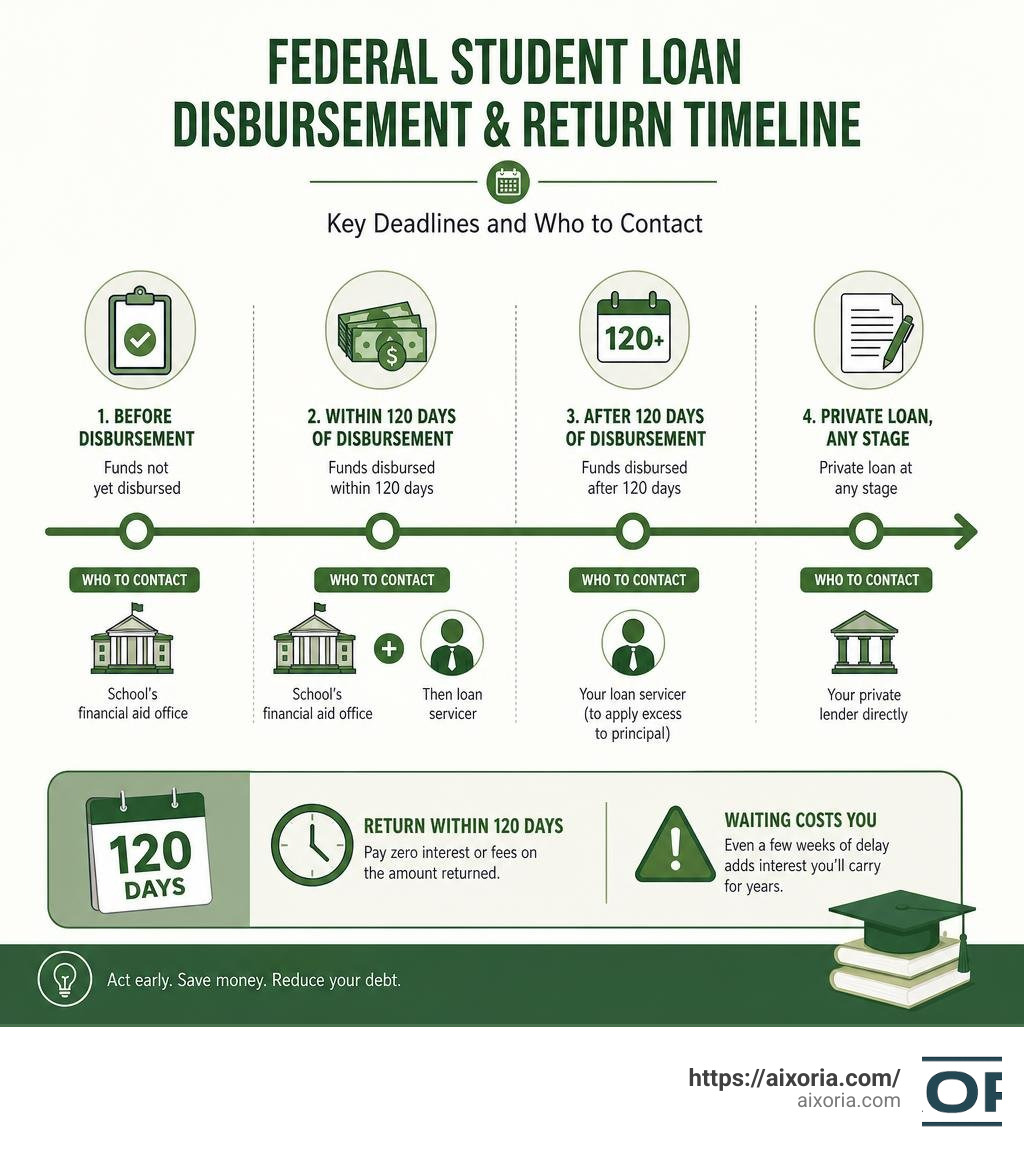
Here’s a quick breakdown based on your situation:
| Situation | Who to Contact |
|---|---|
| Funds not yet disbursed | School’s financial aid office |
| Funds disbursed within 120 days | School’s financial aid office, then loan servicer |
| Funds disbursed after 120 days | Your loan servicer (to apply excess to principal) |
| Private loan, any stage | Your private lender directly |
It happens more often than you’d think. Around 1 in 5 federal student loan borrowers end up with more loan money than they actually need. Sometimes a scholarship comes through after you’ve already accepted loans. Sometimes you just overestimated your expenses.
The good news? You have options. And the sooner you act, the better.
Returning unused federal loan funds within 120 days of disbursement means you pay zero interest or fees on the amount returned. Borrowers who do this save an average of $1,200–$2,500 in long-term debt. Waiting costs you money — even a few weeks of delay adds interest you’ll carry for years.
This guide walks you through exactly what to do, who to call, and what deadlines to watch.
Who Do You Contact If You’ve Already Accepted More Loan Money Than You Need?
When you realize you have accepted more student loan money than you actually need, it is easy to feel a bit panicked. You might worry that you are locked into a massive debt obligation or that you will have to pay heavy penalties just to give the money back. Take a deep breath: the process is highly standardized, but your success depends entirely on contacting the correct entity at the right time.
According to financial aid data, over 60% of students who contact their school’s financial aid office after accepting excess loans successfully reduce or cancel the overaward before the funds are actually disbursed. This is why timing is everything.
To resolve this issue, you must understand the distinction between your school’s financial aid office and your loan servicer.
- Your School’s Financial Aid Office: This office is responsible for calculating your financial need, creating your aid package, certifying your student loans, and initiating the disbursement of funds. They have the administrative power to modify, reduce, or cancel your loan package before the money is sent out—and for a limited window of time immediately after.
- Your Loan Servicer: Once the loan funds are fully disbursed and the school’s administrative window closes, the Department of Education assigns your loan to a federal loan servicer (such as Nelnet, Aidvantage, or MOHELA). The servicer handles the billing, repayment plans, and general customer service for your debt. They cannot change your original award package, but they can process early principal payments.
If you are trying to figure out your next steps, we highly recommend consulting resources like the FSA Handbook on Overawards and Overpayments to understand how federal regulations govern these adjustments. Additionally, community discussions on platforms like Brainly confirm that contacting your school’s financial aid office is universally the first and most effective step. For further reading on the contact process, you can read the helpful guides on Manometcurrent and Call Experts.
Who Do You Contact If You’ve Already Accepted More Loan Money Than You Need Before Disbursement?
If the loan funds have not yet been disbursed—meaning the money has not been applied to your school tuition account or refunded to your personal bank account—your school’s financial aid administrator is your sole point of contact.
At this stage, your loan is still technically in the “packaging” phase. The financial aid office can easily modify your award letter. If you accepted $15,000 in Stafford or Direct loans but realize you only need $10,000, the administrator can log into their system, cancel the pending disbursement, and issue a revised loan certification for the lower amount.
To understand how schools calculate your financial need and package your loans in the first place, you can review the official FSA Guidance on Need and Packaging. This document highlights how schools must adjust your aid packages if your financial circumstances change before the money is delivered.
Who Do You Contact If You’ve Already Accepted More Loan Money Than You Need After Funds Are Disbursed?
If the loan money has already been disbursed, the contact process becomes slightly more nuanced. First, look at the calendar.
If you are within 120 days of the disbursement date, your first contact should still be your school’s financial aid office. Under federal law, schools have the ability to return disbursed federal loan funds directly to the Department of Education through the federal G5 processing system. When the school processes this return, it is treated as a loan cancellation, meaning any interest accrued on that portion of the loan and any associated loan origination fees are completely wiped out.
If you are more than 120 days past the disbursement date, your school can no longer process a loan cancellation. At this point, you must contact your loan servicer. Your servicer is the private company contracted by the Department of Education to manage your account.
To find out who your loan servicer is, you should:
- Log into your account on StudentAid.gov.
- Navigate to your dashboard to view your active loan details.
- Locate the servicer assignment and contact information.
- Alternatively, you can check your Master Promissory Note (MPN) or look up your loan history on the National Student Loan Data System (NSLDS).
When you contact your servicer, you will need to arrange a payment to return the excess funds. That after the 120-day mark, this payment will be treated as a standard principal payment rather than a cancellation, meaning you will be responsible for any interest that accrued during those four months. For more details on what happens to your loan status after disbursement, check out the FSA Loan Follow-up Procedures.
Step-by-Step Guide to Returning Federal Student Loans

Returning federal student loans requires careful attention to timelines. If you act quickly, you can save yourself a significant amount of money in interest and administrative fees.
If you are currently navigating federal loan issues or looking into historical loan discharge options, you may also want to read our guide on the Federal Student Loan Discharge Lawsuit 2026: Who Qualifies & How to Win to stay fully informed on your rights as a borrower.
Here is the exact step-by-step process for returning federal student loans, divided by the critical 120-day window.
Returning Direct Loans Within the 120-Day Window
If you received a refund check or a direct deposit of excess federal loan funds within the last 120 days, follow these steps to return the money interest-free:
- Calculate the Exact Excess: Look at your bank account and your school billing statement. Determine the exact dollar amount of the loan money you do not need.
- Contact Your Financial Aid Office: Send an email or schedule an in-person meeting with a financial aid administrator. State clearly: “I have received an excess disbursement of my Direct Loan, and I want to cancel [Insert Dollar Amount] of the loan.”
- Submit a Written Request: Most schools require you to fill out a brief loan adjustment or cancellation form. This serves as official documentation of your request.
- Return the Funds to the School:
- If the school issued you a physical refund check and you haven’t cashed it, you can often return the uncashed check directly to the bursar’s office.
- If the funds were direct-deposited, you will need to write a personal check to the school or authorize an electronic transfer from your bank account back to the university’s billing office.
- Confirm the Cancellation: The school will return the funds to the federal government via the G5 system. Within a few weeks, log into StudentAid.gov to verify that your principal balance has been reduced by the returned amount and that the corresponding origination fees have been adjusted.
Returning Federal Loans After 120 Days
If you missed the 120-day window, you cannot “cancel” the loan. However, you can still return the money to prevent it from compounding interest over the life of your loan. Borrowers who return excess funds within 30 days of disbursement save an average of 8–12% in total interest costs over the life of the loan. Even after 120 days, making an immediate lump-sum payment is highly beneficial.
Here is how to do it:
- Identify Your Servicer: Log into StudentAid.gov to find your servicer (e.g., Nelnet or Aidvantage).
- Log Into Your Servicer Portal: Create or log into your account on your specific servicer’s website.
- Initiate a Payment: Make a manual payment using the excess funds sitting in your bank account.
- Specify “Principal Payment”: When submitting the payment, you must explicitly instruct the servicer to apply the payment to the principal balance of your loan, rather than counting it as an advance on your next scheduled monthly payments. Most portals have a checkbox or dropdown menu for “Custom Payment Application.”
- Monitor Your Account: Keep an eye on your loan balance to ensure the payment is applied correctly. Your total outstanding debt should drop immediately, though you will still be responsible for the interest that accrued between the disbursement date and the date of your payment.
If you are looking for alternative funding options or want to compare how different loan structures impact your repayment, read our comprehensive Advantage Student Loan Review 2026: Rates, Eligibility & Pros Explained.
How to Handle Excess Private Student Loan Funds
Private student loans are entirely different beasts compared to federal student loans. They are issued by private financial institutions (such as banks, credit unions, or online lenders) rather than the federal government. Consequently, they do not follow the uniform rules laid out in the Federal Student Aid Handbook.
When you accept a private loan, the lender verifies your enrollment and cost of attendance with your school through a process called school certification. If you end up with excess private loan funds, you must deal directly with your private lender’s specific terms.
Below is a comparison of federal and private student loan return policies:
| Feature | Federal Student Loans | Private Student Loans |
|---|---|---|
| Primary Contact | Financial Aid Office (first 120 days) | Private Lender / Bank |
| Zero-Interest Return Window | Up to 120 days | Varies (often 14 to 30 days, if allowed at all) |
| Origination Fee Refund | Yes (within 120 days) | Rarely |
| Prepayment Penalties | Never | Rarely (but check your contract) |
| Interest Accrual | Paused/Subsidized for some loans | Accrues immediately upon disbursement |
Returning Unused Private Loan Money
If you have excess private student loan money, you must act fast. Because private loans usually begin accruing interest the moment they are disbursed, keeping the money in your bank account is costing you cash every single day.
- Review your Promissory Note: Read the fine print of your loan agreement. Look for sections labeled “Loan Cancellation,” “Right to Cancel,” or “Prepayment.”
- Contact the Lender Directly: Call your private lender’s customer service department immediately. Ask them: “What is your policy for returning unused loan funds, and do you have an interest-free cancellation window?”
- Inquire About School Return Policies: Some private lenders will allow the school to return the funds directly to them if you are still within the drop/add period of the semester. Ask if you should route the return through your bursar’s office.
- Make an Immediate Prepayment: If your lender does not offer a cancellation window, use the excess funds to make a lump-sum payment immediately. While you might have to pay a few dollars in interest for the days you held the money, paying it off now prevents that principal from compounding over the next 10 to 15 years.
- Keep Your Cosigner Informed: If you used a cosigner to secure your private loan, keep them in the loop. Reducing your principal balance lowers their financial risk as well.
Frequently Asked Questions About Excess Student Loans
Managing student loans can feel like learning a foreign language. To help you navigate the process, we have answered some of the most common questions regarding excess student aid.
What is the difference between an overaward and an overpayment?
While they sound identical, “overaward” and “overpayment” refer to two distinct stages of financial aid discrepancies:
- Overaward: This occurs when your total packaged financial aid (grants, scholarships, and loans) exceeds your school’s official Cost of Attendance (COA) or your calculated financial need. An overaward is an administrative issue that happens before or during packaging. For example, if you receive an unexpected outside scholarship after your loans are certified, your aid package must be adjusted to eliminate the overaward. This is usually resolved by reducing your unsubsidized loans first.
- Overpayment: This happens when you have actually received more federal student aid funds than you are legally eligible to keep. This often occurs if you withdraw from classes early in the semester, fail to begin attendance, or if your financial aid eligibility changes due to a FAFSA verification correction. If an overpayment is caused by a school error, the school is liable. If it is caused by student misreporting, the student is liable for repaying the excess funds. Unresolved overpayments over $25 must be reported to the National Student Loan Data System (NSLDS) and can cause you to lose your eligibility for future federal aid.
What documentation should I keep when returning loan funds?
Whenever you are modifying financial contracts or returning thousands of dollars, paper trails are your best friend. We recommend keeping a dedicated digital or physical folder containing:
- Date, Time, and Name: Keep a written log of every phone call or in-person meeting. Note the name of the financial aid advisor or loan servicer representative you spoke with.
- Written Requests: Keep copies of any loan reduction or cancellation forms you submit to your school.
- Receipts and Confirmations: Save the transaction receipts showing you returned the money to the school or paid your loan servicer.
- Updated Award Letters: Keep copies of both your original and your revised financial aid award letters.
- Portal Screenshots: Take screenshots of your student portal and your StudentAid.gov dashboard before and after the adjustment is processed.
How can I avoid accepting too much loan money in the future?
The easiest way to deal with excess loan money is to avoid borrowing it in the first place! Here are a few proactive steps you can take:
- Calculate Your True Expenses: Do not rely solely on your school’s estimated Cost of Attendance. Create a personalized budget that details your actual rent, food, books, and personal expenses. Often, you can live more cheaply than the school’s estimate.
- Practice “Partial Acceptance”: When you receive your financial aid award letter, you do not have to click “Accept All.” You have the legal right to accept only a portion of the loans offered. If you are offered $10,000 but only need $4,000, type in “$4,000” in the acceptance box.
- Borrow Semester-by-Semester: If you are unsure of your spring expenses, you can accept only your fall loans first. You can always request additional federal loans later in the academic year if your financial situation changes.
- Aim for the 8% Rule: The Consumer Financial Protection Bureau suggests keeping your total student loan payments at or below 8% of your expected gross monthly salary after graduation to minimize the risk of delinquency and default.
Conclusion
Managing student debt requires a proactive approach, especially when you find yourself with more funds than necessary. By contacting your school’s financial aid office early, utilizing the 120-day interest-free return window, and keeping meticulous records, you can keep your student debt as low as possible.
At Aixoria, we are dedicated to helping you navigate your financial journey with clarity and confidence. Whether you are managing student loans, planning for college, or looking for modern financial strategies, we are here to support your financial wellness.
To stay up to date on the latest financial tools, regulatory changes, and smart debt management strategies, Learn more about AI updates and financial tools on our platform today!