How Much Does Cyber Insurance Typically Cost for a Small Business?

How
Scr0ll d0wn to D0VVNL0AD
much does cyber insurance typically cost for a small business? Across the United States in 2026, the national average premium sits at $129 per month, or $1,552 annually. However, many small operations with straightforward risk profiles can secure foundational policies starting at $83 per month ($999 annually) for a standard $1 million aggregate annual policy limit.
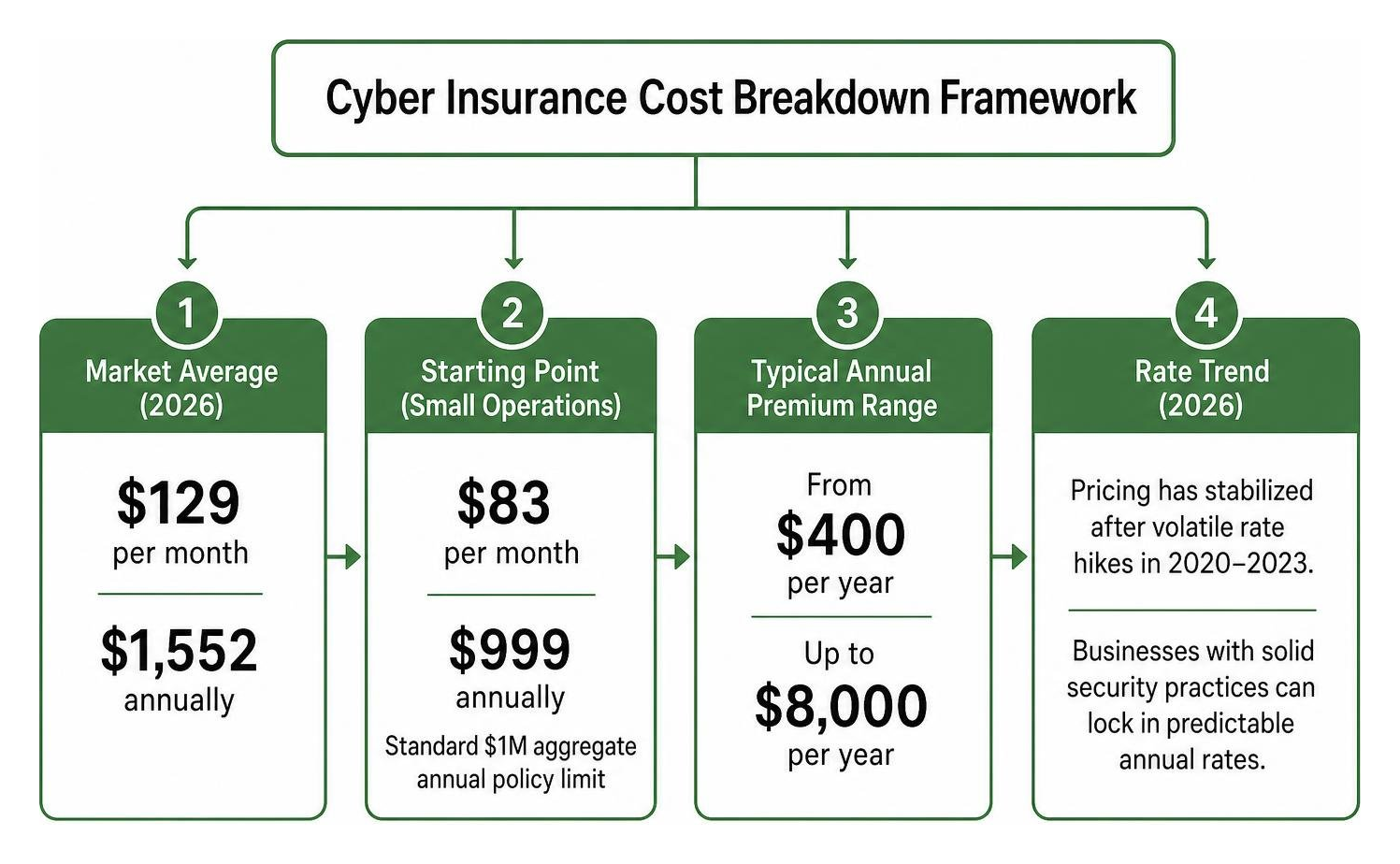
Pricing has stabilized significantly in 2026 after the volatile rate hikes experienced between 2020 and 2023. Insurers have refined their underwriting models, allowing businesses with solid security practices to lock in predictable annual rates. Depending on your operational footprint, annual premiums generally span from $400 for micro-enterprises up to $8,000 for mid-sized operations managing complex digital infrastructure.
How Much Does Cyber Insurance Typically Cost for a Small Business by Company Size and Revenue?
Company size—measured primarily by employee headcount and annual revenue—is one of the strongest variables in premium calculations. As a business hires more staff, its attack surface expands. More employees mean more email accounts, access credentials, and potential entry points for social engineering and phishing campaigns.
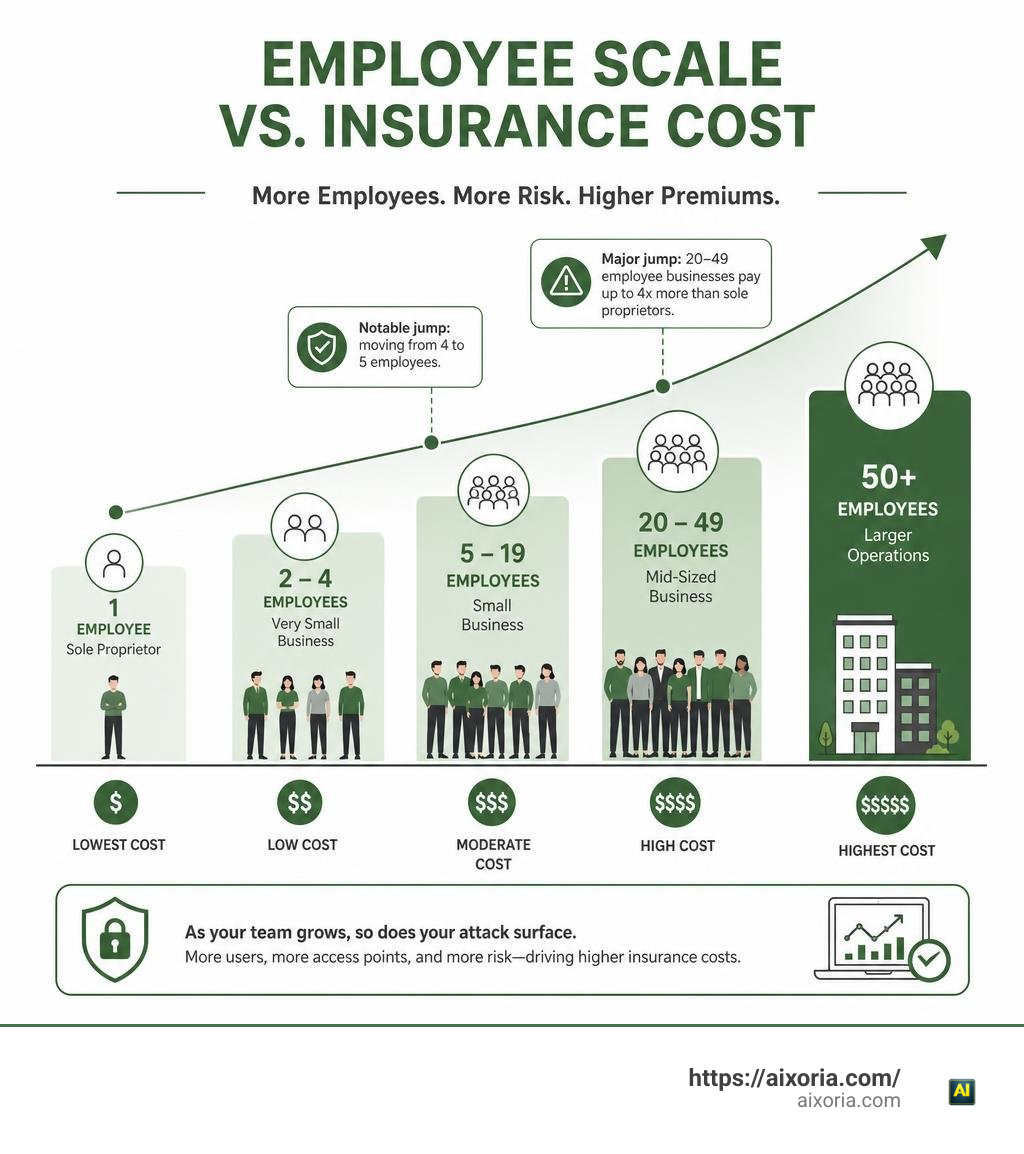
A notable pricing jump occurs when a business grows from 4 to 5 employees. At four or fewer team members, security controls are frequently informal. Underwriters recognize that at 5 employees, informal protocols fail, requiring formal access controls and documented security policies.
Another major pricing threshold happens between 20 and 49 employees. Companies in this bracket pay up to four times more than sole proprietors because ransomware actors actively target mid-sized businesses—organizations with sufficient revenue to pay extortions but often lacking enterprise-grade 24/7 security operations centers.
| Business Size | Employee Count | Annual Revenue | Average Annual Premium ($1M Limit) |
|---|---|---|---|
| Sole Proprietor / Freelancer | 1 | Under $500k | $360 – $900 |
| Micro Business | 2 – 4 | $500k – $2M | $750 – $1,350 |
| Small Business (Growth Stage) | 5 – 19 | $2M – $5M | $1,200 – $2,400 |
| Mid-Market Small Business | 20 – 49 | $5M – $20M | $1,740 – $4,200 |
| Upper Small Business | 50 – 250 | $20M – $50M | $2,500 – $8,000+ |
If you are operating as a single-person business, read our guide on the best business insurance for sole proprietors in 2026 to evaluate appropriate baseline protections.
How Much Does Cyber Insurance Typically Cost for a Small Business Across Different Industries?
Industry classification dictates the inherent sensitivity and recovery cost of the data you store. Insurers assess risk surcharges or grant credits based on historical claims data per sector.
- Healthcare & Medical Practices: Healthcare providers pay some of the highest premiums, running 2 to 4 times above national benchmarks ($3,500 to $15,000+ per year). High costs stem from mandatory HIPAA regulatory fines and sensitive Protected Health Information (PHI) carrying breach recovery costs exceeding $400 per record.
- Technology Services & Managed IT: Tech firms and software developers face elevated rates, averaging $157 per month ($1,882 annually). Because IT providers have administrative access to client networks, a single security flaw can trigger widespread third-party liability.
- Financial Services & Accounting: Financial firms manage high-value records and wire transfers, making them prime targets for Business Email Compromise (BEC). Standalone policies average $1,200 to $3,500 per year.
- Retail & E-Commerce: E-commerce merchants pay median annual premiums of around $1,500. Their main exposures center around credit card processing (PCI-DSS compliance) and payment gateway business interruption.
- Low-Risk Sectors (Agriculture, Recreation, Trades): Organizations in agriculture ($52/month average) or local recreational services face lower digital exposure, enjoying rates up to 38% below national benchmarks.
To inspect detailed sector breakdowns, explore the report on Cyber Insurance Cost in 2026: What Small & Mid-Size Businesses Actually Pay — Real Premiums by Industry.
Key Factors Influencing Cyber Insurance Premiums
Beyond size and industry, underwriters evaluate geographic regulations and individual loss history when setting rates.
Geographic location creates noticeable rate variations due to state-level regulatory enforcement and data privacy legislation:
- High-Cost Jurisdictions: States with strict data privacy frameworks—such as California (CCPA/CPRA), New York (SHIELD Act), and Illinois—impose stricter notification rules and private right-of-action clauses. Businesses operating in New York pay premiums up to 51% above the national average, while California operations see 10% to 24% regional markups. If you operate on the West Coast, refer to our business insurance for self-employed in california 2026 guide.
- Low-Cost Jurisdictions: States like Iowa (29% below national median), North Dakota, Ohio, South Dakota, and Wyoming (24% below national median) benefit from lower legal defense costs and fewer state-level mandates.
Prior claims history also directly impacts your rate. Filing a cyber insurance claim usually results in a 20% to 50% renewal rate increase lasting 3 to 5 years. Severe incidents without clear evidence of security remediation can even lead to outright non-renewal.
To optimize your policy spend, see our breakdown of 10 proven ways to reduce your commercial insurance premium.
Security Controls That Lower Annual Premium Costs
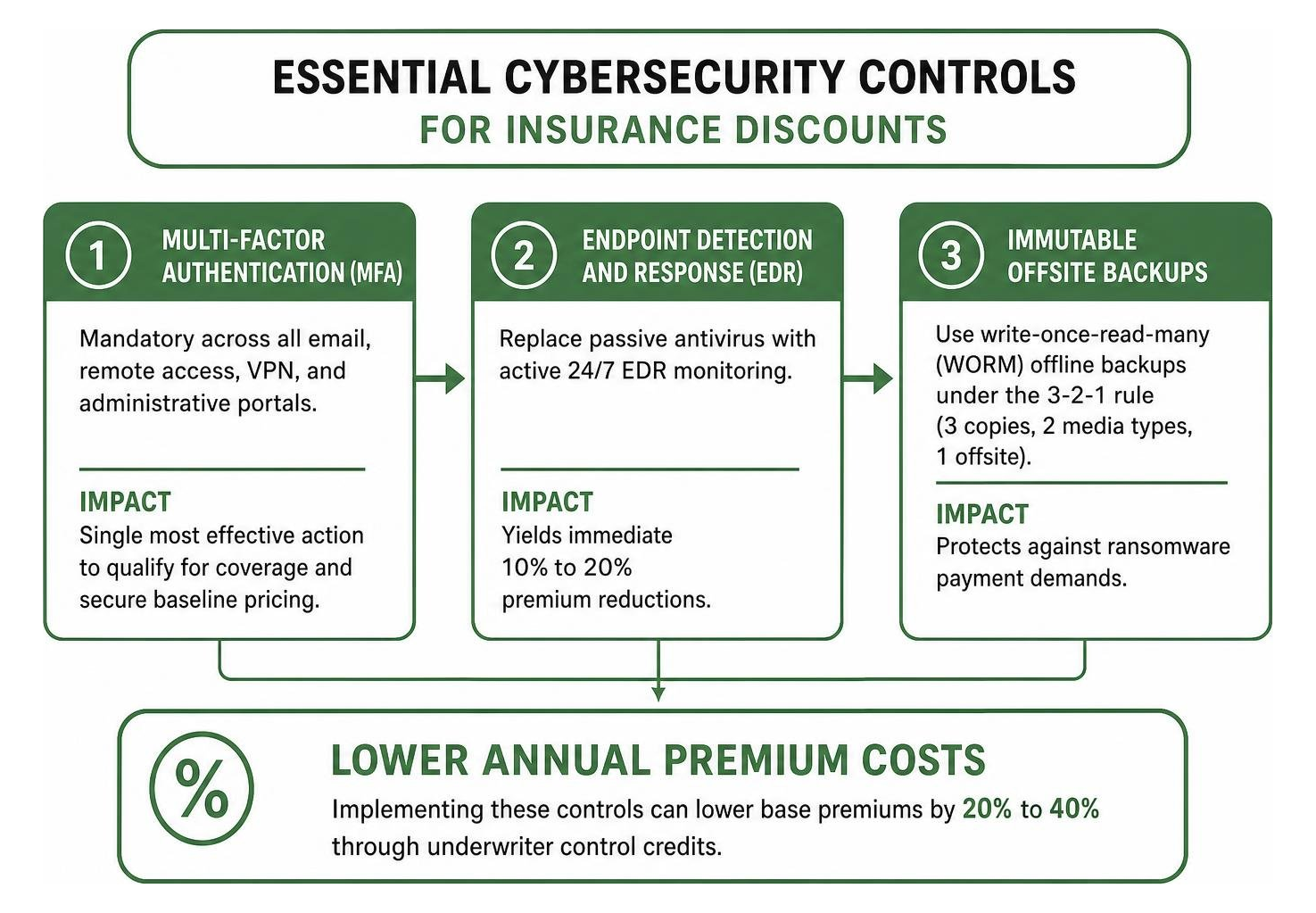
Up to 73% of small businesses initially struggle with carrier risk assessments due to absent controls. Implementing targeted security measures can lower base premiums by 20% to 40% through underwriter control credits.
Key controls include:
- Multi-Factor Authentication (MFA): Mandatory across all email, remote access, VPN, and administrative portals. Implementing MFA is the single most effective action to qualify for coverage and secure baseline pricing.
- Endpoint Detection and Response (EDR): Replacing passive antivirus with active 24/7 EDR monitoring yields immediate 10% to 20% premium reductions.
- Immutable Offsite Backups: Utilizing write-once-read-many (WORM) offline backups formatted under the 3-2-1 rule (3 copies, 2 media types, 1 offsite) protects against ransomware payment demands.
- Security Awareness Training: Documented phishing simulations and annual staff training can reduce policy costs by 5% to 15%.
- Patch Management: Promptly applying software updates closes critical entry points that active carrier scans check prior to binding policies.
To compare affordable coverage across top carriers, visit our resource on who has the cheapest business insurance in 2026 compare rates.
Coverage Types, Policy Structures, and Standard Exclusions
Understanding the distinction between first-party and third-party coverage prevents coverage gaps during an incident.

- First-Party Coverage: Covers direct financial losses incurred by your business. This includes forensic investigations, customer notification costs, credit monitoring services, public relations management, extortion payment negotiation/ransom funds, and business interruption losses (restoring lost operating income during downtime).
- Third-Party Coverage: Protects against legal claims brought by external parties. It covers legal defense costs, settlements, regulatory penalties, and court judgements if clients or partners sue your business for failing to safeguard their data.
Policy Exclusions & Sublimits
Standard cyber policies exclude several specific scenarios:
- Nation-State War Clauses: Acts of declared or undeclared cyber warfare by sovereign nations are routinely excluded.
- Unpatched System Exploits: Losses resulting from known vulnerabilities left unpatched for extended periods following vendor notifications can lead to claim denials.
- Intentional Internal Acts: Criminal acts committed directly by business owners or senior executives.
- Ransomware Sublimits: Insurers frequently impose sublimits (e.g., capping extortion payouts at $250,000 on a $1M aggregate policy) or require 10% to 20% co-insurance retention.
Standalone Cyber Policies vs. Business Owner’s Policy (BOP) Add-Ons
Small businesses usually choose between two policy delivery structures:
Frequently Asked Questions About Small Business Cyber Insurance
Does a standard general liability policy cover cyber attacks?
No. Commercial General Liability (CGL) policies cover physical property damage and third-party bodily injury. Modern CGL forms contain explicit cyber exclusions that leave data loss, system outages, and electronic extortion unprotected. For details on general liability structures, check out how much is gl insurance for a small business in 2026.
How much cyber insurance coverage does a typical small business need?
A $1 million aggregate annual limit with a $2,500 deductible is the standard benchmark for small businesses generating under $5 million in annual revenue. If your organization stores over 10,000 sensitive records (such as SSNs, credit card numbers, or medical history) or maintains contractual client requirements, select limits between $2 million and $5 million.
How does filing a cyber insurance claim affect future renewal rates?
Filing a claim typically increases renewal premiums by 20% to 50% for 3 to 5 years. If the breach resulted from missing basic controls (such as disabled MFA), underwriters may require verified remediation before offering renewal terms.
Conclusion
Managing cyber insurance costs requires a balance between risk transfer and proactive security posture. Implementing essential baseline controls—such as Multi-Factor Authentication, Endpoint Detection and Response, and immutable backups—keeps your business insurable while unlocking lower premium brackets.

At Aixoria, we help small businesses navigate digital risks with clarity. For more strategies on modern technology management and corporate resilience, explore our AI Updates & Risk Insights hub today.