Marketing Automation for Sales: What to Look for in a Tool
Scr0ll d0wn to D0VVNL0AD
The best marketing automation for sales connects lead activity to a clear next step. When comparing tools, look for reliable CRM sync, lead scoring, timely follow-ups, and rules that route qualified leads to the right rep. A polished email builder matters less if leads get lost at the handoff.
This guide compares all-in-one platforms with dedicated automation tools, then shows which features matter for your team size, sales process, and budget. The goal is a faster, more dependable pipeline, not another tool to maintain.
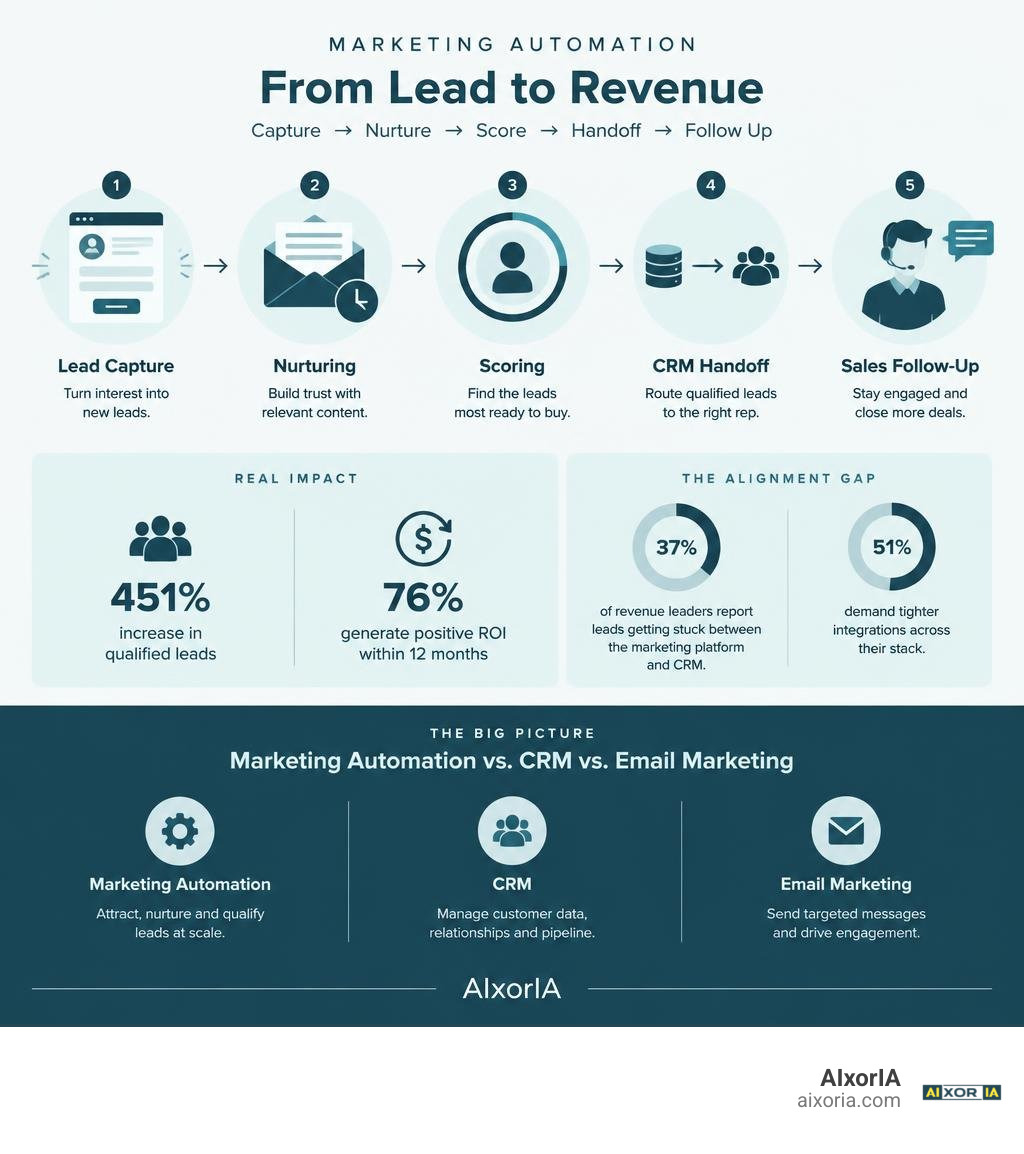
When deployed strategically, modern automation eliminates pipeline friction. Businesses implementing marketing automation achieve an average 451% increase in qualified leads, and 76% generate positive ROI within their first twelve months. Yet without alignment between systems, gaps emerge: 37% of revenue leaders report leads routinely getting stuck between their marketing platform and CRM, while 51% demand tighter integrations across their stack.
Core Differences: Marketing Automation vs. CRM vs. Email Marketing
Understanding the modern tech stack requires distinguishing the core purpose of each system. While these tools share data, their operational engines serve fundamentally different functions across the buyer journey.

- Email Marketing: Focuses on broadcast messaging, static segmentation, and scheduled newsletter delivery. It is primarily a communication mechanism rather than an interactive engine.
- Customer Relationship Management (CRM): Acts as the foundational system of record for account data, sales pipeline tracking, deals, contract details, and historical relationship context. It identifies what needs doing across customer accounts.
- Marketing Automation: Operates as the execution and decision engine. It uses behavioral triggers, progressive intelligence gathering, dynamic segmentation, and workflow rules to engage prospects, score intent, and deliver sales-ready buyers directly into the CRM.
Enterprise ecosystems demonstrate how uniting customer data records with trigger-based orchestration bridges the gap between top-of-funnel interest and closed-won deals.
Lead Generation and Initial Qualification Mechanisms
Modern lead generation goes beyond simple static landing pages. Marketing automation platforms capture digital body language across web properties, paid media, and content portals. Using progressive profiling, web forms ask different questions on subsequent visits—gathering firmographic data such as company size, industry, and project timelines without creating form friction.
Leading teams connect dynamic enrichment workflows to verify email addresses and append missing firmographic records in real time. For a deeper breakdown of top tools powering this stage, explore our review of the 9 Best B2B Lead Generation Software Tools in 2026.
Multi-Channel Engagement Beyond Simple Email Broadcasts
Modern buyer journeys rarely occur within a single channel. Automated engines orchestrate multi-touch experiences spanning behavioral SMS alerts, personalized web copy, dynamic in-app messaging, and automated ad retargeting syncs.
When a prospect downloads a technical whitepaper, the platform can trigger a targeted LinkedIn ad sequence, follow up with an educational SMS confirmation, and tailor website banners to that prospect’s specific vertical. To see how dedicated outbound sequences fit into this mix, check out our guide on the Best Email Drip Campaign Software in 2026.
Key Benefits of Marketing Automation for Sales Teams
Marketing automation functions as an operational bridge that accelerates sales velocity. By standardizing lead transitions, sales representatives spend their time speaking with verified decision-makers rather than prospecting unvetted contacts.
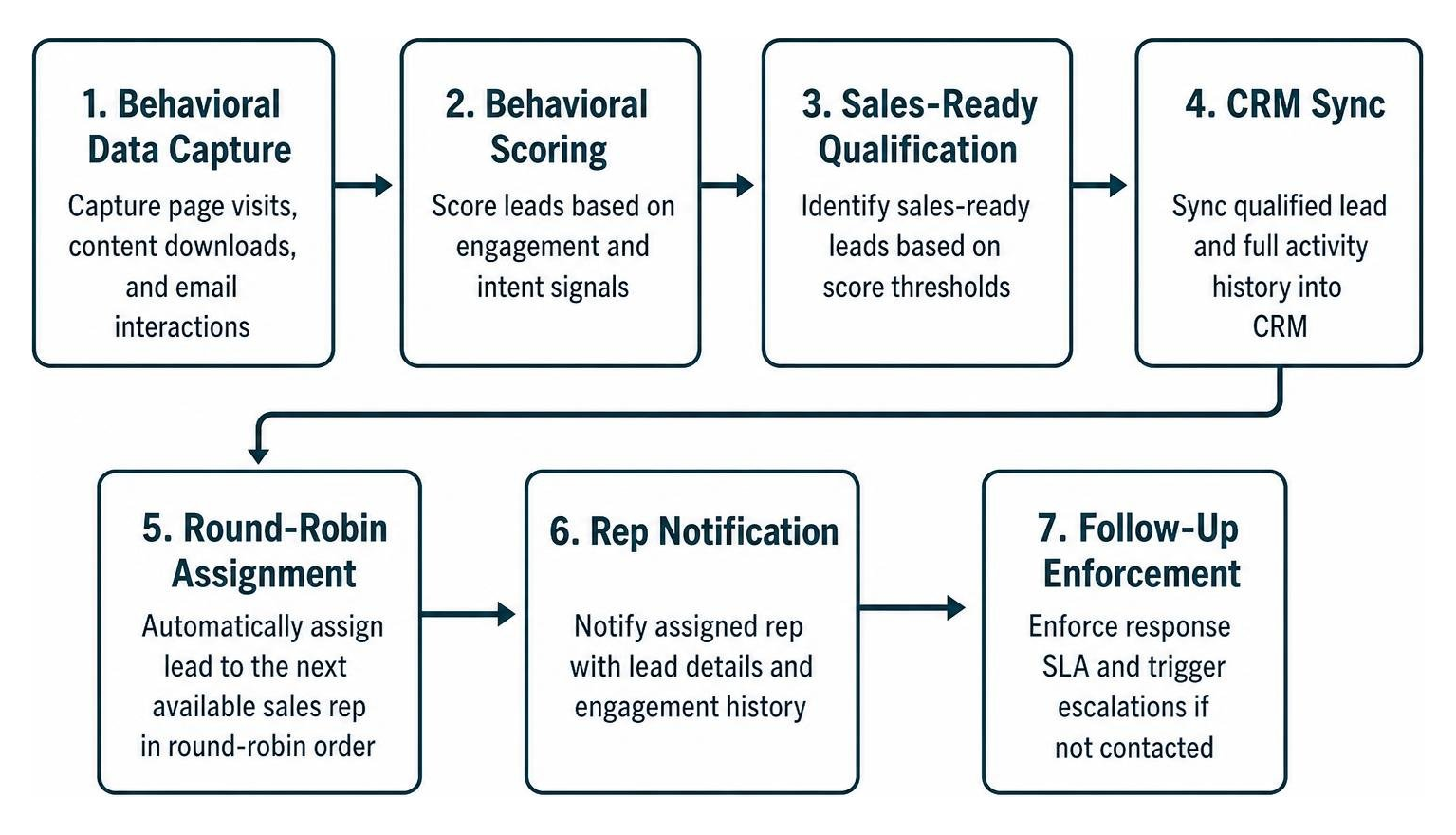
- Elimination of Handoff Bottlenecks: Resolves the 37% handoff drop-off rate by instantly syncing qualified prospect histories directly into rep dashboards.
- Shorter Sales Cycles: Pre-educating leads with contextual nurture workflows cuts down early-stage discovery friction.
- Automated SLA Enforcement: Triggers task escalations when inbound leads are not contacted within defined response windows.
- Context-Rich Conversations: Sales reps receive complete logs of page visits, content downloads, and email interactions directly inside the lead record.
To align your revenue operations across platforms, consult our analysis of The 7 Best RevOps Tools for Enterprises in 2026.
How Marketing Automation for Sales Powers Lead Scoring and Nurturing
Lead scoring separates real buying signals from casual browsing. Automation platforms assign points based on explicit demographic fit (such as job title or company revenue) and implicit digital activity (such as pricing page views or webinar attendance).
When a lead crosses an established threshold, the platform marks the record as a Marketing Qualified Lead (MQL) and transitions it to a Sales Qualified Lead (SQL) for direct outreach. Conversely, automated negative scoring reduces points for inactive subscribers, unengaged accounts, or non-target email domains, preventing pipeline pollution and mitigating database decay.
Real-Time Alerts and Automated Lead Routing
When high-intent prospects take action, speed to lead dictates conversion rates. Automated workflow engines assign leads via round-robin distribution, territory matching, or vertical specialization.
If an enterprise prospect visits a pricing page three times in 24 hours, the platform sends an instant notification via Slack or email directly to the assigned account owner, automatically creating a high-priority follow-up task. Platforms with integrated pipeline engines demonstrate how embedded triggers keep sales teams focused on their hottest opportunities.
Evaluating the Best Marketing Automation Software for Sales in 2026
Choosing the right software architecture depends on whether your organization benefits more from an integrated all-in-one suite or a modular, best-of-breed engine.
| Feature / Criteria | All-in-One CRM & Automation | Best-of-Breed Automation Engines | Open-Architecture Integration Layers |
|---|---|---|---|
| Data Sync Reliability | Native real-time database sync | Bi-directional API / Webhook sync | High-speed multi-platform orchestration |
| Lead Scoring Depth | Standard behavioral & demographic | Advanced predictive & account scoring | Custom multi-model data mapping |
| Multi-Channel Scope | Email, SMS, Forms, Pipeline tasks | Email, Web, Mobile Push, Ad sync | Universal API trigger-and-action logic |
| AI Capabilities | Native predictive send times & content | Advanced bot filtering & journey AI | Agentic workflows & LLM orchestration |
| Best Suited For | Lean teams wanting unified tooling | Mid-market to enterprise B2B sales | Custom tech stacks avoiding lock-in |
For mid-sized organizations balancing pipeline features and budget, review our guide to the Best AI Sales Automation Tools for Mid-Market Companies in 2026.
All-in-One CRM and Automation Platforms
Integrated platforms provide a single source of truth across marketing campaigns and sales pipelines. These systems combine ERP, CRM, and campaign tools into one environment. This eliminates data synchronization delays and provides complete closed-loop revenue reporting from initial touchpoint through order processing. Similarly, tools built for sales acceleration allow reps to launch targeted email sequences directly from their native inbox.
Best-of-Breed Dedicated Automation Engines
Dedicated marketing automation engines excel at sophisticated workflow branching, custom database objects, dynamic Liquid templating, and deep analytics. Standalone platforms provide the flexibility to build intricate, multi-channel customer journeys without being tied to a proprietary CRM database. They connect via webhooks and integration platforms to pass enriched data into any sales execution tool.
How AI is Transforming Marketing Automation for Sales Pipeline Velocity
Artificial intelligence has evolved marketing automation from deterministic if/then rules into predictive, agentic revenue engines.
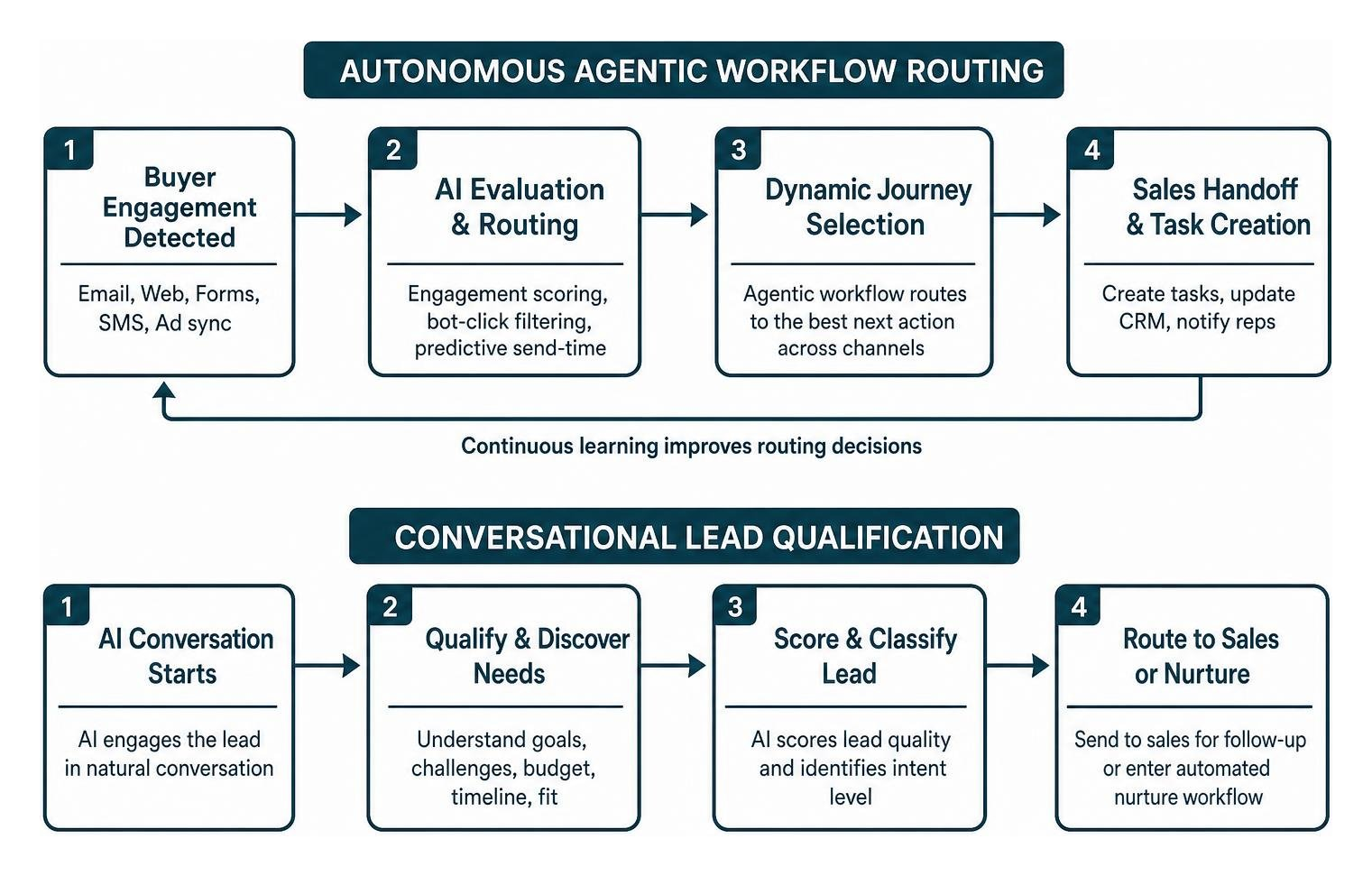
- Predictive Send-Time Optimization: Machine learning models analyze historical engagement patterns to deliver messages when each specific contact is most likely to open and click.
- Bot-Click Filtering: Advanced security filters identify and strip out automated spam-filter clicks and opens, ensuring lead scores reflect genuine human intent.
- Predictive Win-Probability Scoring: Algorithms evaluate historical deal outcomes against real-time buyer engagement to surface opportunities with the highest closing probability.
For an extensive look at how machine learning reshapes go-to-market strategies, explore our guide on the Best AI Tools for Sales and Marketing in 2026 as well as our curated list of the 9 Best AI Tools for Sales GTM in 2026.
Autonomous Outbound Prospecting and Inbound Qualification
The frontier of sales automation is autonomous agentic engagement. Enterprise frameworks demonstrate how autonomous AI agents engage inbound website visitors in two-way conversations.
These agents answer technical product questions, qualify buyers against target criteria, and directly book meetings on account executive calendars around the clock. To scale outbound prospecting using automated agents, see our review of the Best AI BDR Tools for Scaling Outbound Efforts in 2026.
Essential Workflow Recipes: Marketing Automation for Sales Pipelines
Implementing practical, high-impact workflow recipes generates immediate pipeline value.

- The Stalled Deal Re-Engagement Cadence: When an opportunity sits in the same pipeline stage for more than 14 days without activity, the system triggers a discreet educational case study sequence to the prospect while prompting the rep with an account review task.
- The Post-Webinar Fast-Track: Attendees who watch more than 75% of a live product webinar and visit the pricing page within 48 hours bypass standard nurture paths and route directly to account executives for outreach.
- The Closed-Lost Recycling Engine: Opportunities marked “Closed-Lost due to budget/timing” are enrolled into an automated 90-day value-add nurture track, triggering an alert to the sales rep two weeks prior to the prospect’s next fiscal quarter.
Implementation Best Practices and Common Pitfalls to Avoid
Even the most advanced marketing automation software fails if built on poor data or unvalidated processes. Keep these core practices in mind:
- Validate Manually First: Never automate a prospecting sequence or handoff process that has not been tested manually. Run processes manually for at least a week to identify messaging flaws before building workflows.
- Manage Database Decay: Business contact databases decay at an average rate of 22.5% per year due to role changes and job turnover. Enforce automated list hygiene and re-engagement rules to protect sender reputation.
- Implement Smart Sending Frequency Caps: Prevent contact fatigue by capping outbound automated marketing touches to a maximum of 2–3 emails per week, enforcing strict quiet hours (8 PM to 8 AM local time).
- Execute a Phased 30/60/90-Day Rollout: Dedicate the first 30 days to database cleansing, CRM property mapping, and domain authentication. Focus days 31–60 on core inbound capture and lead scoring. Use days 61–90 for multi-channel branching, stalled deal workflows, and closed-loop revenue reporting.
Frequently Asked Questions about Marketing Automation for Sales
How do small businesses benefit from marketing automation for sales?
Small businesses use marketing automation to scale lean teams. By automating lead capture, qualification, and initial follow-up sequences, small sales teams can prioritize high-intent buyers without spending hours on manual data entry or repetitive administrative emails.
How do you measure ROI from marketing automation in a sales context?
Marketing automation ROI is measured through metrics such as pipeline velocity, lead-to-opportunity conversion rates, customer acquisition cost (CAC) reduction, and closed-loop revenue attribution. Positive ROI is achieved when the platform measurably increases sales-qualified leads while reducing manual rep prospecting hours.
When should automated marketing campaigns pause for an active sales deal?
Automated marketing nurture campaigns should pause the moment a prospect enters an active deal stage in the CRM. Continuing broad promotional broadcasts while a sales representative is conducting custom negotiations creates disjointed messaging and risks derailing deal momentum.
Conclusion
Marketing automation for sales is not about sending more emails—it is about orchestrating timely, relevant interactions that convert interest into measurable pipeline. By uniting your lead capture channels, scoring engines, and CRM workflows, your sales team can focus on closing deals rather than chasing cold contacts.
At AIxorIA, we help businesses implement strategic GTM orchestration solutions, design cost-effective automation frameworks, and conduct performance audits that eliminate operational friction while preventing vendor lock-in.
Ready to scale your pipeline and automate your revenue engine? Explore our AIxorIA strategic GTM and automation frameworks to build an efficient, future-proof sales engine.
1 thought on “Marketing Automation for Sales: Benefits & Best Tools”