Best Marketing Automation Platforms for Different Business Needs
Scr0ll d0wn to D0VVNL0AD
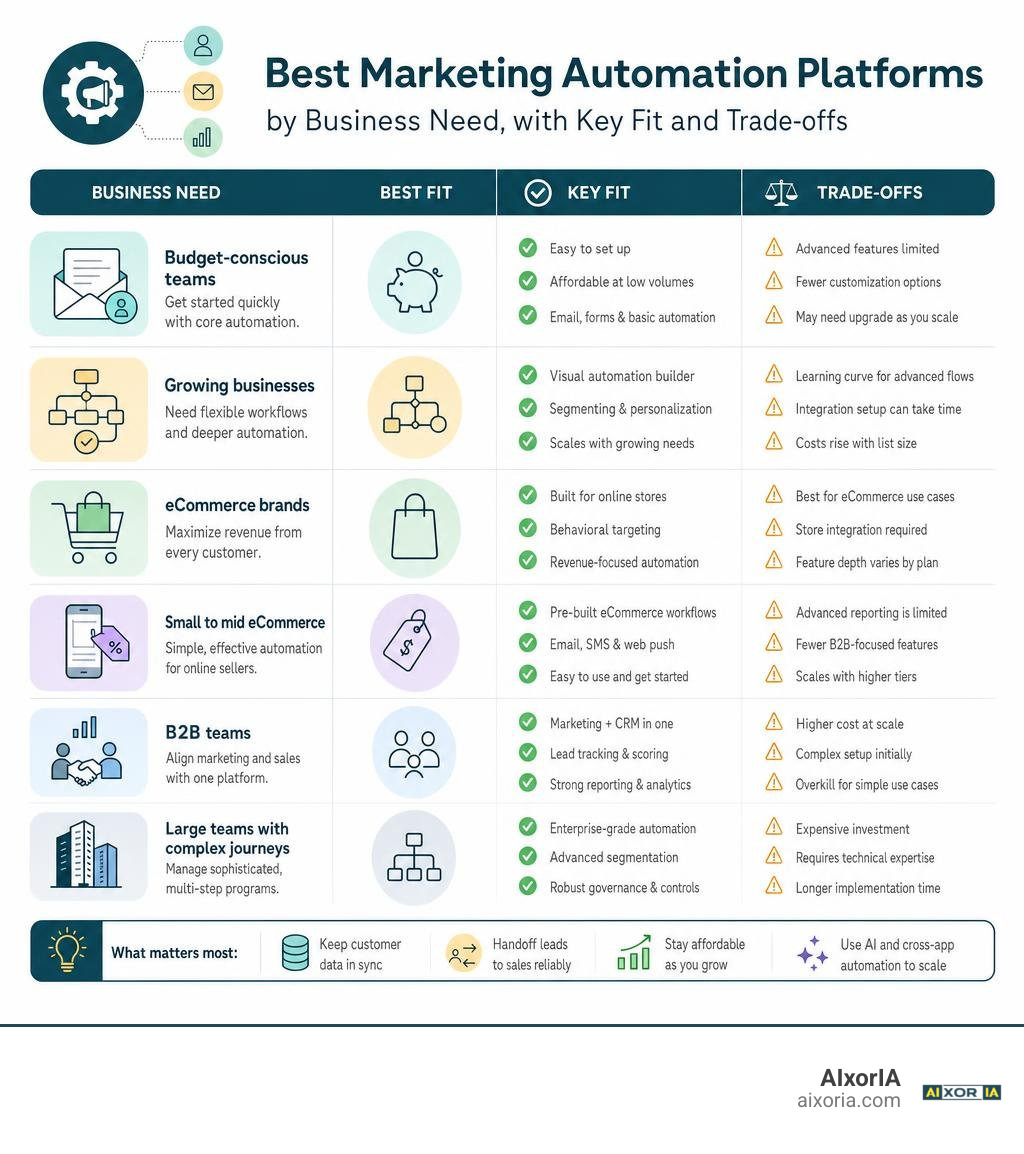
The best marketing automation platforms depend on what you sell and how your team works. Budget-conscious teams should prioritize transparent pricing and core workflow features. Growing businesses often need flexible automation logic, while eCommerce teams benefit from deep storefront integrations. B2B teams may prefer unified marketing and CRM capabilities, and large organizations need support for complex lead journeys.
The right choice is not just the tool with the most features. Check whether it can keep customer data in sync, hand leads to sales reliably, and stay affordable as your contact list grows. This guide compares those trade-offs, including where AI and cross-app automation help.
Between planning multi-stage campaigns, chasing design approvals, and manually scheduling broadcasts across disparate channels, running modern demand generation can easily feel like spinning plates. Marketing automation exists to turn those manual chores into predictable, self-sustaining customer journeys.
Industry data reflects this shift: the global marketing automation market has expanded rapidly from $3.3 billion toward double-digit billions, driven by teams seeking operational scale. Email remains a dominant growth driver, yielding an estimated return of up to 4300% for organizations in the US. Yet, choosing the wrong software can saddle your team with rigid workflows, ballooning contact tiers, and fragmented databases.
Key Criteria to Evaluate the Best Marketing Automation Platforms
Evaluating software goes beyond checking boxes on a generic feature list. True marketing automation relies on trigger-and-action logic combined with branching rules and filters that automate at least two marketing mediums (such as email, SMS, web push, or digital ads).
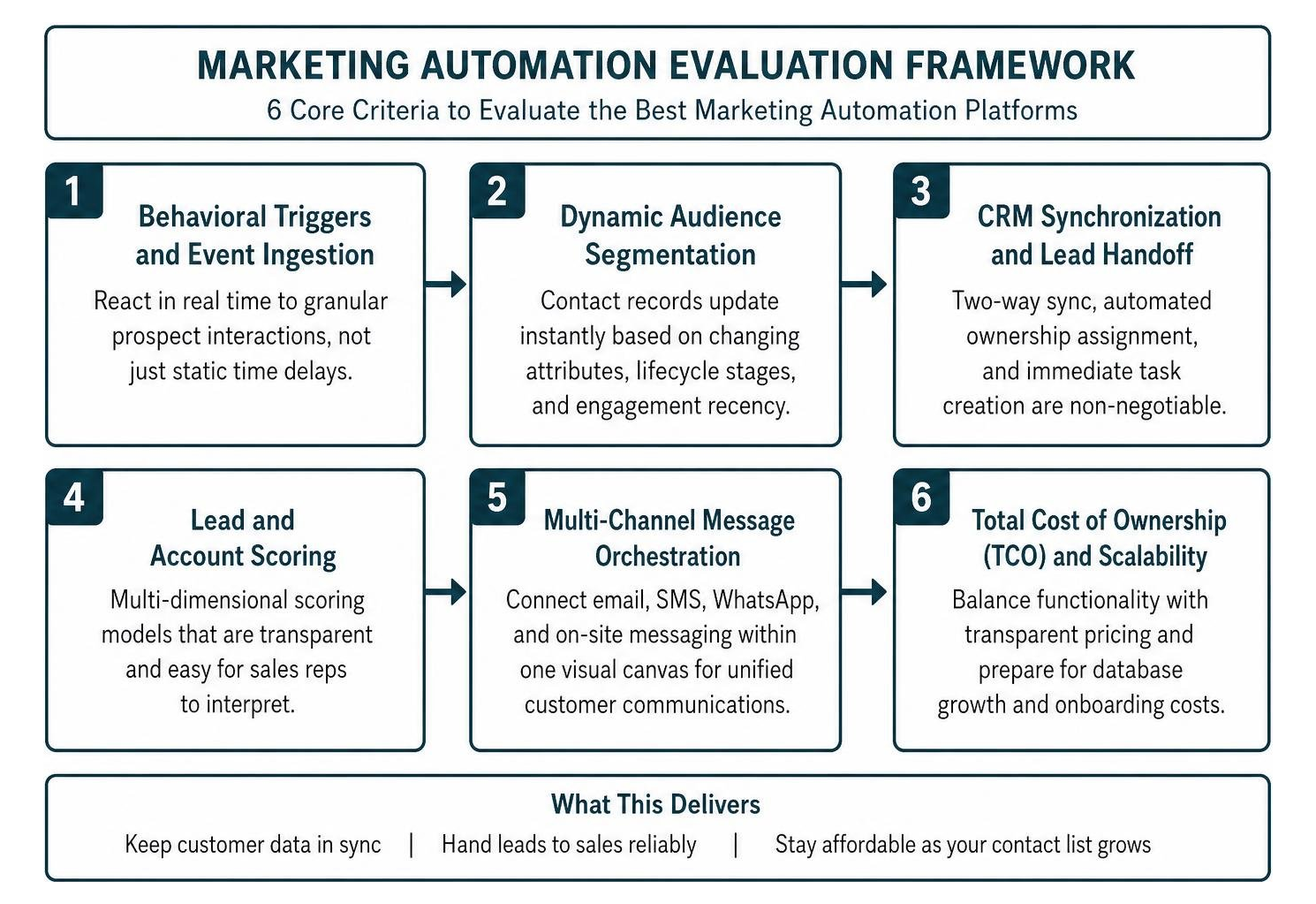
When auditing platforms, we assess six core operational criteria:
- Behavioral Triggers and Event Ingestion: The platform must react in real time to granular prospect interactions—such as browsing a specific product category, downloading a technical asset, or stalling inside an onboarding flow—rather than relying solely on static time delays.
- Dynamic Audience Segmentation: Contact records should update instantly based on changing user attributes, lifecycle stages, and engagement recency.
- CRM Synchronization and Lead Handoff: According to industry surveys, 37% of sales and marketing managers regularly see leads get stuck between marketing tools and the CRM. Reliable two-way synchronization, automated ownership assignment, and immediate task creation are non-negotiable.
- Lead and Account Scoring: The software should provide multi-dimensional scoring models (evaluating both explicit demographic fit and implicit behavioral intent) without creating opaque “black boxes” that sales reps cannot interpret.
- Multi-Channel Message Orchestration: Connecting email, SMS, WhatsApp, and on-site messaging within a single visual canvas prevents disjointed customer communications. Exploring what marketing campaign management software is can help clarify how cross-channel campaigns coordinate across different stages of the funnel.
- Total Cost of Ownership (TCO) and Scalability: Platforms must balance functionality with transparent pricing. According to Capterra’s benchmark data on marketing automation software, entry-level packages often start between $4.67 and $108 per user per month, but costs can jump significantly once database tiers expand and mandatory onboarding fees are factored in.
All-in-One Suites vs. Modular Best-in-Class Automation Stacks
A fundamental structural decision every marketing team faces is whether to adopt an all-in-one suite or build a modular, best-in-class stack.

The All-in-One Approach
All-in-one platforms bundle email, landing pages, forms, basic ad tracking, and CRM functionality under one roof.
- The Upside: Unified reporting dashboards, single sign-on access, and minimal initial configuration.
- The Trade-Off: High monthly fees and steep pricing cliffs. For instance, unlocking event-based web tracking or custom API limits on all-in-one platforms often requires jumping from an entry-level tier straight to an enterprise plan costing $800 to over $3,200 per month.
The Modular Best-in-Class Stack
A modular approach pairs specialized automation engines with dedicated CRM systems, data enrichment tools, and cross-app integration layers.
- The Upside: Deep functional excellence. You get specialized journey builders, granular event tracking, and the freedom to swap out individual components as your strategy evolves. Pairing a focused automation tool with the best CRM software for small business allows lean teams to maintain clean pipeline tracking without paying enterprise bloat.
- The Trade-Off: Requires careful architecture to manage webhook throughput, API rate limits, and cross-system data consistency.
| Feature / Trait | All-in-One Suites | Modular Best-in-Class Stacks |
|---|---|---|
| Primary Strength | Out-of-the-box data alignment and single UI | Best-in-breed functional depth per channel |
| Pricing Predictability | Steep escalations as contact tiers and features unlock | Linear, modular SaaS licensing |
| Implementation Curve | Faster initial launch; rigid long-term customization | Requires initial integration setup; highly adaptable |
| Vendor Lock-In Risk | High (migrating entire tech stack at once is painful) | Low (individual tools can be replaced independently) |
| Ideal Fit | Non-technical teams wanting centralized operations | High-growth SaaS, digital agencies, and specialized retail |
Top Marketing Automation Tools Categorized by Business Model and Scale

Best Marketing Automation Platforms for High-Growth Startups and SMBs
Early-stage companies need intuitive, low-code visual workflow builders, pre-built campaign templates, and accessible pricing that does not penalize rapid list growth.
- Email-first automation platforms: These tools suit teams that need visual multi-step automations, transactional messaging, and basic SMS or WhatsApp capabilities without a complex setup.
- Workflow-focused platforms: Look for branching automation logic, conditional testing, contact management, and pipeline visibility when building multi-stage email drip campaigns.
- Newsletter and journey platforms: Small businesses can benefit from pre-built customer journey maps and AI-assisted copy suggestions, but should monitor how costs change as contact counts increase.
Dedicated Marketing Engines for eCommerce and Digital Retail
Online retail requires deep platform synchronization (Shopify, WooCommerce, BigCommerce), real-time cart tracking, dynamic catalog feeds, and synchronized SMS workflows.
- Data-driven eCommerce platforms: Strong options ingest order history, browsing behavior, and lifetime-value signals directly from digital storefronts. They should support abandoned-cart sequences, back-in-stock alerts, and loyalty messaging with dynamic product blocks. Reviewing the best email marketing tools for online stores can help teams compare these capabilities.
- Budget-conscious eCommerce platforms: Look for unified email, SMS, and web-push workflows that can be deployed without extensive custom coding.
Best Marketing Automation Platforms for Mid-Market and Enterprise B2B
Mid-market and enterprise B2B organizations manage long sales cycles, complex buying committees, and strict data governance protocols.
- Unified B2B suites: These platforms combine marketing automation, content management, CRM records, personalization, and attribution reporting. Review onboarding requirements and feature-based pricing before committing.
- Enterprise demand-generation platforms: Organizations with account-based marketing programs should prioritize lead-lifecycle modeling, revenue attribution, governance controls, and administrative support.
- Event-driven messaging platforms: Product-led B2B SaaS teams benefit from tools that trigger in-app messages, push notifications, and emails from real-time product-usage events and custom API data.
- CRM-aligned B2B platforms: Teams should look for reliable pipeline tracking, automated lead assignment, and analytics that fit their existing CRM environment.
According to Software Advice buyer evaluation metrics for enterprise marketing automation, unexpected cost escalations and external consulting dependencies remain the leading causes of enterprise buyer dissatisfaction. Evaluating software through the lens of AI sales automation tools for mid-market companies helps growing teams balance enterprise capability with manageable overhead.
The Impact of AI and Cross-App Orchestration in Modern Marketing
Marketing automation has shifted from rigid, static “if-this-then-that” rules to adaptive, AI-driven journey orchestration.
Modern platforms now integrate predictive algorithms that optimize send times per contact, calculate churn propensity scores, and dynamically adjust product recommendations. Furthermore, combining automation suites with the best AI content creation tools for marketers allows teams to generate dynamic personalized copy variations tailored to specific buyer personas at scale.
At the infrastructure layer, cross-app orchestration acts as the glue across disconnected marketing stacks. Over 51% of sales and marketing managers report wanting better integrations across their tools. Rather than letting data sit in isolated silos, orchestration engines connect form inputs, ad platforms, billing systems, and messaging apps.
Emerging open protocols, such as Model Context Protocol (MCP), allow external AI chat assistants to query marketing databases and trigger automation sequences directly using natural language commands. Reviewing modern customer engagement software illustrates how unifying conversational channels and backend databases creates responsive, multi-touch buyer journeys.
Common Implementation Pitfalls and How to Prevent Them
Even the most sophisticated software will fail if implemented on top of broken processes or dirty data. A landmark academic review on enterprise marketing automation success factors published in Cogent Business & Management highlights that organizational alignment, data readiness, and clear process definitions are far more critical to deployment success than software feature counts alone.
- The Marketing-to-Sales “Black Hole”: Passing leads to sales without agreed-upon qualification definitions causes pipeline friction. Establish clear Service Level Agreements (SLAs) and automate notifications so sales reps receive immediate context when a prospect hits a qualified score threshold.
- Neglecting Technical Deliverability Infrastructure: Failing to configure authentication records—specifically SPF (Sender Policy Framework), DKIM (DomainKeys Identified Mail), and DMARC (Domain-based Message Authentication, Reporting, and Conformance)—leads to inbox placement issues and degraded sender reputations.
- Database Bloat and Contact Decay: Storing unengaged contacts inflates software subscription tiers. Implement automated sunset workflows that automatically unsubscribe or archive leads who show zero engagement over a 90- to 180-day window.
- Over-Automating at the Expense of Human Touch: Triggering five automated messages across three channels within 24 hours of an asset download alienates buyers. Map visual journey flowcharts and implement global frequency caps to prevent message fatigue.
- Ignoring Hidden Onboarding and Contract Costs: Review contract terms carefully for seat limits, webhook overage fees, and mandatory setup charges before committing to multi-year enterprise agreements.
Frequently Asked Questions About Marketing Automation
What is the difference between a CRM and a marketing automation platform?
A Customer Relationship Management (CRM) platform serves as the central source of truth for contact records, deal stages, and direct sales rep interactions. A marketing automation platform sits upstream, capturing raw leads, nurturing them across multiple channels using automated behavioral triggers, and passing sales-ready prospects into the CRM pipeline. Modern platforms often integrate these functions closely.
How much does marketing automation software cost on average?
Pricing varies widely based on contact list size, send volume, and required capabilities:
- Entry-Level & SMB Plans: Range from $9 to $100 per month for basic visual builders and up to 5,000 contacts.
- Mid-Market Platforms: Typically run between $200 and $900 per month as dynamic segmentation, multi-channel SMS/WhatsApp, and advanced CRM integrations unlock.
- Enterprise Deployments: Often start at $1,200 to $3,500+ per month, frequently carrying annual contracts and $2,500 to $7,000 in mandatory implementation fees.
How do marketing automation platforms handle lead scoring and multi-channel workflows?
Platforms evaluate explicit data (job title, company size, industry) and implicit data (email clicks, pricing page visits, webinar attendance). Points are assigned dynamically based on engagement recency and frequency. When a lead crosses a defined point threshold, conditional branching rules route the contact into an accelerated sales sequence or trigger an automated multi-channel touchpoint across email, SMS, or targeted ad audiences.
Conclusion
Building an effective marketing engine is not about buying the most expensive monolithic software suite on the market. It is about selecting tools that fit your business model, keep customer data synchronized in real time, and scale without imposing unpredictable price hikes.
Whether you start with an affordable visual builder, deploy a specialized eCommerce platform, or manage complex enterprise lifecycles with a unified suite, success comes down to clean data architecture and continuous journey optimization. At AIxorIA, we help businesses implement practical GTM orchestration frameworks, connect disconnected tools, and deploy cost-effective automation strategies that prevent vendor lock-in and maximize sustainable growth. Explore our GTM orchestration and AI automation solutions to build a modern, high-converting marketing engine.
1 thought on “Best Marketing Automation Platforms for Every Business”