Why Finding the Best Homeowners Insurance Comparison Site Can Save You Real Money
Scr0ll d0wn to D0VVNL0AD

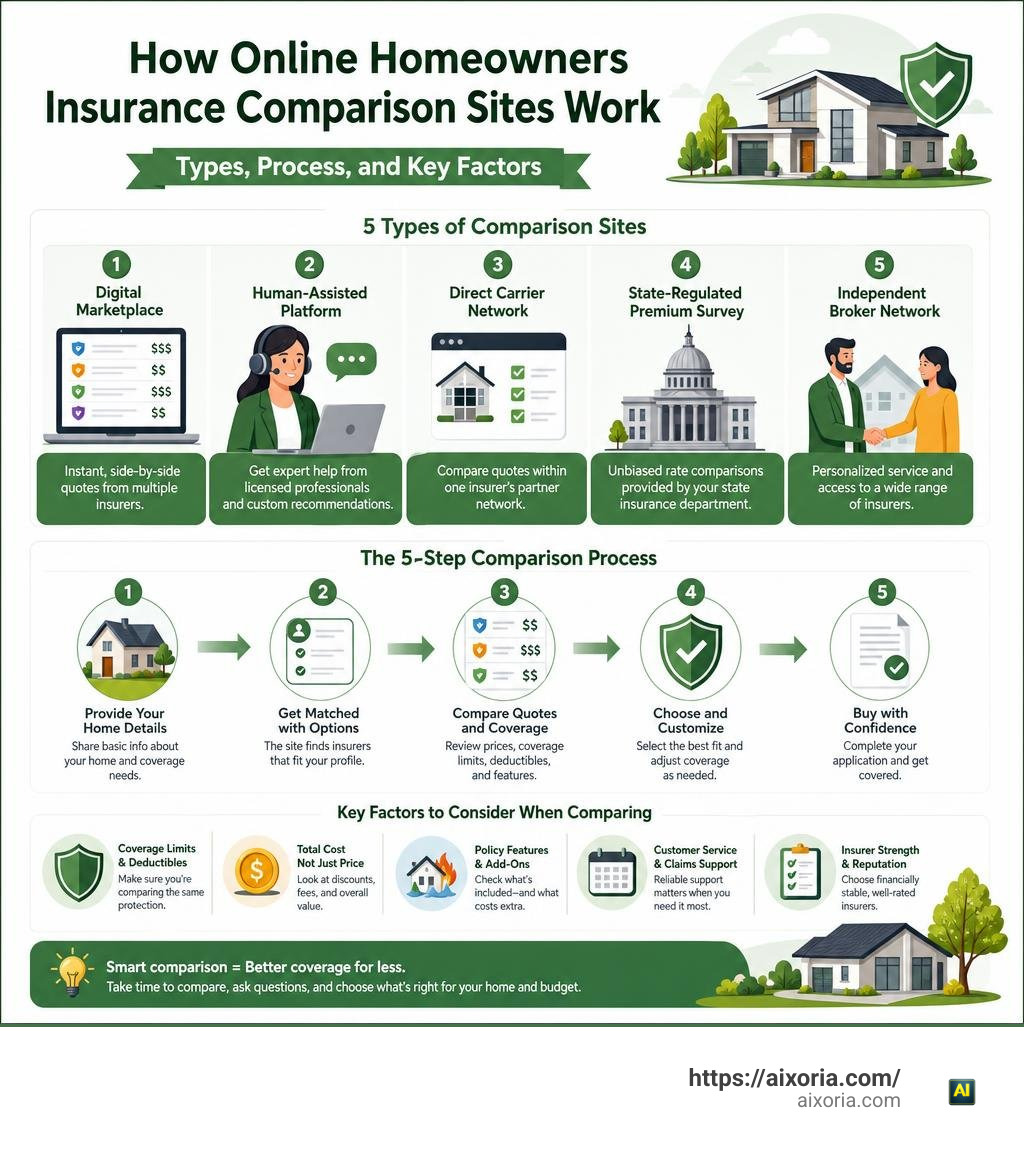
The best homeowners insurance comparison site for most homeowners depends on how much help you want and how fast you need a quote. Here’s a quick breakdown:
| Site Type | Best For | Speed |
|---|---|---|
| Real-time digital marketplace | Fast, side-by-side quotes | ~5 minutes |
| Hybrid human-assisted platform | Guidance from licensed experts | Same day |
| Direct carrier network (e.g., Progressive HomeQuote Explorer) | Comparing within one insurer’s partner network | ~5 minutes |
| State-regulated premium survey (e.g., CA Dept. of Insurance) | Unbiased baseline rates, no sales pressure | Variable |
| Independent broker network | Custom policies, hard-to-insure homes | 1-2 days |
Home insurance costs are rising fast. The national average is now $2,490 per year — and rates have climbed 6% in just the last 12 months. A third of American homeowners have already seen their premiums go up. Yet only about 1 in 5 actually shopped around for a better deal last year.
That gap is costing people money. Rates from the largest insurers can differ by more than $1,000 per year for the exact same home.
The good news? Shopping around doesn’t hurt your credit score. Insurance quotes use soft credit pulls — not hard inquiries — so comparing multiple options costs you nothing.
The tricky part is knowing which type of comparison tool actually fits your situation, and making sure you’re comparing the same coverage across every quote. Apples-to-oranges comparisons are the most common mistake homeowners make.
This guide breaks down the five main types of comparison resources, what each one does well, and how to use them together to find the best rate without giving up the coverage you actually need.
What is the Best Homeowners Insurance Comparison Site Type for You?
When shopping for protection, there is no single “magic button” website. Instead, the market is divided into distinct comparison platforms. Understanding how these platforms differ prevents you from wasting time or, worse, getting flooded with unwanted spam calls.
A common point of confusion is the difference between a true comparison marketplace and a “lead-generation” site. True marketplaces provide real, side-by-side quotes based on your specific information without selling your personal details to dozens of third parties. Lead-generation sites, on the other hand, exist simply to harvest your contact information and sell it to aggressive sales agents.
To make the process easier, we have categorized the options into five distinct types of comparison systems. Whether you are looking for the Highest Rated Condo Homeowners Insurance or trying to insure a brand-new single-family home, matching your shopping style to the right platform is the first step toward saving.
1. The Real-Time Digital Marketplace as the Best Homeowners Insurance Comparison Site
Real-time digital marketplaces are built for speed and autonomy. These platforms allow you to input your home’s details once and receive multiple, real-time quotes from different insurance carriers side-by-side.
These platforms are highly popular because they respect your data privacy. Instead of selling your phone number, they generate revenue through direct commissions from the insurance providers when you purchase a policy.
Why Marketplaces Work
- No Markups: The rates you see come directly from the insurers; the marketplace does not add extra fees.
- Data Protection: Legitimate marketplaces keep your contact info secure, sparing you from endless cold calls.
- Speed: You can typically view side-by-side rates in about five minutes.
It is worth noting that about 59% of customers using these tools start their search because they believe they are currently overpaying. On average, shoppers save around $480 per year by switching through a digital marketplace. However, your results can sometimes be limited by your geographic location, credit score, or local weather risks, which may prevent some carriers from offering an instant online quote.
2. The Hybrid Human-Assisted Platform
If you want the speed of a digital intake form but still want a real human to double-check your coverage limits, a hybrid human-assisted platform is your best option. These platforms combine automated quoting technology with on-demand access to licensed, non-commissioned insurance experts.
This approach is highly valuable for complex financial decisions. The process is simple: you fill out a digital questionnaire, and instead of just spitting out raw data, the platform matches you with a licensed agent who reviews your options, helps you bundle policies, and guides you to the finish line.
This structure is similar to how the Best Life Insurance Agents in 2026 – Top Experts to Compare Before You Buy operate—focusing on personalized guidance rather than high-pressure sales tactics. It is an excellent choice if you are unsure how much dwelling coverage you need or if you have unique liability risks, such as owning certain dog breeds or a backyard trampoline.
3. The Direct Carrier Network
Some major insurance carriers offer built-in comparison tools directly on their websites. A well-known example is Progressive’s HomeQuote Explorer. Rather than only showing you their own rates, these carriers partner with a curated network of other trusted insurers to show you side-by-side options.
These networks specialize in convenience. By entering your address, the platform taps into public property databases to automatically fill in details like your home’s square footage, construction materials, and roof age.
Benefits of Direct Carrier Networks
- Automatic Data Retrieval: Public records pre-fill your application, saving you from guessing your home’s specifications.
- Direct Mortgage Coordination: If you are buying a home, these platforms can send proof of insurance directly to your mortgage lender and set up escrow billing automatically.
- Specialty Carrier Access: They often connect you with specialized companies, which you can learn more about in our American Modern Insurance Review 2026 – Coverage, Cost, Pros & Cons.
The main limitation is that you are restricted to the carrier’s specific partner network, meaning you might miss out on regional insurers that do not participate in their system.
4. State-Regulated Premium Surveys
For homeowners who want completely unbiased, non-commercial data, state-regulated premium surveys are an invaluable, underutilized resource. State departments of insurance, such as the California Department of Insurance, regularly survey licensed insurers to compile comprehensive rate comparison sheets.
These surveys represent over 90% of the active insurance market in each state. They provide a clear, objective baseline of what companies are charging across different counties and zip codes.
However, there is a catch: these surveys show premium indicators, not final binding quotes. They do not account for your specific credit history, claims history, or individual home safety features. Think of state surveys as a high-quality compass—they will show you which direction to head (i.e., which companies are generally cheapest in your area), but you will still need to request a personalized quote to get a final price.
5. The Independent Broker Network as a Traditional Best Homeowners Insurance Comparison Site
Sometimes, the best homeowners insurance comparison site is actually a digital portal to a local, independent insurance broker. Unlike captive agents who only sell policies for a single company, independent brokers have relationships with dozens of national and regional carriers.
Working with an independent broker can be a major advantage, especially if you live in a high-risk area prone to wildfires, hurricanes, or severe storms where national carriers are pulling back. Brokers often have access to smaller, regional insurance companies that do not advertise nationally but offer incredibly competitive rates.
To see how regional carriers stack up against national giants in terms of service and claims handling, take a look at our Aspire General Insurance Review 2026 – Coverage, Claims, Customer Ratings. A broker can help you navigate these smaller companies while ensuring your policy is tailored to your exact needs.
How to Compare Homeowners Insurance Quotes Apples-to-Apples

The most common mistake homeowners make when comparing quotes is looking solely at the bottom-line price. A policy that costs $1,200 a year is not necessarily a better deal than one that costs $1,500 if the cheaper policy leaves you underinsured or carries massive, hidden deductibles.
To ensure you are getting an accurate, apples-to-apples comparison, you must look at the specific coverage limits and deductibles on each quote. Use the following step-by-step process to evaluate your options:
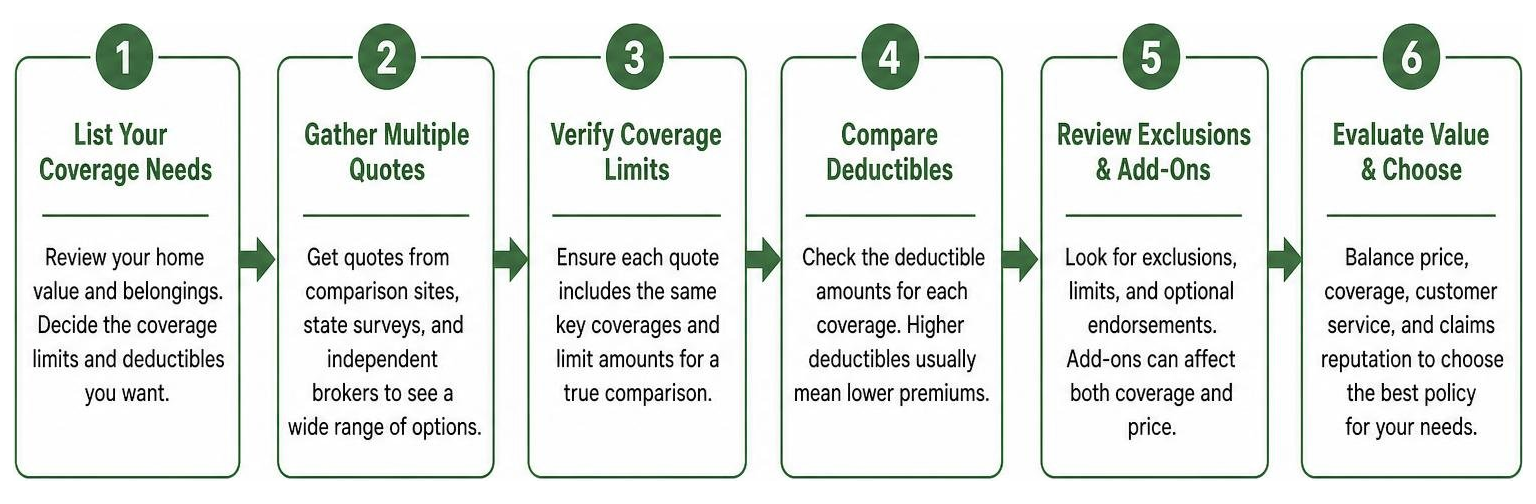
To help you organize your search, make sure you understand the core components of a standard policy:
- Dwelling Coverage (Coverage A): This is the amount of money it would take to completely rebuild your home from the ground up. It should be based on local construction costs, not your home’s market value or tax assessment.
- Other Structures (Coverage B): Covers detached garages, sheds, and fences. This defaults to 10% of your dwelling limit.
- Personal Property (Coverage C): Covers your belongings (furniture, clothes, electronics). This typically defaults to 50% of your dwelling limit.
- Loss of Use (Coverage D): Pays for your living expenses (like hotel stays and meals) if your home is uninhabitable after a covered claim. This defaults to 20% of your dwelling limit.
- Personal Liability (Coverage E): Protects your assets if someone is injured on your property and sues you. We recommend setting this to at least match your household’s total net worth.
Understanding Named Peril vs. Open Peril Policies
The language used in insurance policies can be confusing, but the distinction between “named peril” and “open peril” coverage is critical to understand.
| Policy Type | Coverage Style | How It Works | Best For |
|---|---|---|---|
| Named Peril (e.g., HO-2) | Restricted | Only covers damage caused by disasters explicitly listed in the policy (e.g., fire, lightning, windstorm). If it’s not on the list, it’s not covered. | Budget-conscious homeowners willing to take on more risk. |
| Open Peril (e.g., HO-3 / HO-5) | Broad | Covers damage from all disasters except those explicitly excluded (like earthquakes, flooding, or neglect). | The majority of homeowners wanting comprehensive protection. |
Most standard homeowners insurance policies (HO-3) are a hybrid: they cover your physical house on an open peril basis, but cover your personal belongings on a named peril basis. If you want open peril coverage for both your home and your belongings, you will need to upgrade to an HO-5 policy.
Another crucial detail is how your belongings are valued: Replacement Cost vs. Actual Cash Value (ACV).
If a fire destroys a five-year-old television, an ACV policy will only pay you what that used TV is worth today (which, with a 40% annual depreciation rate, is almost nothing). A Replacement Cost policy, however, will pay you enough to buy a brand-new TV of similar quality. Opting for replacement cost coverage is almost always worth the slightly higher premium.
Information Needed to Get Accurate Quotes
To get the most accurate quotes from any comparison site, you should have the following information ready:
- Property Details: Your home’s square footage, the year it was built, the age of the roof, and the primary construction materials (e.g., brick, wood frame).
- Safety Features: Details on security systems, smoke detectors, deadbolts, sprinkler systems, or smart-home water leak sensors.
- Claims History: Any insurance claims you have filed in the last three to five years.
- Your Current Policy’s Declarations Page: This is the easiest cheat sheet to help you copy your existing coverage limits and deductibles.
If you are currently renting while shopping for a home, you can use similar strategies to save on temporary coverage. Check out our State Farm Renters Insurance Review 2026 – Coverage, Cost, Discounts to see how bundling renters and auto insurance can establish a history of savings before you transition to a homeowners policy.
Key Factors to Consider Beyond Price
A cheap premium means very little if your insurance company stalls on claims or goes bankrupt after a major storm. When evaluating quotes, balance the cost against the insurer’s reputation, customer service ratings, and financial stability.
If you plan to use your property for unique purposes, such as renting it out on Airbnb or Vrbo, standard policies may not protect you. In these cases, you will need specialized coverage, which you can read about in our guide to Homeowners Short Term Rental Insurance.
Financial Strength and Claims Reputation
Before signing a policy, check the insurer’s ratings across three major independent organizations:
- A.M. Best: Rates insurance companies on their financial strength and ability to pay out massive waves of claims after natural disasters. Look for a rating of A- (Excellent) or higher.
- J.D. Power: Publishes annual customer satisfaction studies ranking insurers on claims handling, billing, and customer service. Look for companies scoring above the industry average (typically around 819 points).
- NAIC Complaint Index: The National Association of Insurance Commissioners tracks consumer complaints. A score of 1.00 is the national average; scores below 1.00 indicate fewer complaints than average.
These ratings will help you identify the highest-performing carriers in these categories.
Average Costs and Why Rates Vary
The average cost of homeowners insurance in the U.S. is $2,490 per year, but this average hides massive regional variations.
For example, homeowners in Hawaii enjoy some of the lowest average rates in the country at around $900 per year, thanks to a mild climate and low risk of severe storms. Conversely, homeowners in Oklahoma face average premiums of $7,255 per year due to frequent tornadoes and severe hail storms.
Comparing rates from multiple carriers in your specific area is the best way to find the most competitive pricing.
Frequently Asked Questions About Homeowners Insurance Comparison
Will comparing homeowners insurance quotes hurt my credit score?
No. When you shop for homeowners insurance, carriers perform a “soft inquiry” (or soft pull) on your credit report. Unlike a hard inquiry—which occurs when you apply for a credit card or mortgage—a soft inquiry has zero impact on your credit score.
Additionally, you do not need to lift a credit freeze to get insurance quotes. However, keep in mind that in most states, insurers do use a credit-based insurance score to help calculate your premium, as studies show a correlation between credit history and claim frequency. Only California, Maryland, and Massachusetts legally prohibit insurers from using credit scores to set home insurance rates.
How can I find cheap homeowners insurance without sacrificing coverage?
You do not have to slash your coverage limits to lower your bill. Instead, try these highly effective strategies:
- Raise Your Deductible: Raising your deductible from $1,000 to $2,500 lowers your annual premium by an average of 9%. Just make sure you keep enough cash in an emergency fund to cover that deductible if you ever need to file a claim.
- Bundle Policies: Combining your home and auto insurance with the same carrier is the single most effective discount, often saving you 15% to 30% across both policies.
- Install Protective Devices: Many insurers offer discounts for installing smart-home water leak detectors, deadbolts, smoke alarms, or security systems.
- Avoid Small Claims: Filing small claims can erase your claims-free discount and cause your rates to spike. If the damage is only slightly higher than your deductible, it is usually cheaper in the long run to pay for the repairs out of pocket.”https://www.mediafire.com/file/aqo3x35b8htx008/OCEAN_BIOMES_BY_MCPEUDAY.mcaddon/file“;
Are state-specific premium surveys useful for comparing rates?
Yes, they are highly useful as an initial reality check. Because these surveys are run by state regulatory agencies, they are completely free of commercial bias and affiliate marketing influence. They give you a clear, honest look at which companies generally offer the most competitive rates in your specific county or zip code.
Just remember that they only provide baseline indicators. You will still need to use a comparison site or contact the insurers directly to get a final, binding quote tailored to your specific home and personal history.
Conclusion
Finding the best homeowners insurance comparison site comes down to how you prefer to shop. If you want speed and independence, a real-time digital marketplace is tough to beat. If you prefer a professional to guide you through the fine print, a hybrid platform or an independent broker is the way to go.
Whichever path you choose, shopping around annually is the most reliable way to keep your housing costs under control in a changing economic landscape.
At Aixoria, we are dedicated to keeping you informed on the latest trends, technologies, and strategies to protect your hard-earned assets. To see how modern technology is reshaping the financial and insurance industries, Explore our AI Updates today!
Claro y práctico. Prueba TextSong: . TextSong