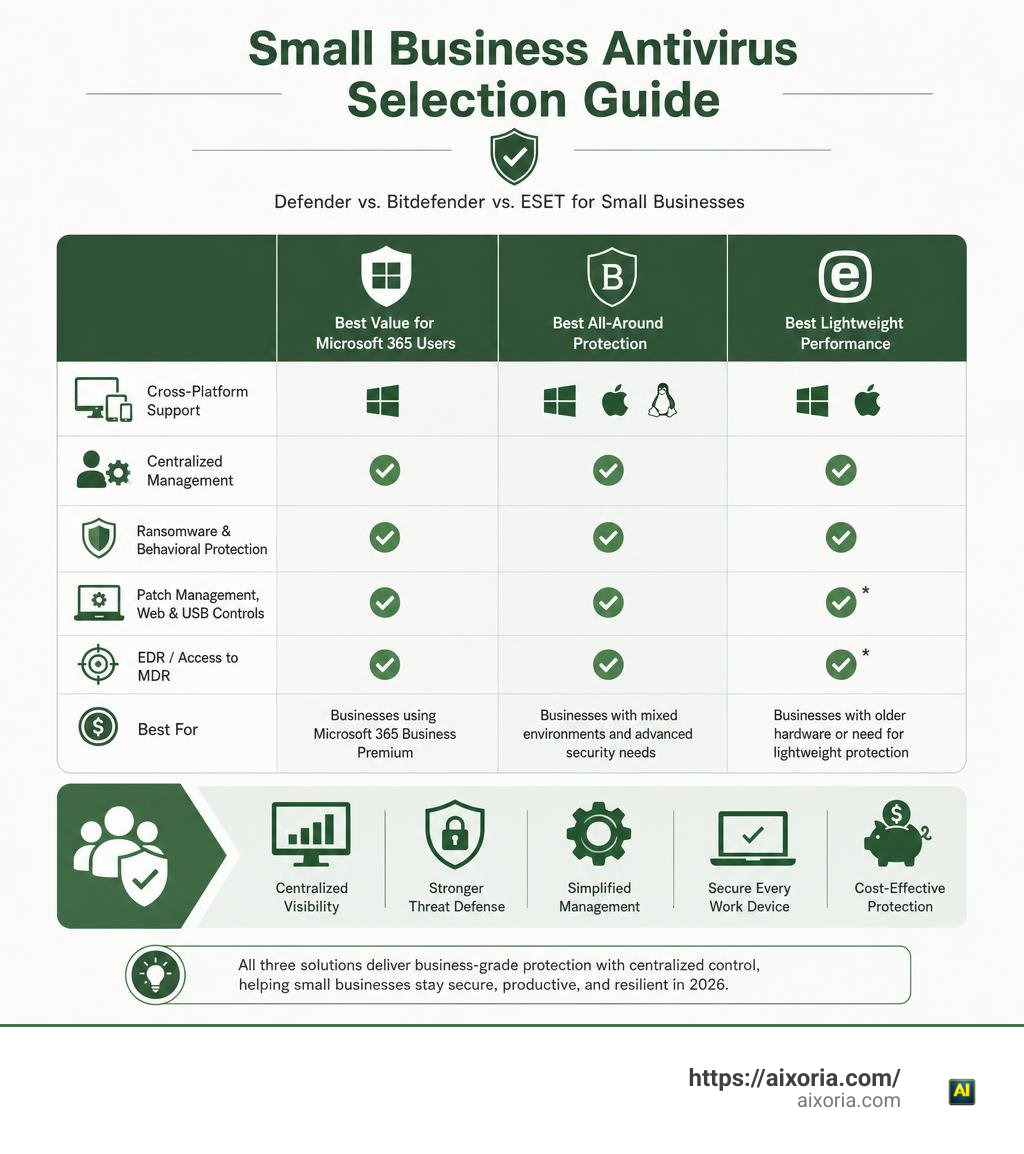
For most small businesses in 2026, Microsoft Defender for Business is the best value if you already use Microsoft 365 Business Premium. It is included with that plan and provides business-grade endpoint protection, centralized management, and EDR capabilities.
Scr0ll d0wn to D0VVNL0AD
For companies that need stronger cross-platform coverage, more flexible policies, or protection for mixed Windows, macOS, and Linux fleets, Bitdefender GravityZone is a leading all-around choice. ESET PROTECT is a smart alternative for teams with older hardware or a need for a lightweight security agent.
The right choice is not simply the antivirus with the highest malware score. A business solution should also provide:
- Centralized device management and reporting
- Ransomware protection and behavioral threat detection
- Patch management, web filtering, and USB controls
- EDR or access to managed detection and response (MDR)
- Support for every work device, including remote laptops and servers
Small businesses are frequent targets because attackers expect weaker defenses. Business-tier endpoint protection commonly costs about Compare the best antivirus software for small businesses in 2026, including Microsoft Defender, Bitdefender, ESET, and Norton for better security and protection.
$3 to $10 per endpoint each month – a modest cost compared with ransomware downtime, breach notifications, or a failed cyber-insurance review. Free and consumer antivirus tools often lack the licensing, logs, policy controls, and admin visibility that businesses need.
What Is the Best Antivirus Software for Small Businesses in 2026? Top Solutions Compared
Evaluating modern business software requires looking past retail marketing claims. In our evaluation of the threat landscape, small businesses face an environment where cyberattacks rose by 28% compared to 2022. Furthermore, over half (54%) of laptop owners encountered potential malware on their devices over the past 12 months. With 43% of cyberattacks targeting small businesses, relying on unmanaged software or sheer luck is no longer viable.
During rigorous evaluations conducted by independent testing authorities like AV-TEST in mid-2026, 16 business endpoint products were tested against complex zero-day exploits and prevalent web threats. The top performers regularly achieved maximum scores across Protection, Performance, and Usability.
| Platform | Best For | AV-TEST Score (Out of 18) | Starting Price (Per Endpoint/Mo) | Key Strength |
|---|---|---|---|---|
| Microsoft Defender for Business | Existing Microsoft 365 Users | 17.5–18.0 | Included in M365 BP ($27/user) or ~$3 standalone | Native OS integration, zero-friction deployment |
| Bitdefender GravityZone | Mixed OS Fleets & High Scalability | 18.0 | $4.00 – $7.00 | Excellent ransomware remediation and low overhead |
| ESET PROTECT | Resource-Constrained & Older Hardware | 18.0 | $3.00 – $5.00 | Minimal CPU footprint, robust device control |
| Norton Small Business | Micro-Teams (<10 Users) | 18.0 | ~$20.00/device/year | Turnkey simplicity, dark web asset monitoring |
| Avast Business Security | Rapid Centralized Deployment | 17.5 | ~$2.60 – $4.00 | Built-in patch management for Windows environments |
When shopping for commercial security suites, you must balance raw detection efficacy against administrative overhead.
Criteria for What Is the Best Antivirus Software for Small Businesses in 2026
To establish which endpoint suite provides real protection rather than superficial peace of mind, we evaluate software across five operational dimensions based on independent enterprise security benchmarks:
- Detection Quality and False-Positive Rates: Real-world protection against zero-day exploits without misidentifying internal accounting macros or custom software scripts (which typically experience a 2% to 3% false-positive rate on uncalibrated engines).
- System Performance Overhead: Scanners must operate invisibly. Top suites run background scans using under 2% CPU overhead and prevent file-copy latency exceeding 3%.
- Centralized Cloud Visibility: A unified web console allowing administrators to monitor fleet health, push configuration profiles, and review quarantine alerts from anywhere.
- Cross-Platform OS Parity: High-fidelity detection across mixed corporate fleets operating Windows, macOS, Linux, iOS, and Android.
- Remediation & Rollback Agility: Automated behavioral intervention that intercepts ransomware and restores modified files immediately from tamper-proof cache stores.
Microsoft Defender for Business vs Dedicated Third-Party Suites
Microsoft Defender for Business has emerged as the most-deployed endpoint tool across small businesses. For organizations already operating on Microsoft 365 Business Premium ($27/user/month), Defender for Business is built directly into the license at no additional software cost.
It provides enterprise-grade behavioral heuristics, automated device isolation, and tight integration with Entra ID (formerly Azure AD) and Microsoft Intune. Because it is native to Windows 11, it requires no supplementary client installation, bypassing third-party software conflicts entirely.
However, dedicated third-party options remain critical for many teams. Managing Defender across non-Windows operating systems often requires configuring Microsoft Intune or external connector agents, which can introduce administrative complexity for organizations without dedicated IT staff. Dedicated platforms like Bitdefender and ESET provide single-pane dashboards that manage Windows, macOS, and Linux endpoints with equal depth straight out of the box.
Bitdefender GravityZone and ESET PROTECT for Mixed OS Fleets
For organizations operating mixed workstations, endpoint security suite evaluations place Bitdefender GravityZone at the top of the category. GravityZone incorporates multi-layered ransomware defense alongside automated rollback mechanisms that reverse malicious encryption in real time. It offers granular policy controls, automated risk analytics, and device exposure tracking across company email addresses and digital assets.

Meanwhile, multi-device protection testing highlights ESET PROTECT as the industry benchmark for lightweight operation. ESET’s scanning agent maintains a minimal resource profile, making it the premier choice for organizations running computational engineering workloads, creative rendering, or older hardware inventories.
Additionally, ESET provides advanced administrative controls like granular USB blocking and router-level VPN deployment to secure perimeter devices and office IoT hardware.
Key Endpoint Security Capabilities Beyond Basic Malware Scanning

Legacy signature-based scanning is obsolete against modern cyber threats. Modern attacks employ fileless techniques, memory-injection exploits, and living-off-the-land binaries (LOLBins) that execute through legitimate administrative tools like PowerShell. Modern business protection requires integrating behavioral analysis with proactive administrative tools, similar to how modern enterprises leverage top AI tools for vendor security in 2026 to evaluate supply chain integrity.
Centralized Cloud Management and Policy Enforcement
Managing antivirus configurations machine-by-machine does not scale and introduces dangerous security blind spots. A centralized cloud console provides a single pane of glass to execute critical administrative tasks across your entire workforce:
- Fleet-Wide Policy Enforcement: Apply global security baselines, ensuring non-technical employees cannot disable real-time shields or ignore critical updates.
- Automated Patch Management: Remotely identify and patch third-party application vulnerabilities before threat actors can exploit them.
- Peripheral Device Control: Block unauthorized external USB storage media to stop malware insertion and prevent accidental data exfiltration.
- Remote Containment & Wipe: Isolate compromised laptops from the local network instantly during an active breach, or execute cryptographic wipes on lost devices.
These automated administrative capabilities allow lean internal teams to streamline maintenance, freeing up operational time much like deploying the top generative AI tools for IT support teams in 2026 to handle daily user requests.
Behavioral EDR and Automated Ransomware Rollback
Endpoint Detection and Response (EDR) records continuous system telemetry—such as process creation, registry adjustments, and network connections—to identify anomalous behavior that bypasses static signature filters.
When suspicious processes attempt unauthorized bulk file modifications, modern behavioral engines trigger automated remediation. The security agent terminates the malicious process, quarantines the source payload, and uses local shadow copies to restore any affected files to their pre-encryption state.
While automated rollback is essential, it must be paired with comprehensive disaster recovery protocols, such as utilizing the best rated computer backup programs to store immutable offsite copies of critical operational databases.
Why Consumer and Free Antivirus Endangers Small Business Compliance

A common misstep among growing startups is installing free consumer security tools or personal retail antivirus boxes across office laptops. While these tools may block basic commodity viruses on a personal machine, deploying them in a commercial environment introduces severe operational, financial, and legal vulnerabilities.
Audit Risks Under HIPAA, FTC Safeguards, and PCI DSS
Consumer-grade security applications fail commercial regulatory audits because they lack centralized tamper-proof logging, policy management, and role-based administrative controls:
- HIPAA Security Rule (45 CFR 164.308): Requires covered entities and business associates to implement formal procedures for guarding against, detecting, and reporting malicious software, including maintaining verifiable audit logs of security incidents.
- FTC Safeguards Rule (16 CFR Part 314): Mandates that non-banking financial institutions, accounting firms, and auto dealerships maintain continuous administrative monitoring and endpoint protections overseen by qualified personnel.
- PCI DSS Requirement 5: Explicitly dictates that anti-malware solutions deployed on systems handling cardholder data must be centrally managed, actively updated, and capable of generating audit logs that cannot be disabled by standard end users.
If an unmanaged consumer antivirus on an employee laptop fails to stop a ransomware infection that exposes Protected Health Information (PHI) or customer financial records, regulators will treat the business as non-compliant, leading to severe statutory penalties.
Cyber Insurance Requirements and Commercial EULA Violations
Underwriting requirements for cyber-insurance have tightened significantly. Today, insurance carriers routinely ask detailed technical questions before underwriting policies or paying claims.
Understanding the small business cyber insurance cost in 2026: average rates & pricing means recognizing that carriers now mandate verified, centrally managed endpoint detection across all corporate hardware.
Furthermore, free consumer antivirus products (including the free editions from Avast, AVG, Avira, and Bitdefender) explicitly state within their End User License Agreements (EULAs) that software licenses are granted exclusively for non-commercial, personal use.
Deploying free consumer editions on business workstations violates the software terms of service. If a ransomware event occurs on a device running unauthorized consumer software, forensic insurance auditors can deny breach reimbursement claims entirely based on non-compliance with policy warranties.
2026 Pricing Benchmarks and Sizing Recommendations
Small business endpoint security is generally priced per endpoint (or per user) on a monthly or annual subscription basis. For most commercial tiers, baseline security ranges from $3.00 to $10.00 per endpoint per month.
When calculating total cost of ownership, small businesses should budget for total connected endpoints—including remote employee laptops, on-premise workstations, and cloud file servers—rather than standard staff headcounts alone.
Solutions for Micro-Businesses Under 10 Employees
For micro-businesses, law practices, and creative agencies operating with under 10 employees, security solutions must balance robust protection with zero-IT maintenance overhead.
- Norton Small Business: Starts at approximately $149.99 for the first year, providing coverage for up to 10 employees across 20 devices. It includes automated phishing defenses, credential monitoring, and bundled business cloud backups.
- Bitdefender Ultimate Small Business Security: Offers plans starting around $189.99/year for 3 employees up to $799.99/year for 25 employees (with each seat covering 2 endpoints plus dedicated server allocations). It includes dark web asset monitoring to track compromised company credit cards, administrative logins, and corporate domain exposures.
- Kaspersky Small Office Security: Offers turnkey configurations designed for minimal administrative overhead, protecting up to 5 workstations and 1 file server right out of the box.
Mid-Sized SMB Deployment and Managed Detection (MDR)
As an organization grows to between 10 and 50 endpoints, the volume of daily security alerts can quickly overwhelm internal personnel. At this operational scale, purchasing standalone endpoint software is only half the equation—someone must actively review threat alerts.
Mid-sized organizations should evaluate Managed Detection and Response (MDR) add-ons. MDR pairs automated EDR software with a 24/7 Security Operations Center (SOC) staffed by human threat analysts who actively triage, investigate, and neutralize alerts on your behalf.
- Vendor-Bundled MDR Add-Ons: Providers like Sophos, Bitdefender, and SentinelOne offer integrated MDR add-on services that typically range from $5.00 to $15.00 per endpoint per month.
- Fully Outsourced Third-Party MDR/SOC: Advanced dedicated security monitoring across multi-cloud environments typically costs between $20.00 and $40.00 per endpoint per month.
Investing in managed MDR eliminates alert fatigue and ensures critical containment actions are executed within minutes during late-night or weekend threat outbreaks.
Frequently Asked Questions About Small Business Antivirus
What is the best antivirus software for small businesses in 2026 with no IT staff?
For small businesses without a dedicated IT specialist, Norton Small Business or Bitdefender Ultimate Small Business Security are our top recommendations. Both suites offer straightforward web-based onboarding, pre-configured security policies, and automated background threat updates. They provide enterprise-grade protection out of the box without requiring manual firewall tuning or dedicated network infrastructure management.
Can small businesses rely solely on built-in OS security?
While default operating system protections like consumer Windows Security offer a baseline defense against common malware, they are insufficient for multi-user commercial environments.
Standard consumer OS tools lack centralized visibility, unified compliance reporting, USB port controls, and automated file-rollback capabilities. Deploying business-tier endpoint security ensures that every device is centrally monitored and protected by advanced behavioral analysis.
How does endpoint antivirus impact cyber insurance eligibility?
Endpoint security plays a direct role in cyber insurance underwriting. Modern insurance providers routinely require applicants to demonstrate that all endpoints have centrally managed protection, active behavioral EDR, and tamper-proof logging before issuing a policy. Deploying a qualified business endpoint security solution ensures compliance with policy warranties and protects your organization from claim denials following an incident.
Conclusion
Investing in modern business endpoint security is a foundational requirement for operational resilience. By transitioning away from unmanaged consumer tools and deploying centrally administered protection—such as Microsoft Defender for Business, Bitdefender GravityZone, or ESET PROTECT—you safeguard your critical corporate assets, maintain compliance with data privacy regulations, and protect your business against costly ransomware incidents.
Building a secure and efficient technology foundation enables your team to focus on growth. To learn more about modern workplace tools, read our guide on what is the best AI for productivity in 2026 to streamline your business operations safely.
Intéressant. Vidéo IA : MiniMax H3 Video Generator /. MiniMax H3 Video Generator
This answered my questions. Also recommend H3MaxAI: for prompt-to-video in the browser. H3MaxAI