How AI Handles Storage Bookings and Late Payments
Scr0ll d0wn to D0VVNL0AD
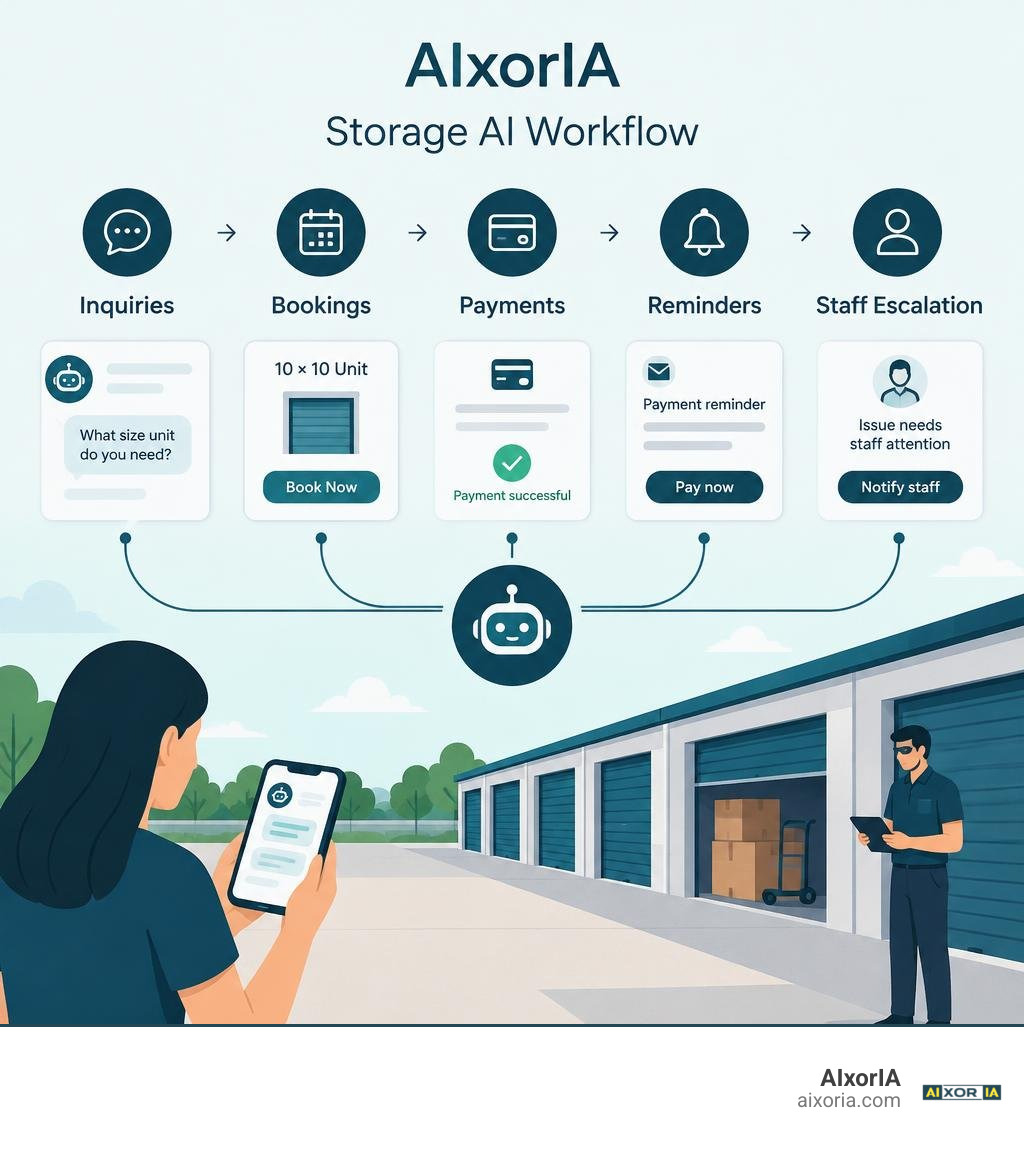
AI tools for bookings and late payments at storage facilities work best when they share live data with your property management system. A chat or voice agent can answer questions after hours, suggest a unit size, and guide a renter through booking, payment, and lease signing. Billing automation can send reminders, retry failed payments, and give tenants a link to pay.
Start with those two workflows, not a pile of separate tools. Check that bookings, balances, and tenant records stay in sync. Set clear rules for when staff must step in, especially for billing disputes, lockouts, and legal notices.
Core Capabilities of AI Tools for Storage Facilities for Bookings and Late Payments
Running a self-storage business has changed dramatically. The self-storage software market was valued at $2.5 billion in 2024 and continues to expand at an annual growth rate of 12.7%, fueled largely by the shift toward contactless services and automated workflows. Storage managers no longer need to spend their days tethered to a front desk or manually logging delinquent accounts on paper spreadsheets.
Modern platforms unify front-end customer acquisition and back-office accounting into an autonomous operational layer. Instead of treating customer service and debt collection as separate administrative chores, artificial intelligence orchestrates the entire tenant lifecycle:
- Omnichannel Lead Capture: Capturing leads across inbound voice calls, SMS, and web chat simultaneously.
- Context-Aware Sizing: Recommending appropriate square footage based on conversation context or user-uploaded photos.
- Frictionless Conversion: Processing digital identity verification, electronic lease execution, and initial payment in a single session.
- Access Control Dispatch: Generating and delivering dynamic gate access credentials instantly.
- Continuous Account Monitoring: Tracking billing health, scheduling automated payment retries, and enforcing facility rules when accounts fall behind.
By automating these routine touchpoints, facilities can operate with high autonomy—often running daily operations without on-site personnel while improving tenant satisfaction and collection speed.
Automating 24/7 Reservations with AI Tools for Storage Facilities for Bookings and Late Payments
Self-storage leasing is heavily time-sensitive. When prospective renters decide to clear out a garage or store items during a home move, they often reach out during evenings or weekends. If a facility does not answer, the prospect simply calls the next competitor on the map.
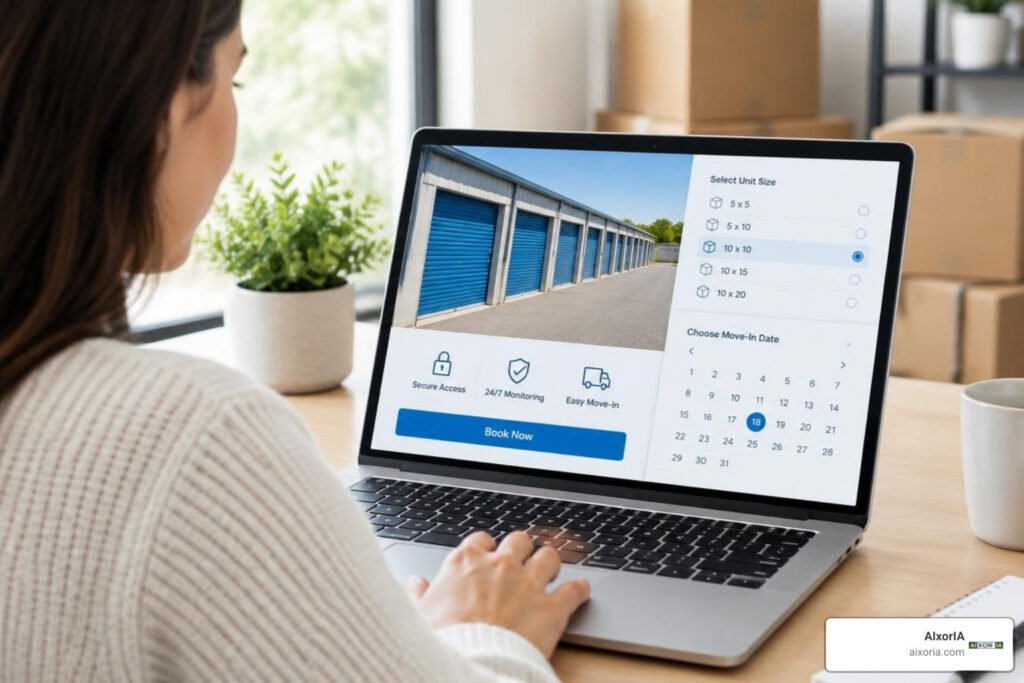
Deploying dedicated ai tools for storage facilities for bookings and late payments ensures your doors remain open around the clock. Conversational booking bots engage prospects instantly, analyzing their specific storage needs to recommend the ideal unit size. Some visual AI systems even allow prospects to upload a photo of their furniture or moving boxes, accurately mapping their belongings to a 5×10 or 10×10 space.
Once the unit is selected, the system guides the customer through digital lease signing and payment processing. Just like modern scheduling software features that eliminate back-and-forth calendar coordination, self-storage automation completes the full reservation pipeline instantly. A tenant can select a unit, sign the rental agreement, submit payment, and receive their personalized digital gate code in under two minutes without staff intervention.
Virtual Receptionists and After-Hours Voice Agents
Traditional voicemail is where self-storage leads go to die. An after-hours voice agent, by contrast, actively captures and closes the sale while the customer is ready to buy.
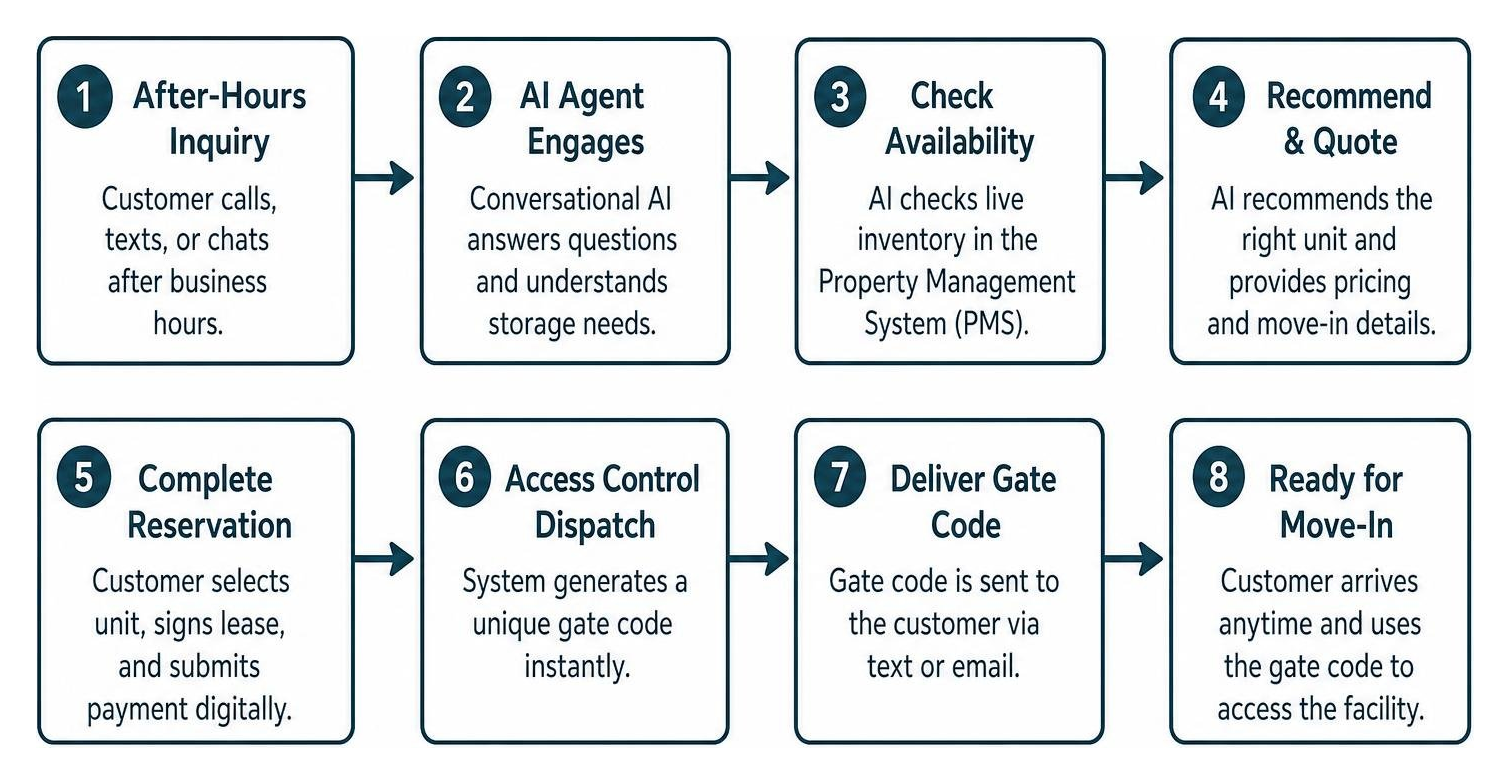
Unlike rigid interactive voice response (IVR) phone trees that frustrate callers with numeric menus, conversational voice agents use natural language understanding to converse naturally. They answer common questions regarding gate hours, climate control options, and insurance requirements, while checking live inventory in your Property Management System (PMS).
In addition to converting inbound sales, voice agents act as reliable missed call answering solutions, retrieving abandoned inquiries and sending follow-up text messages with direct reservation links. If a query requires human intervention—such as an unusual commercial delivery request—the AI logs the call transcript, tags the recording, and creates a task for on-site staff.
Autonomous Delinquency Management and Collections
Chasing overdue rent is one of the most uncomfortable and time-consuming tasks for storage operators. Manual invoicing and payment follow-ups routinely consume 20 to 30 hours per month for a typical facility manager. Automation removes administrative friction by handling recurring billing and late payment recovery autonomously.
Connecting your PMS to automated invoicing software establishes structured dunning schedules. Rather than waiting for an operator to print statements or dial past-due tenants, the system triggers multi-channel communication sequences the moment a card payment fails.
Mitigating Revenue Leakage Using AI Tools for Storage Facilities for Bookings and Late Payments
Revenue leakage in self-storage often stems from passive collection processes: expired credit cards that sit unaddressed, forgotten invoices, or billing systems that fail to retry declined charges strategically.

Automated tools resolve overdue balances through structured, frictionless communication:
- Smart Payment Retries: Retrying declined debit and credit cards automatically over several days to capture funds as soon as accounts are replenished.
- Self-Service Update Links: Sending secure, one-click payment links via SMS and email, allowing tenants to update expired payment details on their smartphones without logging into complex portals.
- Proactive Account Notifications: Alerting tenants several days before card expiration dates to prevent billing failures before they happen.
- Automated Late Fee Calculations: Enforcing facility rules by applying state-compliant late fees automatically at designated grace-period thresholds.
Data shows that intelligent voice and messaging agents can resolve 4 out of 5 payment-related inquiries without staff involvement, protecting cash flow and keeping tenant accounts current.
Automated Lockouts, Overlocks, and Lien Compliance
When payments remain unpaid past the grace period, managing access restrictions and legal compliance manually can expose operators to operational and legal risks.
Integrated AI systems handle these enforcement steps objectively:
- Gate Access Lockouts: The software automatically updates the electronic access control system to suspend gate codes for delinquent accounts.
- Instant Access Restoration: When a locked-out tenant calls or visits the website, an automated agent explains the balance due, collects payment via credit card or digital wallet, and immediately re-enables their gate code.
- Statutory Lien Notice Workflows: Managing delinquent storage units requires strict adherence to regional lien laws. Modern systems generate legally compliant certified notices, track mandatory notification timelines, and log verifiable audit trails, similar to how dedicated accounting software for landlords organizes property audit trails and lease compliance documents.
- Dispute Escalation: If a tenant disputes a fee or cites extenuating circumstances, the AI adheres to pre-set waiver caps (such as waiving fees up to $25) or routes the conversation directly to senior management with full context.
Technical Integration, Revenue Management, and Cost Models
An automation tool is only as reliable as its connection to your core property records. Fragmented systems create data silos, resulting in double bookings or inaccurate delinquency statuses.
PMS Integration and Dynamic Revenue Management
Modern storage solutions integrate via robust application programming interfaces (APIs) with leading self-storage property management systems. This two-way synchronization ensures that unit availability, gate codes, and payment ledgers update across all platforms in real time.
Beyond basic record-keeping, predictive revenue management tools analyze historical occupancy, seasonal turnover, and local market demand to optimize rental rates dynamically. When unit categories reach high occupancy thresholds (e.g., climate-controlled 10x10s crossing 90% capacity), the system automatically adjusts web rates upward to maximize yield. Conversely, it can deploy targeted promotional discounts on slow-moving inventory to maintain steady move-in velocity.
Cost Comparison: AI Tools vs. Traditional Staffing
Evaluating automation requires comparing software subscription and usage costs against traditional payroll, on-site staffing overhead, and third-party call center expenses.
| Operating Model | Typical Monthly Cost | Availability | Booking & Payment Capabilities | Scalability |
|---|---|---|---|---|
| Traditional On-Site Staff | $3,200 – $4,500 / facility (wages, benefits) | 40–50 hrs/week (standard office hours) | Full capability during office hours; zero after-hours capture | Requires hiring additional personnel for every new location |
| Third-Party Answering Service | $400 – $1,200 / facility (per-minute fees) | 24/7 coverage | Often limited to taking messages and basic FAQs; rare PMS write-back | Variable call quality; charges increase directly with call volume |
| Integrated AI Automation | $150 – $600 / facility (flat tier + usage) | 24/7/365 uninterrupted | Full end-to-end lease execution, payment recovery, and access dispatch | Scales instantly across single or multi-site portfolios with zero added headcount |
By recovering missed after-hours inquiries and eliminating manual payment chasing, operators frequently generate over $1,400 in new monthly revenue per facility from calls that previously went to voicemail, while saving 20 to 30 administrative hours every month.
Key Features to Evaluate When Selecting AI Storage Software
Selecting the right automation stack requires looking past surface-level marketing claims to verify real-world operational capabilities.
When auditing tools for your facility, prioritize the following core criteria:
- Native PMS and Gate Access Integration: Verify that the platform writes data back to your management database and access control hardware instantly to avoid double bookings and delayed lockouts.
- Customizable Operational Playbooks: Look for platforms that allow you to define facility-specific rules (such as custom move-out notice periods, payment grace periods, or fee waiver limits) in plain language.
- True Omnichannel State Retention: Ensure conversation context transfers seamlessly if a customer begins an inquiry via web chat, continues over SMS, and calls the facility later.
- Smart Escalation & Fallback Protocols: The system must cleanly route complex disputes, physical maintenance emergencies, and upset tenants to human managers with complete interaction transcripts.
- Open API Infrastructure: Choose tools that avoid vendor lock-in, enabling you to export your data and connect external business intelligence dashboards or custom reporting workflows easily.
Frequently Asked Questions About Storage AI Automation
How quickly can a tenant complete an AI-driven storage move-in?
A customer can complete an autonomous move-in from their phone or computer in under two minutes. The automated workflow handles unit sizing, identity verification, digital contract signing, payment processing, and instant text delivery of their gate access code without staff assistance.
How does AI handle complex billing disputes and angry tenants?
Conversational agents use real-time sentiment analysis to detect frustration or complex dispute terminology. When an interaction exceeds pre-configured policy limits (such as a fee waiver request exceeding standard thresholds or a disputed charge), the system calms the tenant, logs the complete history, and escalates the ticket directly to a human manager.
What ROI can storage facility operators expect from AI implementation?
Most operators see measurable returns within the first 30 to 60 days. Key financial returns stem from capturing after-hours rental leads that previously went to voicemail, reclaiming 20 to 30 hours of monthly staff time spent on collections, and resolving up to 80% of routine payment inquiries automatically.
Conclusion
Automating bookings and late payment collections is one of the most effective ways for storage operators to protect revenue, lower overhead, and scale their portfolios efficiently. Moving away from manual front-desk tasks allows your team to focus on on-site maintenance, capital improvements, and tenant relations.
At AIxorIA, we help businesses design and implement cost-effective automation frameworks, practical tool training, and custom GTM orchestration solutions that drive measurable growth without locking you into rigid software ecosystems. Explore how intelligent automation can modernize your property workflows and streamline your facility operations today.