Why Small Businesses Need Cyber Insurance Policies for Small Businesses Canada

As Canadian companies shift more operations online, using cloud databases, digital point-of-sale platforms, and remote workplace software, their exposure to cybercrime increases. Under federal statutes like the Personal Information Protection and Electronic Documents Act (PIPEDA), as well as corresponding provincial privacy laws, small businesses are legally responsible for safeguarding customer, employee, and partner data. If a breach occurs, businesses are required to notify affected individuals and privacy commissioners, cover notification costs, and offer credit monitoring services.
In 2023, the average total cost of a data breach for a Canadian organization reached approximately $6.9 million. While mega-corporations account for the largest single incidents, smaller organizations face proportional financial risks. Nearly half (45%) of all Canadian small businesses have suffered a cyber attack, and over 40% report that an incident cost them more than $100,000. For a small business, a $100,000 unplanned expense can derail cash flow and operational stability.
Many owners assume their standard commercial policies will shield them from these events. However, standard commercial policies often contain explicit exclusions for digital threats or provide very low limits for online incidents.
Understanding how much general liability insurance is in Canada for 2026 costs reveals that traditional policies protect primarily against physical bodily injury and property damage, not corrupted code or stolen servers.
To determine which insurance is best for business in 2026 in our complete guide, evaluating standalone cyber insurance policies for small businesses Canada is essential.
Debunking Small Business Cybersecurity Misconceptions
A persistent gap exists between actual cyber risk and owner awareness. Over 60% of small business owners believe their operations are too small to be targeted by cybercriminals, a figure that rises to 73% among sole proprietors.
Attackers frequently use automated bots to scan the internet for vulnerabilities regardless of company size. Small firms often serve as gateways into the networks of larger corporate partners.
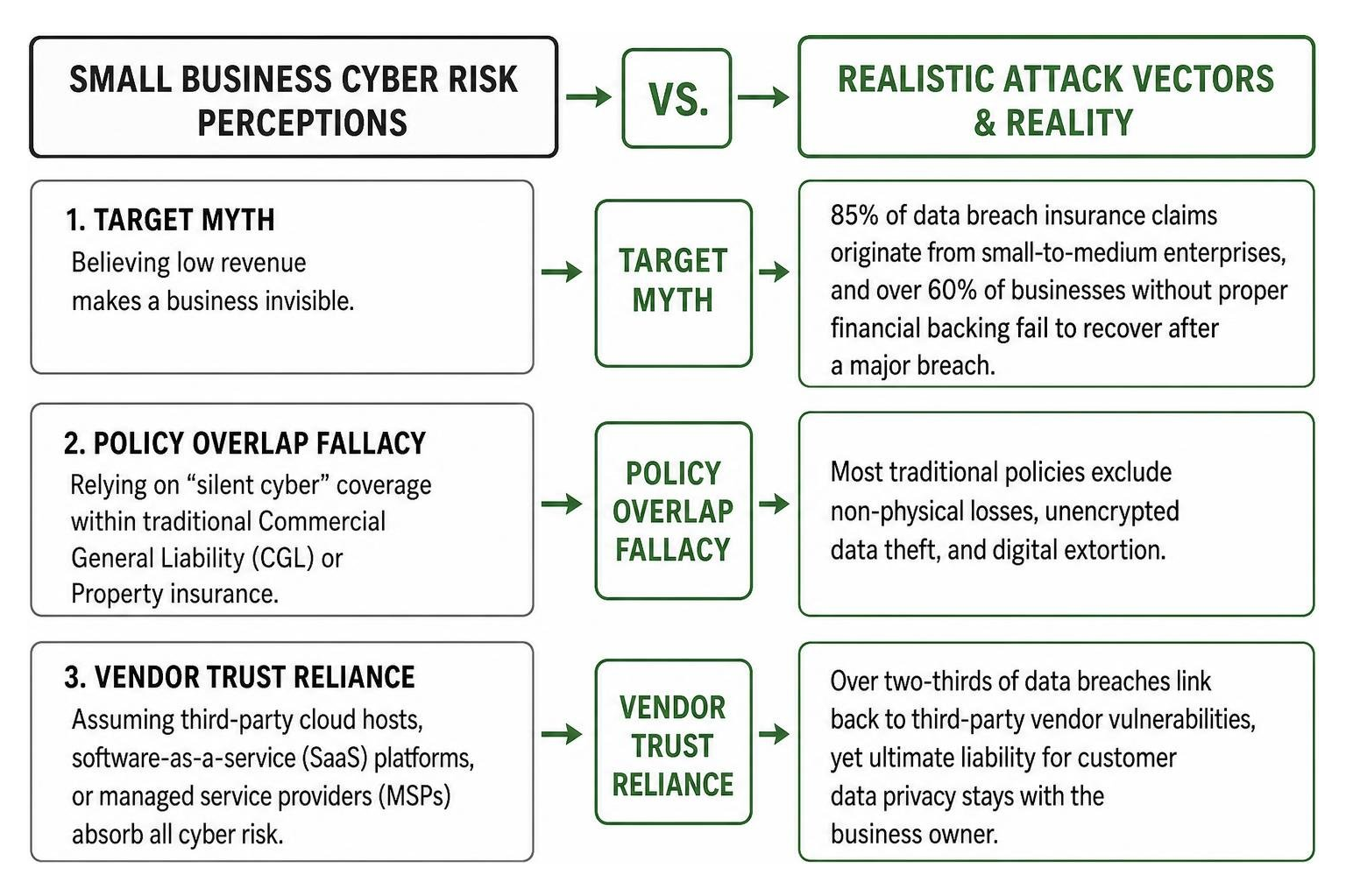
Key misconceptions include:
- Target Myth: Believing low revenue makes a business invisible. In reality, 85% of data breach insurance claims originate from small-to-medium enterprises, and over 60% of businesses without proper financial backing fail to recover after a major breach.
- Policy Overlap Fallacy: Relying on “silent cyber” coverage within traditional Commercial General Liability (CGL) or Property insurance. Most traditional policies exclude non-physical losses, unencrypted data theft, and digital extortion.
- Vendor Trust Reliance: Assuming third-party cloud hosts, software-as-a-service (SaaS) platforms, or managed service providers (MSPs) absorb all cyber risk. Over two-thirds of data breaches link back to third-party vendor vulnerabilities, yet ultimate liability for customer data privacy stays with the business owner.
Sole proprietors handling client files or financial credentials face direct personal exposure. Exploring the best business insurance options for sole proprietors in 2026 helps show why explicit digital asset protection is vital for independent operators.
Core Coverage Breakdown: First-Party vs. Third-Party Protections
Cyber insurance policies organize their protection around two core coverage pillars: First-Party Protections (direct financial impact to your business) and Third-Party Protections (liabilities owed to external entities).
| Coverage Category | Specific Included Expenses | Typical Operational Scenario |
|---|---|---|
| First-Party Coverage | • Forensic IT investigations • System restoration & data recovery • Cyber extortion/ransom payments • Business interruption income loss • Customer notification & credit monitoring | A ransomware virus encrypts operational databases, forcing a temporary closure and requiring specialized IT engineers to decrypt and restore records. |
| Third-Party Coverage | • Legal defense expenses • Privacy lawsuits & civil settlements • PIPEDA regulatory defense & fines • PCI DSS assessments & credit card penalties | Clients sue your firm after their personal payment details are leaked online due to a security breach in your digital checkout system. |
Core Coverage Elements in Cyber Insurance Policies for Small Businesses Canada
Comprehensive cyber insurance policies for small businesses Canada combine multiple specialized insurance components into a single agreement:
- Data Restoration & Computer Attack Recovery: Covers costs to clean infected hardware, remove malware, re-install corrupted operating systems, and reconstruct destroyed data files.
- Business Interruption & Operational Loss: Reimburses lost net income and ongoing payroll costs when a cyber attack temporarily halts core business operations.
- Funds Transfer Fraud & Social Engineering: Protects against financial loss caused by trickery, such as malicious actors spoofing executive emails to trick employees into sending funds to rogue external accounts.
- Identity & Executive Recovery: Reimburses business executives and owners for out-of-pocket expenses, legal guidance, lost personal wages, or identity restoration services if personal identities are compromised during a corporate breach.
Key Exclusions in Cyber Insurance Policies for Small Businesses Canada
While cyber policies offer extensive protection, policies contain explicit exclusions:
- Known Unpatched Vulnerabilities: Insurers will deny claims if an attack exploited a software flaw for which an official security patch had been available for an extended period but was ignored by the business.
- Intentional Fraud or Executive Acts: Illegal, dishonest, or criminal acts carried out directly by business owners, directors, or executive officers are never covered.
- Bodily Injury and Physical Property Damage: Cyber policies cover intangible digital records and lost electronic operations. Physical destruction of hardware caused by fires or severe weather falls under property policies.
- Non-Monetary Liabilities: Statutory exclusions often apply to criminal fines or non-monetary court injunctions.
Reviewing whether commercial property insurance is mandatory helps clarify how physical building policies and digital liability policies work side-by-side to insulate a company.
Underwriting Criteria, Costs, and Risk Mitigation Strategies

Underwriters analyze small business applications based on technical risk controls, annual revenues, stored data volume, and general cyber hygiene. Businesses with weak internal controls face higher premiums, higher deductibles, or denial of coverage.

Key security requirements insurers evaluate include:
- Multi-Factor Authentication (MFA): Mandatory deployment across email systems, remote server logins, administrative accounts, and external cloud access points.
- Immutable Offline Backups: Establishing regular data backups that are stored off-site and isolated from the main network, ensuring ransomware cannot encrypt back-up copies.
- Employee Risk Awareness Training: Conducting regular staff training on phishing techniques, password security, and safe AI usage. Over 75% of surveyed employees admit to workplace actions that increase cyber risk, such as pasting sensitive data into public generative AI tools.
Applying 10 proven ways to reduce your commercial insurance premium helps lower overall premium costs while strengthening network security defenses. Comparing rates across multiple carriers allows companies to determine who has the cheapest business insurance in 2026.
Self-Assessment and Qualification Standards
Insurers evaluate business readiness using formal underwriting tools. To streamline the qualification process, small business owners should audit internal operations against these four core standards:
- Cyber Hygiene Protocols: Require strong, unique passwords across all user accounts, enforce automatic patching of software programs, and install managed firewalls across operational devices.
- Offline Backup Verification: Regularly test system restoration procedures from isolated offline backups rather than assuming automated cloud syncs will work smoothly after a network breach.
- Endpoint Detection & Response (EDR): Deploy continuous monitoring tools across corporate laptops, mobile phones, and local servers to detect and isolate suspicious network activity.
- Virtual CISO & Advisory Integration: Small firms lacking dedicated IT teams can utilize virtual Chief Information Security Officer (vCISO) services or third-party IT partners to manage risk policies and incident response frameworks.
Immediate Action Steps Following a Cyber Incident

When a breach occurs, immediate action is required. Taking proper steps right away ensures business continuity and protects your policy coverage rights.
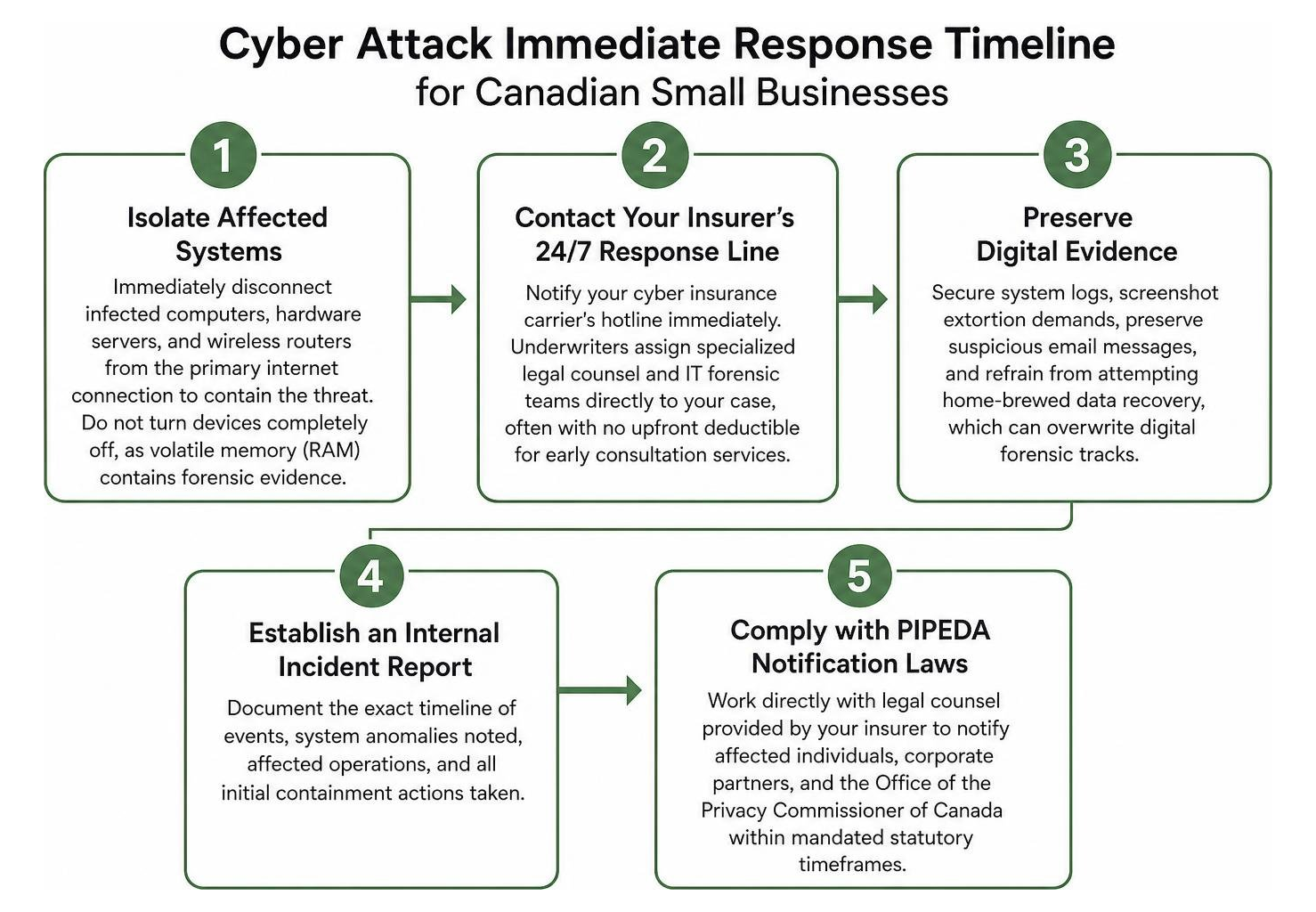
- Isolate Affected Systems: Immediately disconnect infected computers, hardware servers, and wireless routers from the primary internet connection to contain the threat. Do not turn devices completely off, as volatile memory (RAM) contains forensic evidence.
- Contact Your Insurer’s 24/7 Response Line: Notify your cyber insurance carrier’s hotline immediately. Underwriters assign specialized legal counsel and IT forensic teams directly to your case, often with no upfront deductible for early consultation services.
- Preserve Digital Evidence: Secure system logs, screenshot extortion demands, preserve suspicious email messages, and refrain from attempting home-brewed data recovery, which can overwrite digital forensic tracks.
- Establish an Internal Incident Report: Document the exact timeline of events, system anomalies noted, affected operations, and all initial containment actions taken.
- Comply with PIPEDA Notification Laws: Work directly with legal counsel provided by your insurer to notify affected individuals, corporate partners, and the Office of the Privacy Commissioner of Canada within mandated statutory timeframes.
Frequently Asked Questions About Canadian Business Cyber Insurance
Does general liability insurance cover ransomware demands?
Standard Commercial General Liability (CGL) insurance policies almost never cover ransomware extortion demands, system decryption fees, or digital business interruption costs. CGL policies protect primarily against physical injuries to people or physical damage to tangible property.
Most traditional policies include explicit “silent cyber” exclusions that block coverage for unencrypted data loss, malicious software infections, and digital ransom payments, making a standalone cyber policy necessary.
How much does cyber insurance cost for a small business in Canada?
Cyber insurance premiums for small businesses in Canada vary based on several factors:
- Annual Revenue: Higher revenues generally mean larger data exposure and higher premiums.
- Industry Threat Profile: Healthcare, financial services, e-commerce, and legal firms pay more due to the sensitive nature of the data they manage.
- Security Controls: Implementing Multi-Factor Authentication (MFA), offline backups, and password policies can lower annual costs.
- Deductibles & Limits: A policy offering $1 million in coverage with a $2,500 deductible costs less than one with a higher coverage limit and lower deductible.
Basic policies for low-risk micro-businesses start at manageable monthly rates, while specialized policies for tech providers carry higher premiums based on exposure.
Are PIPEDA regulatory penalties covered under cyber insurance?
Yes, many standalone cyber insurance policies for Canadian small businesses include coverage for regulatory defense and civil fines resulting from mandatory PIPEDA proceedings.
If a privacy commissioner investigates your firm following a customer data breach, policy coverage can pay for specialized privacy lawyers, investigation defense costs, and insurable regulatory penalties levied for failing to safeguard personal data.
Conclusion
At Aixoria, we believe maintaining strong digital security relies on a clear understanding of operational risks and insurance protections. As small business technology evolves, purchasing dedicated cyber insurance policies for small businesses Canada helps safeguard digital infrastructure, protect operational cash flow, and build long-term business resilience.
To stay informed on emerging security frameworks, operational technology insights, and digital risk management strategies, explore our latest AI & insurance updates to keep your organization protected.
1 thought on “Cyber Insurance for Small Businesses in Canada: 2026 Guide”