Which Auto Insurance Is Best in the US in 2026?

Which auto insurance is best in US depends on your driving record, location, credit score, and what you value most — price, service, or claims handling. But here’s a quick answer to get you started:
Top Auto Insurance Companies in the US for 2026
| Company | Best For | Avg. Annual Full Coverage |
|---|---|---|
| Travelers | Best overall value | $1,653 |
| USAA | Military families | $1,335 |
| Progressive | High-risk drivers | $1,948 |
| GEICO | Discounts & savings | $2,058 |
| Amica | Customer satisfaction | $3,167 |
| Erie | Claims handling | $1,812 |
| National Average | — | $2,496 |
USAA is available only to military members, veterans, and their families.
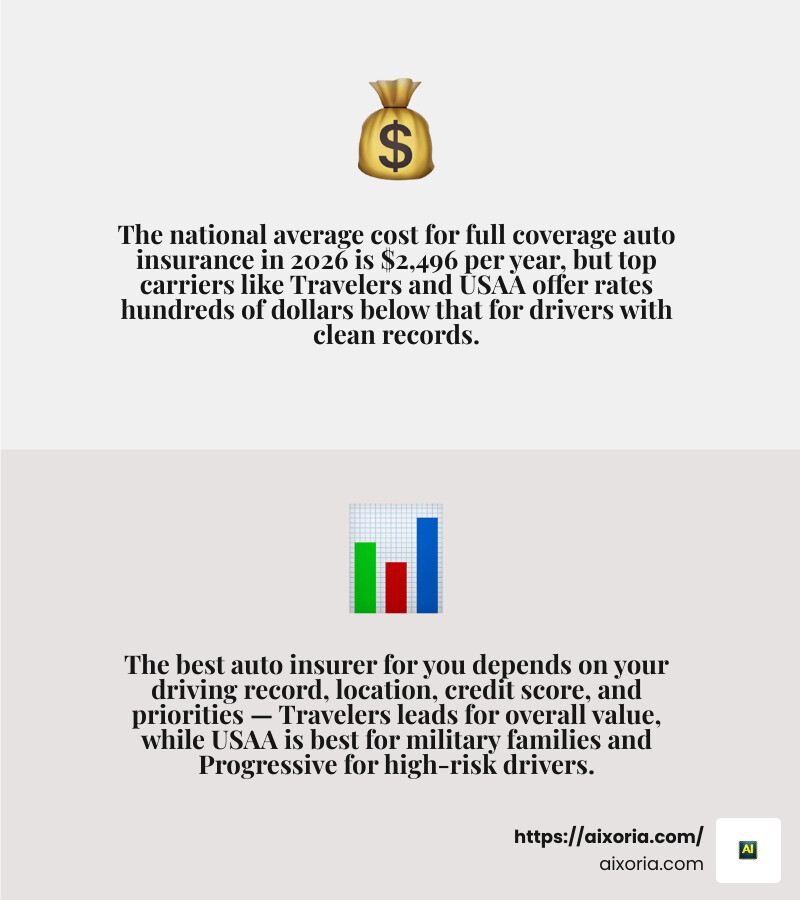
Most drivers overpay for car insurance — and don’t know it. The national average for full coverage in 2026 is $2,496 per year. But top-rated carriers like Travelers and USAA come in hundreds of dollars below that for drivers with clean records.
The problem? There’s no single “best” insurer for everyone. The right company for a 22-year-old with one speeding ticket in Atlanta is completely different from the right company for a 45-year-old homeowner with perfect credit in Ohio.
This guide cuts through the noise. You’ll learn which carriers win in each category, how to stop overpaying at renewal, what coverage levels actually protect your assets, and how factors like your credit score and driving history quietly shape your rate.
Decoding Which Auto Insurance is Best in US?
When searching for the perfect car insurance carrier, we have to look past the funny commercials and talking geckos. To truly understand which auto insurance is best in US, we must evaluate carriers on a holistic mix of affordability, financial strength, and consumer complaint history.
In July 2026, the national average cost of car insurance stands at $2,496 per year for full coverage and $912 per year for minimum coverage. However, the leading carriers offer vastly different rates and experiences:
- Travelers: Currently leading the pack as the best overall national car insurance company. With an average annual rate of $1,653 for clean-record drivers, it sits well below the national average while boasting a superior AM Best financial strength rating of A++.
- Amica: If customer service is your absolute non-negotiable, Amica is the gold standard. While its average annual full coverage rate is higher at $3,167, its dividend-paying policies and legendary claims handling make it highly popular for drivers who prioritize peace of mind over the lowest premium.
- Erie Insurance: A regional powerhouse operating in 13 states. Erie consistently tops third-party studies, scoring an impressive 743 out of 1,000 in the J.D. Power Auto Claims Satisfaction Study. It offers a stellar average annual rate of $1,812.
- GEICO: The master of discounts. With an average annual full coverage rate of $2,058 for a clean-record driver, GEICO is highly competitive and offers a 97% customer satisfaction rating alongside over $900 in average annual savings for those who switch.
- Progressive: The ultimate choice for optional coverage add-ons and high-risk drivers. Its average full coverage rate sits at $1,948 per year.
To see how these rates stack up against other budget-friendly options, check out our guide on the Top 10 Cheapest Car Insurance Companies and explore the nuances of Cheapest Auto Full Coverage Insurance to find the best policy for your wallet. For a deeper look at industry reputations, you can also browse the Most Reputable Car Insurance Companies in 2026 Top 10 Ranked.
To learn more about how experts evaluate these top contenders, you can read the Best Car Insurance Companies of 2026: 6 Top Carriers.
Which Auto Insurance is Best in US for High-Risk Drivers?
If your driving record has a few blemishes, the search for the right carrier changes dramatically. A single DUI conviction raises the national average cost of full coverage insurance to a staggering $4,342 per year, while an at-fault accident typically bumps premiums by an average of 49%.
For high-risk drivers, Progressive is widely recognized as the strongest national option. While GEICO is highly aggressive for clean-record drivers, Progressive is much more accommodating to drivers with speeding tickets, at-fault accidents, or those requiring an SR-22 filing. For example, after an at-fault accident, Progressive’s average rate is significantly more forgiving than many of its competitors.
State Farm is another excellent post-accident option, historically raising rates by only about 14% after a crash, compared to the 49% national average. For drivers who standard carriers decline outright, non-standard specialist insurers like National General or The General (which was acquired by Sentry Insurance for $1.7 billion) specialize in insuring higher-risk individuals.
Navigating coverage for younger, inexperienced drivers is equally challenging. If you have a teenager in the household, read our breakdown of Cheap Auto Insurance for Teens to keep your premiums from skyrocketing.
Which Auto Insurance is Best in US for Military Families?
For active-duty military members, veterans, and their immediate families, the answer to which auto insurance is best in US is almost always USAA.
USAA regularly outperforms every other carrier in virtually every metric, including price, customer service, and claims handling. In 2026, USAA’s average annual full coverage rate is a remarkably low $1,335 — nearly half the national average of $2,496.
With an NAIC complaint ratio of just 0.71 (well below the national median of 1.0) and a J.D. Power score of 909, USAA would easily sweep the “best overall” category in national rankings if its membership weren’t restricted to the military community. If you qualify, it is almost always your best starting point.
If you are a young driver or student in a military household looking for specialized rates, you may also find our guide on Cheapest Car Insurance for Young Adults helpful for comparing your options.
How to Avoid the Loyalty Tax and Find the Cheapest Rates

Did you know that staying loyal to your car insurance company can actually cost you hundreds of dollars a year? Insurers use an underwriting practice known as “price optimization.” Essentially, they use data algorithms to predict which customers are unlikely to shop around, and they slowly raise their rates over time.
This is what consumer advocates call the loyalty tax. On average, the loyalty tax raises premiums on existing customers by 6% to 11% per year of tenure. After 5 years with the same carrier, you are typically paying 30% to 45% more than a new customer would for the exact same coverage level.
According to data from the Bureau of Consumer Financial Protection, drivers who actively shop around at renewal save an average of $487 per year. If you want to keep your hard-earned money in your pocket, we highly recommend checking out our list of the Top 5 Affordable Auto Insurance Companies to see where you can find immediate relief.
Shopping at Renewal to Save Hundreds
The single most effective weapon against the loyalty tax is establishing a consistent renewal shopping routine. We recommend quoting at least three outside carriers at every renewal cycle (typically every 6 months).
The optimal window to switch auto insurance carriers is 7 to 14 days before your current policy’s renewal date. To make this process as simple and accurate as possible, follow these steps:
- Pull Your Current Declarations Page: This document lists your exact coverage limits, deductibles, and active discounts.
- Request Identical Quotes: When shopping with other carriers, input the exact same limits and deductibles to ensure an apples-to-apples comparison.
- Check for the “Loyalty Tax” Math: If an outside quote beats your current renewal rate by 8% or more, it is mathematically worth making the switch.
To maximize your savings during this process, read our comprehensive guide on How to Get the Maximum Discount on Car Insurance as well as our expert tips on What is the Best Way to Reduce Car Insurance.
Regional vs. National Carriers
When most people think of car insurance, they think of national giants. But regional carriers like Erie Insurance and Auto-Owners are often the best-kept secrets in personal finance.
Because regional carriers do not spend billions of dollars on massive national advertising campaigns, they can pass those savings directly to policyholders. Within their operating footprints, regional carriers are frequently 15% to 25% cheaper than national brands while offering superior, highly localized customer service.
For example, Auto-Owners operates in 26 states and is widely praised for its incredibly low minimum coverage rates (averaging just $447 annually). If you live in a major metropolitan area where rates are historically high, checking regional options is crucial. For instance, residents of Texas can check out our hyper-local analysis of the Best Car Insurance Rates in Houston to see how local and regional players compare.
Recommended Coverage Levels to Protect Your Assets

Choosing the right insurance company is only half the battle; you also need to select the right amount of coverage. Opting for state minimum coverage might save you a few dollars a month, but it can leave you financially vulnerable in a major accident.
If you have personal assets to protect — such as savings, a home, or investments — state minimums are dangerously low and represent a potential multi-thousand-dollar mistake.
Understanding Liability Limits
We strongly recommend maintaining a modern minimum liability limit of 100/300/100 instead of your state’s minimums. Here is what those numbers actually mean:
- $100,000 Bodily Injury Liability per person: The maximum amount your insurer will pay for a single injured person’s medical bills in an accident you cause.
- $300,000 Bodily Injury Liability per accident: The total maximum your insurer will pay for all injured parties in a single accident.
- $100,000 Property Damage Liability: The maximum amount paid to repair or replace another person’s vehicle, fence, or property.
Additionally, you should always carry Uninsured/Underinsured Motorist (UM/UIM) coverage at the exact same limits as your liability coverage. Approximately 13% of US drivers carry no auto insurance at all. If one of them hits you, UM/UIM ensures your medical bills and property damage are covered.
Finally, if your net worth exceeds $250,000, we recommend adding a $1 million personal umbrella liability policy. This typically costs only $250 to $400 per year and provides an extra layer of protection over both your auto and homeowners insurance.
When to Drop Comprehensive and Collision
Comprehensive and collision coverages (which pay to repair your own car after an accident, theft, or weather event) are essential for newer or financed vehicles. But if you drive an older vehicle, you might be paying more in premiums than the car is actually worth.
To determine when to drop these physical damage coverages, use the 10x Rule:
The 10x Rule: If the actual cash value (ACV) of your vehicle is less than 10 times the annual premium cost of your comprehensive and collision coverages combined, it is time to drop them and pocket the savings.
For example, if comprehensive and collision cost you $400 a year, but your old sedan is only worth $3,000, you are spending more than 13% of the car’s total value every year just to protect it. To run the numbers on your specific vehicle, you can use our Insurance Car Quotes Online Comparison tool to see how dropping physical damage coverage impacts your monthly rates.
Frequently Asked Questions About US Auto Insurance
How does my credit score affect my auto insurance rate?
In every state except California, Hawaii, Massachusetts, and Michigan, insurance companies use your credit history to calculate a “credit-based insurance score.” Statistically, drivers with lower credit scores file more claims, so insurers charge them higher premiums.
Having poor credit can raise your national average full coverage rate to $3,911 per year, even if you have a completely clean driving record. Conversely, a 100-point improvement in your credit score can drop your auto insurance premiums by 15% to 25%.
Should I use an independent agent or buy directly?
Both paths have distinct advantages, and the right choice depends on your shopping style:
- Independent Agents: These licensed professionals represent multiple insurance companies (such as Travelers, Erie, and Auto-Owners) simultaneously. They do not charge you an extra fee (they are paid via commission by the carrier), and they can shop your profile across dozens of carriers to find the absolute best rate.
- Buying Direct: Buying directly from a carrier’s website (like GEICO or Progressive) gives you complete control over your policy and is ideal for tech-savvy drivers who prefer a DIY digital experience.
To better understand how these direct models operate, read our detailed guide on How Does Direct Auto Insurance Work.
What are the best ways to maximize policy discounts?
In 2026, insurance carriers are offering more high-tech ways to save than ever before. Here is a step-by-step process to ensure you are getting every discount you deserve:
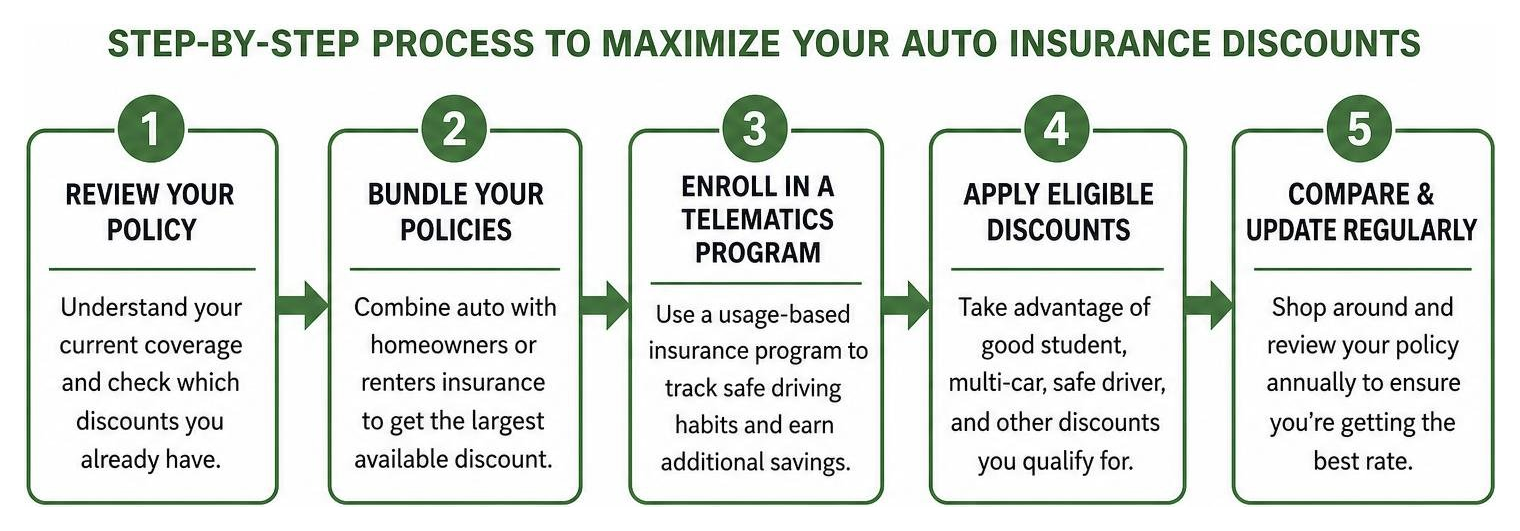
- Bundling: Combining your auto and homeowners (or renters) insurance is the single largest discount available. For example, American Family offers an average bundling discount of up to 23%. To see how much you can save, read our guide on the Best Homeowners Car Insurance Bundle in 2026 Save More on Home Auto.
- Telematics (Usage-Based Insurance): Programs like Nationwide’s SmartRide, Progressive’s Snapshot, or Liberty Mutual’s RightTrack track your real-time driving habits via a mobile app. Safe drivers can save up to 40% on their premiums. Nationwide’s SmartRide is highly recommended because, unlike some competitors, it will not raise your rates if it detects risky driving behavior.
- Good Student & Multi-Car Discounts: If you have a student on your policy with a “B” average or higher, you can secure up to a 15% discount. Registering multiple vehicles under the same household can also save you up to 25%.
Conclusion
Finding which auto insurance is best in US in 2026 isn’t about finding a single, magical company. It is about understanding your unique driving profile, selecting the right asset-protecting coverages, and actively shopping at renewal to avoid the sneaky “loyalty tax.”
Whether you qualify for USAA’s elite rates, prefer the budget-friendly stability of Travelers, or need Progressive’s flexible high-risk options, taking control of your policy is one of the highest-return financial moves you can make this year.
At Aixoria, we are passionate about helping you navigate the intersection of personal finance, insurance, and emerging technology. To stay ahead of the curve on how artificial intelligence is transforming the insurance claims process and lowering premiums, explore our latest insights on AI Updates and Insurance Tech.