Why Your Commercial Premium Keeps Climbing — and What You Can Do About It
What’s the best way to reduce your commercial premium? The short answer: use several strategies together, not just one.
Here are the most effective methods, ranked by impact:
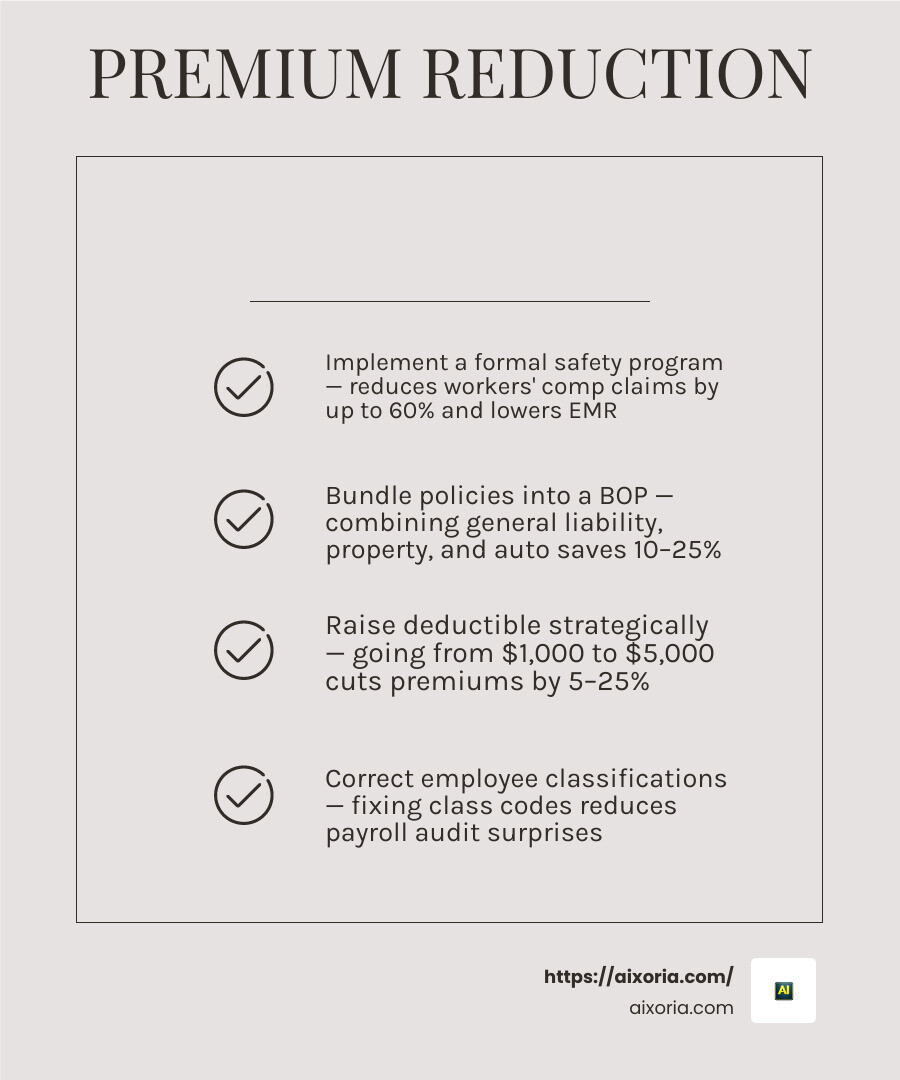
- Implement a formal safety program — reduces workers’ comp claims by up to 60% and can lower your Experience Modification Rate (EMR), saving thousands annually
- Bundle policies into a BOP — combining general liability, property, and auto can save 10–25% through multi-policy discounts
- Raise your deductible strategically — going from $1,000 to $5,000 on commercial property can cut premiums by 5–25%
- Shop the market every 1–2 years — specialty markets can beat generalist carriers by 15–30%
- Audit your coverage regularly — removing redundant or outdated coverage eliminates money wasted on protection you don’t need
- Correct employee classifications — fixing workers’ comp class codes can reduce payroll audit surprises and lower your base premium
- Install security and telematics systems — monitored alarms, dashcams, and driver-tracking programs can earn 5–20% discounts
- Maintain a clean claims history — insurers evaluate 3–5 years of loss runs; fewer claims mean lower rates
- Join trade or professional associations — group discounts through industry organizations can provide exclusive rate reductions
- Pay your premium in full annually — pay-in-full discounts typically range from 5–10%
Commercial insurance is one of the largest fixed costs a business carries. And right now, it’s getting more expensive. Commercial property premiums jumped 7–15% in 2024. Trucking insurance rates have risen by as much as 20% across the board. Even standard business liability coverage is feeling the pressure of rising jury verdicts and inflation in repair costs.
The problem isn’t just the market. Many businesses are also overpaying — insuring assets at outdated valuations, carrying redundant coverages, or auto-renewing without ever questioning what they’re paying for.
The good news? Premium reduction isn’t about gutting your coverage. It’s about being smarter with how you structure, manage, and present your risk to insurers.
What’s the best way to reduce your commercial premium?
When business owners ask us, “What’s the best way to reduce your commercial premium?” they are often looking for a single, magical quick fix. In reality, commercial insurance is an ongoing exercise in risk transfer, financial stability, and premium optimization. The absolute best way to lower your premiums is to systematically reduce your risk profile so that underwriters compete for your business.
Insurance carriers do not pull their rates out of thin air. They price policies based on your perceived risk exposure. By understanding how underwriters calculate your premiums, you can pull the specific levers that make your business look highly attractive on paper.
Rather than viewing insurance as a static, unavoidable tax on doing business, we should treat it as a controllable operating expense. Let’s dive into the core strategies that will immediately start driving down your commercial premiums.
Strategic Deductible Engineering: Balancing Risk and Reward
One of the fastest ways to lower your premium is through what we call “deductible engineering.” If you are treating your insurance policy as a maintenance plan for minor, everyday losses, you are paying a massive premium for the privilege. Insurance is designed to protect your business against catastrophic, business-threatening events. By taking on a bit more of the small, predictable risks yourself, you can dramatically lower your premium.
For example, raising a commercial property deductible from $1,000 to $5,000 can reduce your property premium by 5% to 12%—and in some markets, up to 15% to 25%. On the commercial auto side, increasing your collision deductible from $500 to $1,000 or $2,500 can save you 5% to 15% on the physical damage portion of your policy.
To see how these adjustments affect your overall auto costs, you can use our Best Lower Car Insurance Premium Calculator to model different scenarios.
However, deductible engineering is not about blindly raising numbers to the sky. You must balance the premium drop against your actual risk tolerance and cash flow. We recommend setting up a dedicated, liquid emergency fund specifically to cover these higher deductibles so that you are never caught off guard if multiple claims happen in a single year.
| Policy Type | Standard Deductible | Engineered High Deductible | Typical Premium Savings | Cash Flow Requirement |
|---|---|---|---|---|
| Commercial Property | $1,000 | $5,000 | 15% – 25% | Low (one-off property events) |
| General Liability | $500 | $2,500 | 10% – 15% | Medium (depends on litigation) |
| Commercial Auto | $500 | $1,000 – $2,500 | 5% – 15% (on physical damage) | High (multiple vehicles in fleet) |
Bundling Policies and Consolidating Coverage
If you are buying your general liability from one carrier, your commercial property from another, and your commercial auto from a third, you are leaving substantial savings on the table.
For small to medium-sized businesses, bundling these essential coverages into a Business Owner’s Policy (BOP) is almost always the most cost-effective path. A BOP packages property, general liability, and business interruption insurance into a single, discounted policy. For larger or more complex operations, a Commercial Package Policy (CPP) offers similar multi-policy discounts while allowing for deeper customization.
Consolidating your policies with a single carrier typically yields a multi-line discount of 5% to 20%. Beyond the direct financial savings, bundling simplifies your administration and—most importantly—eliminates dangerous coverage gaps that can occur when different insurers argue over who is responsible for a multi-faceted claim.
If you want to understand how bundling works on a broader scale, check out our guide on the Best Homeowners Car Insurance Bundle in 2026 Save More on Home Auto to see how personal and commercial bundling principles align to keep money in your pocket.
Proactive Risk Management and Underwriting Levers
Underwriters look at hundreds of data points to evaluate your business’s risk profile. If you can prove—with documented evidence—that your business is actively preventing losses, underwriters will apply schedule credits and rate modifiers that directly lower your premium. Proactive risk management is the single most effective long-term strategy for keeping commercial insurance costs low.
Implementing Safety Programs to Lower Your Experience Modification Rate
For businesses with employees, workers’ compensation is often a major financial burden. Your workers’ comp premium is heavily influenced by your Experience Modification Rate (EMR) or “mod rate.” A baseline EMR is 1.00. If your business has a worse-than-average claims history, your EMR rises (e.g., 1.12), acting as a multiplier that increases your premium. If you have a clean safety record, your EMR drops (e.g., 0.92), giving you a direct discount.
By establishing a robust, documented safety culture, you can dramatically shift this number. Implementing a formal safety program has been shown to reduce workers’ comp claims by up to 60%.
Consider the real-world math: a contractor with a baseline premium of $125,000 and an EMR of 1.12 pays $140,000. By investing in safety training, clear return-to-work programs, and regular safety audits, they can lower their EMR to 0.92, reducing their premium to $115,000—saving $25,000 annually.
For more details on how to structure these programs, read about the 5 Proven Ways to Lower Your Commercial Insurance Premiums Without Sacrificing Coverage – Insurance Curator .
Leveraging Telematics and Security Systems for Premium Discounts
Technology is one of your greatest allies in the fight against rising premiums. If you operate commercial vehicles, installing telematics devices can secure immediate and substantial discounts. Telematics programs track driver behavior—such as hard braking, rapid acceleration, and speed—allowing you to coach drivers and maintain a clean fleet safety record.
- Telematics programs typically provide an immediate 5% to 20% discount on commercial auto premiums.
- For trucking operations, where rates have surged, using newer trucks (10 years or newer) and hiring experienced drivers between the ages of 30 and 62 can keep costs manageable.
- On the property side, installing monitored security systems, fire sprinklers, smart leak detection devices, and perimeter fencing can yield property rate improvements of 5% to 15%.
By showing underwriters that you use active, real-time monitoring to prevent theft, fire, and accidents, you make your business an incredibly safe bet. To explore more tactical ways to drive down fleet costs, consult the guide on Cheap Commercial Auto Insurance: 12 Ways to Lower Premium .
Optimizing Your Policy Audits and Market Strategy
Many business owners make the mistake of treating commercial insurance as a “set it and forget it” expense. They let policies auto-renew year after year, unaware that their business operations have changed, leading to over-insurance or outdated classifications.
What’s the best way to reduce your commercial premium through regular audits?
To stop wasting money on coverage you no longer need, you must conduct regular policy audits. As we move through 2026, we are seeing many businesses fall victim to “ITV bloat” (Insurance-to-Value bloat). During the inflation peaks of 2023 and 2024, building replacement costs skyrocketed. However, as construction and material costs stabilize, keeping your property valued at those old peaks means you are paying premiums on an inflated valuation.
For example, a 40,000-square-foot commercial building valued at $300 per square foot in 2023 ($12 million Total Insurable Value) might only cost $265 per square foot to rebuild in 2026 ($10.6 million TIV). Adjusting this valuation to reflect current construction realities can instantly lower your property premium.
Additionally, workers’ compensation premiums are based on your payroll and job classification codes. If an employee’s duties have changed—for example, if a field technician has transitioned to a low-risk administrative role—but they are still classified under a high-risk field code, you are overpaying. Splitting payroll between classifications (where permitted by state rules and supported by meticulous time records) ensures you only pay for the actual risk of the work being performed.
For a deep dive into how changing market dynamics and local building valuations impact your premiums, see the 2026 Guide: Lowering Commercial Property Insurance in Duval County .
What’s the best way to reduce your commercial premium by shopping the market?
The commercial insurance market is highly dynamic. Insurers constantly adjust their “appetite” for different industries. A carrier that offered the most competitive rates for retail stores last year might decide to pull back this year, leading to a quiet rate hike at renewal.
Rarely should a business auto-renew its policy without performing an annual comparison. We recommend working with independent brokers who have access to multiple carriers and specialty markets. Specialty markets often specialize in specific industries (like agriculture, construction, or commercial transportation) and can offer tailored coverages at rates 15% to 30% lower than generalist carriers.
When preparing to shop the market, begin the process 90 to 120 days before your policy expiration. This gives your broker ample time to compile a professional “underwriting pack” and negotiate competitive quotes. To better understand the foundational liability structures you’ll be shopping for, check out our resource on What Is Direct General Liability Auto Insurance.
Frequently Asked Questions about Commercial Insurance Premiums
How does a business’s claims history impact its premium?
Insurers view your past claims history as the single most predictive indicator of your future claims. When underwriting a policy, carriers will request 3 to 5 years of currently valued “loss runs” (your official claims history report).
A high frequency of small claims is often viewed more negatively than a single, large, accidental claim. High frequency suggests poor internal controls or a lack of safety protocols. To keep your loss runs clean:
- Avoid filing minor claims that fall close to your deductible limit; absorb these small costs out-of-pocket.
- Implement rapid remediation steps after any incident and document those changes so underwriters see you’ve fixed the root cause.
For a comprehensive look at what underwriters look for behind the scenes, read Underwriting Levers: What Insurers Look for and How to Improve Your Risk Profile Quickly – Insurance Curator .
What is COPE, and how does it affect commercial property rates?
COPE is the acronym underwriters use to evaluate commercial property risk:
- Construction: What materials is the building made of? (Fire-resistant concrete and steel cost less to insure than wood-frame structures).
- Occupancy: How is the building used? (A commercial bakery with open ovens carries higher risk and premiums than a standard professional office).
- Protection: What fire safety systems are in place? (Monitored sprinklers, fire alarms, and proximity to a local fire station lower rates).
- Exposure: What external hazards exist? (Being located in a high-risk flood zone or wildfire-prone area increases premiums).
Understanding COPE allows you to make physical improvements to your property that directly lower your risk score. For a detailed guide on how to optimize these property factors, check out 10 Proven Ways Business Owners Can Cut Commercial Property Insurance Premiums by 30% .
Can industry-specific or group association discounts lower my costs?
Yes! Many trade groups, professional organizations, and local chambers of commerce partner with insurance carriers to offer exclusive “group discounts” to their members. Because these associations represent a large pool of businesses, insurers can offer lower rates due to purchasing power and shared risk.
Additionally, some carriers specialize in niche markets and offer pre-packaged safety programs that make qualifying for discounts much easier. Always ask your broker if your business qualifies for any affinity group or trade association programs.
For more insights on leveraging these discounts, read 10 Proven Ways to Reduce Your Business Insurance Costs | CPK Insurance | CPK Insurance .
Conclusion
Reducing your commercial premium is not about cutting corners or leaving your business vulnerable to lawsuits and property damage. It is a strategic process of optimizing your coverage, engineering your deductibles, proving your commitment to safety, and utilizing technology to show underwriters that you are a low-risk client.
By freeing up capital through reduced premiums, you can reinvest those savings directly back into your business—whether that means hiring new staff, upgrading equipment, or building a stronger cash reserve.
As technology continues to reshape the commercial landscape, staying on top of the latest digital tools is critical. To see how modern software is streamlining the financial side of insurance, explore our guide on the Best Insurance Billing Software. And to keep your business ahead of the curve, be sure to follow our latest AI Updates and Insurance Trends to learn how emerging technology is making commercial risk management smarter, faster, and more affordable than ever before.
3 thoughts on “10 Proven Ways to Reduce Your Commercial Insurance Premium in 2026”