What Does Allstate Renters Insurance Actually Cost?

How much does Allstate renters insurance cost? Here’s the short answer:
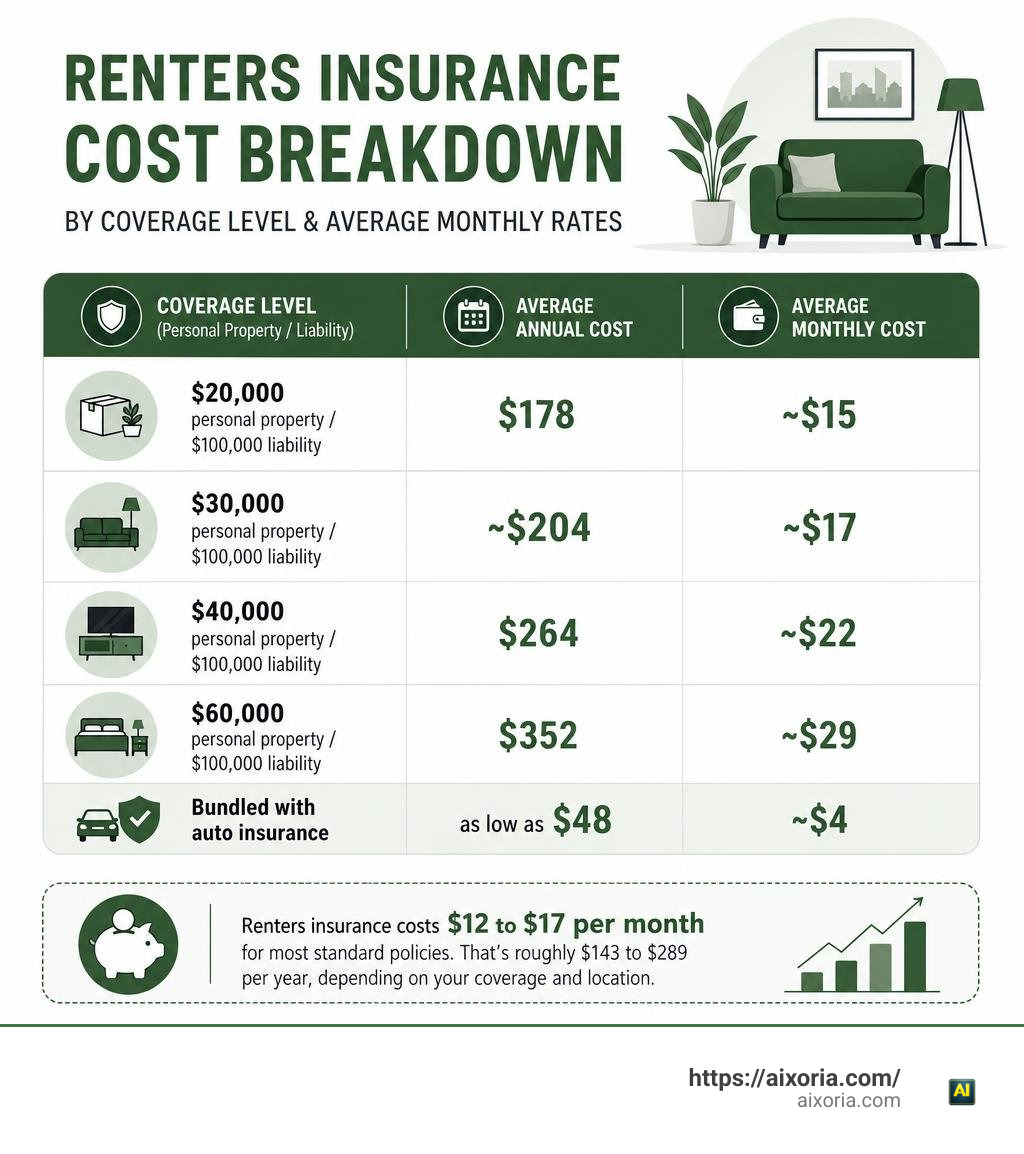
| Coverage Level | Average Annual Cost | Average Monthly Cost |
|---|---|---|
| $20,000 personal property / $100,000 liability | $178 | ~$15 |
| $30,000 personal property / $100,000 liability | ~$204 | ~$17 |
| $40,000 personal property / $100,000 liability | $264 | ~$22 |
| $60,000 personal property / $100,000 liability | $352 | ~$29 |
| Bundled with auto insurance | as low as $48 | ~$4 |
Allstate renters insurance costs $12 to $17 per month for most standard policies. That’s roughly $143 to $289 per year, depending on your coverage limits, deductible, and location.
The national average for renters insurance sits around $18 to $23 per month. Allstate comes in at or slightly below that range for basic coverage — making it one of the more affordable options among major national insurers.
But your actual rate can vary a lot. A renter in Alaska might pay just $122 per year, while someone in Mississippi could pay $797 for the exact same coverage. That’s a six-fold difference — just based on location.
The good news: renters insurance is still one of the cheapest types of insurance you can buy. And there are several ways to push your Allstate premium even lower.
How much does Allstate renters insurance cost?
When we look closely at the numbers, the question of How much does Allstate renters insurance cost? depends heavily on how you structure your policy. According to standard rate analyses, the average cost of an Allstate renters policy is $289 annually when looking across all typical coverage limits. However, for a standard entry-level policy ($20,000 in personal property coverage and $100,000 in liability with a $1,000 deductible), the average drops to $178 per year (about $15 a month).
To understand where Allstate stands in the broader market, let’s compare its average rates to the national average and other major insurance carriers.
As this process shows, while Allstate’s base rates for standalone policies are highly competitive, they can run slightly higher than some budget-focused competitors unless you take advantage of their highly rated bundling options. For example, if you are looking to secure a policy, comparing carriers through tools like the Best Homeowners Insurance Comparison Sites or reading our detailed State Farm Renters Insurance Review 2026 Coverage Cost Discounts can help you weigh your options.
How much does Allstate renters insurance cost by state?
Your geographic location is the single largest driver of your insurance premium. Allstate adjusts its rates based on localized risks, such as regional weather patterns (hurricanes, tornadoes, wildfires) and local crime rates.
Below is a detailed breakdown of Allstate’s average annual premiums for a standard policy featuring $40,000 in personal property coverage, a $1,000 deductible, and $100,000 in liability liability:
- Alabama: $419
- Alaska: $122 (One of the cheapest states in the nation!)
- Arizona: $259
- Arkansas: $444
- California: $256
- Colorado: $186
- Connecticut: $173
- Delaware: $212
- Florida: $178
- Georgia: $646 (One of the highest due to coastal storm risks)
- Hawaii: $229
- Idaho: $259
- Illinois: $197
- Indiana: $301
- Iowa: $257
- Kansas: $162
- Kentucky: $233
- Louisiana: $585
- Maine: $162
- Maryland: $418
- Massachusetts: $223
- Michigan: $301
- Minnesota: $174
- Mississippi: $797 (The most expensive state for Allstate renters)
- Missouri: $367
- Montana: $184
- Nevada: $229
- New Hampshire: $158
- New Jersey: $476
- New York: $174
- North Carolina: $312
- North Dakota: $138
- Ohio: $233
- Oklahoma: $367
- Oregon: $223
- Pennsylvania: $232
- Rhode Island: $239
- South Carolina: $247
- South Dakota: $191
- Tennessee: $233
- Texas: $219
- Utah: $171
- Vermont: $203
- Virginia: $257
- Washington: $230
- Washington, D.C.: $260
- West Virginia: $203
- Wisconsin: $171
- Wyoming: $203
As you can see, states prone to severe weather (like Mississippi, Louisiana, and Georgia) command significantly higher premiums. Meanwhile, states with lower natural disaster risks (such as Alaska, North Dakota, and New Hampshire) enjoy much more affordable rates.
How much does Allstate renters insurance cost by coverage level?
The amount of stuff you own and the level of liability protection you choose will directly dictate your premium. If you live in a minimalist studio apartment, you will need far less coverage than someone renting a fully furnished four-bedroom home.
Let’s look at how adjusting your personal property limits, liability limits, and deductibles alters your average annual Allstate premium:
$20,000 Personal Property Coverage
- $1,000 Deductible / $100,000 Liability: $178
- $1,000 Deductible / $300,000 Liability: $203
- $500 Deductible / $100,000 Liability: $194
- $500 Deductible / $300,000 Liability: $219
$40,000 Personal Property Coverage
- $1,000 Deductible / $100,000 Liability: $264
- $1,000 Deductible / $300,000 Liability: $289
- $500 Deductible / $100,000 Liability: $291
- $500 Deductible / $300,000 Liability: $315
$60,000 Personal Property Coverage
- $1,000 Deductible / $100,000 Liability: $352
- $1,000 Deductible / $300,000 Liability: $377
- $500 Deductible / $100,000 Liability: $389
- $500 Deductible / $300,000 Liability: $413
High-Value Coverage Tiers
- $50,000 Personal Property / $100,000 Liability: $314
- $100,000 Personal Property / $100,000 Liability: $535
- $250,000 Personal Property / $300,000 Liability: $1,322
One of the most important takeaways from this data is how cheap it is to triple your liability coverage. Moving from $100,000 to $300,000 in liability protection generally costs less than $25 extra per year across almost all coverage tiers. If you want to learn more about optimizing these tiers to save cash, check out our guide on How to Get the Cheapest Renters Insurance.
Key Factors and Coverage Options Influencing Cost
When Allstate calculates your renters insurance quote, they don’t just pull a number out of a hat. They use a sophisticated underwriting system that assesses your individual risk profile.
Understanding these factors is key to knowing why your quote might differ from the averages:
- Geographic Location: As shown in the state-by-state breakdown, your ZIP code plays a massive role. Proximity to coastlines, wildfire zones, or high-crime neighborhoods will raise your rates.
- Credit Score: In most states, insurers use a credit-based insurance score to help determine your premium. Renters with excellent credit scores typically pay lower rates than those with poor credit.
- Claims History: If you have filed multiple renters insurance claims in the past three to five years, you will be viewed as a higher risk, which translates to a higher premium.
- Type of Residence: Living in a high-rise brick apartment building with a 24-hour doorman and a sprinkler system is generally cheaper to insure than a wood-frame single-family rental house.
Deductibles and Coverage Limits
Your deductible is the amount of money you agree to pay out-of-pocket before Allstate’s coverage kicks in. For example, if a burst pipe ruins $3,000 worth of your furniture and you have a $500 deductible, Allstate will cut you a check for $2,500.
By raising your deductible from $500 to $1,000, you assume more of the upfront risk. In return, Allstate will reward you with a premium reduction of 10% to 25%. Just make sure you actually have that $1,000 sitting in an emergency fund in case you ever need to file a claim!
Actual Cash Value vs. Replacement Cost
By default, many standard renters insurance policies pay out claims based on Actual Cash Value (ACV). ACV takes depreciation into account. If your five-year-old laptop is stolen, an ACV policy will only pay you what a five-year-old laptop is worth today (which might only be $150, even if you originally paid $1,200).
To avoid this, we highly recommend upgrading your policy to Replacement Cost Value (RCV) coverage. RCV does not factor in depreciation; it pays out whatever it costs to buy a brand-new, comparable laptop at current market prices. While adding an RCV endorsement increases your premium slightly, it is almost always worth the extra couple of dollars a month when a major loss occurs.
How to Lower Your Allstate Renters Insurance Rates

While Allstate’s base rates are highly competitive, the real magic happens when you start applying their diverse menu of discounts. Allstate offers some of the most robust cost-saving opportunities in the industry.
Bundling Renters and Auto Insurance
The absolute best way to slash your renters insurance bill is through multi-policy bundling. If you already have an auto insurance policy with Allstate, adding renters insurance can be incredibly cheap.
In fact, Allstate advertises that bundling renters insurance with an auto policy can lower the cost of your renters coverage to as little as $4 a month (or $48 a year).
Even if you don’t have a car, you can bundle renters with other insurance products, such as life or motorcycle policies. To compare these bundling strategies across different platforms, you can use our resource on the Best Homeowners Insurance Comparison Sites or read about Insurance Car Quotes Online Comparison to see how your auto rates might change.
Smart Payment and Safety Discounts
Beyond bundling, Allstate offers several smaller discounts that can quickly add up to significant annual savings:
- 55 and Retired Discount: If you are at least 55 years old and retired, you can save up to 25% on your renters insurance premium. Why? Retired individuals tend to spend more time at home, which reduces the risk of undetected fires or burglaries.
- Easy Pay Plan (Autopay): Setting up automatic monthly payments directly from your bank account or credit card will earn you an immediate discount.
- Annual Payment Savings: Paying your entire annual premium upfront instead of in monthly installments can save you $8 to $13 per year by avoiding monthly installment fees.
- Safety Device Discount: If your rental property features smoke detectors, fire extinguishers, deadbolt locks, or a monitored home security system, make sure to let your agent know to secure a safety discount.
Frequently Asked Questions about Renters Insurance
Is renters insurance required by law?
No, there is no state or federal law that mandates renters insurance. However, landlords and property management companies frequently require it as a condition of your lease agreement. They do this to protect themselves from liability if you cause damage to the building (such as starting a kitchen fire) and to ensure you have your own protection so you don’t try to sue them for damage to your personal belongings.
Does Allstate renters insurance cover flood damage?
No. A standard Allstate renters insurance policy does not cover damage caused by natural floods, hurricanes, or rising surface water. If you live in a high-risk flood zone, you will need to purchase a separate flood insurance policy. Fortunately, Allstate agents can write and service flood policies directly through the National Flood Insurance Program (NFIP), making it easy to keep your coverages under one roof.
Can roommates share a single renters insurance policy?
Yes, Allstate allows you to list non-related roommates on a single renters insurance policy, but we generally do not recommend it. Sharing a policy means your claims histories will be tied together, and any claim payout checks will be made out to both of you, which can cause administrative headaches. Additionally, you will need to raise your coverage limits significantly to account for both of your belongings, which often negates any potential cost savings. It is usually cleaner and safer for each roommate to purchase their own separate policy.
Conclusion
So, How much does Allstate renters insurance cost? For most renters, the answer is about the price of a couple of fancy cups of coffee per month. At an average of $12 to $17 a month, Allstate provides a highly customizable safety net that protects your electronics, clothes, furniture, and personal liability.
By opting for a higher deductible, upgrading to replacement cost value, and taking full advantage of bundling and senior discounts, you can easily secure top-tier protection without breaking your budget.
If you want to keep exploring the latest trends in insurance technology, smart home integrations, or financial planning, check out our Aixoria AI Updates to stay ahead of the curve!
2 thoughts on “How Much Does Allstate Renters Insurance Cost in 2026? Full Price Guide”