Why Finding the Cheapest Monthly Renters Insurance Matters More Than You Think
Scr0ll d0wn to D0VVNL0AD

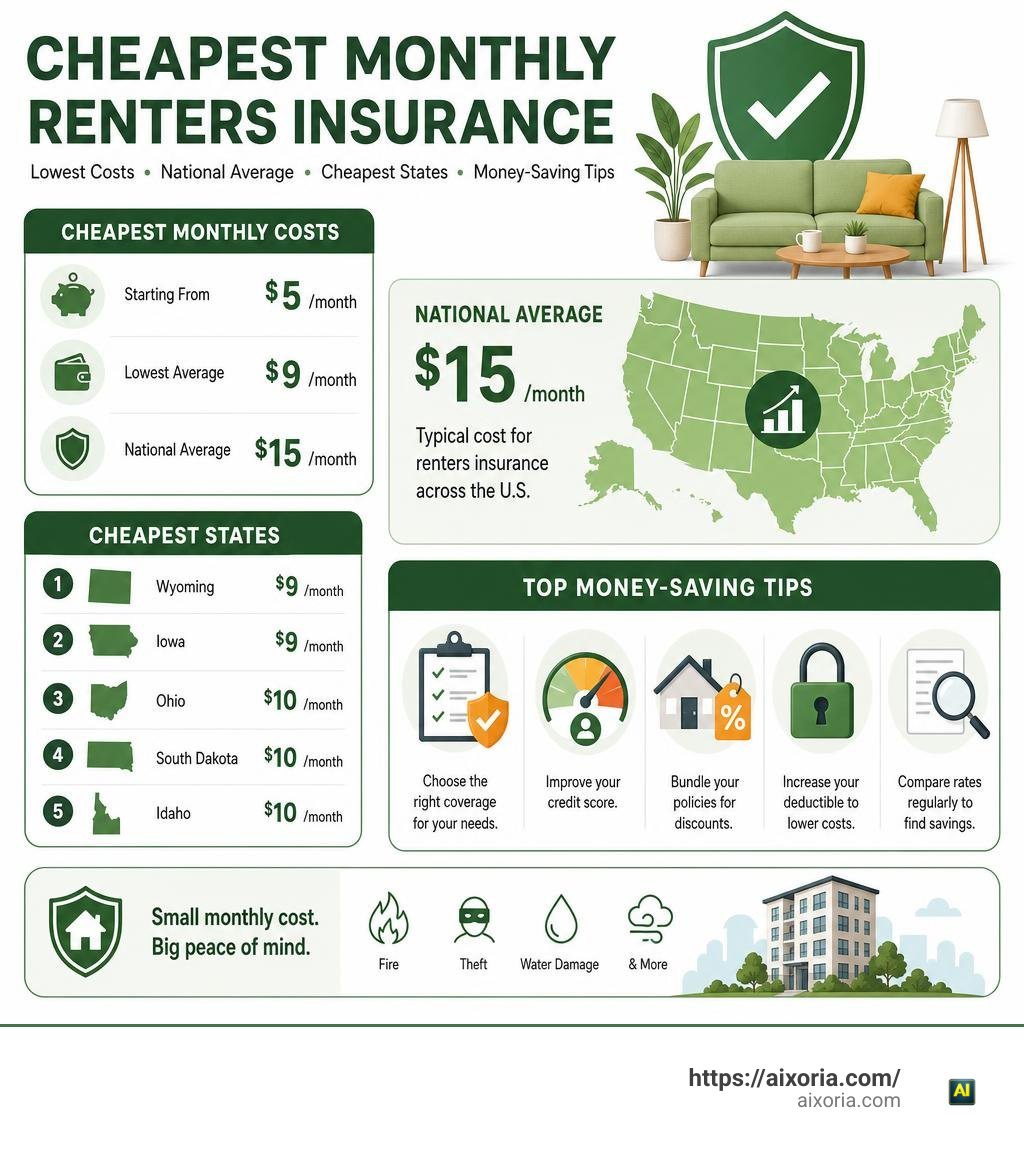
The cheapest monthly renters insurance can cost as little as $9 a month, yet millions of renters either skip it entirely or overpay without realizing it. Here’s a quick snapshot of what you need to know right now:
Cheapest Renters Insurance at a Glance (2026)
| Provider | Average Monthly Cost |
|---|---|
| Amica | $9/month |
| State Farm | $11/month |
| Lemonade | $10/month |
| Allstate | $12/month |
| Liberty Mutual | from $5/month |
| National Average | $15/month |
Your landlord’s insurance covers the building, not your stuff. If a fire, theft, or burst pipe wipes out your laptop, furniture, or clothes, that loss falls entirely on you. Renters insurance is the one policy that closes that gap, and it costs less than most people’s monthly coffee budget. For a neutral consumer overview of what renters insurance generally covers, the National Association of Insurance Commissioners renters insurance guide is a useful reference.
The tricky part? Rates vary a lot by state, by insurer, by your credit score, and by how much coverage you choose. A renter in Wyoming might pay $9 a month. Someone in Louisiana could pay $29 for the same coverage level.
This guide breaks down exactly where the cheapest rates are, which factors drive your premium up or down, and how to compare policies so you only pay for what you actually need.
What is the Cheapest Monthly Renters Insurance in 2026?
When we look at the landscape of renters insurance in July 2026, we see two distinct types of companies competing for your hard-earned dollars: traditional national carriers and digital-first, online-only insurers. Each has its own way of structuring policies, and understanding these differences is key to finding the cheapest monthly renters insurance that still provides robust protection.
Traditional carriers like State Farm, Allstate, and Liberty Mutual have massive financial backing, decades of history, and extensive agent networks. If you prefer talking to a human being who lives in your neighborhood, these companies are hard to beat.
On the other side, digital-first insurers like Lemonade use artificial intelligence to handle onboarding and process claims. Because they don’t have the overhead costs of physical offices and thousands of local agents, they can pass those savings directly to you. In fact, online-only insurers are typically $3 to $6 a month cheaper than traditional insurers.
Here is how the top budget-friendly providers stack up:
- Amica: Taking the crown as the overall cheapest renters insurance company we analyzed, Amica averages just $9 a month ($107 annually). This is a staggering 41% below the national average.
- Lemonade: Known for its modern app and lightning-fast claims (some are paid in as little as 7 seconds!), Lemonade starts as low as $5 a month, with an average rate of $10 a month across 15 states and Washington, D.C.
- State Farm: Offering an incredible balance of low rates and local agent support, State Farm averages $11 a month ($110 per year). It ranks as the cheapest option in more cities than almost any other carrier.
- Allstate: With average rates around $12 a month ($143 per year), Allstate is highly competitive and offers great discounts for seniors and bundled policies.
- Liberty Mutual: While their baseline average is higher, they advertise customized coverage starting as low as $5 a month, especially when you take advantage of their online purchase discounts.
- Progressive: Progressive’s rates typically range from $13 to $27 per month, but they offer some of the most aggressive bundling discounts on the market.
If you want a step-by-step roadmap on how to navigate these providers and secure the lowest rate, check out our guide on how to get the cheapest renters insurance.
Average Cost of the Cheapest Monthly Renters Insurance
To know if you are getting a good deal, you need a baseline. Nationally, the average cost of renters insurance is $15 per month (about $180 to $185 per year) for a basic policy that provides $20,000 in personal property coverage and $100,000 in liability protection.
If you step up your coverage to a more standard $30,000 in personal property protection, the national average rises to about $23 per month ($276 per year).
While these numbers represent the national middle ground, the price you pay is heavily influenced by your location and your financial profile. For example, when looking at national average renters insurance rates, you will find that a standard policy is incredibly affordable compared to other forms of insurance.
Even if you are on a tight budget, there are plenty of affordable coverage options that ensure you aren’t left paying thousands of dollars out of pocket after a disaster.
How Coverage Limits Affect Your Cheapest Monthly Renters Insurance Rate
Every standard renters insurance policy is built on four core pillars:
- Personal Property Coverage: Pays to repair or replace your belongings (furniture, electronics, clothes) if they are damaged or stolen.
- Personal Liability Protection: Covers legal expenses and damages if someone sues you for bodily injury or property damage that happens inside your rental.
- Medical Payments to Others: Pays for minor medical bills if a guest is injured in your home, regardless of who is at fault.
- Loss of Use (Additional Living Expenses): Pays for hotel stays, meals, and relocation costs if a covered event (like a fire) makes your apartment temporarily unlivable.

The limits you choose for these coverages dictate your monthly premium. If you increase your personal property coverage from $25,000 to $50,000, you can expect your premium to rise by 50% to 60%.
Another major factor is whether you choose Actual Cash Value (ACV) or Replacement Cost Value (RCV):
- Actual Cash Value (ACV): This is the cheaper option. If your five-year-old laptop is stolen, the insurer will only pay you what a five-year-old laptop is worth today (which isn’t much).
- Replacement Cost Value (RCV): This costs slightly more per month, but if your laptop is stolen, the insurer pays what it actually costs to buy a brand-new, equivalent model today. We highly recommend RCV because ACV payouts rarely cover the cost of replacing your essentials.
To help you visualize how coverage limits impact your wallet, here is a comparison of average monthly costs across different personal property limits:
| Personal Property Limit | Liability Limit | Average Monthly Premium |
|---|---|---|
| $15,000 | $100,000 | $17 / month |
| $20,000 | $100,000 | $15 / month (Basic Baseline) |
| $30,000 | $100,000 | $22 – $23 / month |
| $50,000 | $100,000 | $28 / month |
| $100,000 | $100,000 | $42 – $47 / month |
For a deeper dive into how individual carriers price these tiers, read our State Farm Renters Insurance Review 2026 Coverage Cost Discounts and see how they compare to Allstate’s pricing in our analysis of how much does Allstate renters insurance cost.
State-by-State Cost Differences: Where is Coverage Most Affordable?
Where you live has a massive impact on your insurance rates. Insurance companies use “geographic rating” to set premiums. If your state is prone to severe weather events (like hurricanes, tornadoes, or wildfires) or has high localized crime and theft rates, you will pay significantly more.
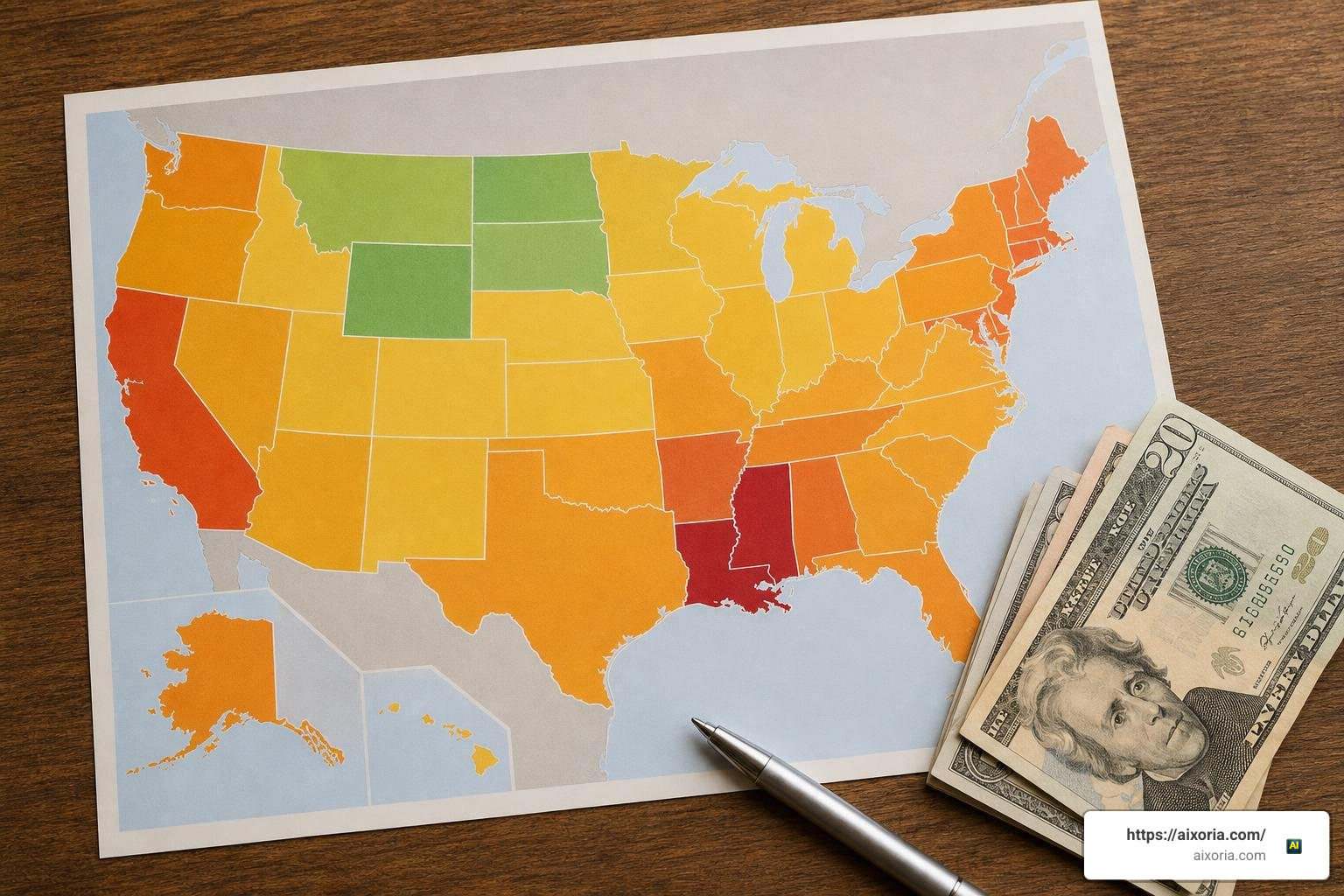
The cost difference between the cheapest and most expensive states can be more than fourfold:
- The Cheapest States: Wyoming is the most affordable state in the country, with average rates of $9 per month ($106 per year) for a basic policy. Other highly affordable states include North Dakota ($180/year), South Dakota, Idaho, Iowa, and Maine, all averaging around $12 a month. These states benefit from lower population densities, fewer catastrophic weather events, and lower property replacement costs.
- The Most Expensive States: Louisiana takes the crown as the most expensive state, averaging $29 per month ($352 per year) for a basic $20,000 policy, and skyrocketing to $88 per month for $100,000 in coverage. Mississippi is close behind at an average of $22 to $25 per month ($346 per year). These coastal and southern states face severe hurricane risks, which heavily drive up insurance losses.
To see where your home state lands on the spectrum, you can review comprehensive renters insurance cost analyses.
If you happen to live in Mississippi, where rates are well above the national average, it is even more critical to shop around and look for regional discounts that can bring those high rates back down to earth.
Key Factors That Drive Your Monthly Premium and How to Lower Them
Your premium isn’t just pulled out of thin air; it is calculated using a variety of personal risk factors. Understanding these factors gives you the power to lower your monthly bill without sacrificing the coverage you need.
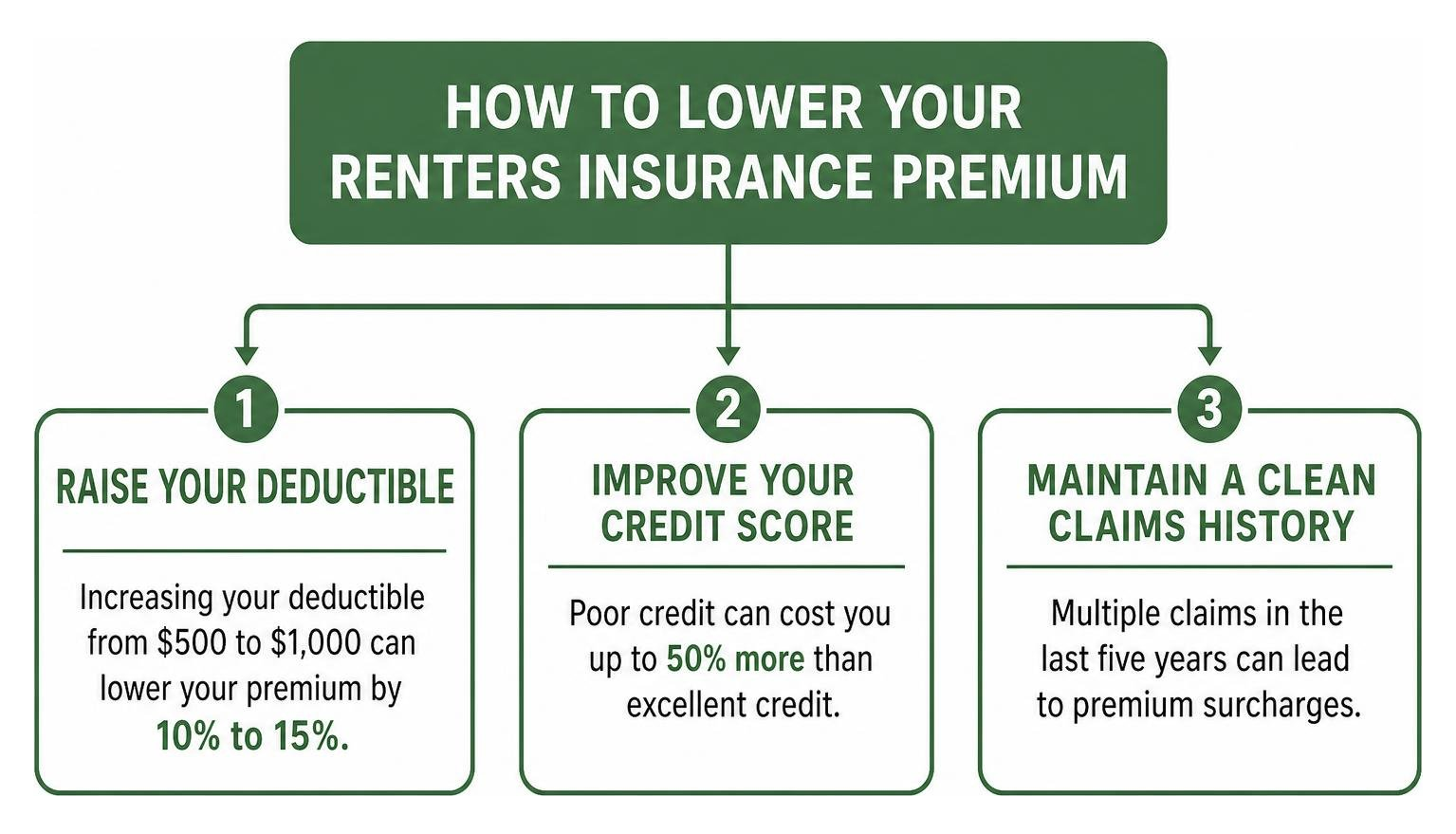
Here are the primary drivers of your renters insurance cost:
- Your Deductible: The deductible is the amount you pay out of pocket before your insurance kicks in. Standard deductibles are usually $500. However, raising your deductible to $1,000 can cut your monthly premium by 10% to 15%. Just make sure you actually have $1,000 saved in an emergency fund in case you need to file a claim!
- Credit Score: In most states, your credit-based insurance score heavily influences your rate. If you have poor credit, you could pay up to 50% more than someone with excellent credit.
- Claims History: Insurance companies view past behavior as a predictor of future risk. If you have filed multiple claims in the last five years, you will face premium surcharges.
- Safety and Security Devices: Having smoke detectors, fire extinguishers, deadbolt locks, or a smart home security system can earn you discounts of 5% to 15%.
To get a better understanding of how these variables interact with your other insurance policies, it helps to research how different coverage limits and personal factors impact your overall premium.
Top Ways to Secure Renters Insurance Discounts
- Bundle Your Policies: This is the single easiest way to save money. Bundling your renters insurance with your auto insurance policy can save you 5% to 15% on your premiums. If you want to see how much you could save on your car policy first, run a quick car insurance quotes online comparison.
- Pay Annually: Many insurers charge a $1 to $3 installment fee for monthly billing. Paying your entire annual premium upfront can save you $12 to $36 a year.
- Go Paperless: Signing up for electronic policy documents and automatic payments (autopay) usually triggers an instant discount of $5 to $10.
- Ask for an Early Shopper Discount: Some companies (like Liberty Mutual) offer a discount simply for requesting a quote several days before your old policy expires.
Frequently Asked Questions about Renters Insurance Costs
Does my credit score affect my renters insurance rate?
Yes, in the vast majority of states, your credit score plays a massive role in determining your premium. Insurance companies use a “credit-based insurance score” to evaluate how likely you are to file a claim.
The financial impact of a poor credit score can be eye-opening. For example, in Mississippi, a renter with excellent credit pays an average of $19 a month, while a renter with poor credit faces an average of $67 a month for the exact same policy!
However, there is a silver lining depending on where you live. California, Hawaii, Maryland, and Massachusetts completely prohibit insurance companies from using credit scores to price renters insurance policies.
If you live in a state that allows credit-based pricing and your credit score has improved over the last 12 months, you don’t have to wait for your policy to renew. You can proactively call your insurer and ask for a mid-term re-rating to lower your monthly cost immediately.
How does my claims history impact my monthly premium?
Your claims history is a major indicator of risk. Filing even a single claim can cause your premium to rise by 10% to 20% at renewal. If you file two or more claims within a five-year window, your premium will increase by an average of $4 per month, and some traditional carriers may even decline to renew your policy.
Because of this, we recommend avoiding “small” claims. If your $600 bicycle is stolen and you have a $500 deductible, the actual insurance payout is only $100. Filing that claim will likely cost you far more than $100 in premium surcharges over the next three to five years. It is almost always better to pay for minor losses out of pocket and preserve your claims-free discount.
Does renters insurance cover roommates?
No. A standard renters insurance policy only covers the policyholder and any relatives who live in the same unit. Unrelated roommates are not covered under your policy, and their belongings will not be protected if a disaster occurs.
While it is technically possible in some states to add a roommate to your policy as an “additional insured,” we highly advise against it. Sharing a policy means:
- You must split the personal property limits, which can easily lead to being underinsured.
- If your roommate files a claim, it goes on your permanent insurance record and will raise your rates for years.
- If you move out or have a falling out, splitting the policy is a major administrative headache.
Landlords frequently require each tenant to carry their own individual liability and personal property limits. To keep your finances clean and your coverage secure, both you and your roommate should purchase separate, cheap monthly renters insurance policies.”https://www.mediafire.com/file/kgri5o22tnxenwv/Mowzie%25E2%2580%2599s_Mobs_1.1_BY_MCMPDL.mcaddon/file“;
Conclusion
Finding the cheapest monthly renters insurance isn’t about choosing the absolute lowest number on a screen; it’s about finding the right balance between a low monthly premium and realistic protection. For the price of a couple of streaming subscriptions, you can protect tens of thousands of dollars of personal property and secure a massive safety net of liability coverage.
At Aixoria, we believe in making complex insurance decisions simple and stress-free. If you are shopping around for coverage, we recommend comparing quotes from at least three different carriers using your specific ZIP code and desired deductible.
To expand your comparison toolkit to other areas of your life, check out our guide on the best homeowners insurance comparison sites or stay ahead of the curve with Aixoria’s latest updates on how technology is making insurance smarter and cheaper for everyone.
1 thought on “Cheapest Monthly Renters Insurance in 2026: Top $5–$15 Plans Compared”