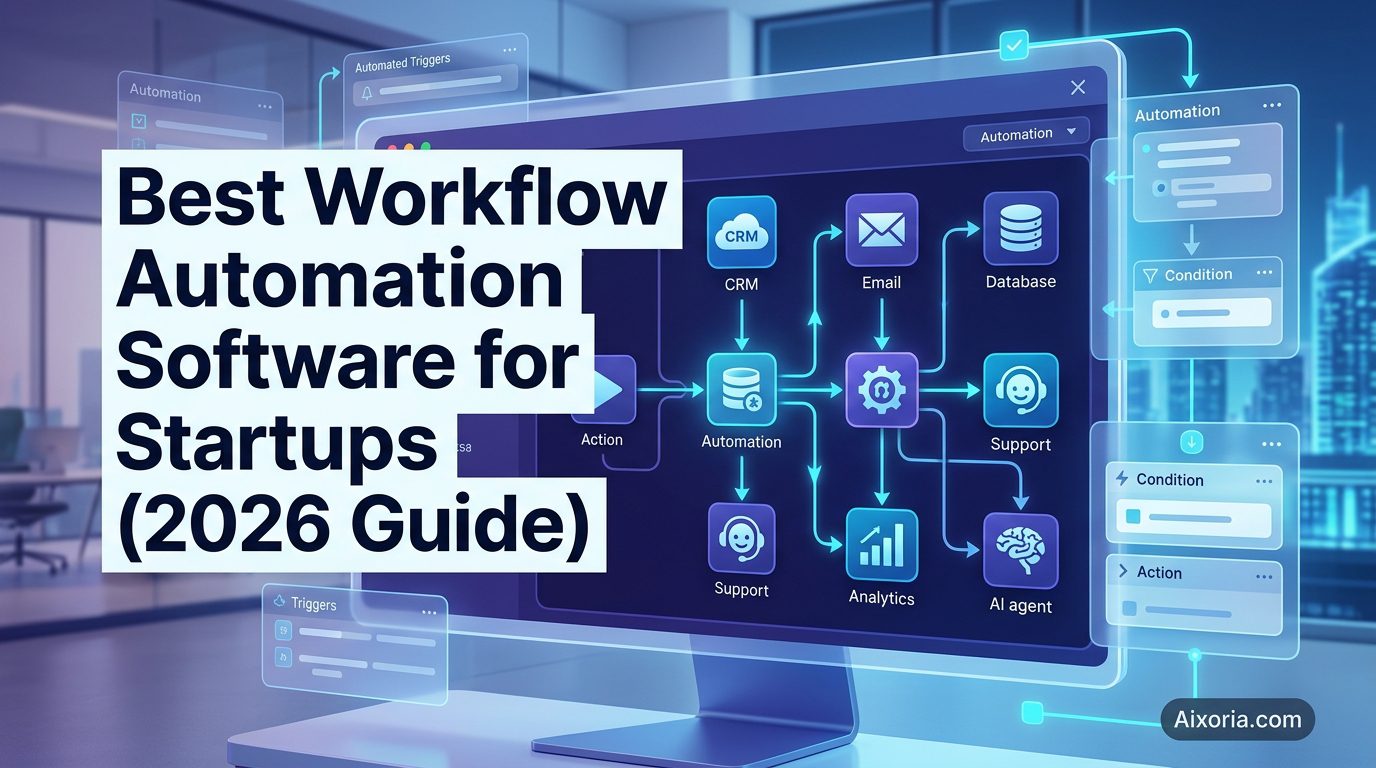
Startups don’t fail because of a lack of ideas—they fail because operations don’t scale. As teams grow, tools multiply, and workflows become fragmented. Data gets stuck between apps, decisions slow down, and manual work starts replacing innovation.
Workflow automation software solves this by creating systems that run in the background—connecting tools, triggering actions, and increasingly, making decisions using AI.
But in 2026, the landscape has shifted. It’s no longer just about simple automation. Startups are now choosing between linear workflows and AI-driven (agentic) automation systems that can think, adapt, and optimize processes in real time.
This guide covers the best workflow automation software for startups, including new emerging tools, deeper AI capabilities, pricing, pros and cons, and practical use cases—written to help you choose based on real startup needs, not just features.
Table of Contents
What Makes the Best Workflow Automation Software for Startups?
Startups need tools that balance speed, flexibility, and cost. The best platforms offer:
- No-code or low-code workflow builders
- Fast setup with minimal technical dependency
- Strong integrations across SaaS tools
- AI-powered automation and decision-making
- Scalable pricing for growth
More importantly, they should reduce operational friction—not add complexity.
READ MORE – Best Accounting Workflow Automation Software
The Best Workflow Automation Software for Startups at a Glance (2026)
| Tool | Best For | 2026 AI Feature | Pricing (Startup) |
|---|---|---|---|
| Zapier | Speed & SaaS automation | AI workflow builder + agents | Free; $19.99/mo |
| Make | Complex logic workflows | Advanced data mapping | Free; $9/mo |
| Vellum AI | Agentic workflows | Native AI agents + evaluation | Free; $25/mo |
| n8n | Data control & flexibility | Self-hosted + AI nodes | Free (community) |
| HubSpot | Marketing automation | AI-driven CRM workflows | Free; $9/mo |
| Airtable | Data + automation | AI insights + triggers | Free; $20/user/mo |
| Pabbly Connect | Budget automation | Basic automation engine | $19/mo (lifetime deals) |
The 2026 Startup Dilemma: Linear vs. Agentic Automation
One of the biggest decisions startups face today is choosing between:
Linear Automation (Traditional)
Tools like Zapier and Make follow a structured flow:
Trigger → Action → Result
Example:
- New lead → Add to CRM → Send email
This is predictable, fast, and easy to control.
Agentic Automation (AI-Driven)
New platforms like Vellum AI introduce a different model:
Input → AI analyzes → Decides next action
Example:
- Customer query → AI evaluates intent → Responds or escalates
This allows startups to automate cognitive tasks, not just repetitive ones.
Which Should You Choose?
- Use linear tools for structured, repeatable workflows
- Use agentic tools for decision-making, AI-driven processes
Most modern startups combine both.
Best Workflow Automation Software for Startups
Best Overall Workflow Automation Platform
Zapier
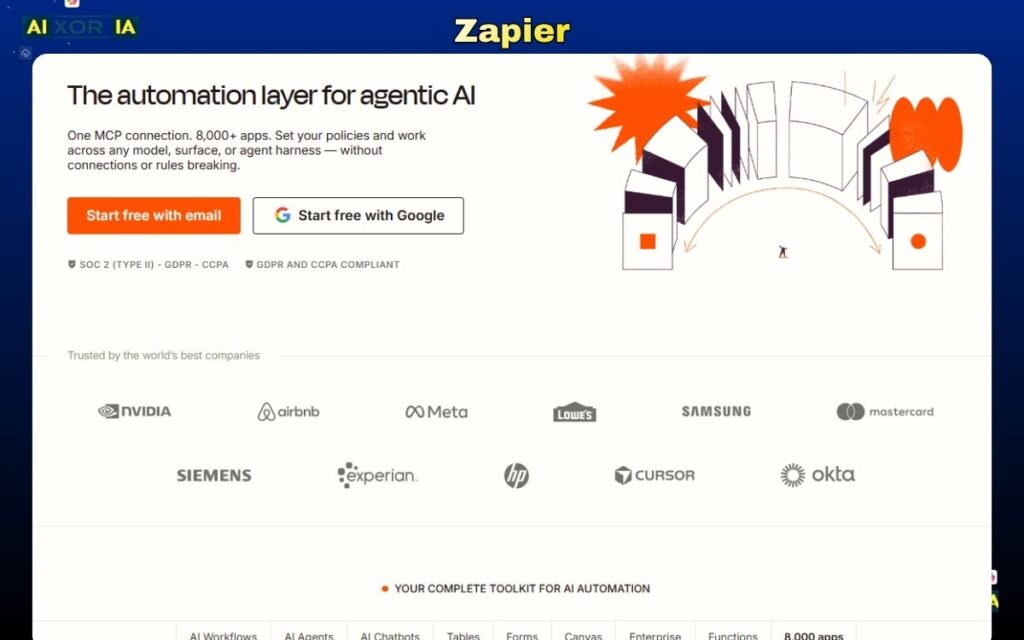
Zapier has evolved from a simple integration tool into a full central automation hub. It now allows startups to manage workflows, data, forms, and AI-driven processes from one platform.
With over 8,000 integrations, Zapier connects almost every major SaaS tool. But what makes it stand out in 2026 is its AI layer. You can describe a workflow in plain English, and Zapier generates it. It also includes AI agents that can take actions based on conditions and data.
Zapier is ideal for startups that want to move fast without relying on developers.
Real experience insight:
In a recent SaaS workflow setup, Zapier reduced manual lead routing time from hours to seconds, but costs increased as task volume scaled.
Pricing: Free plan available; paid from $19.99/month
Pros: Easy to use, massive integrations, strong AI features
Cons: Expensive at scale, limited deep logic control
Best for Advanced Logic and Control
Make (Integromat)
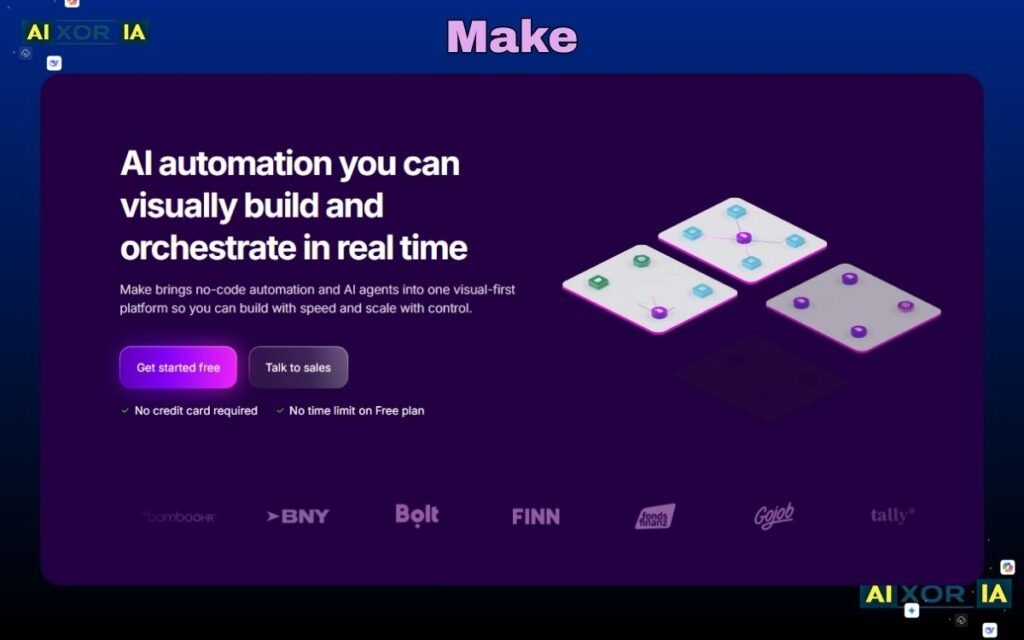
Make is built for startups that need deterministic routing, meaning complete control over how workflows behave.
Its visual builder allows you to create complex scenarios with filters, branching logic, and multi-step workflows. This makes it ideal for data-heavy operations.
Make’s AI capabilities focus on processing and structuring data rather than decision-making, which makes it more predictable than agent-based tools.
Real experience insight:
When handling multi-step API workflows, Make provided more control than Zapier, but required extra time to set up and debug.
Pricing: Free plan; paid from $9/month
Pros: Advanced logic, affordable, powerful visual builder
Cons: Learning curve, complex interface
Best for AI Agent Workflows
Vellum AI

Vellum AI represents the shift toward agentic automation. Instead of building step-by-step workflows, you build AI systems that can reason, evaluate, and act.
It allows startups to test AI models, evaluate outputs, and deploy workflows where AI decides what happens next. This is particularly useful for startups working on AI products, customer support automation, or content generation pipelines.
Vellum also includes built-in evaluation frameworks, which help ensure AI outputs remain reliable—something most tools lack.
Real experience insight:
In AI-driven support workflows, Vellum reduced manual intervention significantly, but required careful tuning to avoid inconsistent outputs.
Pricing: Free plan; paid from $25/month
Pros: Advanced AI capabilities, agent-based workflows
Cons: Not beginner-friendly, requires understanding of AI systems
Best for Developers and Data Privacy
n8n
n8n is a powerful open-source automation tool designed for startups that want full control over their data.
Unlike cloud-only platforms, n8n can be self-hosted, making it ideal for companies concerned about privacy and compliance. It also offers low-code flexibility, allowing developers to customize workflows deeply.
n8n has started integrating AI nodes, enabling users to build AI-powered workflows while maintaining control over infrastructure.
Real experience insight:
In a privacy-focused setup, n8n provided unmatched flexibility, but required technical setup and ongoing maintenance.
Pricing: Free (self-hosted); paid cloud options available
Pros: Full control, cost-effective at scale, flexible
Cons: Requires technical knowledge
Best for Marketing and CRM Automation
HubSpot

HubSpot is ideal for startups focused on growth. It combines CRM, marketing, and automation into one platform.
Its workflows allow you to automate lead nurturing, follow-ups, and customer journeys. AI features help personalize communication and optimize conversions.
Real experience insight:
HubSpot improved lead conversion workflows significantly, but became expensive as contacts and features scaled.
Pricing: Free; paid from $9/month
Pros: All-in-one platform, strong automation
Cons: Expensive at scale
Best for Data-Driven Workflows
Airtable

Airtable combines database functionality with automation, making it ideal for startups managing structured data.
It allows workflows to run directly on data changes, and AI features help generate insights and automate repetitive processes.
Real experience insight:
For content operations, Airtable simplified tracking and automation, but required structured setup to be effective.
Pricing: Free; paid from $20/user/month
Pros: Flexible, data-centric
Cons: Not ideal for simple workflows
Best Budget-Friendly Automation Tool
Pabbly Connect

Pabbly Connect is a cost-effective alternative with a strong focus on affordability, especially through its lifetime deal model.
It offers basic automation features and integrations suitable for startups with limited budgets.
Real experience insight:
For early-stage startups, Pabbly reduced costs significantly, but lacked advanced AI and scalability features.
Pricing: From $19/month (lifetime deals available)
Pros: Affordable, simple
Cons: Limited features, smaller ecosystem
Zapier vs Make: Which Is Better for Startups?
| Feature | Zapier | Make |
|---|---|---|
| Ease of use | Very easy | Moderate |
| Logic control | Basic | Advanced |
| AI features | Strong | Moderate |
| Pricing | Higher | Lower |
| Best for | Speed & simplicity | Complex workflows |
Verdict:
- Choose Zapier for speed and ease
- Choose Make for control and cost efficiency
Real Startup Use Case
A SaaS startup automated 80% of its customer support by combining Zapier with AI tools. Incoming queries were categorized automatically, responses were generated using AI, and only complex issues were routed to human agents.
This reduced response time by over 60% and allowed the team to scale without hiring additional support staff.
The Role of AI in Workflow Automation (2026)
AI is no longer an add-on—it’s becoming the core of automation.
Modern tools now:
- Generate workflows automatically
- Analyze data and optimize processes
- Make decisions without human input
This allows startups to move from task automation to intelligent systems.
Frequently Asked Questions
Which is cheaper: Zapier or Make in 2026?
Make is generally more affordable, especially for complex workflows. Zapier becomes expensive as usage increases.
What is agentic workflow automation?
Agentic automation uses AI to analyze data and decide actions, rather than following fixed steps.
Can I automate workflows without coding?
Yes. Most modern tools are no-code or low-code, designed for non-technical users.
Final Thoughts
The best workflow automation software for startups depends on how you operate.
- If you need simplicity → Zapier
- If you need control → Make
- If you want AI-driven workflows → Vellum AI
- If you need privacy and flexibility → n8n
In 2026, the biggest shift is clear:
Startups are moving from automation tools to intelligent systems.
1 thought on “7 Best AI Workflow Automation Tools for Startups (2026): From No-Code to AI Agents”